Dhauladhar Wildlife Sanctuary

Dhauladhar Wildlife Sanctuary

Dhauladhar Wildlife Sanctuary Latest News

Recently, a snow leopard (Panthera uncia) has been photographed for the first time in the Dhauladhar Wildlife Sanctuary in Kangra district. 

About Dhauladhar Wildlife Sanctuary

  • Location: It is located in the Kangra district of Himachal Pradesh.
  • It was established in 1994.
  • The two significant features of this sanctuary are the Dhauladhar and the Bara Bhangal Range which occupies the maximum part of the natural area and is famous for its diverse flora and fauna.
  • It is spread over a large area, ranging between 1600m to 4500m above sea level.
  • Terrain: It has bare huge rocks, mostly granite and the peaks laden with snow.
  • This wildlife sanctuary is characterized by a predominantly high altitude forest
  • Vegetation: It consists of Western mixed coniferous forest type of vegetation.
  • Flora: It consists of deodar, fir, spruce blue pine, oaks and alpine pastures.
  • Fauna: Musk Deer, Himalayan Black Bear, Serow, Himalayan Weasel, Himalayan Palm Civet; Cheer Pheasant, Western Tragopan, Speckled Wood-Pigeon etc.

Source: TI

Dhauladhar Wildlife Sanctuary FAQs

Q1: Dhauladhar Wildlife Sanctuary is located in which state?

Ans: Himachal Pradesh

Q2: What is the dominant vegetation type in Dhauladhar WLS?

Ans: Temperate coniferous forest

Key Facts about Nathu La Pass

Nathu La Pass

Nathu La Pass Latest News

Border trade via Nathu La Pass, which had remained suspended for six years due to Covid-19 pandemic and India-China border tensions, resumed recently.

About Nathu La Pass

  • It is a mountain pass in the Himalayas in Sikkim, 54 kilometres east of Gangtok.
  • It connects the Indian state of Sikkim with China's Tibet Autonomous Region. 
  • ‘’Nathu’’ means “listening ears”, and ‘’La’’ means “pass” in Tibetan.
  • The pass, at 4,310 m above mean sea level, forms a part of an offshoot of the ancient Silk Road. 
  • It is one of the highest motorable roads in the world.
  • It is guarded on both sides by Chinese and Indian soldiers.
  • It is one of the three open trading border posts between India and China; the other two are in Himachal Pradesh (Shipkila) and Uttarakhand (Lipulekh).
  • Sealed by India after the 1962 Sino-Indian War, Nathu La was reopened in 2006 following numerous bilateral trade agreements.
  • Traded items are limited and include silk, clothes, and yak hair and tail.  
  • Only citizens of India can visit the pass, and then only after obtaining a permit in Gangtok.

News: NIE

Nathu La Pass FAQs

Q1: Where is Nathu La Pass located?

Ans: Nathu La Pass is located in Sikkim, about 54 kilometres east of Gangtok.

Q2: Which two regions does Nathu La Pass connect?

Ans: It connects the Indian state of Sikkim with China's Tibet Autonomous Region.

Q3: At what altitude is Nathu La Pass situated?

Ans: Nathu La Pass is situated at an altitude of 4,310 metres above mean sea level.

Q4: When was Nathu La Pass reopened for trade?

Ans: Nathu La Pass was reopened in 2006.

Q5: What are some of the items traded through Nathu La Pass?

Ans: Traded items include silk, clothes, and yak hair and tail.

Clean Slate Doctrine under the Insolvency and Bankruptcy Code (IBC)

Clean Slate Doctrine under the Insolvency and Bankruptcy Code

Clean Slate Doctrine Latest News

The Supreme Court's recent judgment in Ujaas Energy reminds us that the Clean Slate Doctrine is directed at extinguishing claims and not necessarily every legal consequence that may flow from the facts underlying those claims.

About Clean Slate Doctrine

  • It is a key legal principle embedded in the Insolvency and Bankruptcy Code, 2016 (“IBC”), which plays a pivotal role in the corporate insolvency process in India.
  • The doctrine suggests that once a company successfully undergoes a Corporate Insolvency Resolution Process (CIRP)  and is taken over by a new buyer, the new owner should not be held accountable for any of the company’s pre-existing debts, penalties, or liabilities.  
  • It means that once a resolution plan is approved, the successful resolution applicant acquires the corporate debtor free from past liabilities that are not included in the approved resolution plan. 
  • This principle is designed to give the company a fresh start, essentially, a “clean slate” free from the baggage of its prior financial troubles.  
  • The doctrine is primarily based on Section 31 of the IBC, 2016.
  • Several landmark Supreme Court judgments have reinforced the Clean Slate Doctrine:
    • Committee of Creditors of Essar Steel India Ltd. v. Satish Kumar Gupta & Ors. (2020):
      • The SC emphasized that one of the primary objectives of the IBC is to streamline insolvency procedures in India and bring all claims under a unified system.
      • The SC ruled that once a resolution plan is approved by the National Company Law Tribunal (NCLT), any and all previous liabilities, including debts and penalties, are extinguished.
      • This means no party can initiate or continue any legal proceedings related to a claim that is not included in the approved resolution plan.
    • Arun Kumar Jagatramka v. Jindal Steel and Power Ltd. (2021): The Court reiterated that the approval of a resolution plan under Section 31 of IBC results in a clean slate, allowing the successful resolution applicant to run the business without past encumbrances.
    • Ghanashyam Mishra and Sons Pvt. Ltd. v. Edelweiss Asset Reconstruction Co. Ltd. (2021)
      • This ruling clarified that once a resolution plan is approved, all claims that are not part of the plan stand extinguished.
      • It further held that no stakeholder, including government authorities, can continue proceedings for claims not included in the resolution plan.
    • Ebix Singapore Pvt. Ltd. v. CoC of Educomp Solutions Ltd. (2021): The Supreme Court emphasized that even stakeholders who were not direct participants in the CIRP are bound by the consequences of an approved resolution plan.
    • Vaibhav Goel and Anr. v. DCIT and Anr. (2025): The Court reaffirmed that no belated claims can be introduced once the resolution plan is approved by NCLT.

News: BB

Clean Slate Doctrine FAQs

Q1: Under which law is the Clean Slate Doctrine embedded?

Ans: It is embedded in the Insolvency and Bankruptcy Code (IBC), 2016.

Q2: What does the Clean Slate Doctrine provide after the completion of the Corporate Insolvency Resolution Process (CIRP)?

Ans: It provides that the new owner is not liable for the company's pre-existing debts, penalties, or liabilities that are not part of the approved resolution plan.

Q3: What happens to liabilities not included in the approved resolution plan under the Clean Slate Doctrin

Ans: Such liabilities stand extinguished.

Q4: What is the primary objective of the Clean Slate Doctrine?

Ans: Its primary objective is to give the corporate debtor a fresh start free from past financial liabilities.

Scheme of Venture Capital Fund for Scheduled Castes

Scheme of Venture Capital Fund for Scheduled Castes

Scheme of Venture Capital Fund for Scheduled Castes Latest News

The Scheme of Venture Capital Fund for Scheduled Castes is enabling Scheduled Caste entrepreneurs to establish technology-driven manufacturing enterprises, generate quality employment and contribute to India's vision of self-reliance.

About Scheme of Venture Capital Fund for Scheduled Castes

  • It was launched in 2014-15 by the Ministry of Social Justice and Empowerment.
  • Purpose: To provide concessional finance to SC entrepreneurs and priority is given to Women/Disabled SC Entrepreneurs
  • Initial Capital: Initial Capital of the Fund was Rs. 200 crore, which is to be supplemented every year.
  • Structure of the scheme: The Fund has been set up and registered under AIF regulations 2012 under SEBI, with GoI as the Anchor investor and IFCI Ltd. as Sponsor investor.
  • It has the unique feature of advancing loans from Rs. 10 lakhs to Rs. 15 Crore.
  • Funding pattern
    • Financial assistance upto Rs 5 Crore - Investment under this category shall be funded maximum upto 75% of the project cost and the balance 25% of the project cost will be funded by the promoters;
    • Financial assistance above Rs. 5 Crore: Investment under this category shall be funded maximum upto 50% of the project cost. At least 25% of the project cost has to be financed by bank/other institutions. Balance 25% of the project cost will be funded by the promoters.

Objectives of the Venture Fund

  • It is a social sector initiative to be implemented nationally in order to promote entrepreneurship amongst the SCs who are oriented towards innovation and growth technologies.
  • To provide concessional finance to the SC entrepreneurs, who will create wealth and value for society and at the same time will promote profitable businesses.
  • To increase financial inclusion for SC entrepreneurs and to motivate them for further growth of SC communities.
  • To develop SC entrepreneurs economically.
  • To enhance direct and indirect employment generation for SC population in India.

Source: PIB

Scheme of Venture Capital Fund for Scheduled Castes FAQs

Q1: What is the main objective of Scheme of Venture Capital Fund for Scheduled Castes ?

Ans: Promote SC entrepreneurs and create jobs

Q2: Scheme of Venture Capital Fund for Scheduled Castes is implemented by which Ministry?

Ans: Ministry of Social Justice & Empowerment

Broad Peak

Broad Peak

Broad Peak Latest News

Recently, a team of 10 mountaineers were caught in an avalanche on the slopes of Broad Peak in the Karakoram range.

About Broad Peak

  • Location: It is the world's 12th-highest mountain (elevation of 8,051 m) situated in the Karakoram ranges.
  • In the local Balti language, it is historically known as Falchan Kangri, which translates to “Broad Mountain”.
  • Origin of name: British explorer Sir Martin Conway coined the name in 1892, likened the mountain's elongated summit ridge — which stretches more than 1.5 km (0.93 miles) — to the Breithorn in the Swiss Alps.
  • It sits in the Karakoram range spanning Gilgit-Baltistan, and China's Xinjiang, roughly 8 km southeast of K2.
  • Formation: The Mountain was formed by the ongoing collision of the Indo-Australian and Eurasian tectonic plates.
  • Relief: It consists of massive plutonic granite blocks and layers of metamorphic rock.
  • Its snowpack and ice walls feed the Godwin-Austen and Baltoro glacier systems.
  • Broad Peak has a five-peak structure, three of which cross 8,000 metres. The main summit stands at 8,051 metres, the rocky summit at 8,028 metres and the Central Peak at 8,011 metres.

Source: IE

Broad Peak FAQs

Q1: Broad Peak is located in which mountain range?

Ans: Karakoram

Q2: Broad Peak is part of which massif?

Ans: Gasherbrum Massif

Environmental Performance Index

Environmental Performance Index

Environmental Performance Index Latest News

Recently, experts have called India’s ranking in global Environmental Performance Index (EPI) as a wake-up call that cannot be ignored any longer. 

About Environmental Performance Index

  • It is a biennial index that is a scorecard that ranks countries on their environmental performance.
  • It is a data-driven global benchmark developed by the Yale Center for Environmental Law & Policy, Columbia University’s Center for International Earth Science Information Network (CIESIN) and Yale Center for Geospatial Solutions.
  • Framework: It includes 47 indicators across 12 issue categories spanning three policy objectives: Environmental Health, Ecosystem Vitality, and Climate Change
  • It serves as a vital analytical tool for measuring how close nations are to achieving global sustainability targets, such as the UN Sustainable Development Goals and Paris Climate Agreement objectives.

Highlights of Environmental Performance Index 2026

  • Top 5 countries: Estonia, Luxembourg, United Kingdom, Finland and Netherlands secured
  • Laos ranked the lowest in the Index.
  • India ranked  the 176th position out of 177 evaluated countries.
  • India’s overall EPI score came out to 22.46, compared to a regional average of 31.81.

Source: DTE

Environmental Performance Index FAQs

Q1: Environmental Performance Index is published by?

Ans: Yale University and Columbia University

Q2: Which country is the top performer in EPI 2026?

Ans: Estonia

Suspension Polyvinyl Chloride

Suspension Polyvinyl Chloride

Suspension Polyvinyl Chloride Latest News

Recently, the Directorate General of Foreign Trade (DGFT) imposed a six-month restriction on imports of a Suspension Polyvinyl Chloride (S-PVC) resin which is a key input used for manufacturing of pipes. 

About Suspension Polyvinyl Chloride

  • It is a polymer manufactured from vinyl chloride monomer.
  • It is produced through polymerisation of vinyl chloride monomer (VCM) in aqueous medium with the use of initiators and additives ensuring controlled molecular weight and particle morphology. 
  • Poly(vinyl chloride) resins are produced by four basic processes: suspension, emulsion, bulk and solution polymerization.
    • PVC suspension resins are usually relatively dust-free and granular with varying degrees of particle porosity.
    • PVC emulsion resins are small particle powders containing very little free monomer.
    • Bulk PVC resins are similar to suspension PVC resins, though the particles tend to be more porous.
    • Solution PVC resins are smaller in particle size than suspension PVC with high porosity particles containing essentially no free monomer. 
  • Applications: S-PVC resin is used across sectors, from irrigation pipes and conduits to electrical wires used in construction.

Source: IE

Suspension Polyvinyl Chloride FAQs

Q1: S-PVC is primarily manufactured by which process?

Ans: Suspension polymerization

Q2: What are major use of S-PVC in India?

Ans: Construction - pipes, doors, windows

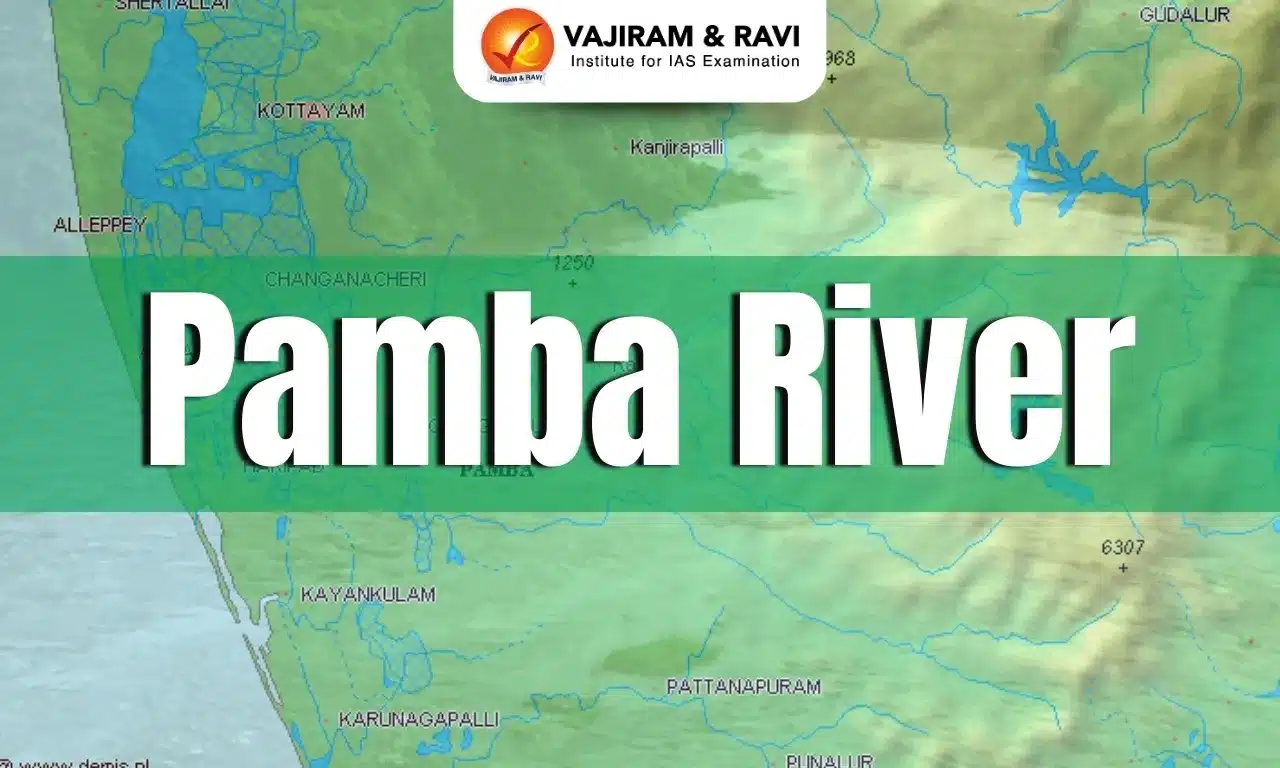
Pamba River

Pamba River

Pamba River Latest News

Recently, the Pamba River breached its banks at several locations due to torrential overnight rain triggered widespread flooding across Pathanamthitta district.  

About Pamba River

  • It is the third longest river in the state of Kerala after the Periyar River and the Bharathappuzha River.
  • It is also called as Pampa River.
  • It is known as the ‘Dakshina Bhageerathi’ or the Ganga of Kerala, the significance of the river is associated with the Sabarimala temple. 
  • Origin: It rises at an altitude of 1650 m in the Pulachimalai Hill on the Peerumedu plateau of the Western Ghats.
  • It joins the Arabian Sea branching into a number of channels. 
  • The entire catchment area lies in Kerala state. 
  • The basin is bounded on the east by the Western Ghats and on the west by the Arabian Sea.
  • Tributaries: The main tributaries of the river are Kakki Ar, Azhuta Ar, Kakkad Ar, Kallar, Manimala, and Achenkovil.

Source: NIE

Pamba River FAQs

Q1: Pamba River is located in which state?

Ans: Kerala

Q2: Pamba River originates from which hills?

Ans: Pulachimalai Hills

Exercise ROTOR CLAP III

Exercise ROTOR CLAP III

Exercise ROTOR CLAP III Latest News

The Indian Air Force (IAF) recently concluded the week-long Exercise ROTOR CLAP III at the Pokhran Field Firing Range in Rajasthan's Jaisalmer district.

About Exercise ROTOR CLAP III

  • It is a specialised helicopter exercise themed “Counter-Unmanned Aerial Systems (Counter-UAS)” conducted by the Indian Air Force (IAF).  
  • Location: Pokhran Field Firing Range in Rajasthan's Jaisalmer district
  • It is the third edition of a series the IAF has built around rotary-wing counter-drone work.  
  • The exercise brought together helicopter units from across the IAF to validate operational concepts against emerging aerial threats and enhance combat preparedness in a dynamic battlefield environment. 
  • Different types of platforms participated in the drill, including the AH-64 Apache, Mi-25/35, and the indigenous Prachand helicopter gunships, along with Chinook, Mi-17, and Dhruv transport and utility helicopters. 
  • The helicopters carried out a series of tactical missions, including precision strikes, battlefield support, reconnaissance, troop insertion, casualty evacuation, and coordinated operations designed to counter aerial and ground-based threats.

News: TOI

Exercise ROTOR CLAP III FAQs

Q1: What is Exercise ROTOR CLAP III?

Ans: Exercise ROTOR CLAP III is a specialised helicopter exercise themed "Counter-Unmanned Aerial Systems (Counter-UAS)" conducted by the Indian Air Force (IAF).

Q2: Which organisation conducts Exercise ROTOR CLAP III?

Ans: The Indian Air Force (IAF) conducts Exercise ROTOR CLAP III.

Q3: What is the theme of Exercise ROTOR CLAP III?

Ans: The theme of the exercise is "Counter-Unmanned Aerial Systems (Counter-UAS)."

Q4: Where was Exercise ROTOR CLAP III conducted?

Ans: It was conducted at the Pokhran Field Firing Range in Jaisalmer district, Rajasthan.

Lohagad Fort

Key Facts about Lohagad Fort

Lohagad Fort Latest News

A video showing a local resident confronting a group of tourists for allegedly smoking cigarettes at Maharashtra's historic Lohagad Fort has gone viral on social media, triggering a wider discussion on responsible tourism and the need to protect heritage monuments.

About Lohagad Fort

  • Lohagad, also known as Iron Fort, is a hill fort located near Lonavala in the Pune district, Maharashtra.  
  • It is raised 1033 meters above sea level in the Western Ghats.
  • The mountain divides basins of the Pavana and the Indrayani rivers, and the Lohagad fort overlooks the Pavana reservoir situated south of the mountain range.  
  • The Visapur fort is located on its eastern side. 
  • It is a UNESCO world heritage site. 

Lohagad Fort History

  • Initially established during the Lohtamia dynasty in the 10th century CE, the fort soon became a coveted prize for rulers across the ages. 
  • Over time, it bore witness to the Chalukyas, Rashtrakutas, Yadavas, Bahamanis, Nizams, Mughals, and Marathas, each leaving an indelible mark on its strategic and cultural significance.
  • In 1648 AD, Chhatrapati Shivaji Maharaj seized Lohagad, recognizing its defensive and strategic importance. 
  • However, due to the Treaty of Purandar in 1665, he was forced to relinquish it to the Mughals. 
  • Undeterred, he recaptured the fort in 1670 AD and used it as a treasury vault to store the riches from his successful Surat campaign. 
  • Later, during the Peshwa era, statesman Nana Phadnavis sought refuge here, constructing essential structures like a large tank and step-well, which still stand as silent witnesses to history.

Lohagad Fort Architecture

  • The fort boasts four grand gates—Ganesh Darwaja, Narayan Darwaja, Hanuman Darwaja, and Maha Darwaja—each narrating tales of war, resilience, and bygone eras. 
  • These gates, still largely intact, exhibit intricate carvings and remarkable masonry that highlight the exceptional engineering skills of the past.
  • One of Lohagad’s most breathtaking features is the ‘Vinchukada’, or ‘Scorpion’s Tail’—a long, narrow, fortified spur extending from the fort’s main structure
  • This naturally sculpted rock formation resembles a scorpion’s sting and offers panoramic views of the surrounding Sahyadri landscapes.

News: IT

Lohagad Fort FAQs

Q1: Where is Lohagad Fort located?

Ans: Lohagad Fort is located near Lonavala in the Pune district of Maharashtra.

Q2: In which mountain range is Lohagad Fort located?

Ans: Lohagad Fort is located in the Western Ghats (Sahyadri Hills).

Q3: Which fort is situated to the east of Lohagad Fort?

Ans: Visapur Fort is situated to the east of Lohagad Fort.

Q4: Who captured Lohagad Fort in 1648 AD?

Ans: Chhatrapati Shivaji Maharaj captured Lohagad Fort in 1648 AD.

Q5: Is Lohagad Fort a UNESCO World Heritage Site?

Ans: Yes, Lohagad Fort is a UNESCO World Heritage Site.

Enquire Now