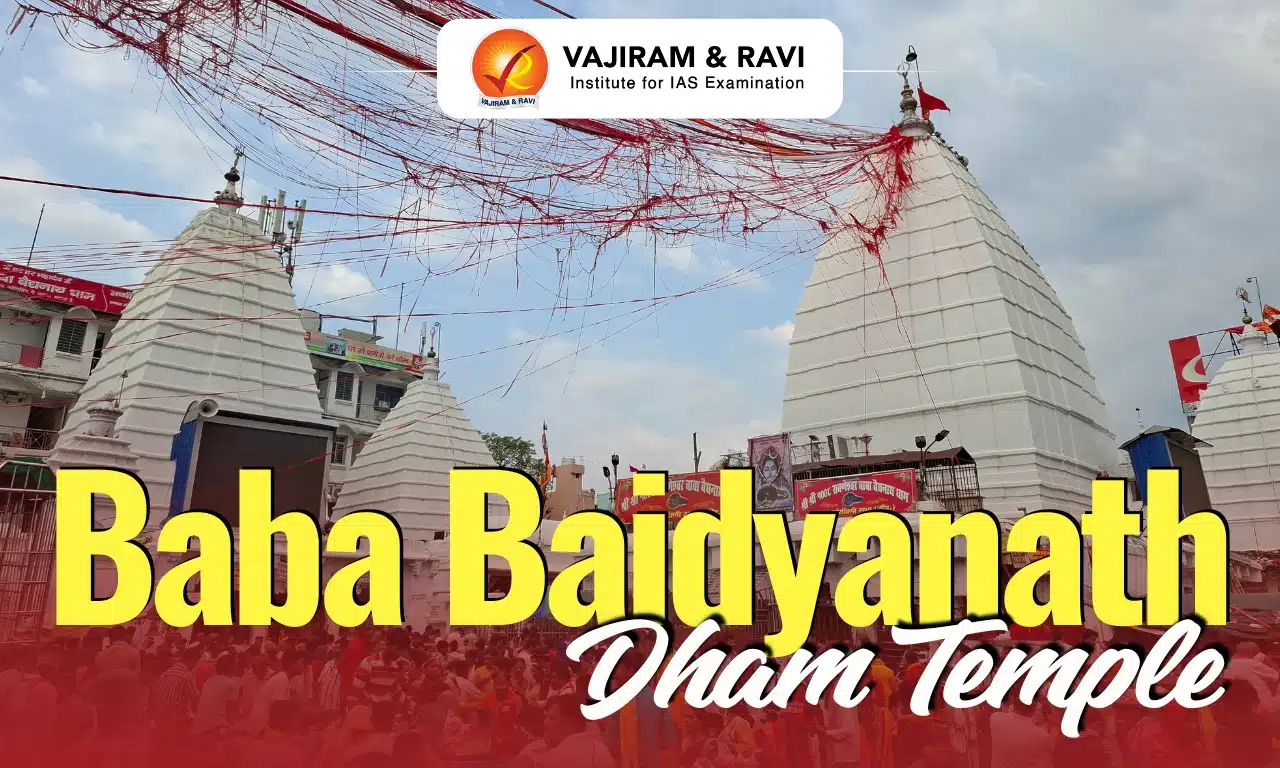
Baba Baidyanath Dham Temple

Baba Baidyanath Dham Temple

Baba Baidyanath Dham Temple Latest News

A large number of devotees thronged the Baba Baidyanath Dham temple in Jharkhand’s Deoghar on the first Monday of the holy month of Shravan.

About Baba Baidyanath Dham Temple

  • It is a Hindu temple dedicated to Lord Shiva located in Deoghar, Jharkhand. 
  • It is one of the 12 Jyotirlingas in India.
  • This ancient temple has been mentioned in several ancient scriptures, such as Puranas, Vedas, Mahabharata, Ramayana, etc.

Baba Baidyanath Dham Temple History

  • The mythological origin of Baidyanath Dham is tied to the legend of King Demon Ravana, who was granted a boon by Lord Shiva to take a sacred Jyotirlinga to his palace in Lanka. 
  • But he placed it on the ground in Deoghar, where the Lingam permanently resides. 
  • Historical records suggest the temple's original construction in the 8th century by Puran Mal, an ancestor of the Nagavanshi dynasty. 
  • Over the centuries, the temple has seen numerous renovations and expansions, reflecting various architectural styles and cultural influences. 
  • The current structure is attributed to Raja Man Singh in the 16th century.
  • The temple hosts the famous Shravani Mela, one of the largest annual religious gatherings in India.

Baba Baidyanath Dham Temple Architecture

  • The temple showcases the classic Nagara style of North Indian architecture.  
  • The temple complex is spread over an area of 12 acres and consists of 22 temples dedicated to various deities. 
  • The main temple is the Baidyanath Jyotirlinga Temple, which houses the lingam of Shiva. 
  • The temple is built of stone and has a pyramidal tower that rises to a height of 72 feet. 
  • The temple has a simple and elegant design, with a spacious hall, a sanctum, and a vestibule. 

News: DD

Baba Baidyanath Dham Temple FAQs

Q1: Where is Baba Baidyanath Dham Temple located?

Ans: Deoghar, Jharkhand.

Q2: To which deity is Baba Baidyanath Dham Temple dedicated?

Ans: Lord Shiva.

Q3: Who is believed to have originally constructed Baba Baidyanath Dham Temple?

Ans: Puran Mal, an ancestor of the Nagavanshi dynasty.

Q4: Which style of architecture is seen in Baba Baidyanath Dham Temple?

Ans: Nagara style of North Indian architecture.

Q5: Why is Baba Baidyanath Dham considered one of India's most important pilgrimage sites?

Ans: Because it is one of the 12 Jyotirlingas dedicated to Lord Shiva and hosts the annual Shravani Mela.

Dikhow River

Dikhow River

Dikhow River Latest News

Flash floods from the Dikhow River recently submerged Assam's Nepali Khuti, a self-reliant Gorkha dairy village, within two hours, destroying homes, livestock, and livelihoods completely.

About Dikhow River

  • It is an important south bank tributary of the Brahmaputra River.
  • Course: 
    • It originates in the Zunheboto district of Nagaland and enters into the Assam plain through Naginimara of the Sivsagar district of Assam.
    • It flows through the Sivsagar district only to join with the river Brahmaputra at Dikhowmukh on its southern bank within the district. 
  • The total length of the river is 236 km.
  • The river basin is surrounded by the Brahmaputra River in the north, the Buridihing basin in the east, the Jhanji basin in the west, and the Naga Hills in the south.
  • The river leaves more than fifteen abandoned channels at different places in the Assam plain mostly in the form of Ox-bow Lakes.

News: RED

Dikhow River FAQs

Q1: Of which major river is the Dikhow River a tributary?

Ans: The Brahmaputra River.

Q2: Where does the Dikhow River originate?

Ans: Zunheboto district of Nagaland.

Q3: Through which district of Assam does the Dikhow River enter the Assam plain?

Ans: Sivasagar district (through Naginimara).

Q4: What is the total length of the Dikhow River?

Ans: 236 km.

Enquire Now