Dhabaleswar Temple

Dhabaleswar Temple

Dhabaleswar Temple Latest News

The president recently offered prayers at the Dhabaleswar Temple near Berhampur, marking the final engagement of her three-day visit to Odisha.

About Dhabaleswar Temple

  • It is a Hindu temple dedicated to Lord Shiva.
  • It is located on an island on River Mahanadi near Cuttack, Odisha
  • It is one of the oldest temples in Odisha. It dates back to the early 10th and 11th century. 
  • The temple structure was constructed during the rule of the Somavamshi dynasty by King Yayati Keshari.
  • The present-day temple was constructed by King Bir Kishore of Khurda around 1232 AD. 

Dhabaleswar Temple Architecture

  • It is built in the Kalinga style of architecture.
  • The main temple structure is built of sandstone. It has a square plan with a pyramidal roof. 
  • Several smaller shrines of various deities surround the main temple. 
  • The temple has three main chambers, with the central chamber housing the idol of Shiva. 
  • The temple has a beautiful entrance known as Jagamohan. Intricate carvings of animals, birds, and mythological figures decorate it. 
  • Around the temple, there is a marble-covered raised platform.  
  • The temple contains multiple sculptures of deities on its walls.  
  • The distinctive feature of the Dhabaleswar Temple is its two-tiered roof, which is made of terracotta tiles. 

News: NOA

Dhabaleswar Temple FAQs

Q1: Where is the Dhabaleswar Temple located?

Ans: It is located on an island in the Mahanadi River near Cuttack, Odisha.

Q2: To which Hindu deity is the Dhabaleswar Temple dedicated?

Ans: It is dedicated to Lord Shiva.

Q3: Which architectural style is followed by the Dhabaleswar Temple?

Ans: The Kalinga style of architecture.

Q4: Who constructed the present-day Dhabaleswar Temple?

Ans: The present-day temple was constructed by King Bir Kishore of Khurda around 1232 AD.

Scheme for Promotion of Culture of Science

Scheme for Promotion of Culture of Science

Scheme for Promotion of Culture of Science Latest News

The Union Minister for Culture and Tourism informed Rajya Sabha about the Scheme for Promotion of Culture of Science.

About Scheme for Promotion of Culture of Science

  • It is a flagship initiative of the Ministry of Culture, Government of India.
  • It is aimed at fostering scientific temper and awareness across the country for the public in general and students in particular.
  • The scheme supports the establishment of Science Cities, Science Centres, Innovation Hubs, and Digital Planetariums in various regions.
  • Nodal Agency: The National Council of Science Museums (NCSM), an autonomous body under the Ministry of Culture, serves as the nodal agency for implementation of the scheme.
  • Under this Scheme Science Centres/Digital Planetariums (Category-III) are set up in areas with a population of less than 5 lakhs.
  • As of July 2025, a total of 27 Science Centres have been established across the country under the Scheme for Promotion of Culture of Science (SPoCS) of the Ministry of Culture.
  • Significance: These institutions have significantly contributed to enhancing scientific awareness and informal science education through hands-on exhibits, innovation hubs, digital planetariums, and outreach programmes.

Source: PIB

Scheme for Promotion of Culture of Science FAQs

Q1: Is NCSM Government or private?

Ans: National Council of Science Museums (NCSM) is an autonomous society under the Ministry of Culture, Government of India.

Q2: What is the main purpose of a planetarium?

Ans: To popularise education and entertainment in astronomy and related fields, especially space science

Himalayan serow

Himalayan serow

Himalayan serow Latest News

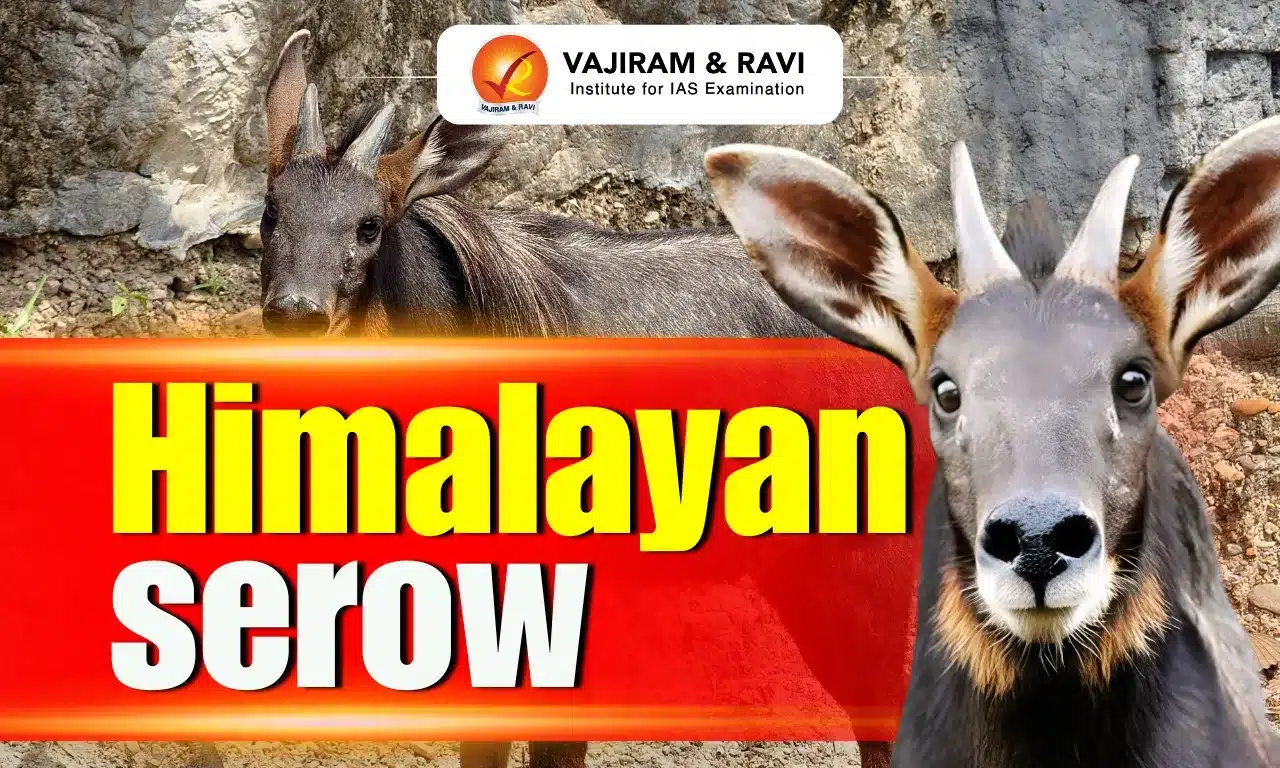
Recently, Himalayan serow has been recorded in the Dalhousie forest division of Himachal Pradesh for the first time in nearly two decades.

About Himalayan serow

  • It resembles a cross between a goat, a donkey, a cow, and a pig.
  • It is a shy, forest-dwelling mountain ungulate found in steep Himalayan terrain.
  • Types: There are several species of serows, and all of them are found in Asia.
  • Habitat: The Himalayan serow, or Capricornis sumatraensis thar, is restricted to the Himalayan region. Taxonomically, it is a subspecies of the mainland serow (Capricornis sumatraensis).
  • Distribution: These are typically found at altitudes between 2,000 metres and 4,000 metres (6,500 to 13,000 feet). They are known to be found in eastern, central, and western Himalayas, but not in the Trans Himalayan region.
  • Diet: These are herbivore species.
  • Threats: Habitat degradation, Fragmentation and hunting pressure.

Conservation Status of Himalayan serow

Source: TOI

Himalayan serow FAQs

Q1: Himalayan Serow is primarily found in which region of India?

Ans: Himalayan Region

Q2: Himalayan Serow is listed in which appendix of CITES?

Ans: Appendix I

Adyar River

Adyar River

Adyar River Latest News

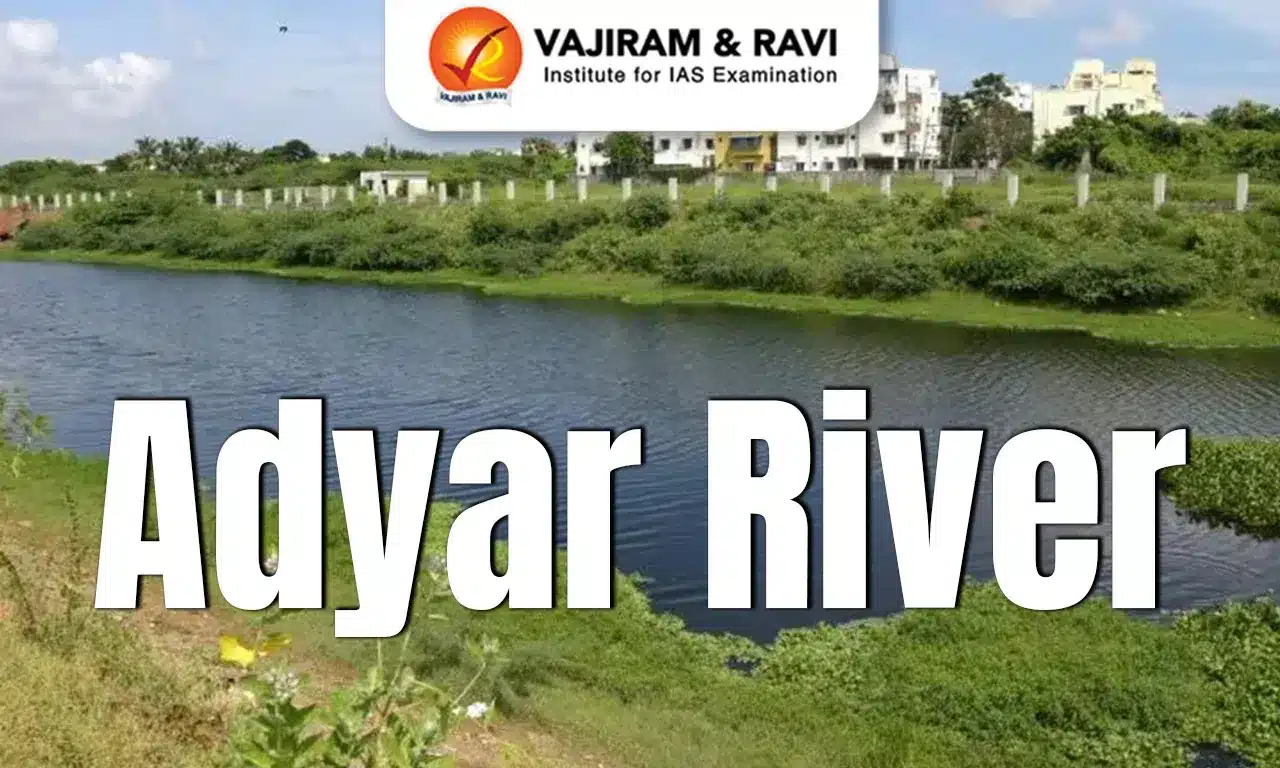
Tamil Nadu Minister for Rural Development and Water Resources recently inspected Adyar river areas, prioritizing cleaning efforts and addressing residents' needs for basic amenities.

About Adyar River

  • The Adyar River (sometimes called Adayar) is an important river flowing through the city of Chennai in Tamil Nadu.  
  • Course
    • It originates near the Chembarambakkam Lake in the Kanchipuram district of Tamil Nadu.
    • Finally, it reaches the Bay of Bengal at a place called the Adyar Estuary. 
  • Total Length: 42.5 km
  • It is one of the three rivers which winds through Chennai.
  • The river forms a backwater near the mouth, known as the Adyar Creek, due to the formation of sandbars at the mouth. 
  • This creek is a natural channel which carries tidal water back into the sea.
  • The river collects surplus water from about 200 tanks and lakes, small streams, and the rainwater drains in Chennai city, with a combined catchment area of 860 sq.km. 
  • Most of the waste from the city is drained into this river.
  • The Adyar Estuary, covering around 300 acres, is home to diverse bird species and marine life. 
    • Recognizing its ecological significance, it was declared a protected wildlife reserve in 1987.

News: TH

Adyar River FAQs

Q1: Where does the Adyar River flow?

Ans: It flows through Chennai in Tamil Nadu.

Q2: Where does the Adyar River originate?

Ans: It originates near Chembarambakkam Lake in Kanchipuram district, Tamil Nadu.

Q3: Where does the Adyar River finally drain into the sea?

Ans: It reaches the Bay of Bengal at the Adyar Estuary.

Q4: What is the total length of the Adyar River?

Ans: Approximately 42.5 km.

Amylotropic Lateral Sclerosis

Amyotrophic Lateral Sclerosis

Amyotrophic Lateral Sclerosis Latest News

People exposed to pesticides at work may be significantly more likely to develop Amyotrophic Lateral Sclerosis (ALS),  according to a new review of global evidence published.

About Amyotrophic Lateral Sclerosis 

  • It is a progressive neurological disorder that damages the nerve cells controlling voluntary muscle movement. These nerve cells are called motor neurons.  
    • One group, called upper motor neurons, extends from the brain to the spinal cord. 
    • The second group, called lower motor neurons, extends from the spinal cord to muscles throughout the body.
    • ALS causes both groups of motor neurons to gradually deteriorate and then die.
    • When motor neurons are damaged, they stop sending messages to the muscles.  As a result, the muscles can't function. 
  • ALS is often called Lou Gehrig's disease after the baseball player who was diagnosed with it.  

Amyotrophic Lateral Sclerosis Cause

  • The exact cause is still not known in most people. 
  • In a small percentage of people, ALS is inherited from a parent. 

Amyotrophic Lateral Sclerosis Symptoms

  • Symptoms vary from person to person and worsen over time. 
  • They depend on which nerve cells are affected.  
  • ALS often begins with muscle twitching and weakness in an arm or leg, trouble swallowing, or slurred speech. 
  • Eventually ALS affects the muscles needed to move, speak, eat, and breathe and can lead to serious complications over time.   

Amyotrophic Lateral Sclerosis Treatment

  • Currently, there’s no treatment to reverse damage to motor neurons or cure ALS. 
  • But some treatments may slow progression of the disorder, improve quality of life, and extend survival. 

News: TP

Amyotrophic Lateral Sclerosis FAQs

Q1: What is Amyotrophic Lateral Sclerosis (ALS)?

Ans: ALS is a progressive neurological disorder that damages and eventually kills motor neurons.

Q2: Why does muscle weakness occur in Amyotrophic Lateral Sclerosis (ALS)?

Ans: Damaged motor neurons stop sending messages to muscles, causing the muscles to weaken and lose function.

Q3: What is Amyotrophic Lateral Sclerosis (ALS) commonly known as?

Ans: ALS is often called Lou Gehrig's disease after the baseball player who was diagnosed with it.

Q4: Is the exact cause of Amyotrophic Lateral Sclerosis (ALS) known?

Ans: No. The exact cause is unknown in most cases.

Q5: Is there currently a cure for ALS?

Ans: No. There is currently no cure that reverses motor-neuron damage.

Mullaperiyar Dam

Mullaperiyar Dam

Mullaperiyar Dam Latest News

The Kerala government strongly protested Tamil Nadu's recent budget announcement on raising the water level in the Mullaperiyar dam. 

About Mullaperiyar Dam

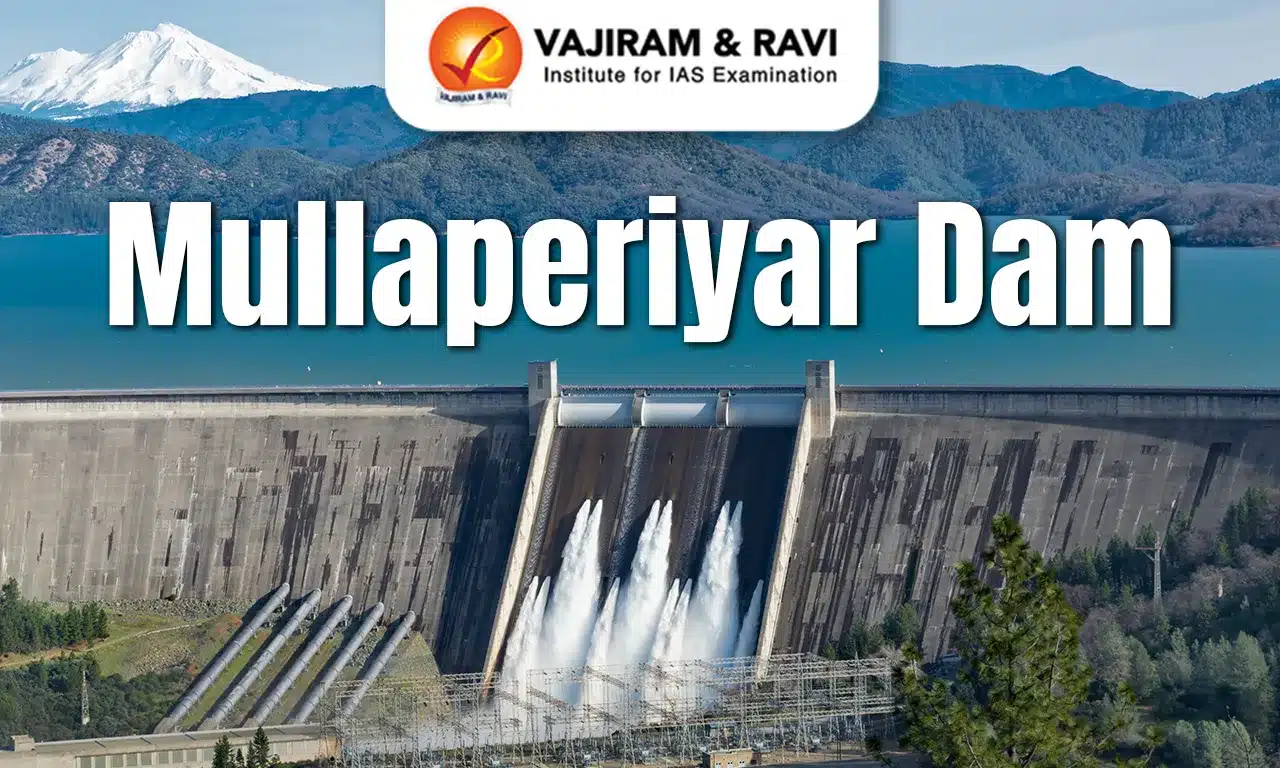
  • It is a masonry gravity dam located in Thekkady, Idukki district, Kerala.
  • The dam is built at the confluence of the Mullayar and Periyar (longest river in Kerala) rivers.
  • It is located at an altitude of 881 m on the Cardamom Hills of the Western Ghats.
  • It is one of the oldest dams in India. Its construction began in 1887 and was completed in 1895. 
  • The construction was carried out by the British Corps of Royal Engineers under the leadership of Pennycuick.
  • The dam’s primary function is to transfer water from the Periyar River to the Vaigai River basin in Tamil Nadu for irrigation and power generation purposes.
    • The water from the reservoir reaches the Theni, Madurai, Sivaganga, and Ramanathapuram districts of Tamil Nadu through tunnels that cut across the Western Ghats. 
    • The dam also generates electricity for Tamil Nadu through four hydroelectric power plants: Lower Periyar, Periyar Dam, Periyar Power House, and Vaigai.
  • The dam was constructed with limestone and “Surkhi” (burnt brick powder and a mixture of sugar and calcium oxide).
  • It has a height of 53.6 meters, a length of 365.7 meters, and a storage capacity of 443 million cubic meters.
  • It created an artificial lake and reservoir that covers an area of 8.5 sq.km.
  • It is surrounded by the Periyar National Park, a renowned biodiversity hotspot that is home to numerous endangered species of animals and birds. 
  • Although the dam is located in Kerala, it is operated and maintained by Tamil Nadu.
    • It was according to a 999-year lease agreement made during British rule that the operational rights were handed over to Tamil Nadu.
  • In recent years, there has been a long-standing dispute between Kerala and Tamil Nadu over the safety of the dam. 
    • Kerala has been demanding that the dam be strengthened or decommissioned, while Tamil Nadu has opposed any such move.

News: DP

Mullaperiyar Dam FAQs

Q1: Where is the Mullaperiyar Dam located?

Ans: The Mullaperiyar Dam is located in Thekkady, Idukki district, Kerala.

Q2: What type of dam is the Mullaperiyar Dam?

Ans: It is a masonry gravity dam.

Q3: At the confluence of which two rivers is the Mullaperiyar Dam located?

Ans: The Mullayar and Periyar Rivers.

Q4: In which mountain range is the Mullaperiyar Dam located?

Ans: The Cardamom Hills of the Western Ghats.

Q5: What is the primary purpose of the Mullaperiyar Dam?

Ans: To divert water from the Periyar River to the Vaigai River basin in Tamil Nadu, primarily for irrigation and power generation.

National Means-cum-Merit Scholarship Scheme

National Means-cum-Merit Scholarship Scheme

National Means-cum-Merit Scholarship Scheme Latest News

The Department of School Education and Literacy under the Ministry of Education has invited fresh and renewal applications for the National Means-cum-Merit Scholarship Scheme (NMMSS) for the 2026-27 academic year.  

About National Means-cum-Merit Scholarship Scheme

  • It is a central sector Scheme launched in 2008.
  • Objective: It was launched with the objective of awarding scholarships to meritorious students belonging to economically weaker sections to reduce dropout at the secondary stage by encouraging them to continue their education after Class VIII.
  • NMMSS is on the National Scholarship Portal (NSP) – a one-stop platform for scholarship schemes given to students.

Features of National Means-cum-Merit Scholarship Scheme

  • Under the Scheme, one lakh fresh scholarships are awarded every year to eligible students studying in Class IX, with renewal of the scholarship in Classes X to XII.
  • Parents Income: Students whose parental income from all sources is not more than Rs. 350,000/- per annum.
  • The students must have a minimum of 55% marks or an equivalent grade in the Class VII examination (relaxable by 5% for SC/ST students).
  • The students should be studying as regular students in a Government, Government-aided and local body school. 
  • The students studying in the Navodaya Vidyalaya Samiti (NVS), Kendriya Vidyalaya Sangathan (KVS), and residential schools are not eligible for the scholarships under the NMMSS.
  • There is reservation as per State Government norms.
  • Selection Test: Each State and UT conducts its own test to select students for awarding the National Means-cum-Merit Scholarship. The test is conducted at the stage of class VIII. 

Selection of Renewal Awardees Students

  • The awardees should get a minimum of 60% marks in Class X for continuation of scholarship (relaxable by 5% for SC/ST candidates) in the next higher classes. 
  • For continuing the scholarship in class X and XII, the awardees should get a clear promotion from class IX to class X and from class XI to class XII in the first attempt.

National Means-cum-Merit Scholarship Scheme FAQs

Q1: National Means-cum-Merit Scholarship Scheme was launched in which year?

Ans: 2008

Q2: National Means-cum-Merit Scholarship Scheme is implemented by which ministry?

Ans: Ministry of Education

GOBARdhan Scheme

GOBARdhan Scheme

GOBARdhan Scheme Latest News

Recently, the Union Cabinet has approved the GOBARdhan Scheme. 

About GOBARdhan Scheme

  • The GOBARdhan (Galvanising Organic Bio-Agro Resources Dhan) is a National Circular Bioenergy Scheme that creates a nationwide waste-to-energy ecosystem.
  • It aims to increase domestic Compressed Biogas (CBG) production nearly ten-fold, mobilize large-scale private investment and create a vibrant circular bioeconomy across the country.
  • Time Period: It will be implemented from FY 2026-27 to FY 2035-36 and will establish Compressed Biogas as a major pillar of India’s future energy mix.
  • Nodal Ministry:  Ministry of Petroleum and Natural Gas.

Components of GOBARdhan Scheme

  • Assured CBG Offtake: Under this, a dedicated framework requires City Gas Distribution entities to meet a notified CBG blending obligation of 3% in FY27, 4% in FY28, and 5% from FY29 onwards in CNG and PNG segments.
  • Stable CBG Pricing Framework: It introduces a stable administered CBG price of Rs.2,110 per Metric Million British Thermal Unit (MMBTU), supported through a government-backed pricing framework.
  • Capital Assistance: Eligible greenfield CBG projects will receive capital assistance of up to Rs.2 crore per ton per day (TPD) of installed CBG capacity.
  • The support extends beyond core plant machinery to critical value-chain assets for feedstock aggregation, organic manure processing and value addition. Brownfield projects expanding their production capacity will also be eligible.
  • Development of Pipeline Infrastructure: The Scheme supports both cluster-based and standalone pipeline infrastructure connecting CBG plants with trunk pipelines and City Gas Distribution networks.
  • Credit Guarantee Support:  A dedicated Credit Guarantee mechanism will strengthen lender confidence and expand the flow of institutional credit to eligible MSME-based CBG projects.
  • CBG Ecosystem Challenge Fund: GOBARdhan establishes a dedicated CBG Ecosystem Challenge Fund to accelerate district-level implementation and strengthen local value chains across the CBG ecosystem.   

Source: PIB

GOBARdhan Scheme FAQs

Q1: What is the aim of GOBARdhan Scheme?

Ans: It aims to increase domestic Compressed Biogas (CBG) production nearly ten-fold.

Q2: Which is the nodal ministry of GOBARdhan Scheme?

Ans: Ministry of Petroleum and Natural Gas

Agni-4 Missile

Agni-4 Missile

Agni-4 Missile Latest News

Recently, Agni-4’ was successfully test-fired from the Integrated Test Range, Chandipur in Odisha.

About Agni-4 Missile

  • It is an indigenously developed Medium-Range Ballistic Missile (MRBM).
  • It is developed by the Defence Research and Development Organisation (DRDO).
  • It is operated by the Strategic Forces Command (SFC) as part of India's strategic missile arsenal.

Key Features of Agni-4 Missile

  • Range: It is capable of striking targets at a range of up to 4,000 kilometres.
  • Propulsion: It is a two-stage, surface-to-surface ballistic missile powered by a solid-fuel rocket motor.
  • Launch Platform: Road-mobile launcher
  • Payload Capacity: It has a payload capacity up to 1,000 kg
  • Technology: It has the most accurate Ring Laser Gyro based Inertial Navigation System (RINS) supported by a highly reliable redundant Micro Navigation System (MINGS), ensuring the vehicle reaches the target within two digit accuracy.
  • It has a circular error probability (CEP) of less than 100 meters.
    • CEP is a measure of a weapon system’s accuracy.
  • Role: It is designed to deliver strategic payloads and maintain credible deterrence.

Source: PIB

Agni-4 Missile FAQs

Q1: What is the range of Agni-4 Missile?

Ans: 4000 km

Q2: Agni-4 is developed by which organization?

Ans: DRDO

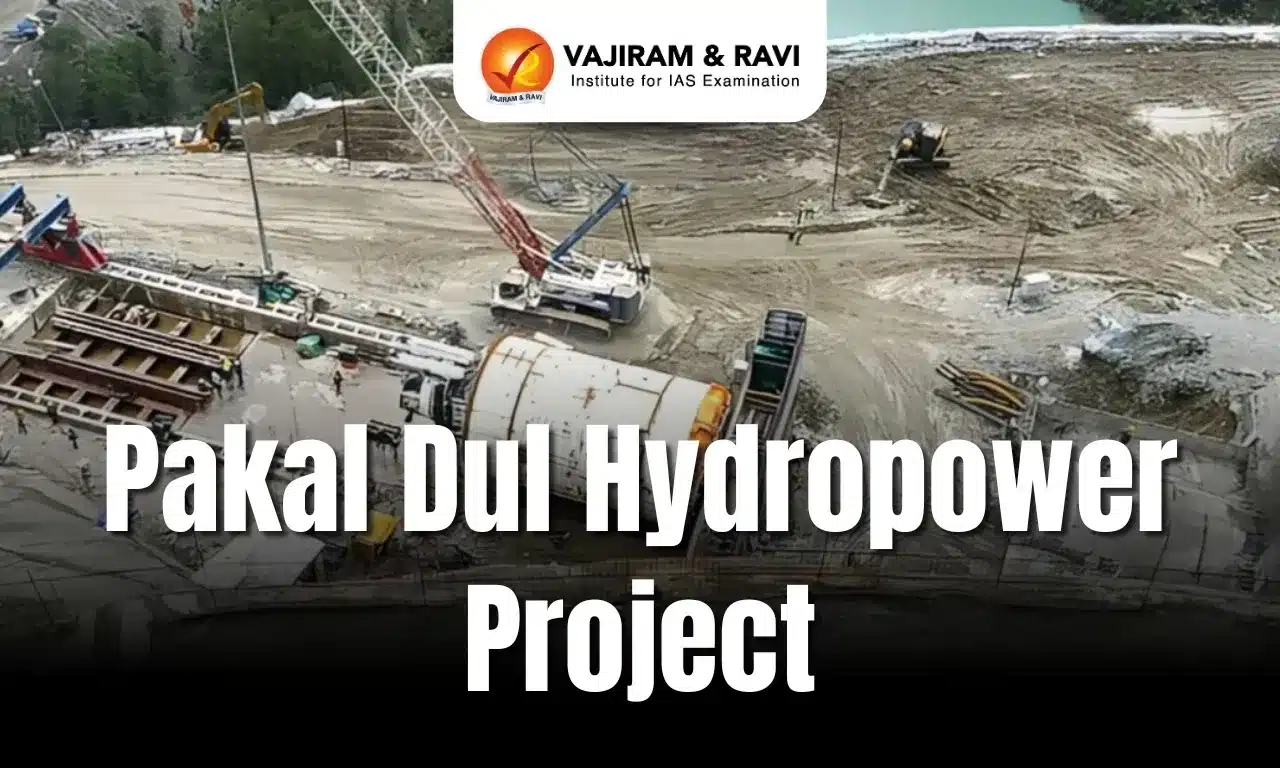
Pakal Dul Hydropower Project

Pakal Dul Hydropower Project

Pakal Dul Hydroelectric Project Latest News

A significant industrial dispute involving workers engaged by L&T Construction through subcontractors at the Pakal Dul Hydroelectric Project, Kishtwar, Jammu & Kashmir, has been amicably resolved recently.

About Pakal Dul Hydroelectric Project

  • It is a 1 GW run-of-the-river scheme hydroelectric project (HEP) under construction in the Kishtwar district of Jammu and Kashmir.
  • The project is being constructed on the Marusudar River, a tributary of the Chenab.
  • It comprises a 167 m high concrete-face rockfill dam and an underground powerhouse.
  • The underground powerhouse will be equipped with four 250 MW Francis turbine units operating at a net head of 397.3 m.
  • It is anticipated to produce around 3,330 million units of energy a year.
  • It is being constructed by Chenab Valley Power Projects [P] Ltd. (CVPPL), a joint venture company of National Hydroelectric Power Corporation (NHPC Limited) and Jammu & Kashmir State Power Development Corporation Ltd (JKSPDC).
  • JKSPDC holds a 49% stake in CVPPL, while NHPC and PTC India hold 49% and 2%, respectively.
  • During the first ten years of operation, the J&K will receive 12% free power from the project, in addition to waiving water usage charges. 
  • J&K will also have the first right to purchase the power allotted to NHPC and PTC.

News: PIB

Pakal Dul Hydroelectric Project FAQs

Q1: Where is the Pakal Dul Hydroelectric Project located?

Ans: It is located in Kishtwar district of Jammu and Kashmir.

Q2: What type of hydroelectric project is Pakal Dul?

Ans: It is a 1 GW run-of-the-river hydroelectric project.

Q3: On which river is the Pakal Dul Hydroelectric Project being constructed?

Ans: It is being constructed on the Marusudar River.

Q4: What is the installed capacity of the Pakal Dul Hydroelectric Project?

Ans: 1,000 MW (1 GW).

Enquire Now