Betwa River

Betwa River

Betwa River Latest News

In Vidisha, Madhya Pradesh, the water level of the Betwa River has risen rapidly following continuous rainfall, increasing concerns in areas along the river.

About Betwa River

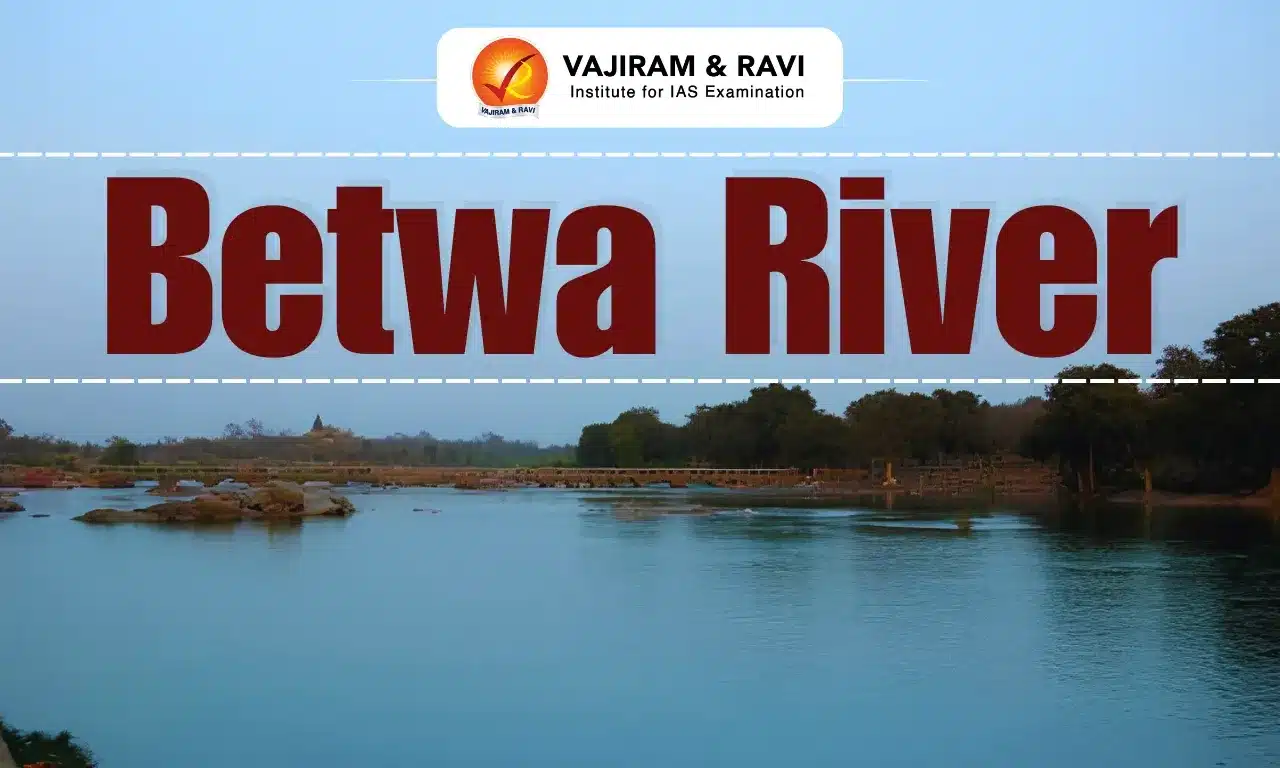
  • It is a significant river in central and northern India.
  • It is an important right-bank tributary of the Yamuna River.
  • Course: 
    • It originates from Jhirri village in Raisen District, near Bhopal, Madhya Pradesh. 
    • It begins at an elevation of around 460 metres in the Vindhya Hills.  
    • It flows generally northeast through Madhya Pradesh and Uttar Pradesh states and empties into the Yamuna River near Hamirpur town in Uttar Pradesh.  
    • Nearly half of its course, which is not navigable, runs over the Malwa Plateau before it breaks into the upland of Bundelkhand
  • The River's total length is 590 km, of which 358 km flows in Uttar Pradesh and 232 km in Madhya Pradesh.
  • In the active monsoon season, the Betwa River discharges exceptionally high levels, while in the summer; it discharges extremely low levels
  • Tributaries: The Jamni and Dhasan rivers are its major tributaries. 
  • Dams: The Betwa is dammed at Dukwan and Deogarh for irrigation and water management. 
  • Significance
    • It has been mentioned in the Mahabharata and once supported the Chedi Kingdom, whose capital Suktimati stood on its banks. 
    • It is part of the Ken-Betwa Link Project, a major interlinking initiative designed to transfer surplus water from the Ken River to the Betwa River for irrigation and drinking purposes.
    • The Indian Navy named one of its frigates INS Betwa in honour of the river.
    • The historical little town of Orchha is famous for its architectural glory and graceful Betwa River.  
      • The town is landlocked and primarily fed by the Betwa River.  
      • Orchha Wildlife Sanctuary lies within the area through which the Betwa River flows.

News: ANI

Betwa River FAQ's

Q1: The Betwa River is a major tributary of which river?

Ans: It is an important right-bank tributary of the Yamuna River.

Q2: Where does the Betwa River originate?

Ans: It originates from Jhirri village in Raisen district, near Bhopal, Madhya Pradesh.

Q3: Through which states does the Betwa River flow?

Ans: It flows through Madhya Pradesh and Uttar Pradesh.

Q4: What is the total length of the Betwa River?

Ans: The Betwa River is approximately 590 km long.

Q5: Which ancient city stood on the banks of the Betwa River?

Ans: Suktimati, the capital of the Chedi Kingdom, stood on its banks.
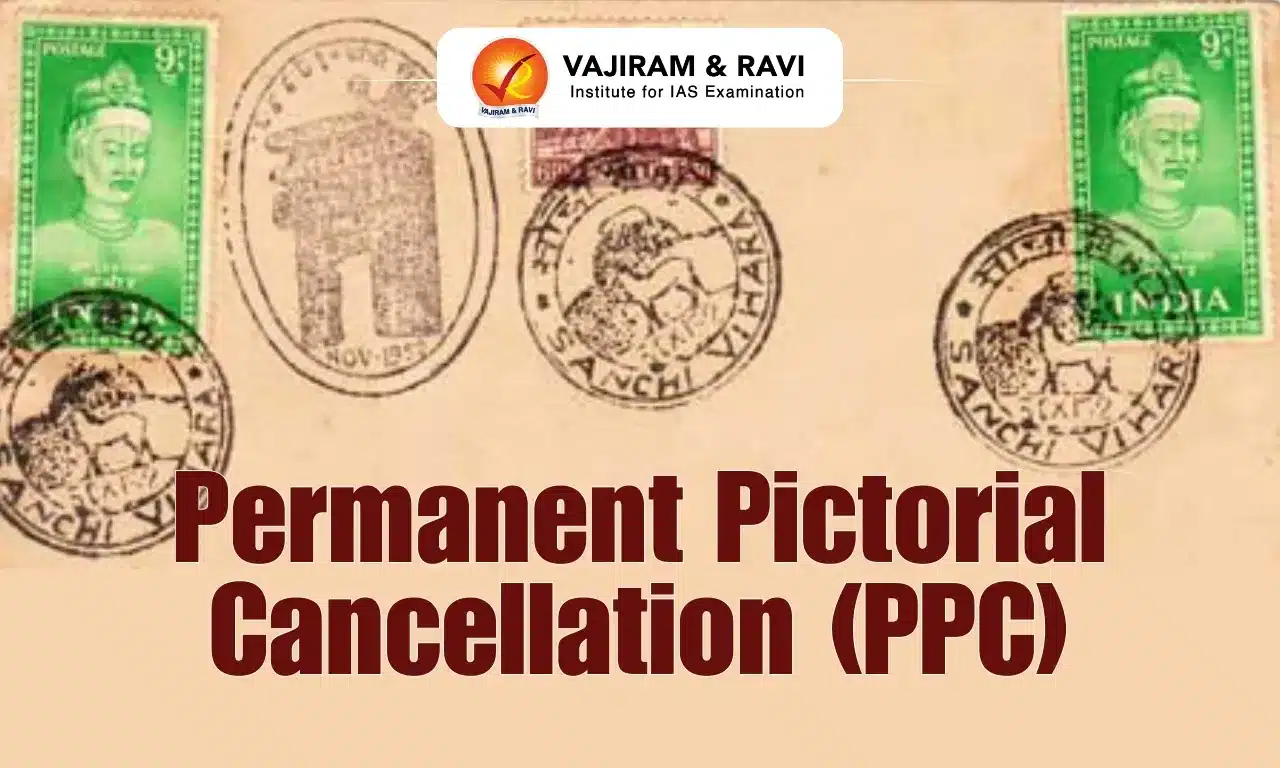
Permanent Pictorial Cancellation (PPC)

Permanent Pictorial Cancellation

Permanent Pictorial Cancellation Latest News

The Department of Posts, Kerala Circle, released the permanent pictorial cancellation (PPC) and premium special cover to commemorate the religious, cultural, historical, and architectural significance of the Sree Padmanabhaswamy temple recently.

About Permanent Pictorial Cancellation

  • It is a postmark, which shows a replica/photo/design or a picture highlighting a tourist, religious, historical, or an important place or a living/non-living thing. 
  • PPCs give wide publicity to many places of historical, cultural, and tourist interest.
  • It is one of the accepted methods of cancellation at post offices. 
  • They are provided at the post offices, which are located near such significant places.
  • In PPC, the replica/photo/design or a picture is used as the cancellation seal.
  • However, the regular features of the cancellation, the zip code, and date will be included in the seal. 
  • Unlike an ordinary cancellation used to cancel postage stamps on a particular day, a PPC is available for use on a permanent basis at a designated post office. 
  • The sender can have his mail sealed pictorially by postal staff by placing an oral request, provided a proper number of stamps are affixed on the mail. 
  • The pictorial cancellation can also be imprinted on postcards and inland letters. Once the pictorial cancellation is made, no normal cancellation is needed.
  • It is of particular interest to philatelists (stamp collectors) because it provides a distinctive and lasting postal marking associated with a specific subject or location. 

Key Facts about Sree Padmanabhaswamy Temple

  • It is a Hindu temple dedicated to Lord Vishnu located in Thiruvananthapuram (Trivandrum), Kerala.
  • The name of the city of Thiruvananthapuram in Malayalam translates to “The City of Lord Ananta, ”referring to the deity of Padmanabhaswamy Temple.
  • The earliest recorded mention of the temple is from the 8th or 9th century CE, although the temple is likely older. 
  • The temple was built and rebuilt over the centuries, most recently by Martanda Varma, king of Travancore, who in 1750 donated the kingdom to the deity.
  • Architecture:
    • It is a blend of Kerala and Dravidian styles of architecture.
    • The idol of Vishnu is in the Anantha shayanam posture, the eternal yogic rest posture on his serpent Adisheshan. 
    • It has a seven-tier-high gopuram, which is decorated with delicate designs and carvings. 
    • Along with exquisite and intricate works on stone and bronze, the interior of the temple is adorned by exquisite paintings and murals, most of which are life-sized depictions of Lord Vishnu in the reclining posture, Lord Ganapati, Gaja Lakshmi, and Narasimha Swamy (half-lion, half-man incarnation of Lord Vishnu). 
    • The flag post of the temple (dhwaja stamba) is covered with gold-plated copper sheets and is about 80 ft high.
  • The temple has around 3 million palm leaf manuscripts dating back to the 14th century CE.
    • Known as Mathilakam records, they contain the administrative and financial details of the temple town and Travancore kingdom spread over six centuries.
  • In 2011 the temple was the subject of international news when an exploration of its vaults revealed a wealth of jewels, precious metals, and other treasures.
  • It is also widely believed to be the world’s richest temple.

News: NIE

Permanent Pictorial Cancellation FAQs

Q1: What is a Permanent Pictorial Cancellation (PPC)?

Ans: It is a postmark that features a replica, photograph, design or picture highlighting a tourist, religious, historical or other important place, or a living or non-living thing.

Q2: Is Permanent Pictorial Cancellation an accepted method of postal cancellation?

Ans: Yes, it is one of the accepted methods of cancellation at post offices.

Q3: Where are Permanent Pictorial Cancellations provided?

Ans: They are provided at post offices located near significant places.

Q4: How does a Permanent Pictorial Cancellation differ from an ordinary cancellation?

Ans: Unlike an ordinary cancellation used for a particular day, a PPC is available for use on a permanent basis at a designated post office.

Kalaburagi Fort

Kalaburagi Fort

Kalaburagi Fort Latest News

The MP for Kalaburagi recently met with Union Culture Minister and submitted a letter seeking urgent approval for the proposed ₹20 crore conservation and rejuvenation project for the historic Kalaburagi fort.

About Kalaburagi Fort

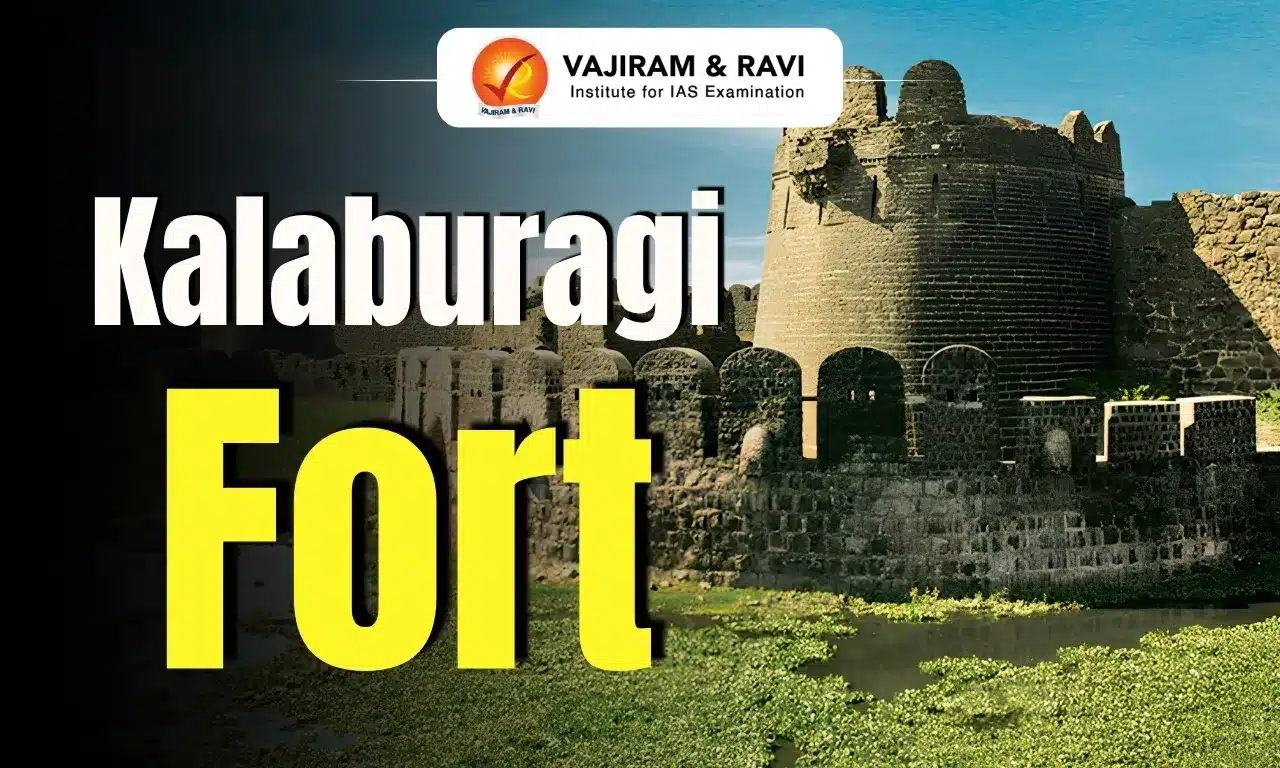
  • Kalaburagi Fort, also known as Gulbarga Fort, is a historic fort located in Kalaburagi (Gulbarga), Karnataka
  • It was initially constructed by Raja Gulchand, a feudatory of the Kakatiya dynasty of Warangal, in the 12th century.   
  • It was later strengthened by Alauddin Hasan Bahman Shah, the ruler of the Bahmani dynasty
  • Bahmani Sultans had the longest rule in Kalaburagi between the 14th and 16th century.
  • It served as the capital of the Bahmani Sultanate, one of the most powerful Muslim kingdoms in the Deccan region during the mediaeval period.  

Kalaburagi Fort Architecture

  • The architecture showcases a blend of Hindu and Islamic styles, reflecting the diverse cultural influences of its builders and occupants over the centuries. 
  • Being positioned atop a hill, the fort provided a strategic advantage for defence.
  • The fort's structures include mosques, palaces, tombs, and other buildings, built using materials like granite and limestone. 
  • Notable features include massive walls, bastions, ornate gateways, and intricate carvings, showcasing the craftsmanship of the artisans of that era. 
  • The fort's layout reflects its strategic importance, with a series of concentric walls and defensive structures designed to withstand sieges.  
  • The fort is a monumental structure highly fortified with 15 towers mounted with 26 guns; each gun located inside the fort is 8 metres (26 ft) long and is still well preserved.

News: TH

Kalaburagi Fort FAQs

Q1: Where is Kalaburagi Fort located?

Ans: It is located in Kalaburagi (Gulbarga), Karnataka.

Q2: Who initially constructed Kalaburagi Fort?

Ans: It was initially constructed by Raja Gulchand, a feudatory of the Kakatiya dynasty of Warangal, in the 12th century.

Q3: Who later strengthened Kalaburagi Fort?

Ans: It was later strengthened by Alauddin Hasan Bahman Shah, the ruler of the Bahmani dynasty.

Q4: Which dynasty ruled Kalaburagi for the longest period?

Ans: Bahmani Sultans had the longest rule in Kalaburagi between the 14th and 16th century.

Q5: What architectural styles are blended in Kalaburagi Fort?

Ans: Hindu and Islamic architectural styles.

Merchant Discount Rate

Merchant Discount Rate

Merchant Discount Rate Latest News

The Govt recently said the proposed merchant discount rate (MDR) for UPI transactions will be nominal and apply only to a limited set of merchants for transactions above a threshold.

About Merchant Discount Rate 

  • It is the fee charged to a merchant for accepting a digital payment.  
  • When a customer pays a business digitally, multiple parties may be involved in completing that transaction. 
  • Depending on the payment mode, these may include the merchant, payment gateway or payment aggregator, acquiring bank, issuing bank, card network or payment network, and other payment infrastructure participants. 
  • MDR is part of the commercial structure that supports this payment acceptance chain. 
  • For a merchant, MDR is best understood as a cost of accepting a particular type of payment. 
  • When a customer makes a payment, the merchant usually receives the transaction amount after deduction of MDR.
  • The MDR fees cover a variety of costs, including:
    • Payment processor fee: These fees are charged by payment processors (companies that handle transactions between merchants and banks like Razorpay) for their services.
    • Interchange fee: These are fees charged by card issuers (banks) to merchants for processing transactions.
    • Assessment fee: These are fees charged by card networks (like Visa, RuPay and Mastercard) to merchants for using their payment processing services.
    • Markup fee: These are fees that are divided among the different entities involved in the transaction.
    • Additional fees: Some payment processors may charge additional fees for services like fraud prevention, chargeback handling, and customer support.
  • MDR is not a single fixed rate that applies to every business or every payment. 
  • It may apply differently across cards, net banking, wallets, UPI, EMI, BNPL, QR, and other payment modes, depending on the provider and the applicable arrangement. 
  • The MDR typically comes in the form of a percentage of the transaction amount. It is typically between 1% and 3%.
  • Merchants must consider these fees as part of managing their business costs and setting their prices.
  • MDR charges are automatically deducted from the merchant’s account at the time of settling the transaction batch.

MDR on UPI

  • When UPI was launched in 2016, MDR was applicable. 
  • But in January 2020, the government removed MDR on UPI and RuPay debit cards to push mass adoption of digital payments. 
  • But zero MDR also meant banks, the National Payments Corporation of India (NPCI) and fintech startups got nothing from the transaction. 
  • The government has compensated the industry through subsidies. 

Recent Changes Introduced in the Taxation and Other Laws (Amendment) Bill, 2026

  • It empowers the government to levy an MDR on select electronic payment modes, with a potential MDR of 0.25 percent to 0.4 percent on business-directed UPI transactions
  • The finance ministry said consumers will face no transaction charges and that all person-to-person (P2P) transfers will continue to be free.
  • The government says it will apply only to a limited set of merchant transactions above a certain value threshold, at a nominal rate, which will be far lower than existing debit or credit card MDRs.   
  • Small merchants and person-to-merchant payments below that threshold are expected to remain free, to protect the digital-payments push among small businesses.

News: ET

Merchant Discount Rate FAQs

Q1: What is Merchant Discount Rate (MDR)?

Ans: MDR is the fee charged to a merchant for accepting a digital payment.

Q2: Who pays the Merchant Discount Rate (MDR)?

Ans: The merchant bears the MDR as a cost of accepting a particular type of digital payment.

Q3: How is Merchant Discount Rate (MDR) typically calculated?

Ans: MDR is typically calculated as a percentage of the transaction amount.

Q4: Is Merchant Discount Rate (MDR) a single fixed rate applicable to all businesses and payment modes?

Ans: MDR is not a single fixed rate that applies to every business or every payment.

Q5: Why should merchants consider Merchant Discount Rate (MDR) while managing their businesses?

Ans: Merchants should consider MDR as part of their business costs when managing expenses and setting prices.

Pteris madhusoodananii

Pteris madhusoodananii

Pteris madhusoodananii Latest News

A team of Indian botanists recently discovered a rare new species of fern named Pteris madhusoodananii within the misty Kolli hills of the Eastern Ghats.

About Pteris madhusoodananii

  • It is a new species of fern.
  • It was discovered within the misty Kolli hills of the Eastern Ghats in Tamil Nadu
  • It is currently known to exist in only two small sites covering just 8 sq.km.
  • It has been immediately classified as ‘Critically Endangered’ due to its extremely small habitat and the threat of human encroachment. 
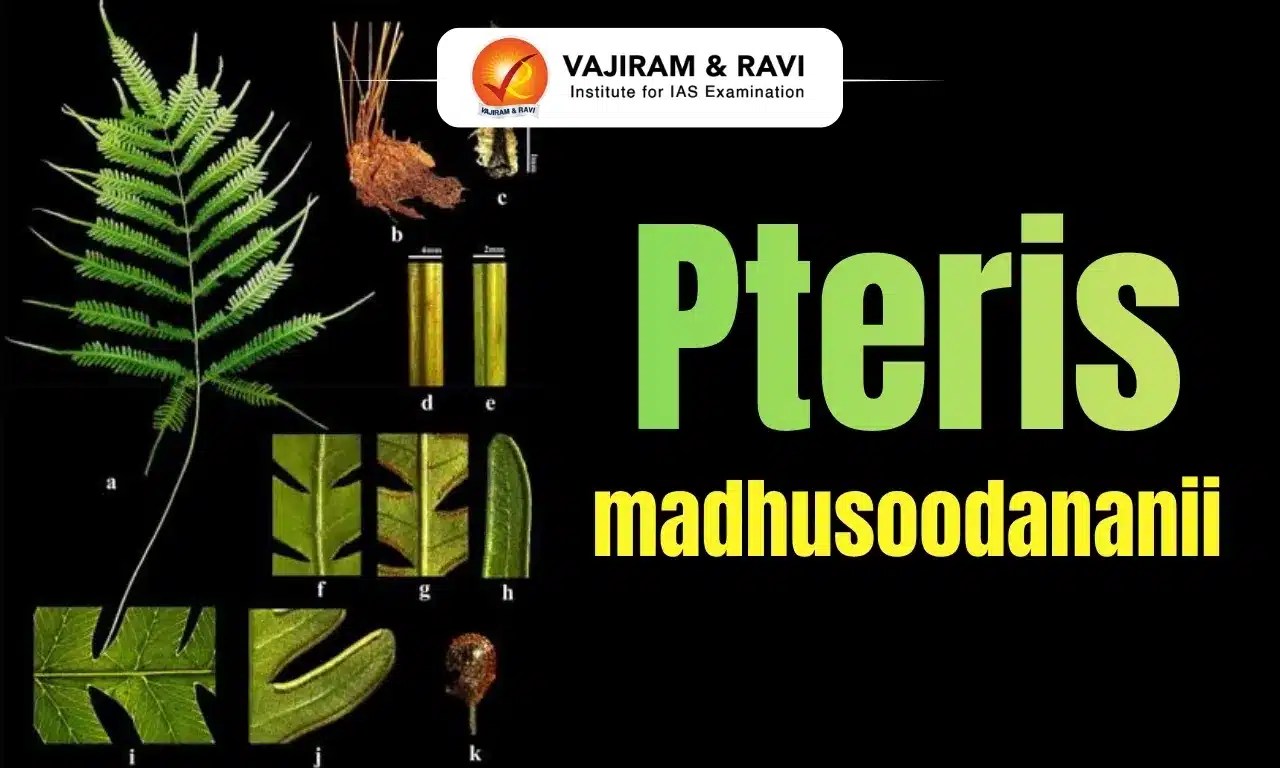
  • While it looks similar to other ferns in the Pteris family, Pteris madhusoodananii is characterised by stiff, leathery leaves with a lustrous, deep green colour. 
  • Unlike its closest relatives, it features a very prominent lobe at the base of its lower segments and a unique pinna-pinnule architecture, in which its smaller leaflets are arranged along the stem. 
  • At a microscopic level, its spores possess a narrow, wavy-edged belt called a cingulum, a feature distinct from the smooth, wider belts found on similar species.

News: RM

Pteris madhusoodananii FAQs

Q1: What is Pteris madhusoodananii?

Ans: It is a newly discovered species of fern.

Q2: Where was Pteris madhusoodananii discovered?

Ans: It was discovered in the Kolli Hills of the Eastern Ghats in Tamil Nadu.

Q3: What is the conservation status of Pteris madhusoodananii?

Ans: It has been classified as Critically Endangered.

Q4: What type of leaves does Pteris madhusoodananii possess?

Ans: It has stiff, leathery leaves with a lustrous, deep green colour.

Dirac Medal

Dirac Medal

Dirac Medal Latest News

Recently, Deepak Dhar, a theoretical physicist from Uttar Pradesh has been named the co-recipient of Dirac Medal.  

About Dirac Medal

  • It was first awarded in 1985.
  • It is given in honor of P.A.M. Dirac, one of the greatest physicists of the 20th century.
  • It is awarded annually on Dirac's birthday (August 8), to scientists who have made significant contributions to theoretical physics.
  • It is awarded by the International Centre for Theoretical Physics (ICTP).
  • Selection Process: An international committee of distinguished scientists selects the winners from a list of nominated candidates.
  • The Dirac Medal is not awarded to Nobel Laureates, Fields Medallists, or Wolf Foundation Prize winners, although several past Dirac medallists later went on to receive those honours.
  • Cash Prize: The Medalist also receives a prize of US $5,000.

What is the International Centre for Theoretical Physics?

  • It is an international research institute for physical and mathematical sciences.
  • The centre was founded in 1964.
  • It operates under a tripartite agreement between the Italian Government, United Nations Educational, Scientific and Cultural Organization (UNESCO), and International Atomic Energy Agency (IAEA).
  • ICTP is a UNESCO Category 1 Institute.
  • It is located in Trieste, Italy.

Source: IE

Dirac Medal FAQs

Q1: Dirac Medal is awarded by which organisation?

Ans: International Centre for Theoretical Physics

Q2: Dirac Medal is given for contributions in which field?

Ans: Theoretical Physics

Eco-Educational Hub

Eco-Educational Hub

Eco-Educational Hub Latest News

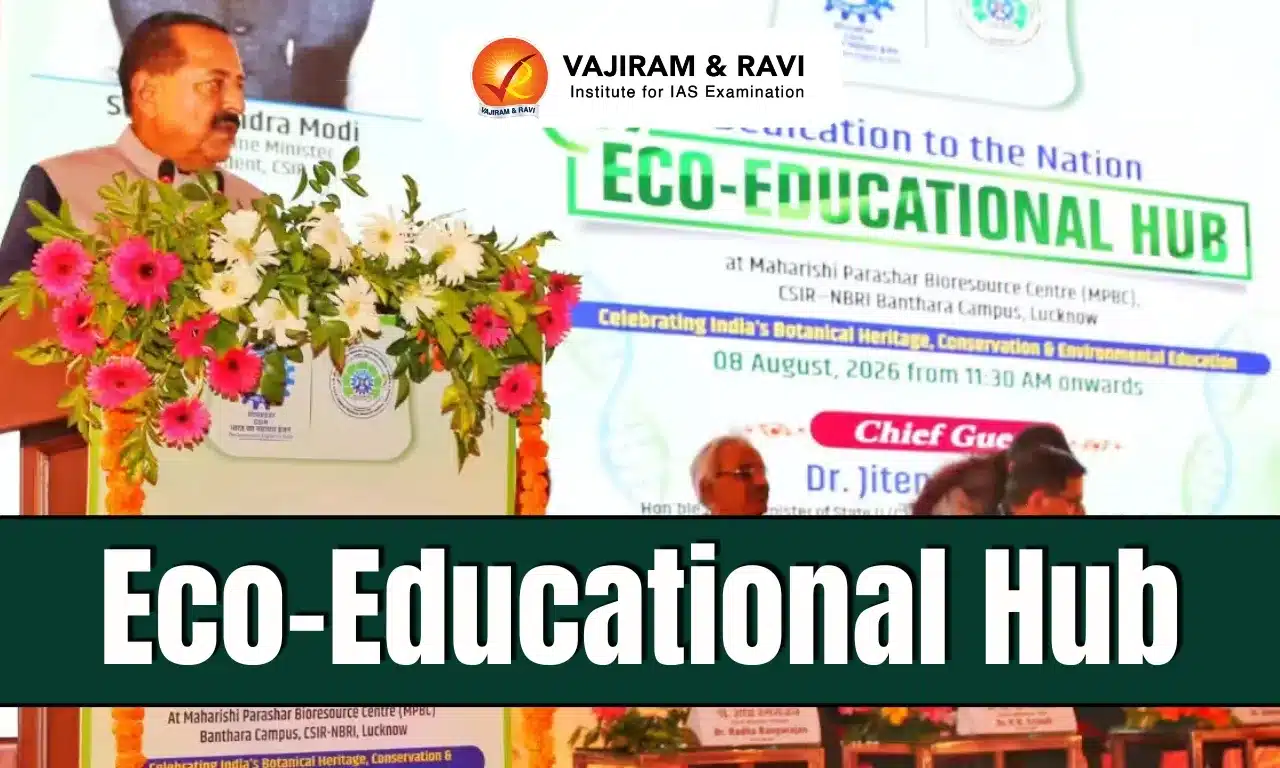
Recently, the Union Minister of State for Science and Technology dedicated the first-of-its-kind eco-educational hub ‘Prakriti Gyan Dham’.

About Eco-Educational Hub

  • It is developed by the CSIR-National Botanical Research Institute (CSIR-NBRI). 
  • It provides a direct interface between scientific knowledge and public engagement, by making it accessible through experiential and interactive learning.
  • Features of the Eco-Educational Hub
    • PAaVan Path (Plants and Associated Vegetations for Appreciating Nature): It is an interpretive heritage trail. The trail takes visitors through curated plant collections representing diverse ecological regions and associated vegetation.
    • Vibhav Enclave: It is a Threatened Plants of India Garden provides a dedicated space for rare, endangered and threatened plant species
      • It promotes awareness about biodiversity loss, habitat degradation, climate change and the need to conserve plant genetic resources.
    • Bhairav Enclave: State Plants of India Garden brings together officially designated State Plants of States and Union Territories, presenting their ecological, cultural and symbolic significance.

Source: PIB

Eco-Educational Hub FAQs

Q1: What is the Main objective of Eco-Educational Hub?

Ans: Environmental education and sustainability awareness

Q2: What is Prakriti Gyan Dham?

Ans: India’s first Eco-Educational Hub

Explosive Ordnance Disposal Exercise

Explosive Ordnance Disposal Exercise

Explosive Ordnance Disposal Exercise Latest News

The Indian Navy–US Navy Explosive Ordnance Disposal (EOD) Exercise 2026 is scheduled to be conducted at Southern Naval Command, Kochi till the 14th of this month.

About Explosive Ordnance Disposal Exercise

  • It is a bilateral exercise conducted between the Indian Navy and US Navy.
  • It aims to enhance interoperability and strengthen professional cooperation between the specialist diving and EOD teams of the two navies.
  • It has been conducted by both countries since 2005.
  • The forthcoming engagement marks the eighth edition of this specialised bilateral training exercise.
  • Features
    • It will comprise Subject Matter Expert Exchanges (SMEEs), cross-training, equipment demonstrations and scenario-based practical exercises.
    • It will facilitate the exchange of contemporary EOD methodologies, emerging technologies and Best Practices.
    • It is designed to promote collaborative learning and operational synergy, enabling personnel from both navies to refine procedures, enhance mutual understanding and strengthen their ability to respond effectively to complex and evolving EOD challenges.
  • Significance: It underscores the enduring commitment of the two navies towards enhancing interoperability, sharing operational expertise and strengthening cooperation in specialised maritime operations.

Source: PIB

Explosive Ordnance Disposal Exercise FAQs

Q1: Explosive Ordnance Disposal Exercise is conducted between which countries?

Ans: Indian Navy and US Navy

Q2: What is the main objective of India-US EOD Exercise?

Ans: Interoperability in explosive ordnance disposal

Philippines

Philippines

Philippines Latest News

The enhanced southwest monsoon and tropical cyclones have affected more than 3.8 lakh people across eight regions in the Philippines. 

About Philippines

  • Location: It is an island country of Southeast Asia in the western Pacific Ocean.
  • Water Bodies: It is surrounded by the South China (north and west); Philippine Sea (east); Celebes Sea (south); and by the Sulu Sea to the (southwest). 
  • Capital city: Manila.

Geographical Features of Philippines

  • Climate: It majorly consists of tropical and monsoonal types of climate.
  • Highest Point: Mount Apo.
  • Major Rivers: Cagayan River (Philippines’ longest river), Mindanao, Agusan etc.
  • Major Lake: Laguna de Bay
  • Volcano: Mayon Volcano, one of the most active in the country. Other volcanoes are Bulusan and Kanlaon.
  • Natural resources: It mainly consists of Timber, petroleum, nickel, cobalt, silver, gold, salt, copper
    • The Philippines is the third-largest producer of geothermal energy globally, after the United States and Indonesia.

Source: New On Air

Philippines FAQs

Q1: What is the Capital of Philippines?

Ans: Manila

Q2: Mount Mayon is a famous volcano located in which country?

Ans: Philippines

Export Promotion Capital Goods Scheme

Export Promotion Capital Goods Scheme

Export Promotion Capital Goods Scheme Latest News

Recently, the Directorate General of Foreign Trade (DGFT) has removed the requirement of submitting physical duty payment challans while applying for Export Obligation Discharge Certificates (EODC) under the Advance Authorisation and Export Promotion Capital Goods (EPCG) Schemes. 

About Export Promotion Capital Goods Scheme

  • It is a trade promotion scheme implemented by the Indian government.
  • It allows the duty-free import of capital goods for the purpose of export production in India.
  • It was first operationalized on 1 April 2015.
  • Objective: The objective of the scheme is to facilitate import of capital goods for producing quality goods and services and enhance India's manufacturing competitiveness. 
  • The EPCG scheme is administered by the Directorate General of Foreign Trade (DGFT) and is governed by the Foreign Trade Policy of India.
  • Features
    • EPCG Scheme allows import of capital goods for pre-production, production and post-production at zero customs duty.
    • It covers manufacturer exporters with or without supporting manufacturer(s), merchant exporters tied to supporting manufacturer(s) and service providers.
    • Second-hand goods of any nature will not be permitted under the EPCG scheme.

Source: PIB

Export Promotion Capital Goods Scheme FAQs

Q1: Export Promotion Capital Goods scheme covers which sectors?

Ans: Both Goods and Services

Q2: EPCG scheme is implemented by which ministry?

Ans: Ministry of Commerce & Industry

Enquire Now