Kikuchi-Fujimoto Disease

Kikuchi-Fujimoto Disease

Kikuchi-Fujimoto Disease Latest News

A 32-year-old man from Visakhapatnam, who had recurrent lymph node swelling for nearly six years and was repeatedly treated for suspected tuberculosis, has finally been diagnosed with rare Kikuchi–Fujimoto disease recently.

About Kikuchi-Fujimoto Disease

  • Kikuchi-Fujimoto disease (KFD), also known as histiocytic necrotizing lymphadenopathy, is a rare inflammatory disorder of the lymph nodes. 
  • It causes swollen, painful lymph nodes that most often develop in your neck (cervical lymphadenopathy), along with fever and fatigue.   
  • It most often affects people aged 30 and under.  
  • It can closely mimic tuberculosis and lymphoma.  

Kikuchi-Fujimoto Disease Causes

The cause of KFD remains unclear, but both viral infections and autoimmune mechanisms have been suggested as potential triggers. 

Kikuchi-Fujimoto Disease Symptoms

  • KFD symptoms typically develop over several weeks and include:
    • Swollen and painful lymph nodes that usually affect one side of your neck, but can also develop in other areas
    • Low-grade fever 
    • Fatigue 
    • Headache
    • Sore throat and cough
    • Skin rash
    • Nausea and vomiting
    • Night sweats
    • Losing weight without trying
  • Usually, this disease does not cause severe problems and gets better on its own. 
  • However, in some people, it can be associated with autoimmune disorders, conditions where the immune system mistakenly attacks the body’s cells and tissues. 

Kikuchi-Fujimoto Disease Treatment

  • There isn’t a specific cure, but your healthcare provider may recommend treatment to relieve symptoms, including:
    • NSAIDs (nonsteroidal anti-inflammatory drugs), for fever, pain, and headache.
    • Corticosteroids may be used in severe cases to reduce swelling in lymph nodes.

News: TOI

Kikuchi-Fujimoto Disease FAQs

Q1: What is Kikuchi-Fujimoto disease?

Ans: Kikuchi-Fujimoto disease (KFD) is a rare inflammatory disorder of the lymph nodes.

Q2: Which part of the body is primarily affected by Kikuchi-Fujimoto disease?

Ans: It primarily affects the lymph nodes.

Q3: What is the exact cause of Kikuchi-Fujimoto disease?

Ans: The exact cause of Kikuchi-Fujimoto disease remains unclear.

Q4: Is Kikuchi-Fujimoto disease usually a severe disease?

Ans: No, it is usually self-limiting and gets better on its own.

Q5: Is there a specific cure for Kikuchi-Fujimoto disease?

Ans: No, there is no specific cure, and treatment generally focuses on relieving symptoms.

Helicase

Helicase

Helicase Latest New

In a recent study scientists from the U.K. found that proteins Sld3-Sld7 detect "switched-on" MCM2-7 helicase and recruit Cdc45 to start DNA replication.

About Helicase

  • Helicase is a crucial enzyme in molecular biology, playing an essential role in DNA replication, repair, and transcription. 
  • It is a motor protein and unwinds the double-stranded DNA (dsDNA) into single strands, so that the cell can copy the genetic information stored in them.
  • Working of Helicase
    • First, the enzyme attaches to a particular region of DNA and moves along the molecule.
    • It uses energy from ATP (the cell’s main chemical energy source)  to change its shape and force apart the two DNA strands.
    • The result is a Y-shaped region called the replication fork, where the two strands are exposed
    • However, DNA tends to become increasingly twisted ahead of the replication fork as helicase moves along it.
    • Other enzymes called topoisomerases relieve this twisting and prevent the DNA from becoming tangled or breaking.
    • Once helicase has separated the strands, other replication machinery can use each exposed strand as a template to make a new complementary strand.

Source: TH

Helicase FAQs

Q1: Helicase uses which molecule as energy source?

Ans: Adenosine triphosphate (ATP)

Q2: What is the Y-shaped structure formed during DNA unwinding by helicase?

Ans: Replication fork

Giloy

Giloy

Giloy Latest News

Giloy, the climbing herb found in gardens and forests across India, has found an unusual patient in Madhya Pradesh, a young tigress battling canine distemper, one of the most dangerous viral diseases affecting wild carnivores.

About Giloy

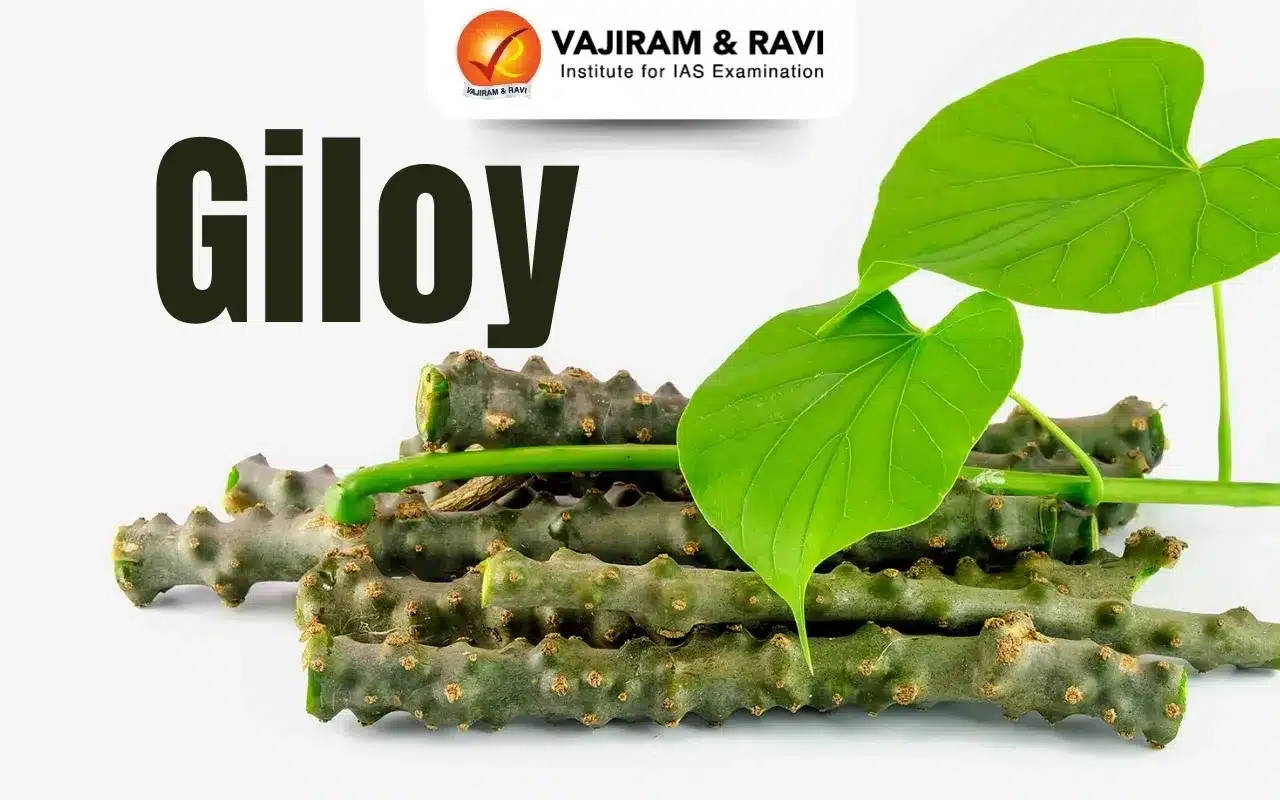
  • It is a climbing shrub that grows on other trees, from the botanical family Menispermaceae. 
  • Scientific Name: Tinospora cordifolia 
  • Giloy is also called giloe, guduchi, and amrita, among other names. 
  • Habitat and Distribution:
    • It is native to India but also found in China and tropical areas of Australia and Africa.
    • It grows well in almost all types of soils and under varying climatic conditions.
    • The plant is cultivated by stem cutting in the months of May-June.
  • It’s considered an essential herbal plant in Ayurvedic and folk medicine, where people use it as a treatment for a wide range of health conditions.  
  • All parts of the plant are used in Ayurvedic medicine. However, the stem is thought to have the most beneficial compounds. 
  • Nutritional Value: 
    • Giloy contains several essential nutrients such as copper, iron, manganese, zinc, calcium, and phosphorus. 
    • It also has alkaloids, steroids, glycosides, sesquiterpenoids, essential oils, fatty acids, and aliphatic compounds. 
  • Traditionally, giloy is used to treat
    • fever
    • urinary problems
    • asthma
    • dysentery
    • diarrhea
    • skin infections
    • Hansen’s disease (formerly called leprosy)
    • diabetes
    • gout
    • jaundice
    • anorexia
    • eye conditions

News: NDTV

Giloy FAQs

Q1: What is Giloy?

Ans: Giloy is a climbing shrub that grows on other trees and belongs to the botanical family Menispermaceae.

Q2: Where is Giloy native to?

Ans: Giloy is native to India.

Q3: In which traditional systems of medicine is Giloy considered an important herbal plant?

Ans: Giloy is considered an important herbal plant in Ayurvedic and folk medicine.

Q4: Which parts of Giloy are used in Ayurvedic medicine?

Ans: All parts of the Giloy plant are used in Ayurvedic medicine.

Central African Republic

Central African Republic

Central African Republic Latest News

Recently, a gold mining site collapsed in the western part of the Central African Republic and killed at least 30 miners and left others trapped. 

About Central African Republic

  • Location: It is a landlocked nation located in the Central Africa region.
  • Bordering Countries: It is bordered by six countries namely Chad (North), Sudan (Northeast), and South Sudan (Southeast), DRC (South), Republic of the Congo (Southwest), and Cameroon (West).
  • Capital City: Bangui

Geographical Features of Central African Republic

  • Topography: It is largely a plateau, covered with savannah (grassland). 
  • Climate:   The climate of the Central African Republic is tropical.
  • Major Rivers: The major rivers include the Oubangui (or Ubangi) River, which is a tributary of the Congo River. In the north, the Chari River drains into Lake Chad.
  • Highest Peak: The highest point in the country Mount Ngaoui (1,410 m) is located in the Karre Mountains range.
  • Natural Resources: It mainly consists of mineral resource which includes diamonds, Gold, uranium, iron ore, copper, and manganese are mined in smaller quantities.
  • The Dzanga-Sangha National Park is located in the southwest corner of the country which is designated as a UNESCO-World Heritage site.

Source: TH

Central African Republic FAQs

Q1: What is the capital of Central African Republic?

Ans: Bangui

Q2: What is the official languages of Central African Republic?

Ans: French and Sango

Thamirabarani River

Tamirabharani River

Tamirabharani River Latest News

Recently, the Madurai Bench of the Madras High Court has declared Tamil Nadu’s Tamirabharani (Porunai) river a deity and granted it legal personhood to curb pollution. 

About Tamirabharani River

  • It is a perennial river of southern India flowing entirely within Tamil Nadu.
  • Origin: It originates from the Agastyarkoodam peak of Pothigai hills of the Western Ghats.
  • Course: It flows initially northward and later turns eastward, passing through Tirunelveli and Thoothukudi districts of the Tamil Nadu state.
  • It drains into the Gulf of Mannar.
  • It is fed by both southwest and northeast monsoons.
  • Tributaries: Major tributaries include Servalar, Manimuthar, Gadananathi, Pachaiyar, Chittar, Ramanathi and Koraiyar, all originating from forested Western Ghats.
  • Waterfalls and Reservoirs: The river forms Paanatheertham waterfalls of about 40 metres near Karaiyar reservoir and Kalyanatheertham and Agasthiar falls near Papanasam.
  • Major Dams:  Key dams on this river include Karaiyar Dam, Manimuthar Dam, Gadananathi Dam and Ramanathi Dam.

Source: DTE

Tamirabharani River FAQs

Q1: Tamirabharani River flows in which state?

Ans: Tamil Nadu

Q2: What are the tributaries of Tamirabharani?

Ans: Servalar, Manimuthar, Gadananathi, Pachaiyar, Chittar

Mushk Budji

Mushk Budji

Mushk Budji Latest News

Kashmir's indigenous aromatic rice variety, 'Mushk Budji', which was granted the GI tag three years ago, is facing the problem of plenty with the government's crop expansion to “unsuitable” areas hitting prices, farmers said recently.

About Mushk Budji

  • It is a highly aromatic short-grain rice variety native to Kashmir.
  • It is usually grown at an altitude ranging from 5000 to 7000 ft above mean sea level in the Highland Himalayas in the higher reaches of the Kashmir Valley.
  • It is often used on special occasions and festivals.  
  • It received a Geographical Indication (GI) tag on 31 July 2023.

Mushk Budji Features

  • Grain & Appearance: It has a light, ivory colour and a slightly translucent appearance.
  • Cooked grains remain slightly sticky, somewhat chewy, and imbued with fragrance. 
  • It has a delicate, nutty flavour.
  • It is rich in carbohydrates, fiber, and select B‑vitamins. 
  • It’s light on fat and easy to digest, making it suitable even for fasting or digestive-sensitive meals.

News: ETVB

Mushk Budji FAQs

Q1: What is Mushk Budji?

Ans: Mushk Budji is a highly aromatic short-grain rice variety native to Kashmir.

Q2: Why is Mushk Budji rice considered special?

Ans: It is considered special because of its distinctive aroma, short grains and delicate flavour.

Q3: When did Mushk Budji receive the Geographical Indication (GI) tag?

Ans: Mushk Budji received the GI tag on 31 July 2023.

Q4: What is the appearance of Mushk Budji rice grains?

Ans: The grains have a slightly translucent appearance.

Q5: What is the colour of Mushk Budji rice grains?

Ans: The grains have a light, ivory colour.

National Sports Awards

National Sports Awards

National Sports Awards Latest News

Recently, the Ministry of Youth Affairs & Sports announced the National Sports Awards 2025. 

About National Sports Awards

  • The National Sports Awards are given every year to recognize and reward excellence in sports.
  • Nodal Ministry: Ministry of Youth Affairs and Sports
  • Arjuna Award
    • It is given for good performance over a period of the previous four years and for showing qualities of leadership, sportsmanship and a sense of discipline.
  • Arjuna Awards (Lifetime)
    • It is given to honour and motivate those sportspersons who have contributed to sports by their performance and continue to contribute to promotion of sports even after their retirement from active sporting careers.
  • Dronacharya Award
    • It is given to coaches for doing outstanding and meritorious work on a consistent basis and for enabling sportspersons to excel in International events.
  • Rashtriya Khel Protsahan Puraskar
    • The ‘Rashtriya Khel Protsahan Puruskar’ is given to corporate entities (Public/Private), non-governmental organizations (NGOs), who have played a visible role in the area of sports promotion and development.

Source: PIB

National Sports Awards FAQ's

Q1: National Sports Awards are given on which day?

Ans: 29th August National Sports Day

Q2: Which Ministry administers National Sports Awards?

Ans: Ministry of Youth Affairs & Sports

Regional Rural Banks

Regional Rural Banks

Regional Rural Banks Latest News

The Ministry of Finance recently said that Regional Rural Banks (RRBs) have recorded strong growth in credit delivery during the financial year 2025-26.

About Regional Rural Banks

  • RRBs are financial institutions established to provide financial services to rural areas.
  • They are formed in collaboration by the Central Government, State Governments, and Sponsoring Commercial Banks to give loans to rural areas.
  • The main objectives of setting up the RRB is to provide credit and other facilities, especially to the small and marginal farmers, agricultural labourers, artisans, and small entrepreneurs in rural areas. 
  • Origin
    • RRBs were set up on the basis of the recommendations of the Narasimham Working Group (1975) and after the legislation of the Regional Rural Banks Act, 1976. 
    • The first RRB Prathama Grameen Bank” was set up on October 2, 1975. 
    • At present there are 82 RRBs in India. 
  • Ownership: The equity of an RRB is held by the Central Government, concerned State Government and the Sponsor Bank in the proportion of 50:15:35.  
  • The RRBs combine the characteristics of a cooperative in terms of the familiarity of the rural problems and a commercial bank in terms of its professionalism and ability to mobilise financial resources. 
  • The area of operation of RRBs is limited to the area as notified by the Government of India, covering one or more districts in the State. 
  • The RBI has set a Priority Sector Lending (PSL) target of 75% of total outstanding advances for RRBs as against 40% for Scheduled Commercial Banks. 
  • Sources of Funds: It comprises owned funds, deposits, borrowings from NABARD, sponsor banks and other sources, including SIDBI and the National Housing Bank.
  • Regulation: RRBs are regulated by the RBI and supervised by the National Bank for Agriculture and Rural Development (NABARD).
  • Management: The Board of Directors manages these banks, overall affairs, which consists of one Chairman, three Directors as nominated by the Central Government, a maximum of two Directors as nominated by the concerned State Government, and a maximum of three Directors as nominated by the sponsor bank.

News: NOA

Regional Rural Banks FAQs

Q1: What are Regional Rural Banks (RRBs)?

Ans: RRBs are financial institutions established to provide banking and financial services to rural areas.

Q2: Which entities collaborate to establish Regional Rural Banks?

Ans: RRBs are established in collaboration by the Central Government, State Governments and sponsoring commercial banks.

Q3: Who are the main beneficiaries of Regional Rural Banks?

Ans: The main beneficiaries include small and marginal farmers, agricultural labourers, artisans and small entrepreneurs in rural areas.

Q4: Which committee recommended the establishment of Regional Rural Banks?

Ans: The establishment of RRBs was based on the recommendations of the Narasimham Working Group (1975).

Q5: What is the Priority Sector Lending (PSL) target for Regional Rural Banks?

Ans: The PSL target for RRBs is 75% of their total outstanding advances.

Escherichia coli

Escherichia coli

Escherichia coli Latest News

A recent report by the Comptroller & Auditor General (CAG) on facilities at railway stations has revealed that E. coli bacteria were found in samples of drinking water. 

About Escherichia coli

  • It is commonly known as E. coli, is a type of bacteria that can be found in the intestines of humans and animals.
  • It is a rod-shaped bacterium of the Enterobacteriaceae family.
  • While most strains of E. coli are harmless and even beneficial, some strains can cause illness and infections.
  • Transmission: It can be transmitted to humans through contaminated food, water, or contact with fecal matter from infected individuals or animals.
  • Impact on Health:  Some kinds of E. coli can cause diarrhea, while others cause urinary tract infections, respiratory illness and pneumonia, and other illnesses.
    • The most familiar strains of E. coli that make you sick by producing a toxin called Shiga.
    • This toxin damages the lining of your small intestine and causes diarrhea.
    • These strains of E. coli are also called Shiga toxin-producing E. coli (STEC).
  • Symptoms: The most common symptoms of E.coli infection include fever, persistent diarrhoea, bloody diarrhoea, and vomiting.
  • Treatment: Most E. coli infections are self-limiting and resolve on their own without treatment. However, it’s essential to stay hydrated during the course of the illness

Source: IE

Escherichia coli FAQs

Q1: Which vitamin is synthesized by harmless E. coli in human gut?

Ans: Vitamin K

Q2: E. coli belongs to which family?

Ans: Enterobacteriaceae

Thames River

Thames River

Thames River Latest News

A traditional Ganga Aarti, a ritual associated with the ghats of Varanasi, Haridwar, and Rishikesh, will be held on the banks of the River Thames in London in September.

About Thames River

  • It is a 346-km river that flows through southern England.
  • It is the longest river in England and the second longest in the United Kingdom, right after the River Severn. 
  • Course
    • Origin: Its source is at Thames Head, near Kemble in the Cotswold Hills, Gloucestershire County.
    • It flows into the North Sea via the Thames Estuary.
    • The Nore is the sandbank that marks the mouth of the Thames Estuary and the confluence point of the Thames and the North Sea. 
  • It is split into two sections, tidal and non-tidal. 
    • The tidal part, which is affected by the North Sea’s tides, runs for 109 km from the mouth of the river to Teddington Lock in west London. 
    • The non-tidal section is 237 km long from Teddington Lock to the source of the river.  
  • Main Tributaries: Lea, Leach, Churn, Coln, Windrush, Kennet, Evenlode, Ock, and Loddon. 
  • Significance:
    • People have lived in the Thames Valley for thousands of years. 
    • Before railways and good roads were built, the Thames was the area’s main trade route. 
    • Over time many industries were set up along the banks.  
    • The river passes numerous popular cities along its way, such as London, Reading, Hendley-on-Thomas, Windsor, and Oxford, where it is also called the Isis River.
    • It provides two-thirds of London’s drinking water.
    • There are 16 bridges that cross the River Thames in Greater London alone, most prominently the Golden Jubilee Bridges and the Millennium Bridges for pedestrians.

News: IS

Thames River FAQs

Q1: Where does the River Thames flow?

Ans: It flows through southern England.

Q2: What is the length of the River Thames?

Ans: The River Thames is approximately 346 km long.

Q3: Which is the longest river in England?

Ans: The River Thames is the longest river in England.

Q4: Into which sea does the River Thames flow?

Ans: The River Thames flows into the North Sea through the Thames Estuary.

Q5: Which major cities does the River Thames pass through?

Ans: It passes through or near London, Reading, Henley-on-Thames, Windsor and Oxford.

Enquire Now