Spoon-Tailed Duskhawker

Spoon Tailed Duskhawker

Spoon-Tailed Duskhawker Latest News

Recently, researchers verified the first photographic evidence of the spoon-tailed duskhawker (Gynacantha basiguttata) in Arunachal Pradesh. 

About Spoon-Tailed Duskhawker

  • It is a species of dragonfly and a member of the Aeshnidae family.
  • Habitat: Individuals can be spotted patrolling or perching near streams, forest pools.
  • Distribution: Philippines and is found in several parts of Southeast Asia.
  • This species hunts flying insects (mosquitoes, small flies, gnats) and plays an important role in aquatic food webs
  • It is strong, fast fliers that hunt on the wing where it can hunt effectively.
  • Features
    • G. basiguttata includes a black T-shaped mark on the frons (forehead or front part of the head), an olive-green thorax without a stripe, distinctive wing pigmentation.
    • It has narrow, expanded cerci (pair of small, jointed feelers) that give the abdominal appendages a spoon-like appearance.

Source: TH

Spoon-Tailed Duskhawker FAQs

Q1: What is Spoon-tailed Duskhawker?

Ans: Dragonfly

Q2: Where does Spoon-tailed Duskhawker find?

Ans: It can be spotted patrolling or perching near streams, forest pools.

SAFE Defence Fund

SAFE Defence Fund

SAFE Defence Fund Latest News

Recently, the Italian government has requested €8 billion ($9.3 billion) from the European Union's SAFE defence funding ​programme. 

About SAFE Defence Fund

  • The Security Action for Europe (SAFE) instrument is a joint borrowing scheme backed by the European Union (EU). 
  • The regulation setting up the SAFE instrument entered into force on 29 May 2025.
  • It is aimed at boosting the bloc's defence ​capabilities and helping member states meet new, ⁠more ambitious NATO spending targets.
  • Focus: The assistance helps EU member states make rapid and significant increases in their defence investments through common procurement.
  • Loan: Through this instrument, the EU is providing financial assistance in the form of loans worth up to €150 billion.
  • Funding
    • The instrument finances urgent and large-scale investments in the European defence technological and industrial base.
    • Allocation of the budget is demand-driven.
    • Disbursements take the form of competitively priced long-maturity loans, to be repaid by the beneficiary EU member states.
    • While only Member States can obtain SAFE loans, the following countries may participate in common procurement: 
      • EU acceding, candidate, and potential candidate countries;
      • Countries that have signed Security and Defence Partnerships with the EU, such as Albania, Canada, India (signed in 2026), Japan, Moldova, North Macedonia, Norway, South Korea, and the United Kingdom.

Source: Reuters

SAFE Defence Fund FAQs

Q1: What is the purpose of SAFE Defence Fund?

Ans: Provide low interest long term loans to EU members for defence procurement

Q2: What can be bought through SAFE Defence Fund?

Ans: Air defence missile defence, artillery ammo, drones, cyber, AI, electronic warfare, naval systems, military mobility, strategic enabler

Buckingham Canal

Buckingham Canal

Buckingham Canal Latest News

The restoration of the Buckingham Canal yet again occupied the attention of the authorities after the new government came into power in Tamil Nadu. 

About Buckingham Canal

  • It runs along the east coast of India for about 450 km (250 km in Andhra Pradesh and 200 km in Tamil Nadu).
  • Together with the Krishna and Godavari irrigation canal systems, it was once a continuous, navigable stretch of about 650 km.
  • Economic lifeline: It was once the only main route by which bulky commodities, such as fuel, salt, and dried fish, could be profitably brought to the city of Madras (now Chennai) in Tamil Nadu state.
  • Historical Background
    • It was originally constructed in 1806 by Basil Cochrane and privately owned and operated by him; the waterway was then called Cochrane Canal.
    • It was taken over by the government in 1837 and named it as East Coast Canal and extended in 1857 to Dugarajapatnam (in Tirupati district of Andhra Pradesh)
    • In 1878, it acquired the present name after the Governor of Madras, the Duke of Buckingham and Chandos.
  • Issues: It is faced with encroachment and severe pollution woes with untreated sewage and solid waste.

Source: TH

Buckingham Canal FAQs

Q1: What is Buckingham Canal?

Ans: It is man-made navigation canal India.

Q2: Who constructed Buckingham Canal?

Ans: The Buckingham Canal was built in stages by the British over many years, starting with Basil Cochrane and later expanded by the Duke of Buckingham.

Jago AI Assistant

Jago AI Assistant

Jago AI Assistant Latest News

Recently, the Union Ministry of Tribal Affairs launched the Jago AI Assistant.

About Jago AI Assistant

  • It is an AI conversational assistant to extend the reach of tribal welfare schemes and programmes.
  • It is an initiative of the Ministry of Tribal Affairs.

Features of Jago AI Assistant

  • The AI-powered chatbot is designed to simplify access to information related to tribal welfare schemes, government policies, programmes, guidelines, and official documents.
  • It enables them to ask questions in simple language and receive relevant responses faster.
  • It has the potential to significantly improve the way tribal welfare information is accessed by citizens.
  • Currently the languages available in Jago are English and Hindi.

Significance of Jago AI Assistant

  • It can help bridge the gap between government information and its intended beneficiaries by making complex policy and scheme-related information more accessible.
  • Its AI-based architecture also provides a foundation for continuously expanding the knowledge base with new schemes, policies, and official documents, officials added.
  • It can contribute to more efficient, transparent, accessible, and technology-driven delivery of tribal welfare services and the conversation will be secure and private.

Source: ETV

Jago AI Assistant FAQs

Q1: Which ministry launched Jago AI Assistant?

Ans: Ministry of Tribal Affairs.

Q2: What is the purpose of Jago AI Assistant?

Ans: It is is designed to simplify access to information related to tribal welfare schemes, government policies, and official documents.

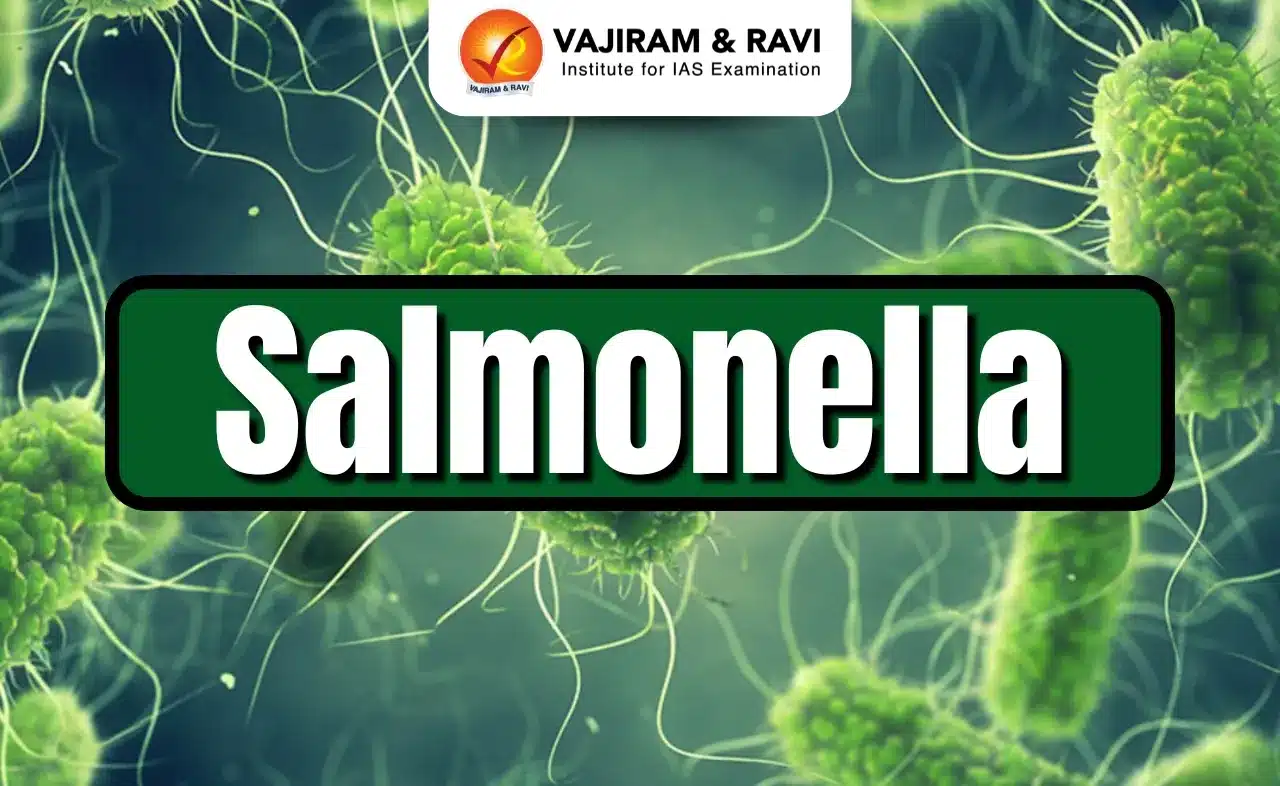
Salmonella

Salmonella

Salmonella Latest News

Experts say that Salmonella infection can range from mild gastroenteritis that gets better on its own to a serious bloodstream infection and deserves more attention than it is currently being given in India. 

About Salmonella

  • Salmonella is a group of bacteria that can cause different infections.
  • Typhoid and paratyphoid or enteric fever, are caused by Salmonella Typhi and Salmonella Paratyphi.

Sources and Transmission of Salmonella

  • Salmonella bacteria are widely distributed in domestic and wild animals. 
  • They are prevalent in food animals such as poultry, pigs, and cattle; and in pets.
  • Salmonellosis in humans is generally contracted primarily through the consumption of contaminated food of animal origin, although other foods, including green vegetables contaminated by manure, have been implicated in its transmission.
  • Person-to-person transmission can also occur through the faecal-oral route.
  • Human cases also occur where individuals have contact with infected animals.

Symptoms of Salmonella

  • Most people infected with Salmonella will begin to develop symptoms 12 to 72 hours after infection. 
  • Most people with salmonellosis develop diarrhea, fever, and abdominal cramps. 
  • More severe cases of salmonellosis may include a high fever, aches, headaches, lethargy, a rash, blood in the urine or stool.

Treatment for Salmonella

  • The illness usually lasts four to seven days, and most people recover without treatment. 
  • Treatment in severe cases is electrolyte replacement and rehydration.

Source: TH

Salmonella FAQs

Q1: What is salmonellosis?

Ans: Salmonellosis is an infection caused by the bacteria Salmonella.

Q2: How do people get salmonellosis?

Ans: Salmonella is usually transmitted to humans by eating foods contaminated with animal feces.

Corbett Tiger Reserve

Corbett Tiger Reserve

Corbett Tiger Reserve Latest News

Recently, a famous tiger named Bhola which was popular among tourists at the Phato zone of the Corbett Tiger Reserve (CTR) in Uttarakhand died. 

About Corbett Tiger Reserve

  • Location: It is located on the foothills of the Himalayas in Uttarakhand.
  • It was originally established as Hailey National Park in 1936.
  • It is not only the first national park in India, but also the first to come under the Project Tiger initiative.
  • It is spread over the Bhabar and lower Shivalik regions with a deep-water table.
  • Terrain: The terrain is undulating with several valleys.
  • Rivers: The rivers Ramganga, Pallaen, and Sonanadi flow through the valleys.
  • Vegetation: North Indian tropical moist deciduous forests and tropical dry deciduous forests:
  • In general, the vegetation comprises sal and mixed forests, interspersed with grass lands and riparian vegetation.
  • The grasslands are locally known as ‘Chaur’, which are an outcome of abandoned settlements or past clearings.
  • Flora: Evergreen Sal and its combined trees, the Sheesham, and the Kanju are found extensively on the ridges.
  • Fauna: Tigers and elephants, leopards, sambar, hog deer, spotted deer etc.

Source: ETV

Corbett Tiger Reserve FAQs

Q1: Where is Corbett Tiger Reserve located?

Ans: Uttarakhand

Q2: Which rivers flow through Corbett Tiger Reserve?

Ans: Ramganga, Pallaen, and Sonanadi

INS Samarthak

INS Samarthak

INS Samarthak Latest News

Recently, the INS Samarthak was delivered to the Indian Navy.

About INS Samarthak

  • It is the first Multi-Purpose Vessel (MPV), built by Larsen & Toubro Ltd. (L&T), Kattupalli.
  • The ship has been named ‘Samarthak’, meaning ‘The Proponent’. 
  • It is engineered to support a wide spectrum of activities.
  • The ship comprises over 75 percent indigenous content and has been conceived as a versatile trial and evaluation platform. 

Key Features of INS Samarthak

  • Speed: The vessel can achieve a maximum speed of 15 knots.
  • Displacement Capacity: It measures 107 meters in length, 18.6 meters in width, and has a displacement of over 3,750 tonnes.
  • Role: It is a highly specialised, multi-role platform designed to support the development and testing of next-generation weapons and sensors for the Indian Navy.
  • It will also perform a variety of other functions, including maritime surveillance, patrolling, launching and recovering surface and aerial targets, providing humanitarian assistance, and combating sea pollution.

Source: PIB

INS Samarthak FAQs

Q1: INS Samarthak wasa built by which organisation?

Ans: Larsen & Toubro Ltd. (L&T), Kattupalli.

Q2: What is INS Samarthak?

Ans: It is the first Multi-Purpose Vessel (MPV).

PM SVANidhi Scheme

PM SVANidhi Scheme

PM SVANidhi Scheme Latest News

According to Ministry of Housing & Urban Affairs As many as 21.86 lakh loans to the tune of Rs 6,294 crore have been disbursed to street vendors under the Prime Minister Street Vendor’s AtmaNirbhar Nidhi (PM SVANidhi) Scheme in the last 12 months. 

About PM SVANidhi Scheme

  • The Prime Minister Street Vendor’s AtmaNirbhar Nidhi (PM SVANidhi) scheme was launched in June 2020.
  • It is a Central Sector Scheme supporting street vendors through affordable working capital, financial inclusion and social protection measures.
  • Implementation: It is a joint responsibility of the Ministry of Housing and Urban Affairs (MoHUA) and the Department of Financial Services (DFS).

Key Features of PM SVANidhi Scheme

  • Working Capital Loan: Collateral-free loans of ₹15,000, ₹25,000, and ₹50,000 are provided in three progressive tranches with interest subsidy and credit guarantee support.
  • UPI-linked RuPay Credit Cards: Vendors successfully repaying the second tranche are eligible for UPI-linked RuPay Credit Cards with limits up to ₹30,000.
  • Digital Adoption: Cashback incentives of up to ₹1,600 are provided to street vendors for retail/wholesale digital transactions to encourage digital adoption and financial literacy.
  • SVANidhi se Samriddhi (SSS): Socio-economic profiling of beneficiaries and their families is undertaken to link them with eight selected Central welfare schemes and create a holistic social security net.  
  • Capacity Building & Entrepreneurship Development: Vendors are provided with training in financial literacy, digital literacy, and food safety & hygiene in collaboration with FSSAI.

Source: PIB

PM SVANidhi Scheme FAQs

Q1: What is the loan structure of PM SVANidhi Scheme?

Ans: It provide loans of ₹15,000, ₹25,000, and ₹50,000 in three progressive tranches with interest subsidy and credit guarantee support.

Canada

Key Facts about Canada

Canada Latest News

Recently, India and Canada formally launched their inaugural Economic and Financial Dialogue in Toronto. 

About Canada

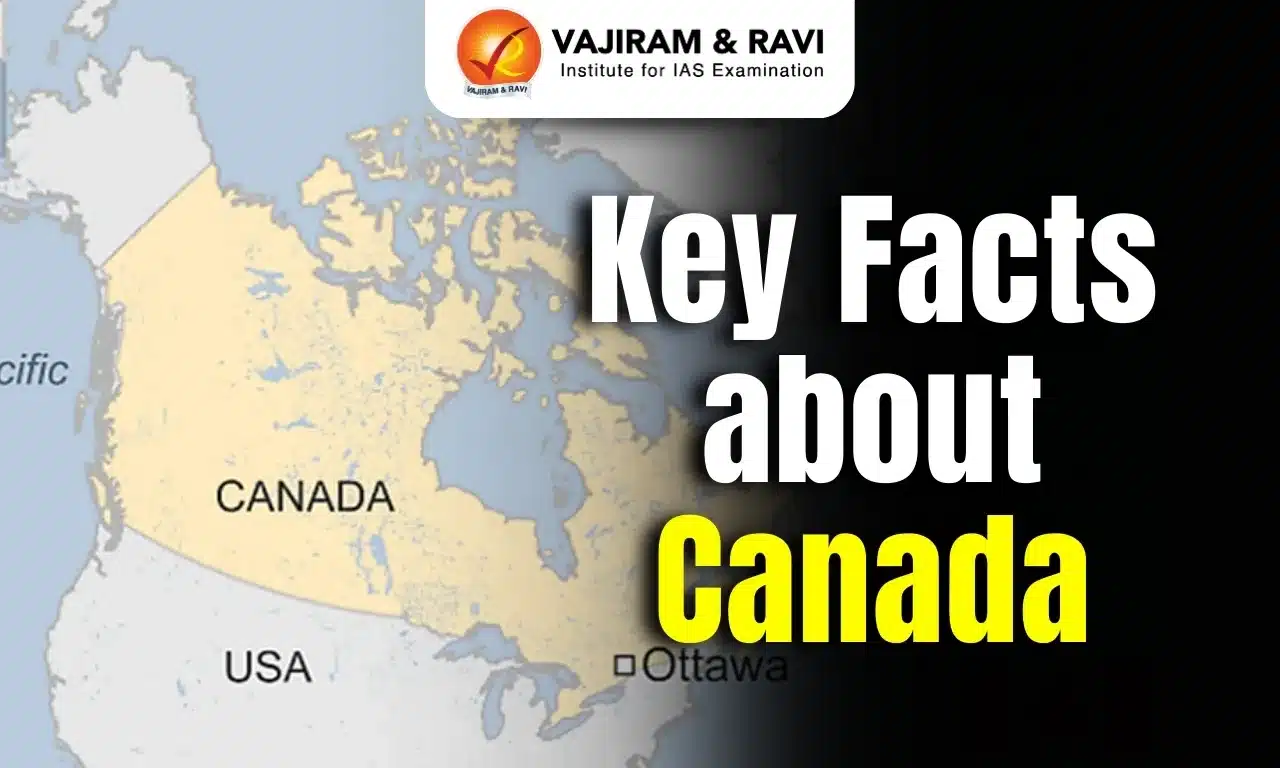
  • Location: It is located in North America.
  • It is the second largest country in the world in area (after Russia).
  • Bordered by: It shares borders with Alaska, a non-contiguous US state, to the northwest, and 12 other US states to the south.
  • The border of Canada with the US is the longest bi-national land border in the world.
  • Maritime Borders: It is bounded by the Arctic Ocean to the north, by the Atlantic Ocean to the east and the Pacific Ocean to the west.
  • Capital City: Ottawa

Geographical Features of Canada

  • Climate: It has seven climatic regions or zones: the Arctic, Subarctic, Prairie, Great Lakes, Cordilleran, plus the East and West Coasts. 
  • Major Mountains: ​Rocky Mountain, the St. Elias Mountains and the Laurentian Mountains.
  • Major Rivers:  Mackenzie River, Yukon River, Saint Lawrence River
  • Lakes: The five Great Lakes namely Superior, Michigan, Huron, Ontario, and Erie form a natural boundary between Canada and the United States. (Amongst these five, only Lake Michigan lies entirely within the US).
  • Natural Resources: It mainly consists of Bauxite, Iron ore, Nickel, Zinc, copper, gold, lead, uranium, rare earth elements, potash, diamonds etc.

Source: HT

Canada FAQs

Q1: What is the capital of Canada?

Ans: Ottawa

Q2: What political system present in Canada?

Ans: Constitutional monarchy

National Disaster Response Force

National Disaster Response Force

National Disaster Response Force Latest News

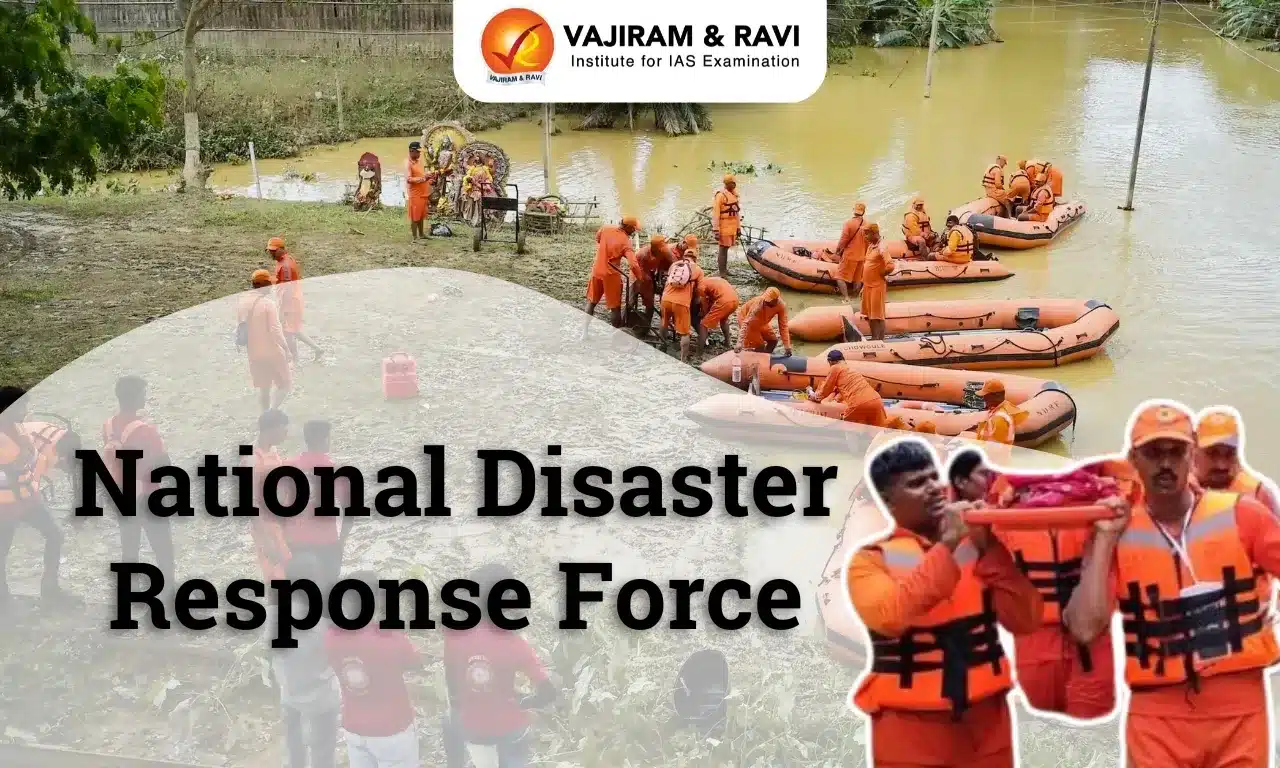
The National Disaster Response Force (NDRF) teams deployed in Bihar & Uttar Pradesh to respond to any flood like situation.

About National Disaster Response Force

  • It was established under section 44 of the Disaster Management Act, 2005.
  • Aim: It is aimed at specialized responses to natural and man-made disasters.
  • Organisation Structure
    • Initially established in 2006 with 8 Battalions, the NDRF has now expanded to 16 Battalions.
    • The NDRF functions as an independent disaster response agency but draws its personnel from various central paramilitary forces. Its organizational framework ensures coordination between central and state disaster management authorities.
    • Parent Ministry: Ministry of Home Affairs (MHA)
    • Controlling Authority: National Disaster Management Authority (NDMA)
    • Head: Director General (DG), NDRF
    • Composition: It mainly consists of personnel deputed from the CAPF, viz Border Security Force, Central Reserve Police Force, Central Industrial Security Force, Indo-Tibetan Border Police, Sashastra Seema Bal and Assam Rifles.
  • Role: It is a multi-skilled and highly specialist force capable of dealing with all types of natural and man-made disasters like Floods, Cyclone, Earthquakes, Landslides, Building-collapse, Trains and road accidents etc.
  • It has been very active in responding to natural disasters under multi-lateral and bi-lateral agreement at International level.

Source: News On Air

National Disaster Response Force FAQs

Q1: Where is the National Disaster Response Force located?

Ans: New Delhi

Q2: What is the role of NDRF?

Ans: It is aimed at specialized responses to natural and man-made disasters.

Enquire Now