Integrated Fertilizer Management System

Integrated Fertilizer Management System

Integrated Fertilizer Management System Latest News

Recently, the Ministry of Chemicals and Fertilizers said that the Integrated Fertilizer Management System (iFMS) has entered a new phase with the introduction of a series of digital initiatives.

About Integrated Fertilizer Management System

  • It is the digital platform for fertilizer management in India.
  • It is developed and technically supported by the National Informatics Centre (NIC) for the Department of Fertilizers.

Features Integrated Fertilizer Management System

  • It offers a range of online services related to fertilizer distribution and management.
  • It includes dealer registration, stock availability tracking, dealer search, and access to Management Information System and Direct Benefit Transfer (DBT) reports.
  • iFMS connects key stages of the fertilizer ecosystem, including production, imports, movement, stock availability, retail sale and subsidy processing.
  • It is operating at a national scale and covers more than 14 crore Aadhaar-linked fertilizer buyers, over 2.5 lakh retailers.
  • The new dashboards and analytical tools have been developed to provide officials with a consolidated view of fertilizer production, imports, dispatches, movement, stocks and retail sales.
  • These tools enable monitoring at the national, State, district and retailer levels, helping identify unusual trends and emerging supply situations at an early stage. 

Source: PIB

Integrated Fertilizer Management System FAQs

Q1: What is iFMS?

Ans: It is the digital platform for fertilizer management in India.

Q2: Who developed the iFMS?

Ans: It is developed and technically supported by the National Informatics Centre (NIC) for the Department of Fertilizers.

Hanging Glaciers

Hanging Glaciers

Hanging Glaciers Latest News

A recent study published in Nature magazine has found that there are as many as 219 hanging glaciers in the Alaknanda basin of the Garhwal Himalayas.  

About Hanging Glaciers

  • Hanging glaciers are ice masses perched on steep slopes that can detach and trigger massive avalanches.
  • Formation
    • They occur when a major valley glacier system retreats and thins, leaving the tributary glaciers in smaller valleys high above the shrunken central glacier surface.
    • If the entire system has melted and disappeared, the empty high valleys are called hanging valleys.
  • Impact of Hanging Glaciers
    • Hanging glaciers pose a significant risk of break-offs.
    • The break-offs from hanging glaciers can also trigger secondary hazards such as glacial lake outburst floods (GLOFs).
    • Glaciers in high-elevation alpine environments are highly sensitive to climate variability and warming.
    • This sensitivity is particularly pronounced in the Himalaya, where warming over the past two decades has exceeded the global average, resulting in accelerated glacier retreat.

Source: IE

Hanging Glaciers FAQs

Q1: What are Hanging Glaciers?

Ans: Hanging glaciers are ice masses perched on steep slopes that can detach and trigger massive avalanches.

Q2: What are the types of Hanging Glaciers?

Ans: Cold hanging and Temperate hanging

Malaria

Malaria

Malaria Latest News

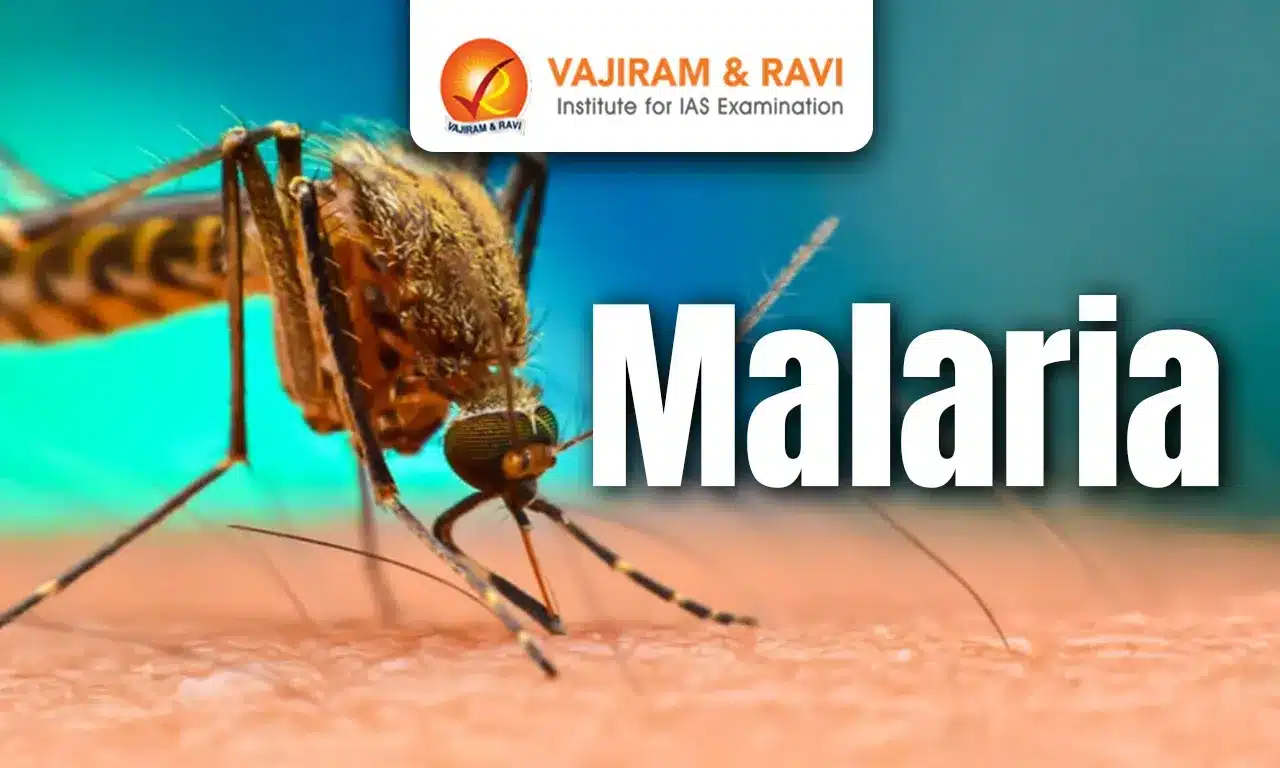
According to the Union Health Ministry India recorded a nearly 80 per cent decline in malaria cases and deaths between 2015 and 2025, while the number of high-burden districts dropped sharply from 155 to 33, 

About Malaria

  • It is a life-threatening febrile illness caused by Plasmodium parasites.
  • Transmission: It is transmitted through the bites of infected female Anopheles mosquitoes.
  • It is not contagious, but can be spread through infected blood or contaminated needles.
  • Risk: Infants, children under 5 years, pregnant women and girls, travellers and people with HIV or AIDS are at higher risk of severe infection. 
  • Symptoms
    • Symptoms appear 10–15 days after infection and include fever, chills, and headache.
    • Severe symptoms can include seizures, difficulty breathing, jaundice, dark urine, and death if untreated.
  • Treatments include
    • ACTs (Artemisinin-based Combination Therapies) for P. falciparum.
    • Chloroquine for P. vivax 
    • Primaquine to prevent relapses in P. vivax and P. ovale infections.

Source: DD News

Malaria FAQs

Q1: What is Malaria?

Ans: It is a life-threatening febrile illness caused by Plasmodium parasites.

Q2: What are the symptoms is Malaria?

Ans: Severe symptoms can include seizures, difficulty breathing, jaundice, dark urine, and death if untreated.

Kamlang Tiger Reserve

Kamlang Tiger Reserve

Kamlang Tiger Reserve Latest News

Recently, the Wildlife Trust of India (WTI), in collaboration with The Serenity Trust and the Department of Environment, Forest and Climate Change, provided essential field gear and equipment to frontline staff of the Kamlang Tiger Reserve. 

About Kamlang Tiger Reserve

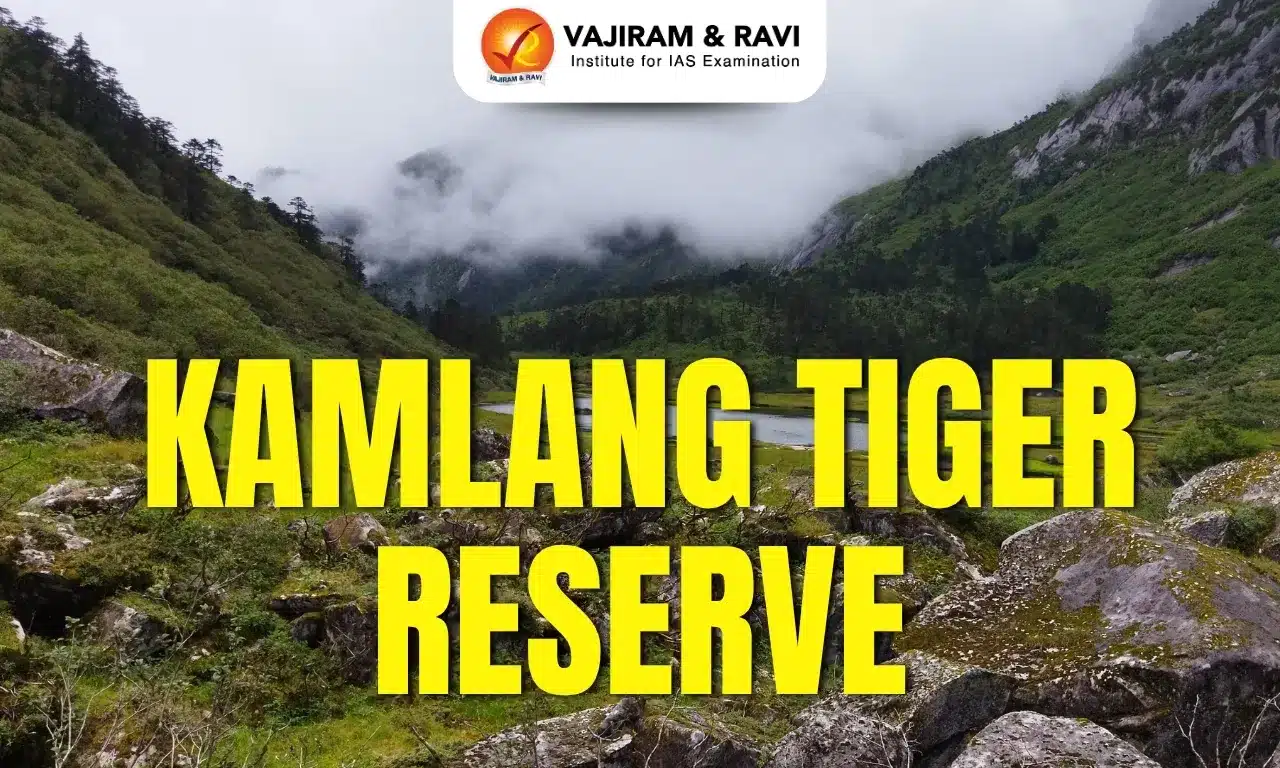
  • Location: It is located in the state of Arunachal Pradesh near the border with Myanmar.
  • It is a part of the larger Eastern Himalayan Biodiversity Hot Spot.
  • It is named after the Kamlang River, which flows through the reserve and joins the Brahmaputra.
  • It is spread between the famed Namdapha National Park on its south and the Lang River on its north.
  • The western border is formed by the Lati River, while its eastern part is bordered by the Tawe River. 
  • Topography: It encompasses a diverse range of landscapes, including dense tropical forests, grasslands, rivers, and hills.
  • Climate: It enjoys a subtropical climate as it falls within the subtropical zone.
  • Vegetation: The vegetation types include moist evergreen tropical forests in the foothills and subtropical and temperate forests in higher elevations.
  • Flora: Common species of trees in the reserve include Ammora wallichi (Amari), Gmelina arborea (Gamari), Terminalia chebula (Hillika), Canarium resigniferum (Dhuna), and many others.
  • Fauna: All four big cats, including the Snow Leopard, Clouded Leopard, Leopard and Tiger and other species like Himalayan Palm Civets, Leopard Cat, Slow Lories and Hoolock Gibbon, can also be spotted in the sanctuary.

Source: AT

Kamlang Tiger Reserve FAQs

Q1: Where is Kamlang Tiger Reserve located?

Ans: Arunachal Pradesh

Q2: Which rivers drains in Kamlang Tiger Reserve?

Ans: Kamlang River

Chile

Chile

Chile Latest News

India and Chile are pushing to conclude negotiations on a Comprehensive Economic Partnership Agreement by the end of 2026. 

About Chile

  • Location: It is located in the southwestern part of South America.
  • It occupies a long, narrow coastal land strip wedged between the Andes Mountains to the east and the South Pacific Ocean to the west.
  • Bordering Countries: It is bordered by Peru to the north, Bolivia to the northeast and Argentina to the east and by the Drake Passage to the south.
  • Capital City: Santiago

Geographical Features of Chile

  • Climate: Temperate; desert in north; Mediterranean in central region; cool and damp in south.
  • Desert: Atacama Desert which is the driest non-polar desert in the world is in Chile.
  • Major River: Loa River
  • Volcano: Ojos del Salado which is the World’s highest active volcano and 2nd highest peak in South America (6,880 m).
  • It is located along the Pacific Ring of Fire.
  • Natural Resources: It is the world’s largest copper and Lithium producer. Other resources include molybdenum, iron ore, timber, hydropower, and precious metals.

Source: PIB

Chile FAQs

Q1: What is the capital of Chile?

Ans: Santiago

Q2: Where is Chile located?

Ans: Chile is located in the southwestern part of South America.

Solar Flare

Solar Flare

Solar Flare Latest News

Recently, scientists have found small, short-lived brightenings in the Sun’s atmosphere that appear in the hours before a major solar flare erupts and cluster around the very spot where the flare later occurs. 

About Solar Flare

  • A solar flare is a tremendous explosion on the Sun that happens when energy stored in 'twisted' magnetic fields (usually above sunspots) is suddenly released.
  • A flare appears as a sudden, intense brightening of a region on the Sun, lasting several minutes to hours.
  • In a matter of just a few minutes, they heat the material to many millions of degrees and produce a burst of radiation across the electromagnetic spectrum, including from radio waves to x-rays and gamma rays.
  • There are five different classes of solar flares: A, B, C, M, and X;
    • X-class flares: These are the biggest; they are major events that can trigger radio blackouts around the whole world and long-lasting radiation storms in the upper atmosphere.
    • M-class flares: These are medium-sized; they generally cause brief radio blackouts that affect Earth's Polar Regions. Minor radiation storms sometimes follow an M-class flare.
    • C-class flares: These are small with few noticeable consequences here on Earth. At its peak, a C-class flare is ten times less powerful than an M-class flare.
    • B-class flares: These are ten times smaller or weaker than C-class flares.
    • A-class flares: These are at least ten times less intense than B-class flares, with no noticeable consequences on Earth.
  • Effect of Solar Flare on Earth
    • The intense radiation emitted during a solar flare can affect satellite communications, disrupt radio signals, and even pose a risk to astronauts in space.
    • Additionally, the increased solar radiation can lead to geomagnetic storms, which may impact power grids and cause auroras (northern and southern lights) at lower latitudes.

Source: TH

Solar Flare FAQs

Q1: What is Solar Flare?

Ans: A solar flare is a tremendous explosion on the Sun that happens when energy stored in 'twisted' magnetic fields.

Q2: What are the types of Solar Flare?

Ans: There are five different classes of solar flares: A, B, C, M, and X.

Enquire Now