Osbeckia ulotricha

Osbeckia ulotricha

Osbeckia ulotricha Latest News

Recently, scientists from the Botanical Survey of India have discovered a new flowering plant in the Western Ghats and named it Osbeckia ulotricha. 

About Osbeckia ulotricha

  • It is a newly identified flowering plant belonging to the Melastomataceae family. 
  • It has been discovered in the shola grasslands of the Agasthyamala Biosphere Reserve in the Western Ghats.

Characteristics of Osbeckia ulotricha

  • It is a woolly-haired species endemic to elevations of 1,200–1,500 metres.
  • It leaves clustered at the apex, a sub-globose hypanthium (or an almost round flower base) and an ovary crowned with true bristles, meaning fine, stiff hairs at the top.
  • It has an urn-shaped hypanthium (a cup-like flower base) with a neck. The species flowers and fruits between February and May
  • Habitat: It grows mainly in the damp margins of Tropical Montane Wet Temperate Forest (shola) and Montane Temperate Grassland ecosystems.

Key Features of Agasthyamala Biosphere Reserve

  • Location: It is located in the southern part of the Western Ghats in India, spreading across Kerala and Tamil Nadu.
  • The reserve was established in 2001 and later included in the UNESCO World Network of Biosphere Reserves in 2016.
  • Vegetation: It consists of variety of vegetation types such as tropical evergreen forests, semi-evergreen forests, moist deciduous forests, montaneAgasthyamalai B rainforests, and shola-grassland ecosystems.
  • Rivers: Important Rivers such as Thamirabarani, Neyyar, and Karamana originate from this region.
  • The biosphere reserve includes several important protected regions namely; Shendurney Wildlife Sanctuary, Peppara Wildlife Sanctuary, Neyyar Wildlife Sanctuary and Kalakkad-Mundanthurai Tiger Reserve.

Source: DTE

Osbeckia ulotricha FAQs

Q1: What is Osbeckia ulotricha?

Ans: It is a newly identified flowering plant belonging to the Melastomataceae family. 

Q2: Where was Osbeckia ulotricha discovered?

Ans: Agasthyamala Biosphere Reserve in the Western Ghats.

Ophiorrhiza assamensis

Ophiorrhiza assamensis

Ophiorrhiza assamensis Latest News

Botanists recently discovered a new plant species, Ophiorrhiza assamensis, near Guwahati, Assam.

About Ophiorrhiza assamensis

  • It is a new species of flowering plant.
  • It was found growing in a moist, shaded patch of habitat near Guwahati, Assam
  • It is a perennial herb with large, ribbed leaves and clusters of small white flowers. 
  • It belongs to the genus Ophiorrhiza, which sits in the Rubiaceae family, the same family that gives us coffee. 
  • The Ophiorrhiza genus is known as a natural source of camptothecin, a compound used in the development of medicines for cancers, including colon cancer.
  • It is currently known only from a highly localised population, making it vulnerable to deforestation and development-related changes in its habitat. 
  • As the species’ total population remains unknown, the researchers classified it as ‘Data Deficient’ under the IUCN criteria. 

News: WION

Ophiorrhiza assamensis FAQs

Q1: What is Ophiorrhiza assamensis?

Ans: It is a newly discovered species of flowering plant.

Q2: Where was Ophiorrhiza assamensis discovered?

Ans: Near Guwahati in Assam.

Q3: What type of habitat does Ophiorrhiza assamensis grow in?

Ans: A moist and shaded habitat.

Q4: What type of plant is Ophiorrhiza assamensis?

Ans: A perennial herb.

Q5: What is the significance of the Ophiorrhiza genus in medicinal research?

Ans: It is a natural source of camptothecin, a compound used in the development of medicines for cancers.

Reverse Vaccinology

Reverse Vaccinology

Reverse Vaccinology Latest News

Recently, a team of British scientists have taken an important first step in developing a vaccine against pneumonia by using reverse vaccinology.

About Reverse Vaccinology

  • It is an emerging concept in the field of vaccine development.
  • It is defined as an innovative approach to vaccine development that utilizes bioinformatics and computational analysis.
  • It identifies potential vaccine targets within pathogen genomes, allowing for the modeling of epitopes and the creation of tailored vaccines for improved efficacy and safety.
  • Reverse vaccinology is a term coined by Rino Rappuoli in 2000.
  • He described it as a method for vaccine design that uses the information obtainable from whole-genome analysis 
  • It was first applied to development of a vaccine against serogroup B Neisseria meningitidis (MenB). 
  • The concept of reverse vaccinology has also successfully been applied to many other pathogens, for example, Bacillus anthracis, Streptococcus pneumonia, M. tuberculosis.
  • Mechanism
    • Genome Sequencing: It involves the cloning and expression of all the proteins in an organism’s genome sequence that are predicted in silico to be surface exposed or secreted.
    • Screening: Then each protein is screened, through high-throughput immunization.
    • Laboratory Testing: Scientists make the chosen proteins in a lab and test them in animal models to see if they safely cause immunity.

Source: TH

Reverse Vaccinology FAQs

Q1: Who coined the term Reverse Vaccinology ?

Ans: Rino Rappuoli in 2000

Q2: What is Reverse Vaccinology?

Ans: It is defined as an innovative approach to vaccine development that utilizes bioinformatics and computational analysis.

Limiting Overshoot Report

Limiting Overshoot Report

Limiting Overshoot Report Latest News

A new Limiting Overshoot report suggests the world will likely “overshoot”, or temporarily breach, the 1.5°C target of warming above preindustrial temperatures within the next few years. 

About Limiting Overshoot Report

  • It is released by the United Nations Environment Programme (UNEP).
  • It has for the first time set out an overshoot, peak and decline pathway, warning that breaching the 1.5°C global warming limit is now unavoidable.

Key Highlights of the Report Limiting Overshoot Report

  • Even a scenario in which every country delivers on its national climate plan and net-zero target puts peak warming at 1.8°C.
  • According to the report, current policies point to a rise of about 2.6°C by 2100, with a range of 1.9–3.6°C.
  • Time spent above 1.5°C carries compounding costs such as faster sea-level rise, coral reef collapse, glacier loss exceeding a quarter of global mass by 2100, declines of up to 14% in global food production by 2050 without effective adaptation,
  • Irreversible tipping points in the West Antarctic and Greenland ice sheets, the Atlantic Meridional Overturning Circulation and the Amazon.
  • It placed significant stress on methane and suggested that cutting it is described as the most effective way to slow warming in the near term.

Source: IE

Limiting Overshoot Report FAQs

Q1: Which organisation published Limiting Overshoot Report?

Ans: United Nations Environment Programme

Q2: Where is the United Nations Environment Programme headquarter located?

Ans: Nairobi, Kenya.

Northern Goshawk

Northern Goshawk

Northern Goshawk Latest News

Recently, a rare hawk Northern Goshawk which is Punjab’s State Bird has created a flutter in the poll ring.

About Northern Goshawk

  • It is a large, powerful bird of prey belonging to the Accipitridae family.
  • Distribution: It is widely distributed across Europe, Asia, and parts of North America.
  • Habitat: It is found in dense forests, particularly coniferous and mixed woodlands.
  • Conservation Status: IUCN Red List: Least Concern

Features of Northern Goshawk

  • Appearance: It has relatively short, broad wings and a long tail. Females are significantly larger than males.
  • These are partial migrants, generally migrating between September and November and February to April in the spring.
  • These birds are diurnal and are always found singly or in pairs.
  • They are highly territorial and maintain their home ranges in display flights.
  • These are powerful hunters and mainly use a perch-hunting style;
    • Perch-hunting style includes a series of quick flights low to the ground, interspersed with brief periods of scanning for unsuspecting prey from elevated perches (short duration sit-and-wait predatory movements).

Source: IE

Northern Goshawk FAQs

Q1: Where do we find Northern Goshawk?

Ans: It is widely distributed across Europe, Asia, and parts of North America.

Q2: What is the IUCN status of Northern Goshawk?

Ans: Least Concern

BIO-NIVESH Platform

BIO-NIVESH Platform

BIO-NIVESH Platform Latest News

Recently, the Union Minister of State (Independent Charge) for Science & Technology launched the BIO-NIVESH platform. 

About BIO-NIVESH Platform

  • It is aimed at connecting biotechnology startups with investors and increasing private capital for innovations that are ready for scale-up and commercialisation.
  • It is envisaged as a recurring platform, with subsequent editions proposed across different cities to broaden participation, connect regional biotechnology innovation ecosystems.
  • It has been designed as a two-way engagement mechanism which enables innovators to understand the investment lens while giving investors deeper insight into the scientific, regulatory and development pathways of biotechnology.
  • The inaugural BIO-NIVESH edition brought together 20 high-potential biotechnology and deep-tech startups and around 50 investors.
    • The first session featured direct startup-investor interactions, with startups selected on the basis of innovation, development stage, market potential, scalability and regulatory readiness.
    • The second session involved an interaction between ministers, investors and startups on access to capital, commercialisation, scale-up and measures to support innovation-led growth.
  • Significance: It would help build the bridge required to take promising ideas from research and entrepreneurship to industry, scale and markets.

Source: PIB

BIO-NIVESH Platform FAQs

Q1: What is the aim of BIO-NIVESH Platform?

Ans: It is aimed at connecting biotechnology startups with investors and increasing private capital for innovations that are ready for scale-up and commercialisation.

Q2: How many start ups have been selected under inaugural BIO-NIVESH edition?

Ans: 20 high-potential biotechnology and deep-tech startups and around 50 investors.

AgriStack

AgriStack

AgriStack Latest News

Telangana recently secured a total of ₹599 crore in central incentives for achieving key milestones under the Centre’s AgriStack programme.

About AgriStack

  • It is a Digital Public Infrastructure (DPI) for the farm sector.
  • It is an initiative under the Digital Agriculture Mission (DAM) and was approved by the Union Cabinet in September 2024.
  • It comprises three foundational registries or databases in the agriculture sector: 
  • The Farmer Registry, Geo-referenced village maps, and the Crop Sown Registry, all created and maintained by the State Governments or Union Territories.
  • Farmer Registry:
    • Under the AgriStack, farmers are given digital identities (Farmer ID), which are linked dynamically to the State’s land records, livestock ownership, crops sown, demographic details, family details, schemes, and benefits availed.
    • Target: The government aims to create digital identities for 11 crore farmers.
    • The Centre has allocated financial support to states to create their respective registries under the Special Assistance to States for Capital Investment.
    • Advantage: A farmer would be able to access benefits and services digitally.
    • The Centre aims to complete the Farmer Registry with dynamic Records of Rights (RoR) synchronisation by March 2027. In the Northeastern States, the target was set to March 2028.
  • Crop Sown Registry:
    • It includes details on crops planted by farmers.
    • This is recorded through mobile-based Digital Crop Surveys on the ground each season.
  • Geo-Referenced Village Map Registry:
    • It comprises geographic information of land records linked with their locations (latitudes and longitudes).
    • The target is to cover all villages by March 2027.
  • Once fully implemented, Agristack will enable farmers to receive several benefits through a paperless and contactless digital ecosystem, including:
    • Paperless and contactless crop loan facilities.
    • Transparent and efficient crop insurance claim settlement.
    • Timely availability of agricultural inputs.
    • Personalized advisories on pests and diseases.
    • Direct Benefit Transfer (DBT) of government scheme benefits.
    • Procurement of agricultural produce at the Minimum Support Price (MSP).
  • Agristack will enable the Government to deliver services to farmers in a more transparent, efficient, and technology-driven manner while improving the accessibility and effectiveness of agricultural support systems.

News: TOI

AgriStack FAQs

Q1: What is AgriStack?

Ans: AgriStack is a Digital Public Infrastructure (DPI) for the farm sector.

Q2: What are the three foundational registries of AgriStack?

Ans: Farmer Registry, Geo-referenced Village Map Registry, and Crop Sown Registry.

Q3: Who creates and maintains the foundational registries under AgriStack?

Ans: State Governments or Union Territories.

Q4: What type of ecosystem will AgriStack create once fully implemented?

Ans: A paperless and contactless digital ecosystem for farmers.

‘RAKSHA’ Framework

‘RAKSHA’ Framework

‘RAKSHA’ Framework Latest News

The Defence Minister recently released ‘Raksha’, a comprehensive strategic framework outlining India’s roadmap and vision for defence diplomacy and global defence partnerships over the next 10 years.

About ‘RAKSHA’ Framework

  • It is a comprehensive strategic framework outlining India’s road map and vision for defence diplomacy and global defence partnerships over the next 10 years. 
  • The document seeks to strengthen India’s strategic engagement with friendly nations by aligning national security objectives with proactive international cooperation.
  • It lays down an actionable vision aimed at promoting long-term stability, strengthening partnerships, and advancing India’s role in an evolving global security environment. 
  • Key pillars highlighted in the strategic blueprint include:
    • Strategic Partnerships: Deepening bilateral and multilateral security cooperation.
    • Capacity Building: Enhancing joint military exercises, training programmes, and sharing best practices with friendly nations.
    • Indigenous Exports: Promoting Make-in-India defence platforms to establish the nation as a reliable global defence manufacturing hub.
    • Maritime security: Strengthening India’s role as a Net Security Provider and First Responder in the Indian Ocean Region.

News: TH

‘RAKSHA’ framework FAQs

Q1: What is the ‘RAKSHA’ framework?

Ans: It is a comprehensive strategic framework outlining India’s roadmap and vision for defence diplomacy and global defence partnerships over the next 10 years.

Q2: What is the main objective of the RAKSHA framework?

Ans: To strengthen India’s strategic engagement with friendly nations through proactive international cooperation.

Q3: What are the four key pillars highlighted in the RAKSHA framework?

Ans: Strategic Partnerships, Capacity Building, Indigenous Exports and Maritime Security.

Pichavaram Mangrove Forest

Pichavaram Mangrove Forest

Pichavaram Mangrove Forest Latest News

A recent study of the Pichavaram mangrove ecosystem estimated its Total Economic Value (TEV) at ₹2,485.38 crore ($289 million), with a per-hectare value of ₹1.83 crore, reflecting the ecological, economic and social benefits it provides.

About Pichavaram Mangrove Forest

  • It is located near Chidambaram in Tamil Nadu. 
  • These mangroves are the second largest mangroves in the world after Sundarbans. 
  • The forest is spread over 1,100 hectares and joins the Bay of Bengal, where it's separated by a lengthy sand bank.  
  • It lies between two important estuaries: the Vellar estuary to the north and the Coleroon estuary to the south. 
  • This mangrove ecosystem is part of the Vellar-Coleroon complex, which shapes the Killai backwater and Pichavaram mangroves.  
  • The Pichavaram forest spans across various habitats, including channels, creeks, gullies, mud flats, and sand flats. 
  • Apparently, the forest has more than 50 islands of various sizes and 4,400 big and small canals. 
  • The trees grow in water that's 3 to 10 feet deep in different places.  
  • It provides a home to more than 200 species of birds. Some of the bird species commonly spotted here include Snipes, Egrets, Cormorants, Storks, Herons, Spoonbills, and Pelicans. 
  • Also, you can spot various marine life such as seaweed, fish, prawns, crabs, and oysters, as well as turtles and otters in this diverse ecosystem. 
  • It was designated a Ramsar Site in 2022.

News: TH

Pichavaram Mangrove Forest FAQs

Q1: Where is the Pichavaram Mangrove Forest located?

Ans: Near Chidambaram in Tamil Nadu.

Q2: Which major water body is connected to the Pichavaram Mangrove Forest?

Ans: The Bay of Bengal.

Q3: Between which two important estuaries is the Pichavaram Mangrove Forest located?

Ans: The Vellar estuary and the Coleroon estuary.

Q4: Which of the following habitats are found in the Pichavaram Mangrove Forest?

Ans: Channels, creeks, gullies, mud flats and sand flats.

Subarnarekha River

Subarnarekha River

Subarnarekha River Latest News

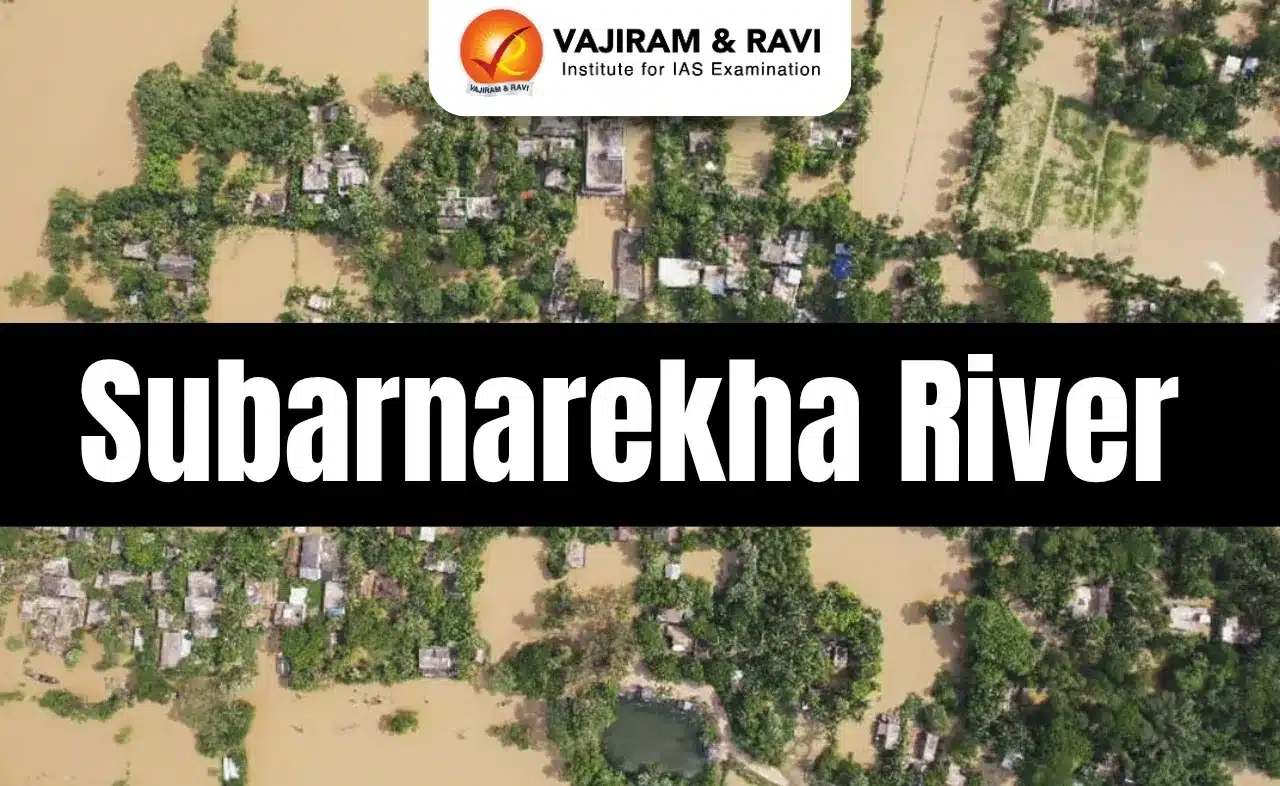
Over 45,000 people in 22 gram panchayats across three blocks of Balasore were affected by floods as the Subarnarekha river breached its banks again recently.

About Subarnarekha River

  • It is an important east-flowing river in India, flowing through Jharkhand, Odisha, and West Bengal.  
  • Subarnarekha means a "streak of gold" in English. The name is associated with the traditional presence of gold particles in its riverbed, particularly near its source. 
  • Course:
    • It originates near Nagri village in the Ranchi district of Jharkhand, at an elevation of 600 meters above sea level. 
    • From here, it flows eastward through the Chhotanagpur Plateau, a region rich in mineral resources like copper. 
    • As it moves across this plateau, the river passes through Hundrugbagh Waterfall, which marks its exit from the plateau. 
    • After covering a distance of 395 kilometers, the Subernarekha finally drains into the Bay of Bengal at Kirtania port in Odisha.  
  • Tributaries: Along the way, it is joined by several important tributaries, including the Kanchi, Kharkai, and Karkari rivers. 
  • Basin
    • Geographically, the Subarnarekha Basin lies between the Damodar River to the north and the Brahmani and Baitarani rivers to the south. 
    • To the west, it’s bordered by the Chhotanagpur Plateau, and to the southeast, it flows into the Bay of Bengal. 
    • The basin extends over States of Jharkhand, Odisha, and a comparatively smaller part in West Bengal.
    • The basin is generally influenced by the Southwest monsoon, which onsets in the month of June and extends up to October.
  • Dams and Reservoirs: Getalsud Reservoir, Chandil Dam, Galudih Barrage, and Icha Dam.
  • Cities along its course:
    • Ranchi (Jharkhand)
    • Jamshedpur (Jharkhand)
    • Chaibasa (Jharkhand)
    • Bhadrak (Odisha)
    • Kirtania Port (Odisha)

News: NIE

Subarnarekha River FAQ's

Q1: Which Indian states does the Subarnarekha River flow through?

Ans: Jharkhand, Odisha and West Bengal.

Q2: Where does the Subarnarekha River originate?

Ans: Near Nagri village in Ranchi district of Jharkhand.

Q3: Through which major physiographic region does the Subarnarekha River flow after its origin?

Ans: The Chhotanagpur Plateau.

Q4: Which waterfall marks the exit of the Subarnarekha River from the Chhotanagpur Plateau?

Ans: Hundrugbagh Waterfall.

Q5: Where does the Subarnarekha River ultimately drain?

Ans: Into the Bay of Bengal.

Enquire Now