Przewalski’s Horse

Przewalski’s Horse

Przewalski’s Horse Latest News

Two Przewalski’s horse foals were born in a reintroduction center in the grasslands of central Kazakhstan and are reportedly the first wild horses born on Kazakh soil in more than 200 years. 

About Przewalski’s Horse

  • It is the only living wild relative of the domestic horse. 
  • Przewalski's horse (Equus ferus przewalskii or Equus przewalskii), otherwise known as P-horse, is named after Nikolai Przewalski.
  • Appearance: It has a short neck, large head, short legs and a stout body. They have a black, upright mane and a reddish-brown to cream-colored coat with a black stripe across their back. 
  • Habitat: It lives on open steppes and semi-deserts and also in winter on the large increasingly barren grassy plains.
  • Distribution: The species historically lived across the steppe grasslands of Russia, Kazakhstan, Mongolia and northern China.
  • Characteristics
    • The horses are capable of resisting harsh winters like the ones in Kazakhstan where temperatures can drop below minus 30 degrees C.
    • These are diurnal and gregarious animals that live in small herds consisting of 10-20 individuals. 
    • Diet: They maintain a herbivorous (graminivorous) diet, which is generally composed of grass and various plants. 
    • They are hind-gut fermenters, meaning that they need to consume large amounts of water and low quality food.
  • Ecological Role:  They graze on dry vegetation to reduce wildfire risk, their hooves disturb the soil letting new plants take root, and they disperse seeds across the landscape as they roam.
  • Conservation Status: IUCN Red List: Endangered

Source: NM

Przewalski’s Horse FAQs

Q1: Where do we find Przewalski’s Horse?

Ans: Russia, Kazakhstan, Mongolia and northern China.

Q2: What is the IUCN status of Przewalski’s Horse?

Ans: Endangered

S-71K Kovyor Missile

S-71K Kovyor Missile

S-71K Kovyor Missile Latest News

Russia has publicly unveiled the S-71K Kovyor, a new air-launched stand-off weapon designed for its Su-57E fifth-generation fighter, during the El Alamein International Airshow in Egypt recently.

About S-71K Kovyor Missile

  • It is an air-launched cruise missile developed by Russia.
  • It is designed primarily for Russia’s Su-57E fifth-generation fighter aircraft.

S-71K Kovyor Missile Features

  • It employs a flattened, broad, aircraft-like planform instead of a conventional cylindrical missile body. 
  • It has an asymmetric design with a trapezoidal nose carrying a chin-mounted optical sensor, low-mounted swept-back wings, and inverted V-tails.
  • The missile's three internal fuel tanks and turbojet propulsion give it a conventional powered-cruise flight profile rather than that of a simple glide bomb, letting it approach a target from a different axis than the launch aircraft.
  • It has an estimated range between 300 to 350 km.
  • It uses an inertial navigation system for guidance and reportedly lacks a sophisticated terminal seeker. 
  • It is primarily designed for attacking pre-programmed fixed targets, rather than behaving like a modern imaging missile that can independently identify and select a target immediately before impact.
  • It carries a 250 kg OFAB-250-270 high-explosive fragmentation warhead.
  • The missile can reportedly cruise near 8,200 metres before descending toward low-level profiles of 20–75 metres over land or approximately five to 15 metres above water, complicating continuous radar tracking.

News: TOI

S-71K Kovyor Missile FAQs

Q1: What is the S-71K Kovyor missile?

Ans: It is a Russian air-launched cruise missile.

Q2: Which aircraft is the S-71K Kovyor missile primarily designed for?

Ans: Russia’s Su-57E fifth-generation fighter aircraft.

Q3: What is the distinctive structural feature of the S-71K Kovyor missile?

Ans: It has a flattened, broad, aircraft-like planform instead of a conventional cylindrical missile body.

Q4: What type of propulsion does the S-71K Kovyor missile use?

Ans: Turbojet propulsion.

Q5: What is the estimated range of the S-71K Kovyor missile?

Ans: Approximately 300–350 km.

Schizopygopsis waddellii

Schizopygopsis waddellii

Schizopygopsis waddellii Latest News

Scientists recently recorded Schizopygopsis waddellii, a rare fish species for the first time from a natural lake in Tawang, at around 12,800 feet above sea level.

About Schizopygopsis waddellii

  • It is a rare species of high-altitude Himalayan fish.
  • It was recorded in India for the first time from the Pangkang Teng Tso Lake, a natural high-altitude lake located at 12,800 feet in Arunachal Pradesh’s Tawang district.
  • It was previously known only from the Tibetan and China Plateau region, including Yamdrok Lake in Tibet. 
  • The present record expands its known distribution range and adds a new species to India’s freshwater fish fauna. 
  • The fish belongs to the Cyprinidae family and is adapted to the harsh conditions of high-altitude freshwater ecosystems. 
  • The fish has an elongated, cylindrical body, a dark greyish to olive-coloured upper side, and a lighter, silvery to creamy-white underside. 
  • It also has a complete lateral line, a blunt snout, a distinctive hard plate-like structure around the lower lip and snout, a subterminal mouth, and a deeply forked caudal fin.

News: NOA

Schizopygopsis waddellii FAQs

Q1: What is Schizopygopsis waddellii?

Ans: It is a rare species of high-altitude Himalayan fish.

Q2: Where was Schizopygopsis waddellii recorded in India for the first time?

Ans: Pangkang Teng Tso Lake in Arunachal Pradesh.

Q3: Where was Schizopygopsis waddellii previously known from?

Ans: The Tibetan and China Plateau region.

Q4: What is the general shape of the body of Schizopygopsis waddellii?

Ans: Elongated and cylindrical.

Solani River

Solani River

Solani River Latest News

The Uttar Pradesh government submitted a report to National Green Tribunal(NGT) on the floodplain demarcation of the Solani river using a one-metre digital elevation model and a 100-year return period.

About Solani River

  • Origin: It originates in the Himalayan foothills near Dehradun in Uttarakhand.
  • Course: It flows through Saharanpur and Muzaffarnagar districts in Uttar Pradesh, and joins the Banganga river upstream of Shukratal.
  • It is located at an elevation of 214 meters above sea level.
  • Climate: The basin experiences an average annual rainfall between 1,170 mm and 1,500 mm. Soils in the catchment are predominantly loamy.
  • Major Landmarks
    • Solani Aqueduct: It is located near Roorkee, which is a historic 19th-century masonry structure that carries the Upper Ganga Canal safely over the Solani River.

What is the National Green Tribunal?

  • It was established in 2010, under the National Green Tribunal Act, 2010.
  • It is a specialised body that fast-tracks environmental justice in India.
  • Functions: It handles cases related to environmental protection, forest conservation, and environmental rights, offering compensation for damages caused by environmental violations.
  • Composition
    • Chairperson: A retired Supreme Court judge or Chief Justice of a High Court, appointed by the Central Government in consultation with the Chief Justice of India, serving for five years or until age 70.
    • Judicial Members: Between 10 to 20 former Supreme Court or High Court judges appointed by the Central Government based on merit, serving for five years or until age 67 (for High Court judges) or 70 (for Supreme Court judges).
    • Expert Members: Includes 10 to 20 members with a Master’s degree in Science, Engineering, or Technology and relevant environmental experience, appointed by the Central Government, serving for five years or until age 65.

Source: DTE

Solani River FAQs

Q1: Where does Solani River originates?

Ans: It originates in the Himalayan foothills near Dehradun in Uttarakhand.

Q2: Solani River joins which river?

Ans: Banganga river

Proteome

Proteome

Proteome Latest News

Proteomic signatures detectable in children may predict an increased risk for cardiovascular-kidney-metabolic disease (CKMD) in later life, offering a potential precision prevention approach to address cardiometabolic diseases at the earliest opportunity.

About Proteome

  • A proteome is a set of proteins produced in an organism, system, or biological context. 
  • We may refer to, for instance, the proteome of a species (for example, Homo sapiens) or an organ (for example, the liver). 
  • The proteome is not constant; it differs from cell to cell and changes over time. 
  • The proteome of any given individual will be unique, as protein expression patterns are determined by an individual’s genes.
  • The proteome is always significantly larger than the number of genes in an individual due to a number of factors:
    • Gene sequences may be alternatively spliced following transcription to generate multiple protein variants from a single gene.
    • Proteins may be modified (e.g. glycosylated, phosphorylated, etc.) following translation to promote further variations.
  • Proteomics is the large-scale study of proteomes. 
  • With each protein playing distinct roles and functions, proteomics provides valuable insights into cellular processes, signaling pathways, and disease mechanisms. 
  • Scientists typically study the proteome using techniques like mass spectrometry or traditional protein sequencing.
  • Proteomics is used to investigate:
    • when and where proteins are expressed
    • rates of protein production, degradation, and steady-state abundance
    • how proteins are modified (for example, post-translational modifications (PTMs) such as phosphorylation)
    • the movement of proteins between subcellular compartments
    • the involvement of proteins in metabolic pathways
    • how proteins interact with one another
  • Understanding the proteome can shed light on disease mechanisms, help identify potential drug targets, and develop novel therapeutic interventions.

News: IPM

Proteome FAQs

Q1: What is a proteome?

Ans: A proteome is the set of proteins produced in an organism, system, or biological context.

Q2: Is the proteome constant?

Ans: No, the proteome is dynamic and changes over time.

Q3: Why does the proteome differ from cell to cell?

Ans: Different cells express different sets of proteins according to their functions and biological conditions.

Q4: Why is an individual's proteome considered unique?

Ans: Protein expression patterns are influenced by an individual's genes, making the proteome unique.

Q5: What is proteomics?

Ans: Proteomics is the large-scale study of proteomes.

Digital India Land Records Modernization Programme (DILRMP) 3.0

Digital India Land Records Modernization Programme (DILRMP) 3.0

Digital India Land Records Modernization Programme (DILRMP) 3.0 Latest News

Recently, the government has launched the operational guidelines for the third phase of the Digital India Land Records Modernisation Programme (DILRMP 3.0) with an outlay of Rs 565.5 crore.

About Digital India Land Records Modernization Programme (DILRMP) 3.0

  • It is aimed at integrating land records, maps, registrations and related data through a GIS-based digital framework.
  • Background
    • The Government of India in 2008, merged Strengthening of Revenue Administration and Updating of Land Records (SRA & ULR) and the Computerization of Land Records (CLR) and named it as National Land Records Modernization Program (NLRMP).
    • NLRMP was brought under the “Digital India” ambit and re-named as Digital India Land Records Modernization Program (DILRMP) in 2016.
  • Time Period: It is a five year initiative i.e 2026-31.
  • Funding: It is a central sector scheme with 100% central funding.
  • Implemented by: The Department of Land Resources (DoLR), Ministry of Rural Development, real-time progress monitored by an upgraded DILRMP-MIS dashboard.

Features of  Digital India Land Records Modernization Programme (DILRMP) 3.0

  • Universal Bhu-Aadhaar (ULPIN): A framework to assign a 14-digit unique identification number to every land parcel in the country, ensuring secure and unmistakable identity for all properties.
  • Digitisation of Maps and Georeferencing: Complete digitization of cadastral maps embedded with exact geographical coordinates.
  • Paperless Property Registration: The introduction of end-to-end online, paperless registration and a new Registration Repository. The Ministry also plans to upgrade 75 Sub-Registrar Offices (SROs) into modern 'Registration Seva Kendras'.
  • Integrated Revenue Courts: A modern, paperless case management system (RCCMS) integrated directly with land records to track disputes and cut down the time and cost of legal battles.
  • NAKSHA Pilot for Urban Areas: Completion of NAKSHA Pilot.
  • Under DILRMP 3.0, each state will be able to develop its own "land stack" by integrating land-related datasets and systems through APIs.
  • These state-level stacks will form the building blocks of a federated national land stack.

Source: PIB

Digital India Land Records Modernization Programme (DILRMP) 3.0 FAQs

Q1: Which ministry implements Digital India Land Records Modernization Programme (DILRMP) 3.0?

Ans: Ministry of Rural Development

Q2: What is the time period of Digital India Land Records Modernization Programme (DILRMP) 3.0?

Ans: It is a five year initiative i.e 2026-31.

Lipulekh Pass

Lipulekh Pass

Lipulekh Pass Latest News

The centuries-old India-Tibet trade route through Lipulekh Pass has reopened recently, with a 17-member Indian delegation entering Taklakot in Tibet after China cleared cross-border trade.

About Lipulekh Pass

  • It is a high-altitude mountain pass located in the Pithoragarh district of Uttarakhand, in India's Kumaon region. 
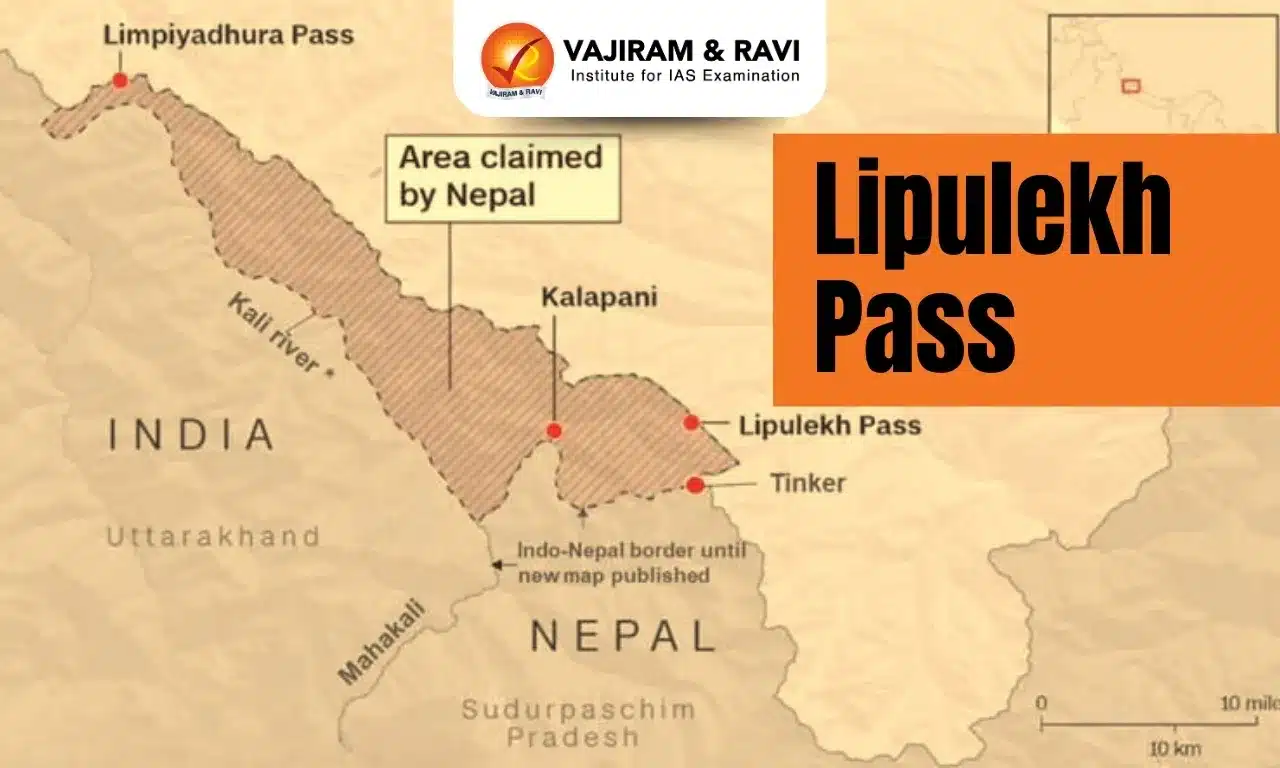
  • It sits at the intersection of three international borders: India to the south and west, China (Tibet Autonomous Region) to the north and east, and Nepal to the west. 
  • It links the Indian state of Uttarakhand with the Tibet region of China.
  • Altitude: It lies at an altitude of approximately 5,334 meters (17,500 feet).
  • Its elevation and strategic location make it a gateway to the higher reaches of the Himalayas.
  • It is the first Indian border post opened for trade with China in 1992.
  • Other passes: This was followed by the opening of Shipki La Pass, Himachal Pradesh, in 1994 and Nathu La Pass, Sikkim, in 2006.
  • Significance:
    • Strategic Location: Lies at the tri-junction of India, Nepal, and China, making it geographically significant.
    • Ancient Trade Route: Lipulekh Pass has been utilized for centuries as a trade route, connecting the Indian subcontinent with the Tibetan plateau.
    • Religious Significance: It is a key corridor for the Kailash Mansarovar Yatra and plays an important role in connecting border communities, especially tribal groups such as the Bhotiyas who depend on cross-border trade.

What are the territorial disputes?

  • The disagreement dates back to the 1816 Sugauli Treaty signed between British India and Nepal after the Anglo-Nepal War. 
  • Under the treaty, the Kali River was accepted as the boundary between the two sides.
  • The problem is that India and Nepal disagree on where the Kali River actually begins. 
  • India maintains that the river originates near Kalapani, placing areas such as Kalapani, Lipulekh, and Limpiyadhura within Indian territory. 
  • Nepal, however, argues that the river begins farther west, which would place all three areas inside Nepal.
  • Because both countries use different interpretations of the treaty, the border remains disputed even today.
  • How does China come into the mix?
    • What adds to the dispute is that Nepal argues that trade between India and China through this pass is often held without Nepali consent.
    • In 2015, India and China agreed to use Lipulekh for bilateral trade and the Kailash Mansarovar pilgrimage, triggering widespread protests in Nepal.

News: NIE

Lipulekh Pass FAQs

Q1: What is Lipulekh Pass?

Ans: Lipulekh Pass is a high-altitude mountain pass in Pithoragarh district of Uttarakhand.

Q2: Which three countries meet at the Lipulekh Pass tri-junction?

Ans: India, China and Nepal.

Q3: Why is Lipulekh Pass strategically important?

Ans: Its location at the India–China–Nepal tri-junction gives it major strategic and geographical significance.

Q4: Which important pilgrimage route passes through Lipulekh Pass?

Ans: The Kailash Mansarovar Yatra.

Enquire Now