Nuakhai Festival

Nuakhai Festival

Nuakhai Festival Latest News

Recently, the Prime Minister of India extended greetings to people on the auspicious occasion of Nuakhai.

About Nuakhai Festival

  • It is an important social festival of Western Odisha.
  • The word nua means new and khai means food.
  • Objective: It is an agricultural festival which is observed to welcome the new rice of the season.
  • It is observed on the fifth day of the lunar fortnight of the month of Bhadrapada or Bhaadra (August–September).
  • Rituals of Naukhai Festivals
    • Nuakhai is understood to have nine colours and as a consequence nine sets of rituals are followed as a prelude to the actual day of celebration.
    • People offer the newly harvested crop called Nabanha to their respective presiding deities.
    • After offering the Nabanha, people relish different types of delicacies prepared from the newly harvested crop.
    • The Nuakhai Juhar is a major ritual of the festival.

Source: DD News

Nuakhai Festival FAQs

Q1: Nuakhai Festival is celebrated in which state?

Ans: Odisha

Q2: What is Nuakhai Festival?

Ans: It is an agricultural festival which is observed to welcome the new rice of the season.

SPARSH Pension System

SPARSH Pension System

SPARSH Pension System Latest News

Defence Accounts Department (DAD) has achieved a remarkable milestone in the normalization of discrepant pension cases on SPARSH (System for Pension Administration – Raksha) through a focused and concentrated approach.  

About SPARSH Pension System

  • It is an initiative of the Ministry of Defence, Government of India.
  • SPARSH is world’s largest pension system for defence personnel which aim to provide comprehensive solution to the defence pensioners.
  • Objective: Meeting the pension sanction and disbursement requirements for Armed Forces viz. Army, Navy, Air Force and Defence Civilians.
  • It is administered by the Defence Accounts Department through the Principal Controller of Defence Accounts (Pensions), Prayagraj and shall cater to all the three Services and allied organisations.

Features of SPARSH Pension System

  • Without relying on a third-party intermediary, this web-based system handles pension claims, and deposits pension payments into the bank accounts of defence pensioners.
  • It is a centralized sanction, claim and pension disbursement system with easy validation and rectification of data through self-verification. 
  • It uses a digital process for pensioner identification, removing the requirement of multiple visits by pensioners to the pension offices.
  • The defence pensioner will be given a completely transparent view of his pension account through this platform.
  • It will capture and maintain a complete history of events and entitlements the pensioner right from the date of commencement of pension to the date of cessation of pension due to his/her last eligible beneficiary.

Source: PIB

SPARSH Pension System FAQs

Q1: What is SPARSH Pension System?

Ans: SPARSH is world’s largest pension system for defence personnel which aim to provide comprehensive solution to the defence pensioners

Q2: Which ministry initiated the SPARSH Pension System?

Ans: It is an initiative of the Ministry of Defence, Government of India.

Ramjak Mountain

Ramjak Mountain

Ramjak Mountain Latest News

A four-member team from Keralam recently scaled Ramjak, a 6,318-metre peak in the remote Lahaul region of Himachal Pradesh.

About Ramjak Mountain

  • It is a high-altitude mountain peak located in the remote Lahaul region of Himachal Pradesh.
  • It rises to around 6,318 metres (20,728 ft). 
  • The peak is located near Shingo La, which is a popular trek route from Himachal to Zanskar
  • Ramjak is known for its sharp, icy summit and technically difficult climbing terrain. 
  • Terrain: The climbing route involves glaciers, steep rock bands, snowfields, exposed slopes, crevasses, seracs, and cornices. 
  • First ascent: An expedition of the Indian Mountaineering Foundation (IMF) led by Sangay Dorjee Sherpa achieved the first ascent in 2002
  • Before the successful ascent, several expeditions had attempted the peak without success.

News: TH

Ramjak Mountain FAQs

Q1: Where is Ramjak Mountain located?

Ans: Lahaul region of Himachal Pradesh.

Q2: What is the approximate elevation of Ramjak Mountain?

Ans: 6,318 metres (20,728 ft).

Q3: Ramjak Mountain is located near which important mountain pass?

Ans: Shingo La.

Q4: What type of terrain is encountered while climbing Ramjak Mountain?

Ans: Glaciers, steep rock bands, snowfields, exposed slopes, crevasses, seracs and cornices.

Pangwala Tribe

Pangwala Tribe

Pangwala Tribe Latest News

A detailed study on the gut microbiome of the Pangwala tribal community has found that members living in the remote Pangi valley and those who have migrated to urban areas retain a remarkably similar "core microbiome" despite having substantial differences in lifestyle, diet, and environment.

About Pangwala Tribe

  • The Pangwala are a Scheduled Tribe living primarily in the Pangi Valley in the Chamba district of Himachal Pradesh.
  • Located in the Pir Panjal range of the Himalayas, the valley is known for its natural beauty and harsh living conditions.  
  • The difficult terrain and long winters historically kept the Pangwala relatively isolated from surrounding populations, helping preserve their distinct language, customs, and social traditions over many generations. 
  • Their culture reflects influences from both Himalayan tribal traditions and neighboring Hindu and Buddhist communities. 
  • Language: The Pangwala speak Pangwali, an Indo-Aryan language connected to the western Himalayan linguistic family.  
  • Economy:
    • Historically, their economy centered on mountain agriculture, animal husbandry, and trade through narrow Himalayan routes linking valleys and neighboring regions. 
    • Life among the Pangwala is heavily shaped by the Himalayan climate and mountainous geography. 
    • Families traditionally depend on terrace farming, livestock raising, and seasonal agricultural work. 
    • Crops may include barley, wheat, maize, potatoes, and peas suited for cooler mountain conditions. Sheep and goat herding are important in some areas, especially where grazing land is available in higher elevations.
  • Villages are often small and closely connected through kinship networks. 
  • Extended family relationships remain important, and cooperation between households is necessary for farming, livestock care, and surviving difficult winters. 
  • Homes are commonly constructed from stone and wood using designs adapted for cold weather and steep terrain. 
  • Religion and Beliefs:
    • The Pangwala primarily follow Hindu religious traditions, though elements of folk religion and local Himalayan spiritual beliefs also influence everyday life. 
    • Religious practice commonly includes devotion to Hindu gods and goddesses, observance of village festivals, temple worship, and rituals connected to family and agricultural life. 
  • Music, folk dances, and seasonal festivals remain important parts of Pangwala cultural identity.

News: IS

Pangwala Tribe FAQs

Q1: Where does the Pangwala tribe primarily live?

Ans: In the Pangi Valley of Chamba district, Himachal Pradesh.

Q2: What language is spoken by the Pangwala people?

Ans: The Pangwala speak Pangwali, an Indo-Aryan language connected to the western Himalayan linguistic family.

Q3: What are the traditional economic activities of the Pangwala?

Ans: Mountain agriculture, animal husbandry and trade.

Q4: Which religious tradition is primarily followed by the Pangwala?

Ans: Hindu religious traditions.

Diplodocus

Diplodocus

Diplodocus Latest News

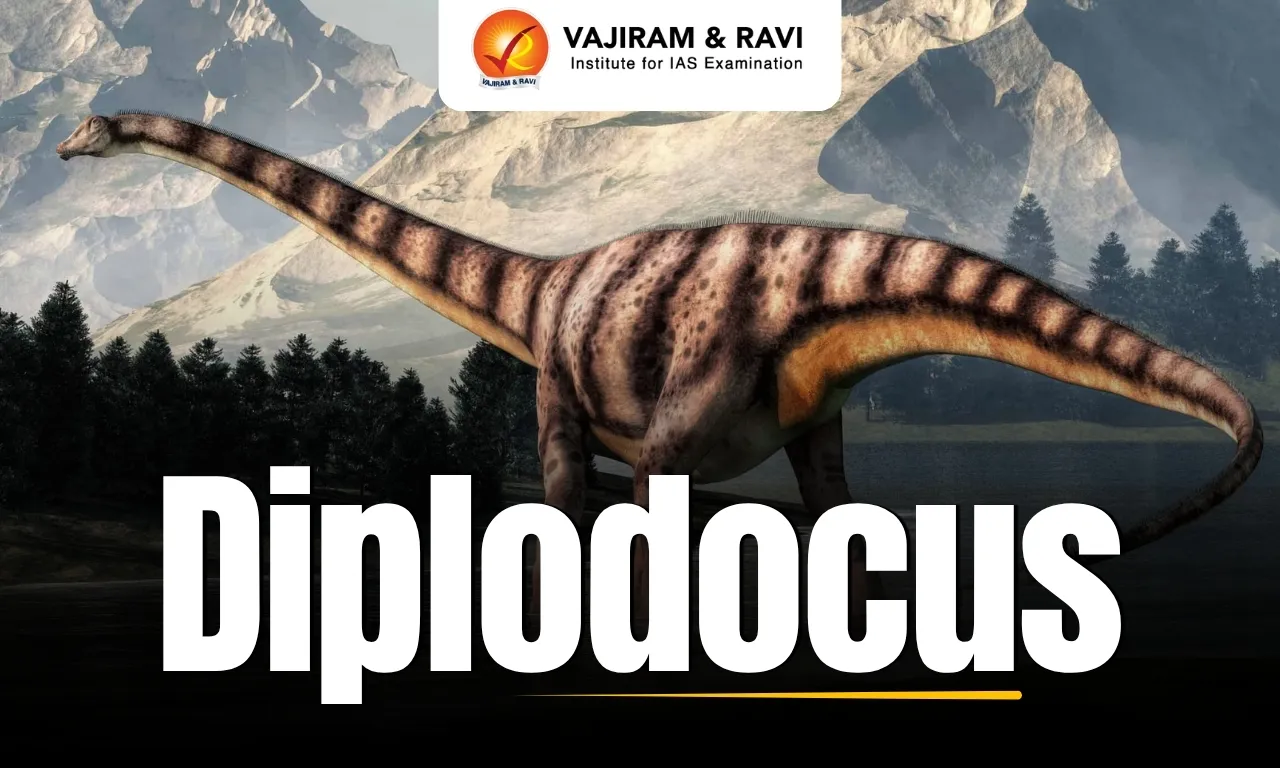
Fossils of the long-necked dinosaur Diplodocus have been recently discovered in Spain, marking the first time remains of this iconic Jurassic-period dino have been found outside the U.S. 

About Diplodocus

  • Diplodocus belongs to a group of enormous dinosaurs called sauropods
    • The sauropods were large, plant-eating dinosaurs with long necks, massive bodies, and four pillar-like legs to support the body. 
  • It is the longest complete dinosaur that scientists have discovered. 
  • Diplodocus translates as ‘double beam’. It refers to the dinosaur’s tail bones. 
  • Diplodocus lived during the Late Jurassic, 155-145 million years ago
  • Remains of this dinosaur have been found in North America, especially in Colorado, Montana, Utah, and Wyoming. 
  • Recently, fossils have been recently discovered in Europe.
  • Diplodocus lived in meadows where plants grew thick and at the edges of forests and other areas where many trees grew. 

Diplodocus Features

  • Diplodocus measured up to 90 feet (27 meters) long and stood about 15 feet (4.6 meters) tall at the hips. 
  • A lightweight among the sauropod dinosaurs, Diplodocus weighed only about 30 tons. 
  • The unique, hollow structure of its backbones helped this animal to be so light.
  • It had a long neck and a very long tail. 
  • Diplodocus had a small, horselike head and a very small brain
  • It had peg-shaped teeth in the front of its mouth. 
  • Its back legs were slightly longer than its front legs, making the animal slope downward from its hips to its head. 
  • Diplodocus had elephantlike feet with three claws on each back foot. 
  • One section of its tail bones featured a pair of anvil-shaped projections on the underside of each bone in that section. 
  • Scientists believe that these bones served as protection for the blood vessels and tissues of the tail. These are the “double beams” for which the dinosaur is named.

News: LS

Diplodocus FAQs

Q1: What type of dinosaur was Diplodocus?

Ans: A sauropod dinosaur.

Q2: When did Diplodocus live?

Ans: During the Late Jurassic period, about 155–145 million years ago.

Q3: Why is Diplodocus called “double beam”?

Ans: The name refers to the paired, beam-like projections on the underside of some tail bones.

Q4: What were the main physical features of Diplodocus?

Ans: A long neck, very long tail, massive body and four pillar-like legs.

Gucchi Mushroom

Gucchi Mushroom

Gucchi Mushroom Latest News

A rare Himalayan ingredient gucchi mushroom has found its way onto the BRICS Summit 2026.  

About Gucchi Mushroom

  • Gucchi is scientifically known as Morchella esculenta.
  • Appearance: These are recognisable by their honeycomb-like caps, which range from pale yellow to dark brown. Their stems are typically pale and hollow. 
  • Distribution: It is found in parts of Jammu and Kashmir, Himachal Pradesh and Uttarakhand.
  • Habitat: The mushroom typically grows in mountainous coniferous forests, where a combination of soil conditions, moisture, temperature fluctuations and seasonal snowmelt creates a suitable environment.
  • It cannot easily be mass-cultivated.
  • Mountain communities collect gucchi by hand, often trekking through steep and rugged terrain.
  • Fresh morels or mushrooms contain substantial moisture. They are commonly dried to preserve them and extend their shelf life, but the process significantly reduces their weight.
  • They may or may not grow in the same spot the next season, which only makes the process of collection more tedious.
  • It is known to be one of the most expensive mushrooms.
  • Health Benefits: Gucchi mushrooms contain protein, dietary fibre and various antioxidant compounds. They are also reported to contain vitamin D.

Source: BT

Gucchi Mushroom FAQs

Q1: What is the scientific name of Gucchi Mushroom?

Ans: Gucchi is scientifically known as Morchella esculenta.

Q2: Where do we find Gucchi Mushroom?

Ans: It is found in parts of Jammu and Kashmir, Himachal Pradesh and Uttarakhand.

Hilsa Fish

Hilsa Fish

Hilsa Fish Latest News

India has exported around 500 tonnes of hilsa to Bangladesh over the past two months, marking the first reversal of the traditional trade flow of the sought-after fish between the two countries. 

About Hilsa Fish

  • It is a species of fish belonging to the Clupeidae family, which includes herring fish.
  • It is also called Ilish and holds an exceptional position in the culinary customs and social practices of Bengal. 
  • It is a fish that is highly prized because of its delicate flavour, distinct taste, and silky texture.
  • Bangladesh produces around 70% of the world’s ilish.
  • Appearance of Hilsa Fish
    • Hilsa fish have a silvery body. 
    • They are quite flat and have a pointed head. 
    • They are known for their many small bones.
  • Habitat and Distribution of Hilsa Fish
    • Distribution: It is found in rivers and estuaries in Bangladesh, India, Pakistan, Myanmar, and the Persian Gulf area.
    • Habitat: Hilsa fish live in both saltwater and freshwater. 
    • However, when it’s time to lay their eggs, they swim up into rivers. This journey is called a migration. 
    • They travel to rivers like the Padma River and Meghna River in Bangladesh. 
    • They also go to rivers in India, such as the Ganges River and Godavari River
  • Conservation Status
    • IUCN Red List: Least Concern

Source: IE

Hilsa Fish FAQs

Q1: What is the IUCN status of Hilsa Fish ?

Ans: Least Concern

Q2: Where do we find Hilsa Fish ?

Ans: It is found in rivers and estuaries in Bangladesh, India, Pakistan, Myanmar, and the Persian Gulf area.

Nagarahole Tiger Reserve

Nagarahole Tiger Reserve

Nagarahole Tiger Reserve Latest News

Recently, the Centre has issued a draft eco-sensitive zone (ESZ) notification for Nagarahole Tiger Reserve for the second time, identifying a 573.95 sqkm area around the reserve forest where some activities will be regulated. 

About Nagarahole Tiger Reserve

  • Location: It is situated in the districts of Mysore and Kodagu in Karnataka.
  • It is situated at the tri-junction area of the States of Karnataka, Tamil Nadu, and Kerala.
  • Geographically, it is an “ecological confluence” of the Western and Eastern Ghats.
  • It is named after a small river, ‘Nagarahole’ (literally a snake stream in Kannada), which meanders within the habitat before joining the river Kabini.
  • It is part of the larger Nilgiri Biosphere Reserve, which is recognized as a UNESCO World Heritage Site.
  • It is flanked by the Bandipur Tiger Reserve on its southeastern side and the Wayanad Wildlife Sanctuary of Kerala on the southwest. 
  • Rivers: It is surrounded by the River Kabini in its north and River Moyar in its south.
  • Vegetation
    • The dry eastern limits of the reserve have dry deciduous forests. 
    • Towards the west, with the increase in rainfall, the vegetation changes to tropical moist and semi-evergreen forests. 
  • Flora: It includes rosewood, Indian kino tree, sandalwood, Indian laurel, clumping bamboo, giant clumping bamboo, etc.
  • Fauna: It comprises mammals such as Bengal tiger, gaur, sloth bear, golden jackal, dhole, four-horned antelope, etc

Source: DH

Nagarahole Tiger Reserve FAQ's

Q1: Where is Nagarahole Tiger Reserve located?

Ans: It is situated at the tri-junction area of the States of Karnataka, Tamil Nadu, and Kerala.

Q2: Nagarahole Tiger Reserve is surrounded by which rivers?

Ans: It is surrounded by the River Kabini in its north and River Moyar in its south.

National Dam Safety Authority

National Dam Safety Authority (NDSA)

National Dam Safety Authority Latest News

Recently, the National Dam Safety Authority (NDSA) has sought time-bound action in Jharkhand for comprehensive dam safety evaluation and rehabilitation of Category-II dams. 

About National Dam Safety Authority

  • It is a statutory body set up by the Central Government under the Dam Safety Act, 2021.
  • It operates with a clear mandate to regulate, oversee, and inspect dams.
  • It is headed by a chairman and assisted by five members to lead its five wings – policy and research, technical, regulation, disaster and resilience, and administration and finance.
  • Headquarter: New Delhi.

Functions of National Dam Safety Authority

  • Implementation: Implementing the policies formulated by the National Committee on Dam Safety;
  • Resolve Issues: Resolving issues between State Dam Safety Organisations (SDSOs), or between a SDSO and any dam owner in that state;
  • Regulation: Specifying regulations for inspection and investigation of dams;
  • Accreditation: Providing accreditation to agencies working on construction, design, and alteration of dams.
  • These standards encompass various aspects, including structural integrity, environmental impact, and emergency response protocols.
  • The NDSA actively engages in nationwide awareness programs to educate citizens about dam safety.
  • In the face of natural calamities or unforeseen events, the NDSA ensures that comprehensive emergency response plans are in place.

Source: PIB

National Dam Safety Authority FAQs

Q1: What is National Dam Safety Authority?

Ans: It is a statutory body set up by the Central Government under the Dam Safety Act, 2021.

Q2: Where is National Dam Safety Authority's headquarter is located?

Ans: New Delhi

New Zealand

New Zealand

New Zealand Latest News

Recently, New Zealand’s parliament passed legislation to implement a free trade agreement (FTA) with India. ‌ 

About New Zealand

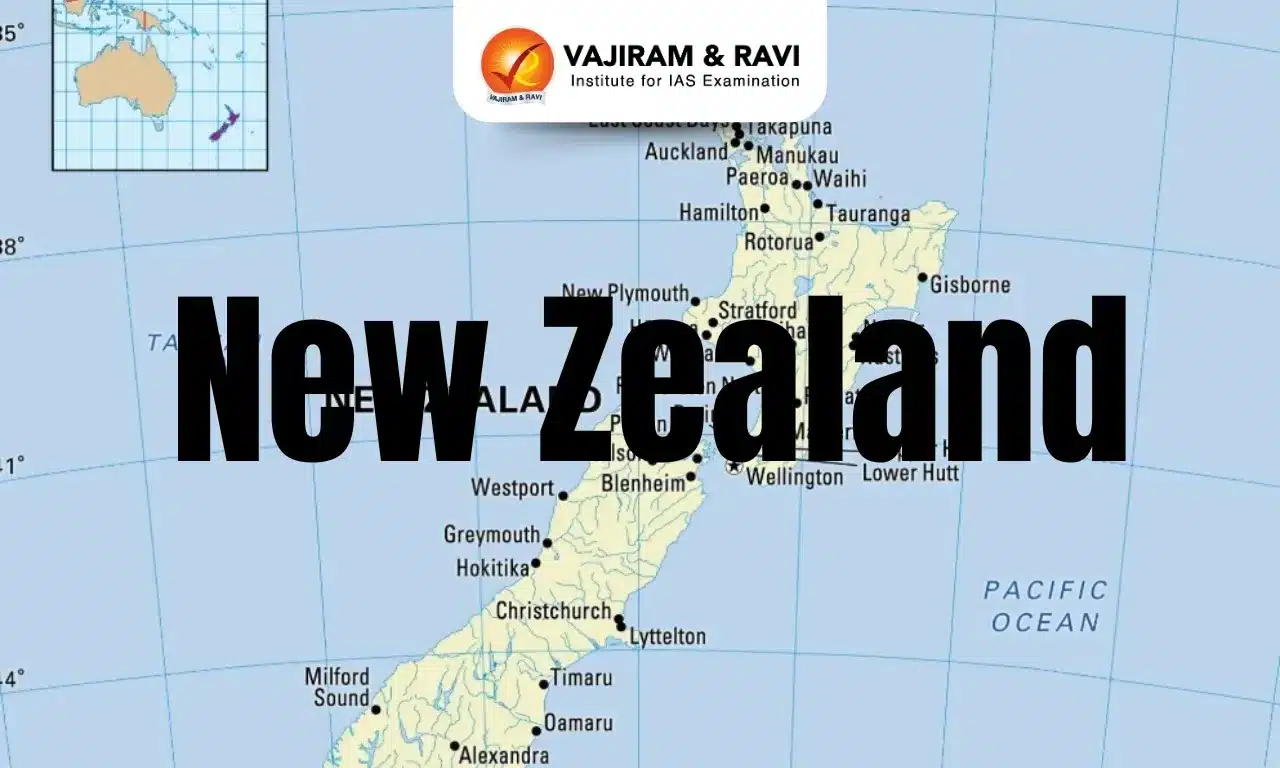
  • It is an island country and one of the many islands that make up Oceania.
  • It is located in the South Pacific Ocean to the southeast of Australia, south of New Caledonia, Fiji and Tonga Islands. 
  • It is primarily divided into two main islands, the North Island and the South Island, separated by the Cook Strait.
  • Capital City: Wellington

Geographical Features of New Zealand

  • It is part of the Pacific Ring of Fire—the circum-Pacific seismic belt marked by frequent earthquakes and considerable volcanic activity. 
  • Climate: New Zealand’s climate is complex and varies from warm subtropical in the far north to cool temperate climates in the far south.
  • Highest Peak: Mount Cook at 12,316 feet is the highest peak of New Zealand
  • Active Volcano: Mount Ruapehu
  • Glacier: Tasman Glacier, the largest in New Zealand
  • Lake: Lake Taupo which is the largest natural lake.
  • Natural Resources: It consists of gold, silver, iron sands, phosphate and limestone etc.

Source: TH

New Zealand FAQs

Q1: Where is New Zealand situated?

Ans: It is located in the South Pacific Ocean to the southeast of Australia, south of New Caledonia, Fiji and Tonga Islands. 

Q2: Which is the largest lake of New Zealand?

Ans: Lake Taupo

Enquire Now