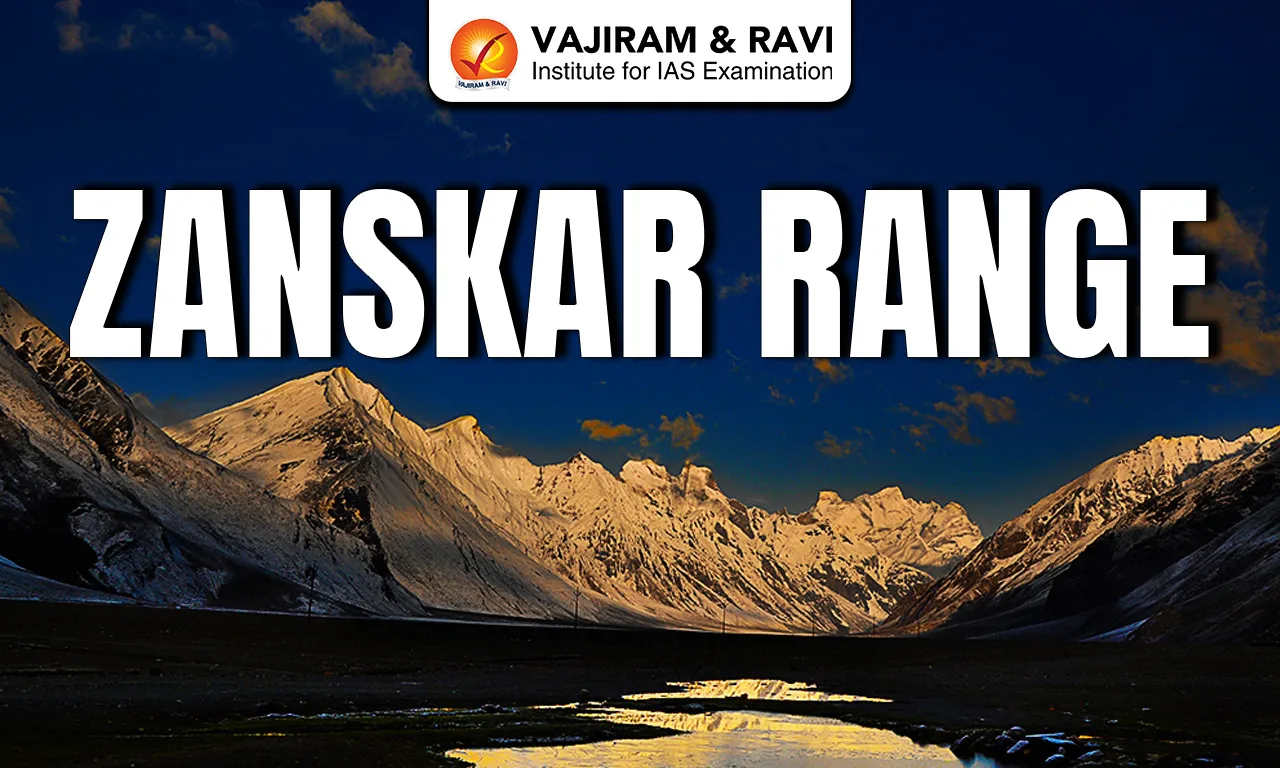
The Zanskar Range is an important mountain range of the Trans-Himalayan system, located mainly in the Union Territory of Ladakh. It forms a natural divide between the Indus Valley in the north and the Zanskar Valley in the south and is known for its high mountains, glaciers, deep gorges, cold desert landscape and strategic importance.
Zanskar Range Location and Extent
- The Zanskar Range is located mainly in the Kargil and Leh regions of Ladakh, with its extension reaching towards Himachal Pradesh.
- It lies south of the Ladakh Range and north of the Great Himalayan Range, forming an important part of the Trans-Himalayan mountain system.
- The range extends from the Suru Valley in the northwest to the Tso Kar basin in the southeast.
- The range separates the Indus Valley to the north from the Zanskar Valley to the south and is surrounded by valleys such as Stod, Tsarap and Zanskar.
- Along with the Karakoram, Ladakh and Kailas ranges, the Zanskar Range forms part of the broader Trans-Himalayan region.
Zanskar Range Geological Formation
- The Zanskar Range belongs to the Tethys Himalaya, one of the major geological divisions of the Himalayan system.
- It is mainly composed of folded and thrust sedimentary and metamorphic rocks formed from sediments deposited in the ancient Tethys Sea.
- Marine fossils found in the rocks provide evidence that the region was once part of an ancient sea before the collision of the Indian and Eurasian plates.
- The range was formed due to the convergence of the Indian Plate with the Eurasian Plate, which resulted in the uplift of the Himalayan mountain system.
- The deep gorge carved by the Zanskar River exposes highly folded rock layers, making the region important for studying Himalayan geological evolution.


Zanskar Range Physiography and Peaks
- The elevation of the Zanskar Range generally varies between 3,500 metres and over 7,000 metres, with several peaks exceeding 6,500 metres.
- The region contains several high-altitude peaks, glaciers and mountain valleys due to its rugged Himalayan terrain.
- Kamet (7,756 m), located in Uttarakhand, is the highest peak of the broader Zaskar Range
- The mountains of the Zanskar Range are characterised by barren slopes, deep valleys and steep gorges due to extreme climatic conditions and erosion.
Zanskar Range Important Passes
- Pensi La Pass (around 4,400 m) is an important pass connecting the Suru Valley of Kargil with the Zanskar Valley and is known as the gateway to Zanskar.
- Shingo La (Shinku La) Pass (around 5,091 m) connects the Zanskar Valley with the Lahaul region of Himachal Pradesh.
These high-altitude passes play an important role in regional connectivity, tourism and strategic movement.
Zanskar Range Drainage System
- The Zanskar River is the main river of the region and forms an important tributary of the Indus River.
- The Zanskar River is formed by the confluence of the Doda River and the Lungnak River near Padum. The Lungnak River is formed by the confluence of the Tsarap and Kargyag rivers
- The Zanskar River flows northwards through deep gorges and joins the Indus River near Nimmu in Ladakh.
- The Drang-Drung Glacier, located near Pensi La, is one of the largest glaciers in Ladakh and provides meltwater to the Zanskar river system.
Zanskar Range Climate and Natural Vegetation
- The Zanskar Range experiences a cold desert climate due to its location in the rain-shadow region of the Himalayas.
- The range blocks moisture-bearing monsoon winds, resulting in very low rainfall and dry conditions in Ladakh and Zanskar.
- Winters are extremely cold and long, while summers are short and relatively mild.
- Vegetation is sparse and mainly consists of alpine grasses, shrubs and steppe vegetation adapted to high altitude and aridity.
Zanskar Range Flora and Fauna
Zanskar region supports a unique high-altitude Himalayan ecosystem. Important wildlife species found in the region include the snow leopard, Himalayan blue sheep (bharal), ibex and Himalayan marmot.
Zanskar Range Cultural and Tourism Importance
- Zanskar is known for its unique Tibetan Buddhist culture, monasteries and traditional lifestyle.
- The Chadar Trek, conducted on the frozen Zanskar River during winter, is one of India’s most famous high-altitude trekking routes.
- Monasteries such as Phuktal Monastery represent the rich cultural heritage of the region.
- The region attracts tourists for trekking, mountaineering, river expeditions and adventure activities.
Zanskar Range Environmental Concerns
- Climate change is affecting glaciers, snowfall patterns and water availability in the Zanskar region.
- Rapid glacier retreat may impact agriculture, biodiversity and the livelihoods of local communities dependent on glacier-fed rivers.
- Increasing tourism and infrastructure development require sustainable planning to protect the fragile cold desert ecosystem.

 Last updated on Oct, 2026
→ UPSC 2027 Notification will be released on 13 January 2027 at upsconline.nic.in.
→ Check Nobel Prize 2026 Winners List here.
→ Download PIB PRiSM Monthly Magazine 2026 here.
→ Check UPSC Monthly Current Affairs Magazine The Recitals here.
→ Check out the latest UPSC Syllabus here.
→ Download UPSC Model Answers for Mains 2026
→ UPSC Mains Question Paper 2026 is out now for Essay & GS Paper 1, 2, 3 & 4.
→ UPSC Calendar 2027 has been released.
→ Enroll in Vajiram & Ravi’s UPSC Mains Test Series 2027 for structured answer writing practice, expert evaluation, and exam-oriented feedback.
→ Join Vajiram & Ravi’s UPSC Mentorship Program 2027 for personalized guidance, strategy planning, and one-to-one support from experienced mentors.
→ Go through the UPSC Mains Previous Year Papers to enhance your preparation.
→ UPSC has released UPSC Toppers List 2025 with the Civil Services final result on its official website.
→ Also check Best UPSC Coaching in India
Zanskar Range FAQs
Q1. Where is the Zanskar Range located?+
Q2. Which physiographic division does the Zanskar Range belong to?+
Q3. Between which regions does the Zanskar Range lie?+
Q4. How was the Zanskar Range formed?+
Q5. Which river flows through the Zanskar Range?+
Q6. Where does the Zanskar River originate and where does it meet the Indus?+
Q7. Which pass connects Suru Valley with Zanskar Valley?+
Q8. Which pass connects Zanskar with Himachal Pradesh?+
Q9. Why does Zanskar have a cold desert climate?+
Q10. Which glacier is associated with the Zanskar region?+
Q11. Which important wildlife species are found in Zanskar?+
Tags: zanskar range