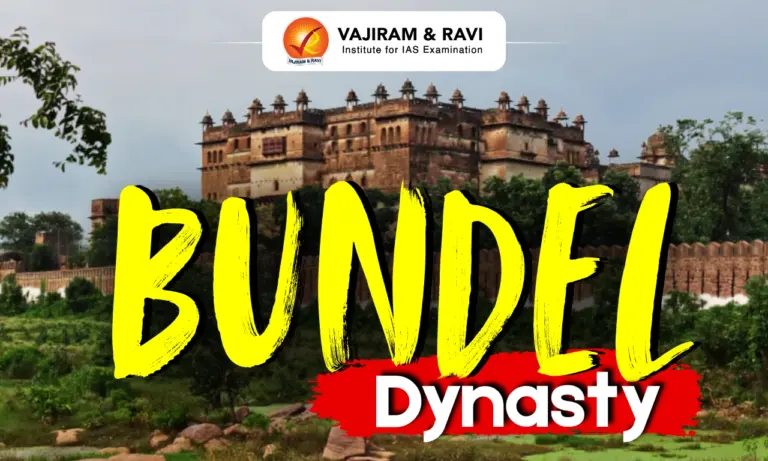
The Bundela Dynasty was one of the most influential Rajput dynasties in central India. It ruled large parts of present-day Bundelkhand, covering regions of Madhya Pradesh and Uttar Pradesh, between the 16th and 18th centuries. The dynasty is known for its brave rulers, magnificent forts and palaces, rich cultural heritage, and resistance against the Mughal Empire. Famous rulers such as Raja Rudra Pratap Singh, Raja Bir Singh Deo, and Maharaja Chhatrasal played a significant role in shaping the political history of central India.
Bundela Dynasty
The Bundela Dynasty was a Rajput dynasty that established its rule over the Bundelkhand region during the medieval period. The name “Bundela” is believed to have originated from the legendary ancestor Pancham, who is said to have received divine blessings after performing severe penance. His descendants came to be known as the Bundelas.
Bundela Dynasty Origin and History
The Bundela Dynasty emerged as a powerful Rajput dynasty in central India and established its rule over the Bundelkhand region, leaving a lasting impact on the political, cultural, and architectural history of medieval India.
- Origin: The Bundelas are believed to have descended from the Gaharwar Rajputs, though their origin is also associated with local legends.
- Foundation: Raja Rudra Pratap Singh founded the Kingdom of Orchha in 1531 CE and made Orchha his capital.
- Expansion: The dynasty expanded its territories across present-day Madhya Pradesh and Uttar Pradesh, establishing several princely states.
- Golden Period: The reign of Raja Bir Singh Deo (1605-1627) marked the peak of Bundela power, with significant military success and architectural development.
- Resistance to the Mughals: Maharaja Chhatrasal successfully fought against Mughal rule under Aurangzeb and established an independent Bundela kingdom.


Important Rulers of the Bundela Dynasty
The Bundela Dynasty was led by several capable rulers who strengthened the kingdom through military achievements, efficient administration, and patronage of art, architecture, and religion.
- Rudra Pratap Singh (1501-1531): Founder of the Kingdom of Orchha in 1531 CE and established Orchha as the capital of the Bundela rulers.
- Bharti Chand (1531-1554): Consolidated the newly established kingdom, strengthened its administration, and expanded Bundela influence in the region.
- Madhukar Shah (1554-1592): A devout Hindu ruler known for promoting religion, temple construction, literature, and cultural activities.
- Bir Singh Deo (1605-1627): One of the greatest Bundela rulers, famous for constructing the Jahangir Mahal, expanding the Orchha Fort Complex, and maintaining close ties with Emperor Jahangir.
- Jujhar Singh (1627-1635): Succeeded Bir Singh Deo and resisted Mughal authority, but his conflict with Emperor Shah Jahan eventually weakened the kingdom.
- Maharaja Chhatrasal (1649-1731): The most celebrated Bundela ruler who fought against Mughal rule, established an independent kingdom in Bundelkhand, and later allied with the Marathas to strengthen his position.
Also Read:- Khilji Dynasty
Administration, Culture, and Architecture
The Bundela Dynasty developed an effective administrative system and made significant contributions to art, culture, literature, and architecture, leaving behind a rich heritage in the Bundelkhand region.
Administration
- Followed a decentralized administrative system, with provinces managed by local governors and officials.
- Maintained a strong military to protect the kingdom from external invasions and internal rebellions.
- Collected land revenue as the primary source of state income and promoted agricultural development.
- Built forts and defensive structures to strengthen border security and maintain law and order.
- Encouraged local governance through village heads and officials for efficient administration.
Culture
- Promoted Hindu religion, traditions, and festivals while respecting other faiths.
- Patronized Sanskrit and Braj literature, attracting scholars and poets to the royal court.
- Supported music, dance, painting, and sculpture, contributing to the cultural growth of the region.
- Built numerous temples, palaces, and religious institutions that reflected their devotion and artistic vision.
- Preserved the unique cultural identity and folk traditions of Bundelkhand.
Architecture
- Developed a distinctive Bundela architectural style, blending Rajput and Mughal influences.
- Constructed iconic monuments such as the Orchha Fort Complex, Jahangir Mahal, Raja Mahal, and Chaturbhuj Temple.
- Built impressive forts, palaces, temples, and royal cenotaphs (Chhatris) using sandstone and locally available materials.
- Architectural features include ornate balconies (jharokhas), domes, chhatris, murals, frescoes, courtyards, and decorative carvings.
- Many Bundela monuments continue to be important historical and architectural heritage sites in India.
Decline and Legacy of the Bundela Dynasty
Bundela Dynasty gradually declined after the death of Maharaja Chhatrasal in 1731 due to internal succession disputes, the growing influence of the Marathas, and later the expansion of British rule in central India. Although their political power diminished, the Bundelas left behind a remarkable legacy through their forts, palaces, temples, and contributions to art, architecture, and regional governance. Monuments in Orchha, Datia, and Panna continue to reflect their architectural brilliance and cultural achievements.

 Last updated on Oct, 2026
→ UPSC 2027 Notification will be released on 13 January 2027 at upsconline.nic.in.
→ Check Nobel Prize 2026 Winners List here.
→ Download PIB PRiSM Monthly Magazine 2026 here.
→ Check UPSC Monthly Current Affairs Magazine The Recitals here.
→ Check out the latest UPSC Syllabus here.
→ Download UPSC Model Answers for Mains 2026
→ UPSC Mains Question Paper 2026 is out now for Essay & GS Paper 1, 2, 3 & 4.
→ UPSC Calendar 2027 has been released.
→ Enroll in Vajiram & Ravi’s UPSC Mains Test Series 2027 for structured answer writing practice, expert evaluation, and exam-oriented feedback.
→ Join Vajiram & Ravi’s UPSC Mentorship Program 2027 for personalized guidance, strategy planning, and one-to-one support from experienced mentors.
→ Go through the UPSC Mains Previous Year Papers to enhance your preparation.
→ UPSC has released UPSC Toppers List 2025 with the Civil Services final result on its official website.
→ Also check Best UPSC Coaching in India
Bundela Dynasty FAQs
Q1. Who founded the Bundela Dynasty?+
Q2. Which region was ruled by the Bundela Dynasty?+
Q3. Who was the most famous ruler of the Bundela Dynasty?+
Q4. Why is Raja Bir Singh Deo important?+
Q5. What was the capital of the Bundela Kingdom?+
Q6. Which famous temples were built during Bundela rule?+
Q7. Why did the Bundela Dynasty decline?+
Tags: art and culture art and culture notes bundela dynasty dynasty history history notes