Misagh-2

Misagh-2

Misagh-2 Latest News

Russian forces have begun using an Iranian Misagh-2 man-portable surface-to-air missile system to intercept Ukrainian unmanned aircraft, according to Ukrainian reporting and imagery.

About Misagh-2

  • It is an Iranian man-portable infrared-guided surface-to-air missile system. 
  • It is a variant of the Chinese QW-2 Vanguard missile system.  
  • Its main mission is to strike tactical targets such as fighters, attackers, and armed helicopters at low and very low altitudes.
  • It can also supply effective air defense for military bases, political and industrial centers, and other important facilities. 

Misagh-2 Features

  • The missile itself weighs 11.32 kg at launch, the warhead 1.42 kg, and the complete system 18 kg in the firing position. 
  • It can engage approaching targets out to 6 km and receding targets out to 5.2 km.  
  • The maximum effective altitude against jet fighters is about 2.5 km, and helicopters and subsonic aircraft about 3.5 km.  
  • It uses a passive infrared (IR) seeker and is designed as a fire-and-forget weapon. 
  • Once launched, the missile can track the infrared signature of its target without requiring continued guidance from the operator, allowing the firing team to immediately leave its position. 
  • Its dual-band passive IR seeker has strong resistance to heat flares dispensed by the target and solar/ground heat, thus improving the missile’s performance in day/night, all-weather conditions.

News: MIL

Misagh-2 FAQs

Q1: What is Misagh-2?

Ans: It is an Iranian man-portable, infrared-guided surface-to-air missile system.

Q2: What type of guidance system does Misagh-2 use?

Ans: It uses a passive infrared (IR) seeker.

Q3: What is the maximum engagement range of Misagh-2 against approaching targets?

Ans: It can engage approaching targets up to 6 km away.

Q4: How does the fire-and-forget capability of Misagh-2 work?

Ans: After launch, its missile tracks the infrared signature of the target without requiring

Schokari Sand Racer

Schokari Sand Racer

Schokari Sand Racer Latest News

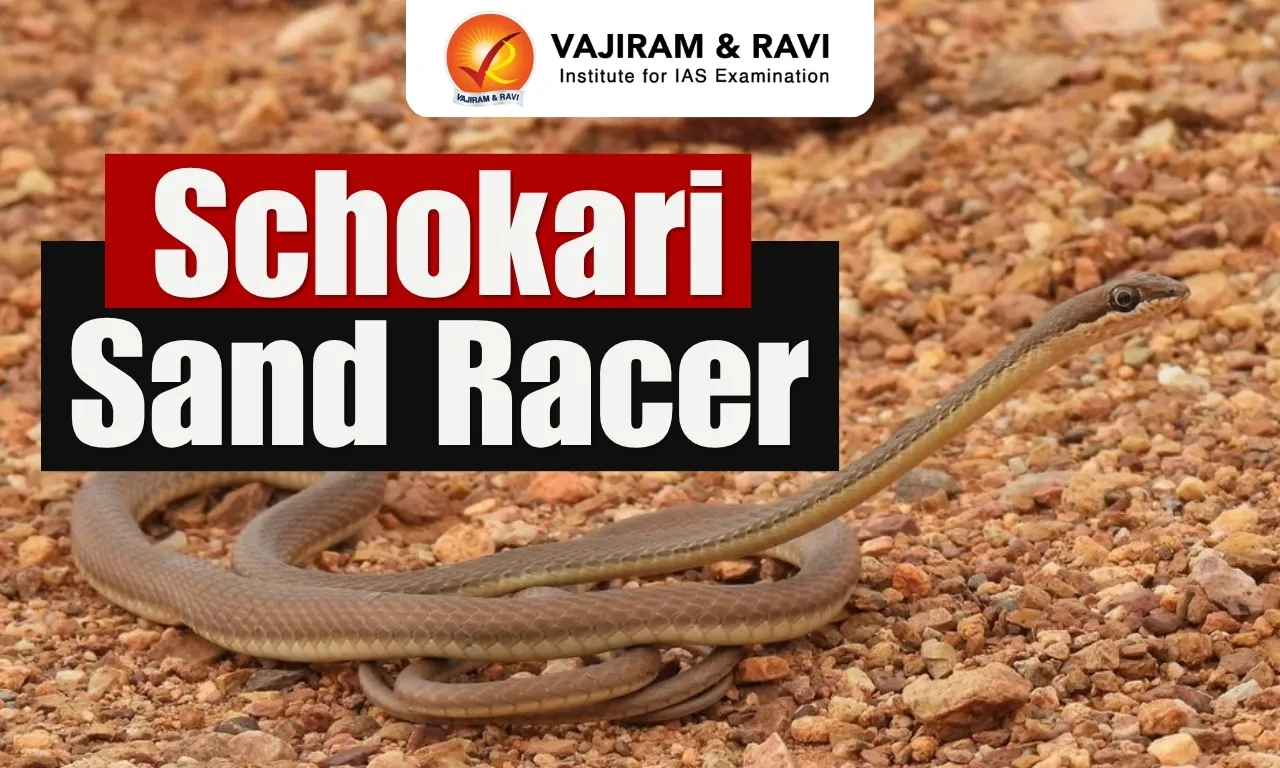
A routine forest patrol in Gujarat's Kutch recently led to an unusual wildlife discovery: an elusive snake named Schokari Sand Racer that had not been conclusively recorded in the region for more than 150 years.

About Schokari Sand Racer

  • The Schokari Sand Racer, also known as the Afro-Asian sand snake, is an extremely fast diurnal snake well adapted to arid and desert environments.  
  • It is mildly venomous but generally poses little danger to people and feeds on small animals, including lizards and rodents. 
  • Scientific Name: Psammophis schokari  

Schokari Sand Racer Habitat and Distribution

  • It inhabits desert regions with sparse vegetation, especially sand deserts, wadis, and oasis margins.
  • Its distribution stretches from North Africa (Libya, Egypt) across the Arabian Peninsula and the Near East to Pakistan, including southern Turkmenistan and northwestern India. 
  • From India, it has been reported only from the deserts of Rajasthan and Kutch of Gujarat. 

Schokari Sand Racer Features

  • It is a medium-sized snake, typically about 100 to 120 cm long.
  • The body is long, slender, smooth, and glossy. 
  • It has an elongated head and large eyes adapted for active daytime hunting. 
  • The coloration is highly variable, usually sandy, olive, or grey-brown with longitudinal dark stripes running along the body. 
  • The belly is pale, and the scales are smooth, giving the snake a sleek appearance. 

Schokari Sand Racer Conservation Status

It is classified as 'Least Concern' under the IUCN Red List.

News: IT

Schokari Sand Racer FAQs

Q1: What is the Schokari Sand Racer?

Ans: It is an extremely fast, diurnal, mildly venomous snake adapted to arid and desert environments.

Q2: Is the Schokari Sand Racer venomous?

Ans: Yes, it is mildly venomous but generally poses little danger to humans.

Q3: What type of environments does the Schokari Sand Racer inhabit?

Ans: It inhabits arid and desert environments, including sand deserts, wadis and oasis margins.

Q4: Where is the Schokari Sand Racer distributed?

Ans: Its distribution extends from North Africa through the Arabian Peninsula and Near East to Pakistan, including southern Turkmenistan and northwestern India.

Q5: What is the conservation status of the Schokari Sand Racer according to the IUCN?

Ans: Least Concern.

Bathymyrus perplexus

Bathymyrus perplexus

Bathymyrus perplexus Latest News

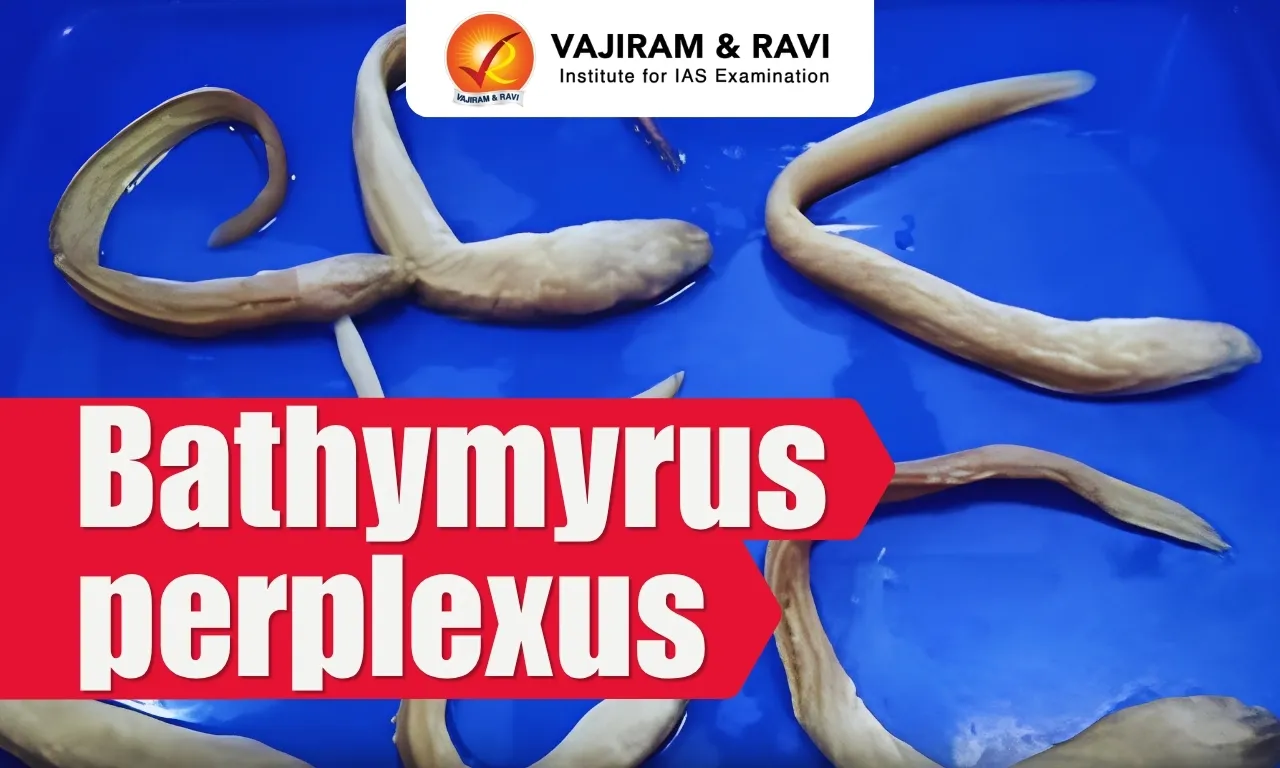
Scientists recently identified a new fish species in the Bay of Bengal, Bathymyrus Perplexus, almost four years after it was first discovered off the coast of Paradip.

About Bathymyrus perplexus

  • It is a new species of fish.
  • It was identified in the Bay of Bengal, almost four years after it was first discovered off the coast of Paradip, Odisha. 
  • Between 2021 and 2025, researchers recorded 32 specimens from Paradip, West Bengal, the Godavari region and Kakinada. 
  • It is typically found in waters ranging from 50 to 100 meters deep off the coast. 

Bathymyrus perplexus Features

  • The fish has a long, cylindrical body. It possesses a distinctive head and snout structure. 
  • Its body colour ranges from pink to a cloudy pink hue. 
  • There is heavy black pigmentation on the upper part of the head, and a black mark extends from the eye to the snout. 
  • Thin black margins line the outer edges of its dorsal and anal fins. 
  • Its mouth features teeth on both the upper and lower jaws, as well as on the head region.

News: ETVB

Bathymyrus perplexus FAQs

Q1: What is Bathymyrus perplexus?

Ans: It is a new species of fish identified in the Bay of Bengal.

Q2: Where was Bathymyrus perplexus first discovered?

Ans: It was first discovered off the coast of Paradip, Odisha.

Q3: From which regions were specimens of Bathymyrus perplexus recorded?

Ans: Paradip, West Bengal, the Godavari region and Kakinada.

Q4: What is the body shape of Bathymyrus perplexus?

Ans: It has a long, cylindrical body.

Q5: What is the body colour of Bathymyrus perplexus?

Ans: Its body colour ranges from pink to cloudy pink.

Bandhavgarh Tiger Reserve

Bandhavgarh Tiger Reserve

Bandhavgarh Tiger Reserve Latest News

A five-day Elephant Festival and Rejuvenation Camp is being held at Bandhavgarh Tiger Reserve in Umaria district of Madhya Pradesh. 

About Bandhavgarh Tiger Reserve

  • It is located between the Vindhyan and Satpura ranges in the Umaria district of Madhya Pradesh. 
  • It was declared a National Park in 1968 and a Tiger Reserve in 1972 and spreads over 1150 sq.km. 
  • It derives its name from the most prominent hillock in the area, which was said to be given by Hindu Lord Rama to his brother Lakshmana to keep a watch on Lanka. Hence the name Bandhavgarh (Sanskrit: Brother’s Fort).
  • The habitat is characterized by valleys, hills, and plains, with the Bandhavgarh fort prominently seen as a major landmark. 
  • The reserve features around 39 caves with Pali inscriptions and animal depictions.
  • It also contains ancient structures, including stupas and statues from the 1st century BCE.
  • Flora:
    • Main vegetation in the reserve consists of Sal trees along with huge expanses of grasslands and bamboo forests. 
    • Other kinds of trees which are found here are Saja, Dhauda, Tendu, Arjun, Aonla, Pals, Salai, Bhirra, Khamer, Dhaman, Mango, Jamun, Dhobin, etc. 
  • Fauna:
    • It is known to have one of the highest density of tigers in the world. It is also considered the origin of all the white tigers in the world.  
    • It also hosts other notable mammals such as leopards, Indian bison (gaur), sambar deer, spotted deer, nilgai, wild boar, sloth bears, Indian wolves, jackals, and both langur and rhesus macaque monkeys.
    • It also has over 250 bird species, including the crested serpent eagle, Malabar pied hornbill, white-rumped vulture, and Indian roller.

News: NOA

Bandhavgarh Tiger Reserve FAQs

Q1: Where is Bandhavgarh Tiger Reserve located?

Ans: It is located in Umaria district of Madhya Pradesh, between the Vindhyan and Satpura ranges.

Q2: How did Bandhavgarh Tiger Reserve get its name?

Ans: It derives its name from the prominent Bandhavgarh hillock, traditionally believed to have been given by Lord Rama to his brother Lakshmana to keep watch over Lanka.

Q3: What is the dominant vegetation of Bandhavgarh Tiger Reserve?

Ans: Sal forests, along with extensive grasslands and bamboo forests, form the main vegetation.

Permafrost

Permafrost

Permafrost Latest News

Alaska’s thawing permafrost is releasing acid and metals that turn rivers orange, changing water chemistry for dozens of miles.

About Permafrost

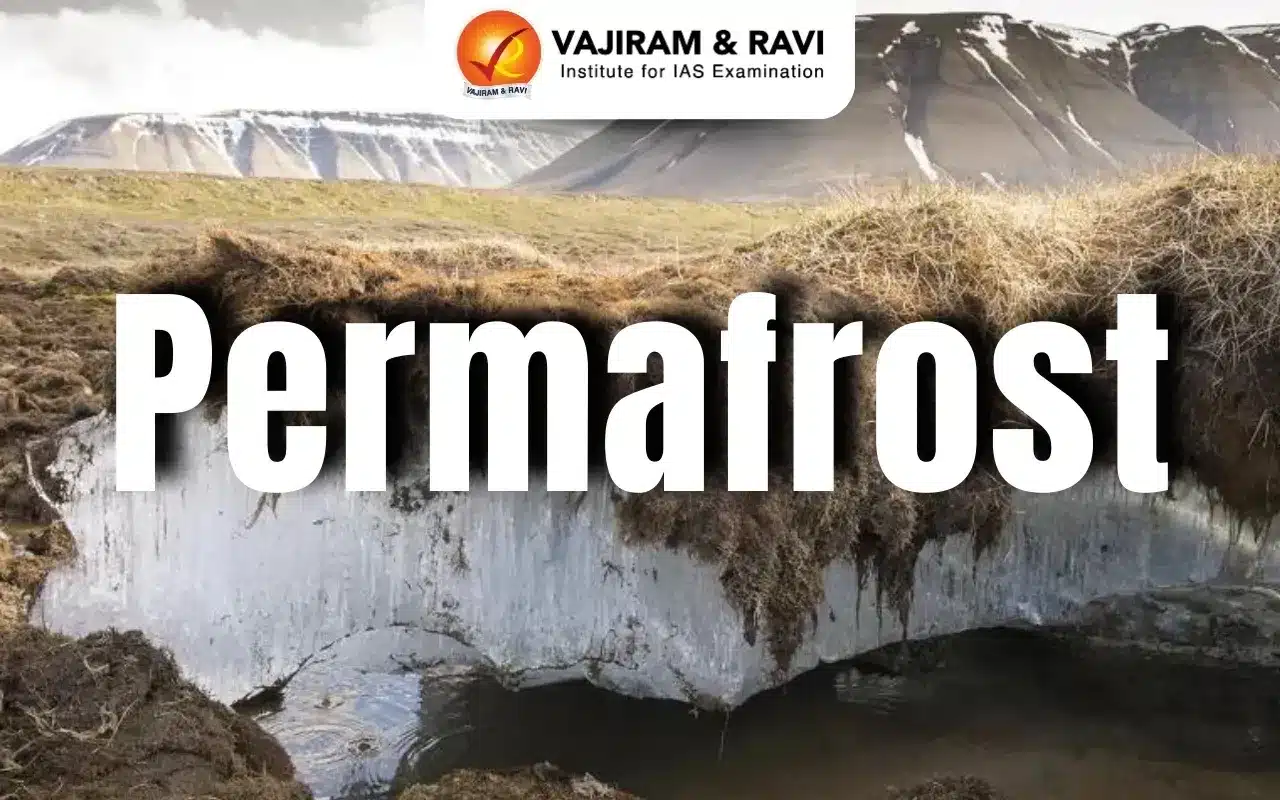
  • Permafrost is any ground that remains completely frozen—32°F (0°C) or colder—for at least two years straight. 
  • While two years is the minimum for permafrost consideration, some regions have had frozen ground for hundreds of thousands of years. 
  • Scientists discovered the oldest known permafrost in Siberia, which has been frozen for the past 650,000 years.
  • Where are they found?
    • These permanently frozen grounds are most common in regions with high mountains and in Earth’s higher latitudes—near the North and South Poles.
    • It can be found on land and below the ocean floor. 
    • Its thickness can range from one meter to more than 1,000 meters, covering entire regions, such as the Arctic tundra, or a single, isolated spot, such as a mountaintop of alpine permafrost.
    • Permafrost covers large regions of the Earth. Almost a quarter of the land area in the Northern Hemisphere has permafrost underneath. 
    • It occurs in 85 percent of Alaska and 55 percent of Russia and Canada, and covers probably all of Antarctica.  
  • What Is Permafrost Made Of?
    • Permafrost is made of a combination of soil, rocks, and sand that are held together by ice. 
    • The soil and ice in permafrost stay frozen all year long.
    • Although the ground is frozen, permafrost regions can be snow-free in summer. 
    • Near the surface, permafrost soils also contain large quantities of organic carbon—a material leftover from dead plants that couldn’t decompose, or rot away due to the cold.
    • Lower permafrost layers contain soils made mostly of minerals.
  • Permafrost loss, also known as permafrost thaw, is the progressive loss of ground ice in permafrost, usually due to input of heat. 
  • A layer of soil on top of permafrost does not stay frozen all year. This layer, called the active layer, thaws during the warm summer months and freezes again in the fall. 
  • In colder regions, the ground rarely thaws—even in the summer. There, the active layer is very thin—only 4 to 6 inches (10 to 15 centimeters).
  • A thawing permafrost layer can lead to severe impacts on people and the environment.
    • When permafrost melts, it raises water levels in Earth's oceans.  
    • Melting permafrost and warming global temperatures have a positive feedback loop. 
    • Organic matter currently frozen in the permafrost will start to decompose when the ground thaws, resulting in the emission of methane and carbon dioxide into the atmosphere. 
    • As ice-filled permafrost thaws, it can turn into a muddy slurry that cannot support the weight of the soil and vegetation above it. 
    • Infrastructure such as roads, buildings, and pipes could be damaged as permafrost thaws.
    • Melting permafrost also releases heavy metals, such as mercury, and other toxins. 
    • As it melts, the contaminated permafrost can pollute water sources for local people. 
    • It is even possible that thawing permafrost may release dormant, disease-causing microbes that are harmful to animals and humans.

News: EARTH

Permafrost FAQs

Q1: What is permafrost?

Ans: Permafrost is ground that remains completely frozen at 0°C (32°F) or colder for at least two consecutive years.

Q2: Where is permafrost commonly found?

Ans: It is commonly found in high-mountain regions and Earth's higher latitudes, particularly near the North and South Poles.

Q3: Can permafrost occur beneath the ocean floor?

Ans: Yes, permafrost can occur both on land and beneath the ocean floor.

Q4: What is permafrost made of?

Ans: It consists of a combination of soil, rocks and sand held together by ice.

Q5: What is permafrost thaw?

Ans: Permafrost thaw is the progressive loss of ground ice in permafrost, usually caused by the input of heat.

Enquire Now