Green Keelback

Green Keelback

Green Keelback Latest News

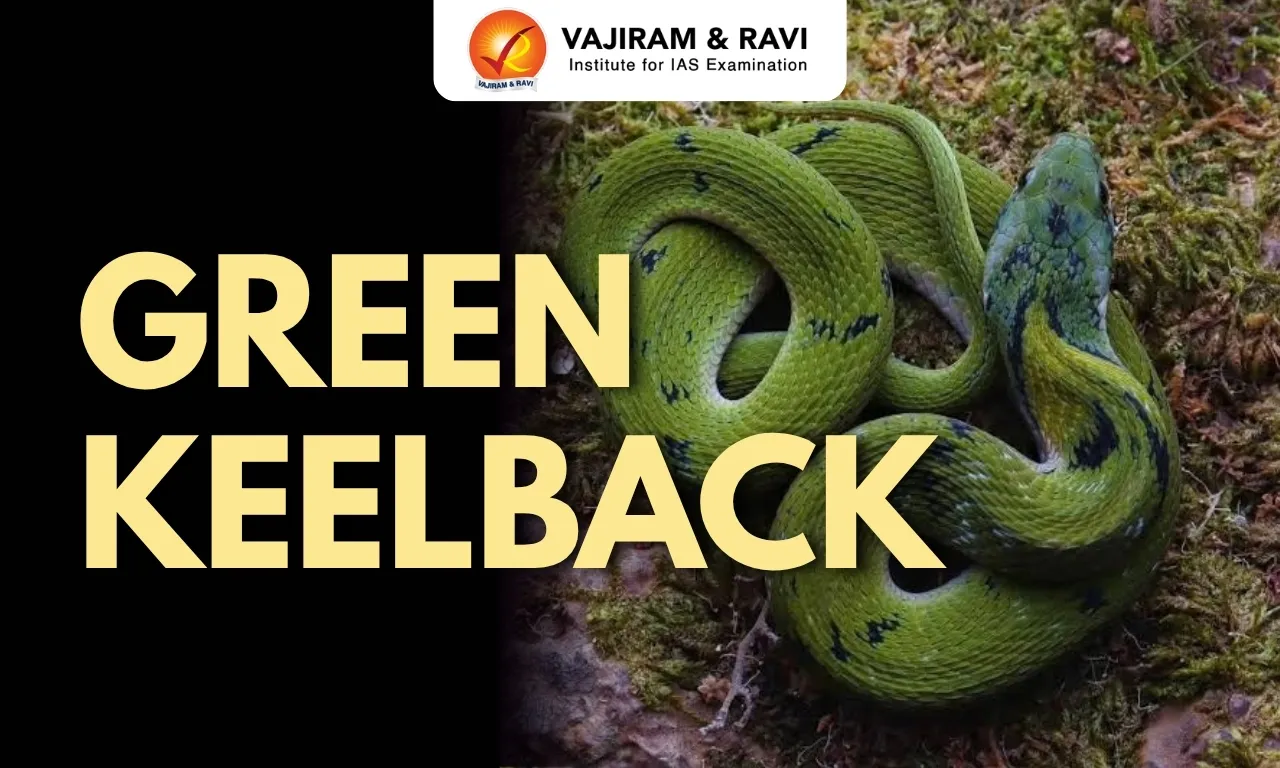
A snake, identified as 'Green Keelback', that is usually found in Central Asia, Sri Lanka and Eastern India, was recently found near Gangawadi village, on the fringes of Biligiri Rangana Betta (BR Hills), in Yelandur taluk, Chamarajanagar district, Karnataka.

About Green Keelback

  • It is a non-venomous, semi-aquatic snake that is native to South and Southeast Asia.  
  • Scientific Name: Macropisthodon plumbicolor

Green Keelback Habitat and Distribution

  • It is found in parts of South and Southeast Asia, including India, Sri Lanka, Bangladesh, Myanmar, Thailand, Malaysia, and parts of Indonesia. 
  • It prefers wetlands, including ponds, rivers, streams, rice fields, and marshy areas. 
  • It is often found in areas with abundant vegetation where it can hide and hunt in the water and on land. 

Green Keelback Features

  • Size: Green Keelbacks are medium-sized snakes, typically ranging between 60 cm to 1 meter in length, though some individuals can reach up to 1.2 meters.
  • Coloration: Their bodies are typically green, ranging from light to darker shades, often with lighter yellowish or white underbellies. 
  • Some may have faint dark markings along the back and sides, though their overall appearance remains quite smooth.
  • Keels: The term "keelback" comes from the pronounced ridges or "keels" along the scales of their bodies. These keels provide texture and grip, assisting the snake in climbing and swimming.
  • Head: The head is moderately triangular but distinct from the body, with large, round eyes that are set on the sides of the head. Its large eyes help it navigate in both water and dense vegetation.
  • Tail: The tail is slender and helps with swimming, acting as a rudder to guide the snake through water.

Green Keelback Conservation Status

It is classified as 'Least Concern' under the IUCN Red List.

News: DH

Green Keelback FAQs

Q1: What is the Green Keelback?

Ans: The Green Keelback is a non-venomous, semi-aquatic snake native to South and Southeast Asia.

Q2: Which countries are part of the distribution range of the Green Keelback?

Ans: India, Sri Lanka, Bangladesh, Myanmar, Thailand, Malaysia and parts of Indonesia.

Q3: What type of habitat does the Green Keelback prefer?

Ans: Wetlands, including ponds, rivers, streams, rice fields and marshy areas.

Q4: What is the IUCN Red List conservation status of the Green Keelback?

Ans: Least Concern (LC).

Bhavanisagar Dam

Bhavanisagar Dam

Bhavanisagar Dam Latest News

Demanding the release of water from Bhavanisagar Dam into the Kalingarayan Canal, ayacut farmers staged a protest on the Erode Collectorate premises recently.

About Bhavanisagar Dam

  • Bhavanisagar Dam and Reservoir, also called Lower Bhavani Dam, is located on the Bhavani River (a major tributary of the Cauvery River) in Erode district, Tamil Nadu. 
  • It is one of the world's largest earthen dams.  
  • The dam was constructed during the independent period from 1948 to 1955. 
  • It is a Multi-Purpose Dam. 
    • It is used to store water for irrigation, generate electricity, supply drinking water, control floods, and control the silt formation in the downstream river. 
    • The dam feeds the Lower Bhavani Project Canal and is the second largest dam in Tamil Nadu. 
    • It forms the tail end of the long river chain on the eastern side of the Western Ghats in Nilgiris.

News: TH

Bhavanisagar Dam FAQs

Q1: Where is Bhavanisagar Dam located?

Ans: It is located in Erode district, Tamil Nadu.

Q2: On which river is Bhavanisagar Dam constructed?

Ans: The Bhavani River.

Q3: Why is Bhavanisagar Dam significant globally?

Ans: It is one of the world's largest earthen dams.

Q4: What are the major purposes of Bhavanisagar Dam?

Ans: Irrigation, electricity generation, drinking water supply, flood control and control of silt formation downstream.

Slaty Egret

Slaty Egret

Slaty Egret Latest News

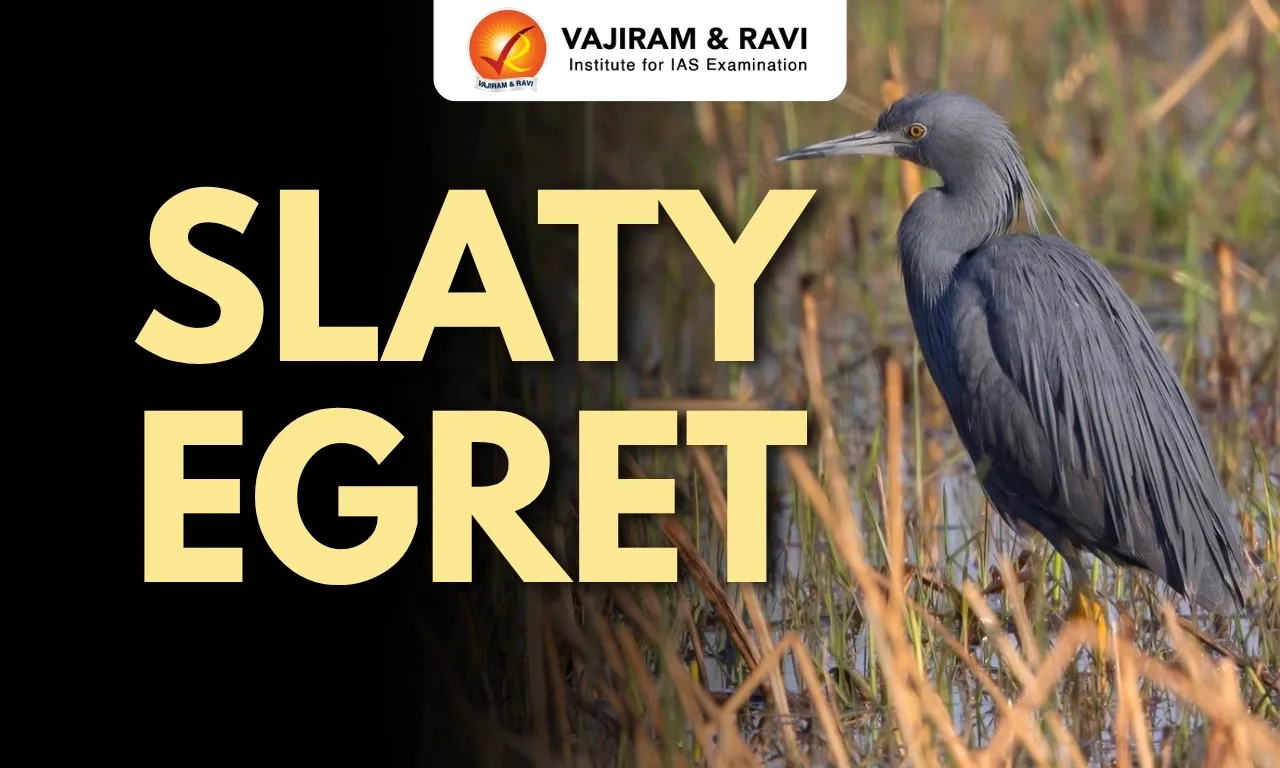
According to the United Nations Environment Programme (UNEP) officials said that the behavioural shifts of the Slaty Egret (Egretta vinaceigula) are an important instance of changes in natural ecosystems. 

About Slaty Egret

  • It is a small, shy water bird mainly found in Botswana’s Okavango Delta.
  • Appearance
    • It features a slender form with long legs and neck, distinctive of egrets.
    • It exhibits slaty gray plumage with a subtle purple tint, giving it a unique coloration.
  • Habitat: It is usually found in seasonal wetlands and floodplains
  • Distribution: The slaty egret lives in south-central Africa. The largest populations are found in Zambia and Botswana.
  • Behavior: It is a fishing maestro, known for its unique "foot-ruffling" technique—stirring up the water with its feet to flush out tasty fish.
  • Nesting Preference: It typically breeds in colonially dense vegetative areas on islands or marshlands, usually away from potential predators.
  • Diet: The Slaty Egret is known for its diverse diet primarily consisting of fish, amphibians, and aquatic invertebrates.
  • Threats: It is highly dependent on wetlands, which makes it vulnerable to habitat loss due to agricultural expansion and changes in water management.
  • Conservation Status
    • IUCN Red List: Vulnerable

Source: DTE

Slaty Egret FAQs

Q1: What is Slaty Egret ?

Ans: It is a small, shy water bird.

Q2: Where do we find Slaty Egret ?

Ans: It is mainly found in Botswana’s Okavango Delta.

Conservation Assured | Tiger Standards

Conservation Assured | Tiger Standards

Conservation Assured | Tiger Standards Latest News

Recently, Nameri Tiger Reserve in Assam has secured the Conservation Assured | Tiger Standards (CA|TS) Approved status.

About Conservation Assured | Tiger Standards 

  • It is a global framework designed to assess the effectiveness of tiger reserve management and protection.
  • It was launched at the 1st Asian Parks Congress in Japan in 2013.
  • CA|TS is a global certification system that ensures effective management specifically of tiger conservation areas.
  • It sets benchmarks for protection, habitat management, community involvement, and wildlife monitoring.
  • CA|TS helps identify strengths and improvement areas within reserves, supporting efforts to create safe, sustainable environments for tigers and preserve global biodiversity.
  • Assessment Structure
    • CA|TS consists of seven pillars (Importance and status, Management, Community, Tourism (optional), Protection, Habitat management, Tiger populations) and 17 elements with standards and criteria for managing tiger conservation areas.
    • Five of these pillars are applicable to conservation area management in general and represent the Conservation Assured (CA) aspect of the scheme; the two final pillars focus specifically on management issues related to tiger conservation – the Tiger Standards (TS).
  • The Global Tiger Forum (GTF) and World Wildlife Fund India are the two implementing partners of the National Tiger Conservation Authority for CA|TS assessment in India. 

The list of 15 Tiger Reserves of India who Received CA|TS Accreditation

  • Kaziranga, Manas, Orang and Nameri Tiger Reserve, Assam
  • Sundarbans, West Bengal
  • Valmiki Tiger Reserve, Bihar
  • Dudhwa Tiger Reserve Uttar Pradesh
  • Kanha, Panna and Satpuda Tiger Reserve, Madhya Pradesh
  • Pench Tiger Reserve, Maharashtra
  • Anamalai and Mudumalai Tiger Reserve, Tamil Nadu
  • Parambikulam Tiger Reserve, Kerala
  • Bandipur Tiger Reserve, Karnataka 

Source: DD News

Conservation Assured | Tiger Standards FAQ's

Q1: What is Conservation Assured | Tiger Standards?

Ans: It is a global framework designed to assess the effectiveness of tiger reserve management and protection.

Q2: How many Tiger Reserves of India who received CA|TS accreditation?

Ans: 15 Tiger Reserves

New Species of Springtails

New Species of Springtails

New Species of Springtails Latest News

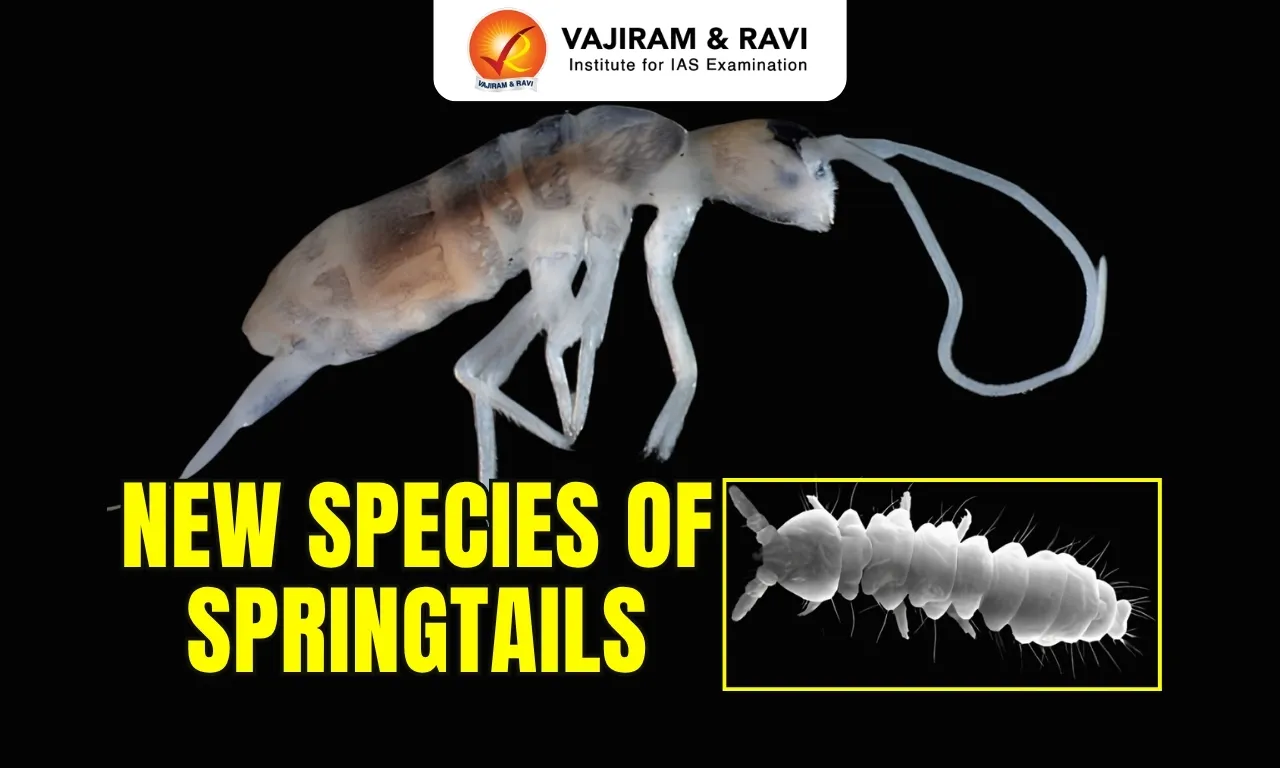
Scientists recently discovered two new species of tiny soil-dwelling creatures called springtails named Folsomia ciega and Folsomia unioculata in the Nilgiri Hills of the Western Ghats, taking the number of known species of the genus Folsomia in India to 13.

About Folsomia ciega and Folsomia unioculata

  • They are two new species of tiny soil-dwelling creatures called springtails.
  • They were discovered in the Nilgiri Hills of the Western Ghats.   
  • Both species belong to the genus Folsomia. 
  • Folsomia ciega, named after the Spanish word for ‘blind’, lacks eyes entirely. 
    • It is a small, pale, and elongated springtail measuring about 1 mm and is distinguished by the arrangement of bristles and a two-pronged tail structure called a mucro.
  • Folsomia unioculata, meaning ‘one-eyed’ in Latin, has a single eye on each side of its head. 
    • It grows up to 1.3 mm and differs from related species that either have multiple eyes or are completely blind.

What are Springtails?

  • Springtails (Collembola) are tiny insect-like creatures. 
  • They are one of the world’s tiniest arthropods, measuring up to 0.2 mm in length. The largest springtail you could find is just about 10 mm long. 
  • They lack wings, and the body is divided into three parts: head (with short antennae), thorax, and abdomen. 
  • Six legs, short antennae, and a soft, elongated, or circular body distinguish these tiny organisms. 
  • Springtails are creamy white or grey in colour, with some having yellow, orange, metallic green, or red scales. 
  • Their skin has comb-like hexagonal or rhombic granules that are water repellent and self-cleaning.

News: NIE

New Species of Springtails FAQs

Q1: What are Folsomia ciega and Folsomia unioculata?

Ans: They are two newly discovered species of tiny soil-dwelling creatures known as springtails.

Q2: Where were Folsomia ciega and Folsomia unioculata discovered?

Ans: They were discovered in the Nilgiri Hills of the Western Ghats.

Q3: What are springtails?

Ans: Springtails are tiny soil-dwelling arthropods commonly found in moist environments.

Q4: What are the distinguishing physical features of Folsomia ciega?

Ans: It is small, pale and elongated, measuring about 1 mm, with a distinctive arrangement of bristles and a two-pronged tail structure called a mucro.

PRASHAST Portal

PRASHAST Portal

PRASHAST Portal Latest News

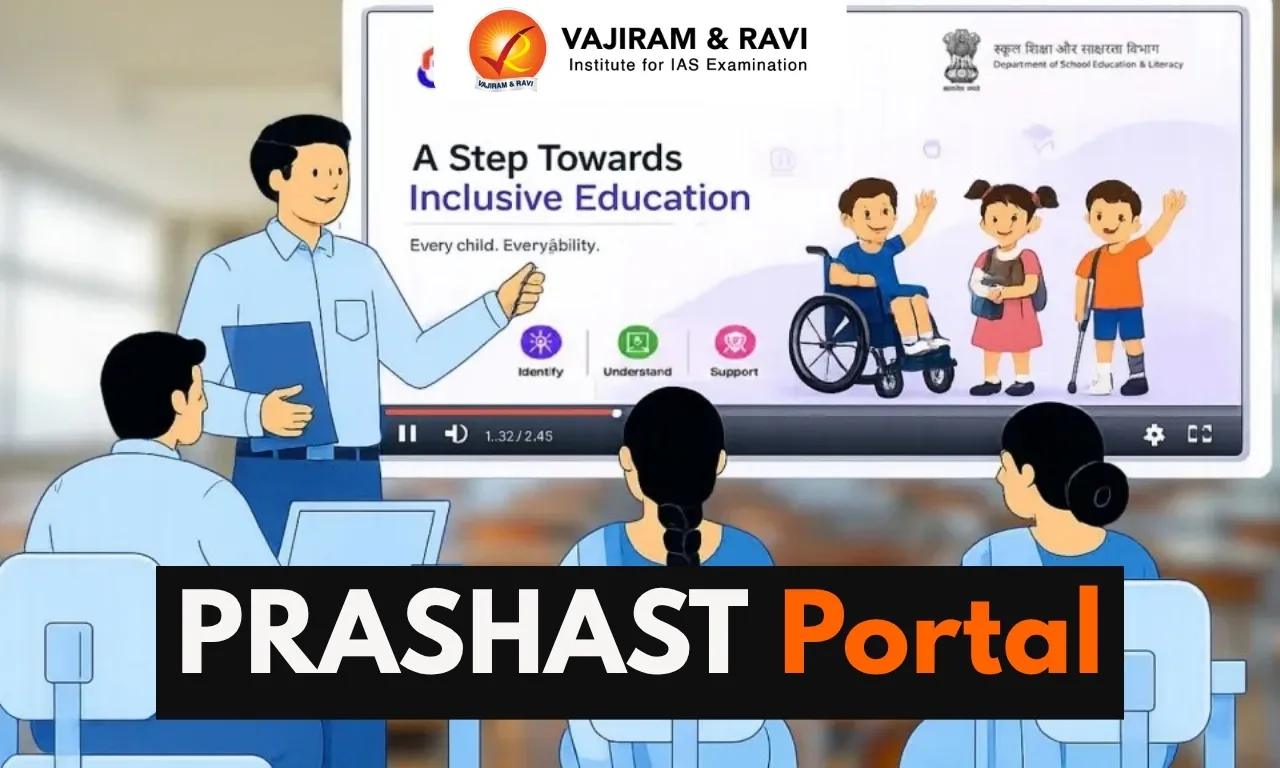
Recently, the Department of School Education & Literacy (DoSEL) organized the nationwide screening of a 30-minute Sensitization and Orientation Module on Inclusive Education for Children with Special Needs (CwSN) through the PRASHAST Portal in schools across the country.

About PRASHAST Portal

  • PRASHAST (Pre-Assessment Holistic Screening Tool) is a school-based disability screening tool.
  • It is for identifying children with probable disability conditions (21) covered under the Rights of Persons with Disabilities (RPwD) Act, 2016 .
  • It serves as an initial screening and referral mechanism.
  • It is designed for use by regular teachers, special educators, counsellors, and school heads involved in the screening and support of students.
  • Structure
    • PRASHAST consists of two parts:
      • Part-1: Initial screening conducted by regular teachers.
      • Part-2: Validation of observations and tentative identification of disability categories by special educators or counsellors.
  • Process
    • Teachers should observe students for a minimum period of 1–2 months in various settings such as classrooms, playgrounds, co-curricular activities, and social interactions before recording their observations.
    • After screening, the observations are validated through the second-level screening process. If required, the child may be referred for detailed assessment and certification by competent authorities.
  • Significance: The initiative is part of the Ministry of Education’s continued efforts to strengthen equitable, accessible and inclusive education , in line with the National Education Policy (NEP), 2020 and the RPwD Act, 2016 .

Source: PIB

PRASHAST Portal FAQs

Q1: What is PRASHAST Portal?

Ans: PRASHAST (Pre-Assessment Holistic Screening Tool) is a school-based disability screening tool.

Q2: Who use this PRASHAST Portal?

Ans: It is designed for use by regular teachers, special educators, counsellors, and school heads involved in the screening and support of students.

Gomti River

Gomti River

Gomti River Latest News

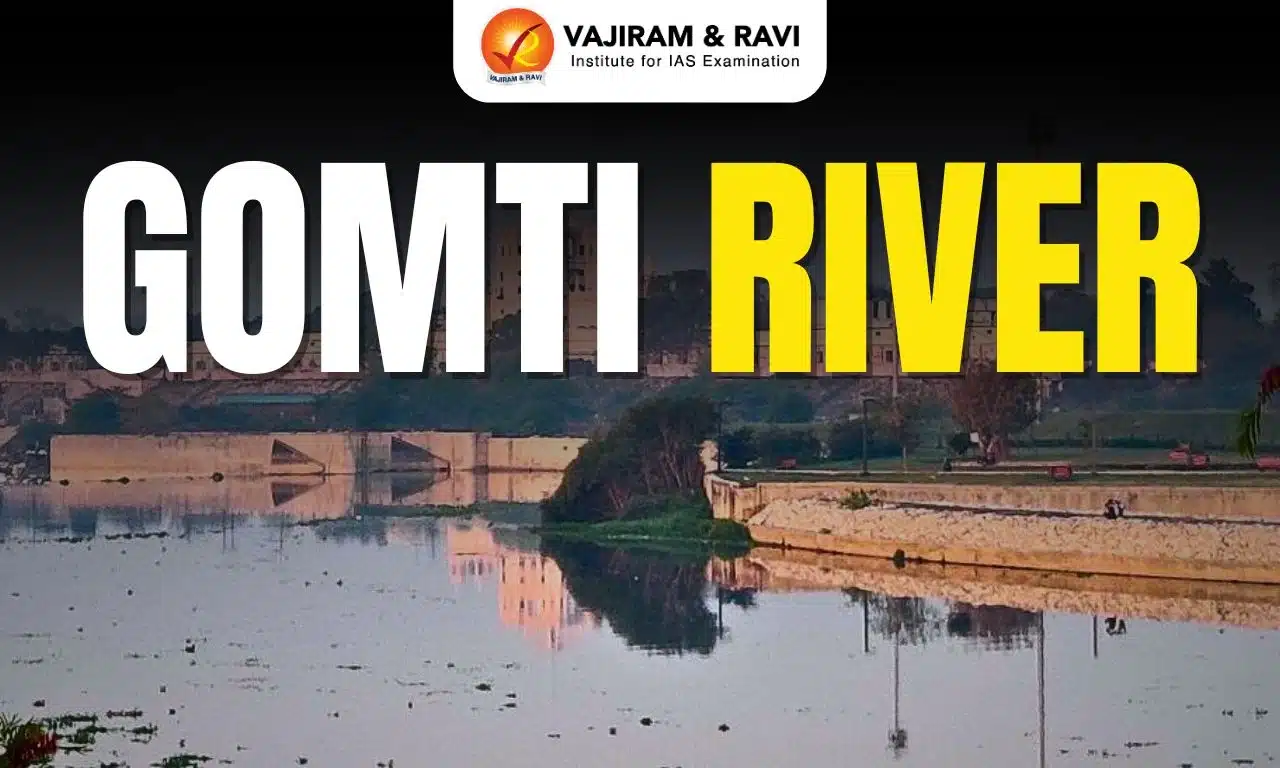
The rising level of water in the Gomti River in Lucknow has triggered a flood-like situation in parts of the city recently.

About Gomti River

  • It is a tributary of the Ganges (Ganga) River, flowing entirely through the state of Uttar Pradesh.
  • The river is also known by the names Gumti or Gomati.
  • Course:
    • It originates from Gomath Tal (Fulhar Jheel) near the town of Madho Tanda in the Pilibhit district which lies within the Pilibhit Tiger Reserve. 
    • From here, the river travels a distance of about 940 kilometers before it merges with the Ganga River near Saidpur/Kaithi in Ghazipur district. 
  • The entire Gomti basin is underlain by thick alluvial sediments of the Quaternary age. 
    • The alluvial sediments consist of boulders, pebbles, gravel, sand, silt, clay, and kankars.
    • The unconsolidated unit may be further subdivided into younger alluvium and older alluvium. 
    • The younger alluvium occupies the present-day flood plains, while the older group occupies elevated portions, mainly the doab portions.
    • The older alluvium is characterized by kankar nodules at depth otherwise it is similar to the younger alluvium. 
  • It is a perennial river. The river is characterised by sluggish flow throughout the year, except during the monsoon season, when heavy rainfall causes a manifold increase in the runoff.
  • Major Tributaries: Sai River, Chowka River, Kathina River, and Saryu River.
  • There are various cities that are situated on the banks of River Gomti, such as Sultanpur, Lucknow, Jaunpur, and Lakhimpur Kheri.
  • Over the years, Gomti has become one of the most polluted rivers in Uttar Pradesh.

News: NDTV

Gomti River FAQs

Q1: Which major river is the Gomti River a tributary of?

Ans: The Ganga River.

Q2: In which Indian state does the Gomti River flow entirely?

Ans: Uttar Pradesh.

Q3: Where does the Gomti River originate?

Ans: It originates from Gomath Tal, also known as Fulhar Jheel, near Madho Tanda in Pilibhit district, Uttar Pradesh.

Q4: What is the approximate length of the Gomti River?

Ans: About 940 kilometres.

National SC-ST Hub Scheme

National SC-ST Hub scheme

National SC-ST Hub Scheme Latest News

The National SC-ST Hub Scheme has assisted 1,90,414 beneficiaries, and trained 54,499 candidates, as of 31st July 2026 since its inception. 

About National SC-ST Hub Scheme

  • It was launched in October 2016.
  • It is one of the flagship schemes of the Ministry of Micro, Small & Medium Enterprises.
  • It is aimed at capacity enhancement of Schedule Caste – Schedule Tribe entrepreneurs and promoting “entrepreneurship culture” amongst the SC-ST population.
  • Implementation: It is implemented by the National Small Industries Corporation Ltd. (NSIC).
  • The NSSH scheme supports purchase of plant & machinery/equipment; capacity building & training, market linkage, facilitation for participation in exhibitions, credit, Udyam registration and GeM onboarding.
    • One of the major components of NSSH is the Special Credit Linked Capital Subsidy Scheme (SCLCSS).
    • Under the scheme, new and existing SC/ST-owned MSEs can receive a 25 per cent capital subsidy, capped at ₹25 lakh, for investment in plant, machinery and equipment financed through institutional credit.

Functions of the scheme

  • To encourage SC/ST owned units to be part of 4% of total procurement being made by Central/State Governments, CPSEs and other government agencies
  • To prepare strategy for intervention through industry associations to sensitize, encourage and enable the SC/ST owned units for participation in Public Procurement Process
  • Facilitating SC/ST Entrepreneurs to be part of vendor development programs and mentoring support by specific CPSE matching the products/services of such entrepreneurs
  • Capacity building of existing and prospective SC/ST entrepreneurs through skill development programs
  • Significance: These initiatives are fostering inclusive economic growth, promoting self-reliance and strengthening the MSME ecosystem by creating greater opportunities across India.

Source: PIB

National SC-ST Hub Scheme FAQs

Q1: What is the National SC-ST Hub Scheme?

Ans: It is one of the flagship schemes of the Ministry of Micro, Small & Medium Enterprises.

Q2: Which organization implements the National SC-ST Hub Scheme?

Ans: It is implemented by the National Small Industries Corporation Ltd. (NSIC).

Ghana

Ghana

Ghana Latest News

Recently, Ghana's Cabinet has approved a decision to seek membership of the BRICS organization.

About Ghana

  • Location: It is located in West Africa.
  • Bordering Countries: It shares its borders with three countries: Côte d’Ivoire to the west, Burkina Faso to the north, and Togo to the east.
  • It is situated on the Gulf of Guinea and the Atlantic Ocean in the subregion of West Africa. 
  • The Prime Meridian passes through it.
  • Capital City: Accra.

Geographical Features of Ghana

  • Climate: Generally, the country has a tropical, warm and humid climate. 
  • Topography: In Ghana Kwahu Plateau and Gambaga Scarp form major uplands and escarpments.
  • Mountains: Mount Afadjato , Mount Djebobo, Mount Torogbani , all situated east of the Volta River near the Togo border. 
  • Lakes: Lake Volta which is created by the Akosombo Dam and considered as one of the largest artificial lakes globally
  • Rivers: The drainage system is dominated by the Volta River basin, which includes Lake Volta and the Black Volta, White Volta, and Oti rivers. 
  • Natural Resources: Gold, cocoa and more recently oil form the cornerstone of Ghana’s economy and have helped fuel an economic boom.

Source: DD News

Ghana FAQs

Q1: Where is Ghana located?

Ans: It is located in West Africa.

Q2: What is the capital city of Ghana?

Ans: Accra

Snow Leopard

Snow Leopard

Snow Leopard Latest News

India’s first high-altitude snow leopard wildlife safari was launched in the cold desert of Ladakh recently.

About Snow Leopard

  • It is a large wild cat native to the high-altitude mountain ranges of Central and South Asia.
  • It is popularly known as the “Ghost of the Mountains” because of its elusive nature and excellent camouflage. 
  • Scientific Name: Panthera uncia 
  • Formerly classified as Leo uncia, the snow leopard has been placed—with the lion, tiger, and other big cats—in the genus Panthera. 

Snow Leopard Habitat and Distribution

  • They inhabit the highlands of central Asia and the Indian subcontinent, ranging from the Himalayas, Hindu Kush, and Plateau of Tibet in the south to the Altai Mountains and highlands west of Lake Baikal in Russia. 
  • They are found in rocky, shrub-dominated, and grassy habitats occurring between 500 and 5,800 meters.
  • India is home to an estimated 500–700 snow leopards spread across the Himalayas and Trans-Himalayan region.
  • It is the state animal of Himachal Pradesh. 

Snow Leopard Features

  • Adult snow leopards grow to a length of about 2.1 meters, including the 0.9-meter-long tail. 
  • They stand about 0.6 meter high at the shoulder and weigh 23–41 kg , with males slightly heavier and larger than females. 
  • Their soft coat, consisting of a dense insulating undercoat and a thick outercoat of hairs about 5 cm long, is pale grayish with dark rosettes and a dark streak along the spine. 
  • The underparts, on which the fur may be 10 cm long, are uniformly whitish. 
  • They have several other physical adaptations to conserve heat in cold mountain environments, including broad front paws, small rounded ears, and a wide head containing large nasal cavities, which can warm the cold air it takes in. 

Snow Leopard Conservation Status

It is classified as 'Vulnerable' under the IUCN Red List.

News: NIE

Snow Leopard FAQs

Q1: What is the Snow Leopard?

Ans: The Snow Leopard is a large wild cat native to the high-altitude mountain ranges of Central and South Asia.

Q2: In which countries and regions is the Snow Leopard found?

Ans: It is found across the mountainous regions of Central and South Asia, including India, Nepal, Bhutan, China, Mongolia, Pakistan and Russia.

Q3: What type of habitat does the Snow Leopard prefer?

Ans: Rocky, shrub-dominated and grassy habitats in high-altitude mountain regions.

Q4: What is the IUCN Red List conservation status of the Snow Leopard?

Ans: Vulnerable (VU).

Guru Ravidas

Guru Ravidas

Guru Ravidas Latest News

The Prime Minister recently inaugurated the Adampur Airport in Punjab and renamed it after Sri Sant Guru Ravidas Ji in a bid to honour the revered saint and social reformer on his birth anniversary.

About Guru Ravidas

  • Guru Ravidas (1377-1527 C.E.) was a renowned saint known for his contributions to the Bhakti movement.
  • His devotional songs and verses made a lasting impact upon the Bhakti Movement.
  • Guru Ravidas is also known as Raidas, Rohidas, and Ruhidas.
  • Ravidas was born in a village called Sir Gobardhanpur, near Varanasi in Uttar Pradesh, India. 
    • Today, his birthplace is a special place known as Shri Guru Ravidass Janam Asthan.
    • His birthday is celebrated as Ravidas Jayanti.
  • Ravidas is traditionally seen as a student of the bhakti-poet Ramananda. 
  • He is also thought to have lived around the same time as Kabir, another famous poet-saint.
  • He was a well-known poet. His poems, written in local languages, inspired many people.
    • 41 of his devotional songs and poems are found in the Sikh holy book, the Guru Granth Sahib. 
    • Many of his poems are also in the Panch Vani text of the Dadu Panthi tradition within Hinduism. 
  • Philosophy and Teachings:
    • The core of Guru Ravidas’s philosophy was the rejection of the caste system and the promotion of human rights and dignity. 
    • He envisioned a society called 'Beghumpura' (a city without sorrow), where there is no suffering, no fear, and no discrimination.
    • He also became a symbol of opposition to untouchability in society by the higher caste people for the lower caste people.
    • He emphasised the philosophy of spiritual freedom.
    • He abandoned the saguna (with attributes, image) forms of supreme beings and focussed on the nirguna (without attributes, abstract) form of supreme beings.
    • Meera Bai, a revered figure in Hindu spiritualism, is said to have considered Guru Ravidas as her spiritual Guru. 
  • Ravidassia religion:
    • The Guru’s teachings now form the basis of the Ravidassia religion.
    • Ravidassias believe that Guru Ravidas should be treated as a saint just like the other gurus, as he lived before the first Sikh Guru, and his teachings were studied by the Sikh Gurus.
    • The Ravidassia community adopted the Amrit Bani Guru Ravidass as its holy book and established its own symbols and rituals.

Source: IT

Guru Ravidas FAQs

Q1: Who was Guru Ravidas?

Ans: Guru Ravidas was a renowned saint known for his contributions to the Bhakti movement.

Q2: During which period did Guru Ravidas live?

Ans: Guru Ravidas lived from 1377 to 1527 C.E.

Q3: By what other names is Guru Ravidas known?

Ans: He is also known as Raidas, Rohidas, and Ruhidas.

Q4: Who is traditionally considered Guru Ravidas’s spiritual teacher?

Ans: Ramananda, the Bhakti poet-saint.

Q5: Which contemporary saint is Guru Ravidas believed to have lived alongside?

Ans: He is also thought to have lived around the same time as Kabir, another famous poet-saint.

Pandya Dynasty

Pandya Dynasty

Pandya Dynasty Latest News

An 800-year-old Shiva temple of the later Pandya period was recently unearthed at Udampatti, a village in Melur taluk, Madurai district, Tamil Nadu.

About Pandya Dynasty

  • The Pandya dynasty was an ancient Tamil dynasty of South India that developed during the Sangam Age. 
  • It is one of the three Tamil dynasties, the other two being the Chola and the Chera. 
    • The kings of the three dynasties were referred to as the Three Crowned Kings of Tamilakam.
  • The Early Pandyas ruled parts of Southern India from at least 4th century BCE. Pandya rule ended in the first half of the 16th century CE.
  • They ruled extensive territories, at times including the Chera (Kerala) country, the Chola country, and Ceylon (now Sri Lanka) through collateral branches subject to Madura.
  • They initially ruled their country, Pandya Nadu, from Korkai, a seaport on the southernmost tip of the Indian Peninsula, and in later times moved to Madurai.
  • The early Pandya Dynasty of the Sangam Literature faded into obscurity upon the invasion of the Kalabhras.
  • The dynasty revived under Kadungon in the early 6th century, pushed the Kalabhras out of the Tamil country, and ruled from Madurai. 
  • They again went into decline with the rise of the Cholas in the 9th century and were in constant conflict with them. 
  • The Pandyas allied themselves with the Sinhalese and the Cheras in harassing the Chola empire until they found an opportunity for reviving their fortunes during the late 13th century. 
  • The Later Pandyas (1216–1345) entered their golden age under Maravarman Sundara Pandyan and Jatavarman Sundara Pandyan (c. 1251), who expanded the empire into Telugu country,conquered Kalinga (Orissa), and invaded and conquered Sri Lanka. 
  • They also had extensive trade links with the Southeast Asian maritime empiresof Srivijaya and their successors. 
  • The Pandyas excelled in both trade and literature.
  • They controlled the pearl fisheries along the South Indian coast between Sri Lanka and India, which produced some of the finest pearls in the known ancient world.
  • The Pandyas had diplomatic relations as far as Rome. 
  • The symbol of the Pandya Dynasty was the fish. 

Pandya Dynasty Literary Sources

  • Pandyas are mentioned in Sangam literature (c. 100–200 C.E.) as well as by Greek and Roman sources during this period. 
  • The country of the Pandyas was described as Pandaie by Megasthenes, Pandi Mandala in the Periplus of the Erythraean Sea (1st-century CE Greco-Roman travelogue) and as Pandya Mediterranea and Modura Regia Pandionis by Ptolemy.

Pandya Dynasty Literary Sources Cultural Contributions

  • The Pandya empire was home to temples including Meenakshi Temple in Madurai, and Nellaiappar Temple in Tirunelveli.
  • Jainism, Shaivism, and Vaishnavism flourishedduring the reign of the early Pandya kings, but after the revival of the Pandya power by Kadungon, the Shaivite Nayanars and the Vaishnavite Alvars rose to prominence. and the non-Hindu sects declined.
  • Traditionally, the legendary Sangams (congregation of Tamil poets who created the great Sangam literature) were held in Madurai under their patronage, and some of the Pandya Kings were poets themselves. 
  • Under Pandya patronage, Tamil poets and scholars thrived, enriching Tamil literature significantly. 
  • The dynasty also made notable contributions to art, music, and dance, particularly Bharatanatyam. 
  • Advancements in irrigation and agriculture further bolstered their economic stability. 
  • The Pandyas actively promoted education and established renowned centers of learning.

Pandya Dynasty Literary Sources Decline

  • During their history, the Pandyas were repeatedly in conflict with the Pallavas, Cholas, Hoysalas, and finally the Muslim invaders from the Delhi Sultanate. 
  • The Islamic invasion led to the end of Pandya supremacy in South India, and in 1323, the Jaffna Kingdom of Sri Lanka declared its independence from the crumbling Pandya Empire. 
  • The Pandyas lost their capital city, Madurai, to Madurai Sultanate in 1335. 
  • However, they shifted their capital to Tenkasi and continued to rule the Tirulnelveli, Tuticorin, Ramanad, and Sivagangai regions. 
  • Meanwhile, the Madurai sultanate was replaced by Nayaka governors of Vijayanagara in 1378. 
  • In 1529 Nayaka governors declared independence and established the Madurai Nayak dynasty.

Pandya Dynasty FAQs

Q1. What was the earliest known capital of the Pandya Dynasty?

Ans. They initially ruled their country, Pandya Nadu, from Korkai, a seaport on the southernmost tip of the Indian Peninsula, and in later times moved to Madurai.

Q2. Which ancient travelogue referred to the Pandya territory as "Pandi Mandala"?

Ans. Periplus of the Erythraean Sea

Q3. Which symbol is associated with the Pandya Dynasty?

Ans. Fish

Source: TH

Who was Rani Durgavati?

Who was Rani Durgavati?

About Rani Durgavati:

  • Rani Durgavati (1524-2024) was the descendant of the famous Chandela dynasty of Mahoba and the queen of the Gond kingdom of Garha-Katanga.
  • She was born on 5th October 1524 A.D. in the family of famous Chandel emperor Keerat Rai.
    • The Chandel Dynasty is famous in Indian history for the valiant king Vidyadhar, who repulsed the attacks of Mehmood Gaznavi.
    • His love for sculptures is shown in the world famed temples of Khajuraho and Kalanjar Fort. 
  • Rani Durgavati was born in Kalinjar (Banda, U.P.), one of the most important forts of medieval India.
  • In 1542, she was married to Dalpatshah, the eldest son of King Sangramshah of the Gond Dynasty. Chandel and Gond dynasties got closer as a consequence of this marriage.
  • She gave birth to a son in 1545 A.D. who was named Vir Narayan.
  • Dalpatshah died in about 1550 A.D. As Vir Narayan was too young at that time, Durgavati took the reins of the Gond kingdom in her hands. 
  • Two ministers, Adhar Kayastha and Man Thakur, helped the Rani in looking after the administration successfully and effectively. 
  • Rani moved her capital to Chauragarh in place of Singaurgarh. It was a fort of strategic importance situated on the Satpura hill range.
  • It is said that trade flourished during this period. Peole were prosperous.
  • Like her husband’s predecessors, she extended her territory and accomplished the political unification of Gondwana, also called Garha-Katanga, with courage, generosity, and tact.
  • She distinguished herself as a warrior and fought with unvarying success against BazBahadur, the Sultan of Malwa.
  • In the year 1562, Akbar vanquished the Malwa ruler Baj Bahadur and annexed the Malwa with Mughal dominion. Consequently, the state boundary of Rani touched the Mughal kingdom.
  • She is chiefly remembered fordefending Gondwana against the Mughal Empire. She took on the might of the Mughal Empire with great courage and leadership.
  • Though she finally faced defeat at the hands of the Mughal army, she is remembered as a warrior in blood and spirit.

Q1: What is the Gond Dynasty?

The Gond dynasty arose in the Gondwana region of central India around the 13th century CE. Their influence spread from eastern Madhya Pradesh to western Odisha and parts of Andhra Pradesh and Uttar Pradesh. They governed four major kingdoms: Garha-Mandla, Deogarh, Chanda, and Kherla. The Gond rulers held power between the 16th and 18th centuries in present-day Madhya Pradesh.

Source: Madhya Pradesh Cabinet gives nod to Rs 100 crore memorial for Rani Durgavati in Jabalpu

What is Atal Mission for Rejuvenation and Urban Transformation (AMRUT) Scheme?

What is Atal Mission for Rejuvenation and Urban Transformation (AMRUT) Scheme?

About AMRUT Scheme

  • It was launched by the Ministry of Housing and Urban Affairs on 25th June 2015, in 500 selected cities and towns across the country. 
  • It focuses on development of basic infrastructure in the selected cities and towns in the sectors of water supply, sewerage and septage management, storm water drainage, green spaces and parks, and non-motorized urban transport. 
  • A set of Urban Reforms and Capacity Building have been included in the mission.
  • AMRUT Mission has been subsumed under AMRUT 2.0, which was launched on 01st October, 2021.
  • AMRUT 2.0, which was launched for a period of five years, from the financial year 2021-22 to the financial year 2025-26, is designed to provide universal coverage of water supply through functional taps to all households in all the statutory towns in the country and coverage of sewerage/septage management in 500 cities covered in the first phase of the AMRUT scheme.
  • AMRUT 2.0 will promote a circular economy of water through the development of City Water Balance Plan (CWBP) for each city focusing on recycle/reuse of treated sewage, the rejuvenation of water bodies, and water conservation.
  • It will help cities to identify scope for projects focusing on universal coverage of functional water tap connections, water source conservation, rejuvenation of water bodies and wells, recycle/reuse of treated used water, and rainwater harvesting. 
  • Based on the projects identified in CWBP, Mission envisages making cities ‘water secure’ through a circular economy of water.
  • The mission also has a reform agenda on ease of living of citizens through reduction of non-revenue water, recycle of treated used water, rejuvenation of water bodies, augmenting double entry accounting system, urban planning, strengthening urban finance etc.
  • Other components of AMRUT 2.0 are:
    • Pey Jal Survekshan to ascertain equitable distribution of water, reuse of wastewater, mapping of water bodies, and promote healthy competition among the cities /towns.
    • Technology Sub-Mission for water to leverage latest global technologies in the field of water.
    • Information, Education, and Communication (IEC) campaign to spread awareness among the masses about conservation of water.
  • The total indicative outlay for AMRUT 2.0 is ₹2,99,000 crore including Central share of ₹76,760 crore for five years.

Q1) Which are the major tributaries of Krishna River?

The principal tributaries joining Krishna are the Ghataprabha, the Malaprabha, the Bhima, the Tungabhadra and the Musi.

Source: 39 sewage treatment plants from AMRUT scheme to line Musi river in Hyderabad

Enquire Now