Bharat Tulip

Bharat Tulip

Bharat Tulip Latest News

Recently, the Ministry of Social Justice & Empowerment has introduced BHARAT TULIP at the Mysuru Dasara Exhibition Grounds at Mysuru in Karnataka.

About Bharat Tulip

  • Bharat Tulip (Traditional Artisans’ Upliftment Livelihood Programme) was launched in 2024.
  • It is an initiative by the National Backward Classes Finance and Development Corporation (NBCFDC) under the Ministry of Social Justice and Empowerment.
  • It is a transformative platform designed to empower marginalized artisans by integrating them into the global digital economy.
  • Objectives
    • Empower artisans with access to digital marketplaces.                      
    • Enable artisans to participate in domestic/global trade fairs, exhibitions, and fashion shows.                     

Functions of Tulip

  • E-Commerce Integration: Tulip collaborates with leading e-commerce platforms to expand artisans' reach and boost sales opportunities.                     
    Facilitating Sales: It enables artisans to sell high-quality products through digital marketplaces.
  • Quality Assurance: Ensuring rigorous quality checks so that only premium products are delivered directly to customers.                      
  • Skill Development: Providing essential training to artisans to improve craftsmanship and market readiness.                      
  • Global Outreach: Expanding artisans' presence on international B2C platforms to tap into global markets.                      
  • Participation in Fair: Offering artisans opportunities to showcase and sell their products at national and international fairs, opening new revenue streams.

Source: PIB

Bharat Tulip FAQs

Q1: Which organisation initiated Bharat Tulip?

Ans: It is an initiative by the National Backward Classes Finance and Development Corporation.

Q2: What is the purpose of Bharat Tulip?

Ans: It is a transformative platform designed to empower marginalized artisans by integrating them into the global digital economy.


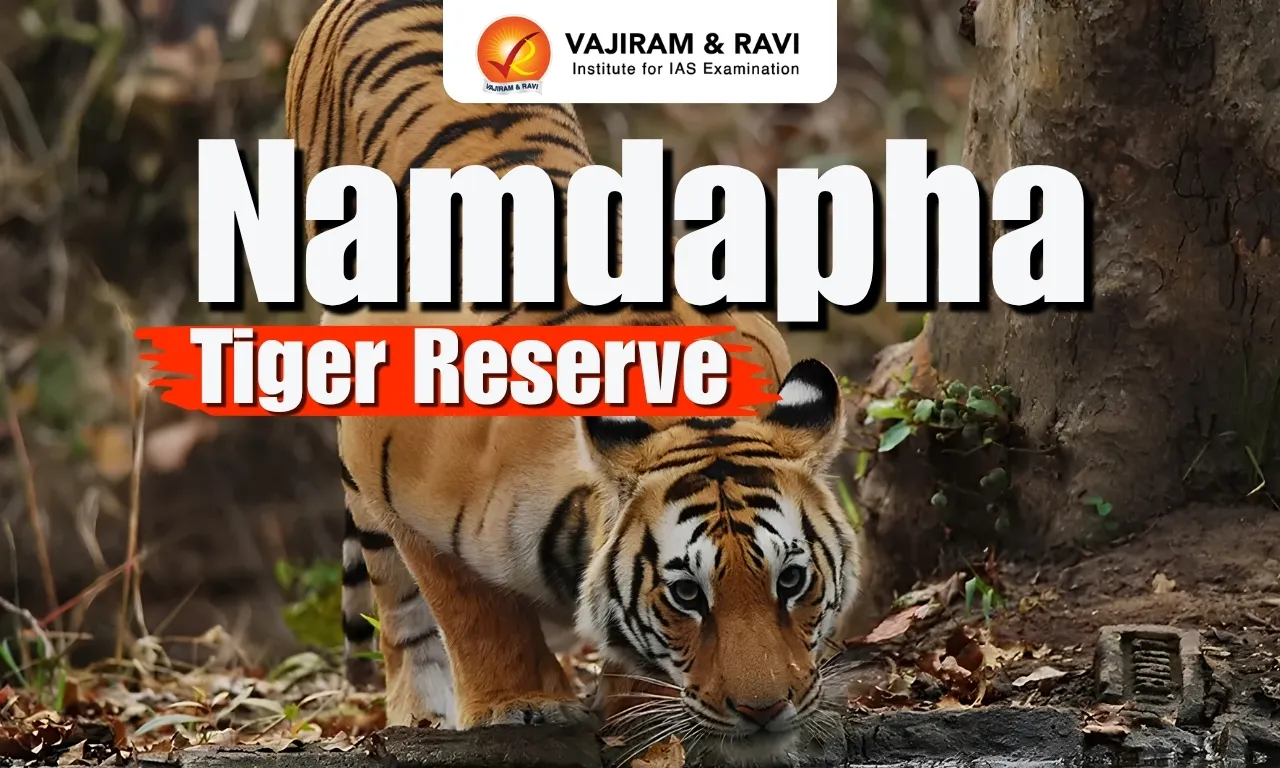
Namdapha Tiger Reserve

Namdapha Tiger Reserve

Namdapha Tiger Reserve Latest News

Recently, employees of Namdapha National Park and Tiger Reserve in Arunachal Pradesh engaged under the Centre's Project Tiger have raised wage issues. 

About Namdapha Tiger Reserve

  • Location: It is located in the state of Arunachal Pradesh.
  • It is named after the river Namdapha originating from Daphabum, the highest mountain peak in the Reserve.
  • This area was originally Reserved Forests and was declared as Wildlife Sanctuary in 1972
  • It was declared as a Tiger Reserve in 1983 under Project Tiger scheme.  
  • Topography: It has a dense cover of vegetation with high hills, and numerous rivers and seasonal streams.
  • Vegetation: The vegetation of the reserve is mainly tropical evergreen rainforest, with very dense and multi-layered forest structure.
  • Flora: The forests include thick growth of bamboo, cane, wild banana, and other undergrowth, making them almost impenetrable in some areas.
  • Fauna: It is home to four big cats viz. tiger, leopard, clouded leopard and snow leopard
    • Other animals like Hoolock Gibbon, Golden Cat, Marbled Cat, Mishmi Takin, Red Panda, Namdapha Flying Squirrels are found here.

Source: IT

Namdapha Tiger Reserve FAQs

Q1: Where is Namdapha Tiger Reserve located?

Ans: Arunachal Pradesh

Q2: What type of vegetation is found in Namdapha Tiger Reserve?

Ans: It mainly consists of tropical evergreen rainforest

Exercise IBSAMAR IX

Exercise IBSAMAR IX

Exercise IBSAMAR IX Latest News

Indian Naval Ship (INS) Tarkash deployed in South Africa to participate in the ninth edition of the India-Brazil-South Africa Maritime (IBSAMAR) Exercise 2026. 

About Exercise IBSAMAR IX

  • It is a joint multinational maritime exercise conducted between Indian, Brazilian, and South African Navy.
  • IBSAMAR has been conducted biennially since 2008 under the India-Brazil-South Africa (IBSA) framework.
  • Theme: The theme of IBSAMAR IX is Stronger Together Towards a Shared Future in the Maritime Domain.
  • It aims to promote collective maritime security and preparedness to address maritime challenges.
  • Participating Warships and Aircraft: The Indian Navy is participating with INS Tarkash, accompanied by an integral Chetak helicopter.
  • The exercise will cover a broad spectrum of maritime operations, including surface warfare, anti-air warfare, anti-submarine warfare, naval air operations, maritime interdiction, Visit Board Search and Seizure (VBSS), anti-piracy operations, search and rescue, damage control and firefighting.

Key facts about INS Tarkash

  • It is a frontline guided-missile stealth frigate of the Indian Navy.
  • It is the second of three Talwar-class guided missile frigates. 
  • It is designed and built in Russia, the Talwar-class guided missile frigates are modified versions of the Krivak III-class frigate. 
  • It was built by the Yantar shipyard in Kaliningrad, Russia.
  • It was commissioned into Indian Navy service on 9 November 2012 at Kaliningrad.
  • Speed: With maximum speed in excess of 30 knots, a range of 4,500 miles or 30 days.

Source: PIB

Exercise IBSAMAR IX FAQ's

Q1: Exercise IBSAMAR IX conducted between which countries?

Ans: Indian, Brazilian, and South African Navy.

Q2: What is the theme of Exercise IBSAMAR IX?

Ans: The theme of IBSAMAR IX is Stronger Together Towards a Shared Future in the Maritime Domain.

TRISHNA Satellite

TRISHNA Satellite

TRISHNA Satellite Latest News

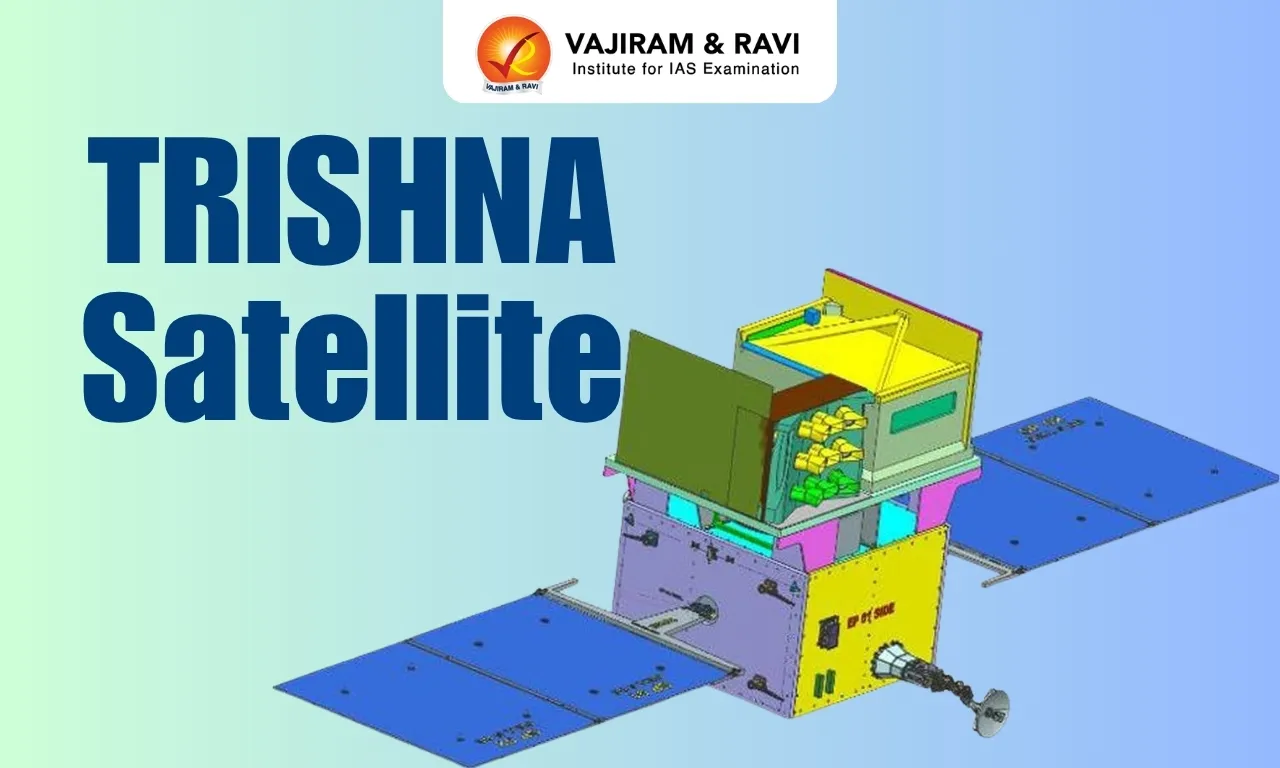
Recently, the project head of the Indo-French satellite TRISHNA informed us that it will be launched in the next 12-16 months. 

About TRISHNA Satellite

  • The TRISHNA (Thermal Infra-Red Imaging Satellite for High-resolution Natural Resource Assessment) is a collaborative endeavor between the Indian Space Research Organisation (ISRO) and the French Space Agency Centre National d’Etudes Spatiales (CNES).
  • It is the third satellite that India and France are developing after Megha-Tropiques and SARAL (Satellite with ARGOS and ALTIKA) satellites.
  • Objectives
    • Detailed monitoring of the energy and water budgets of the continental biosphere for quantifying terrestrial water stress and water use.
    • High-resolution observation of water quality and dynamics in coastal and inland waters.
    • A comprehensive assessment of urban heat islands detection of thermal anomalies linked to volcanic activity and geothermal resources.
    • Precise monitoring of snow-melt runoff and glacier dynamics. 
    • Provide valuable data on aerosol optical depth, atmospheric water vapor, and cloud cover. 
  • Payloads
    • The Thermal Infra-Red (TIR) Payload: It is provided by CNES and features a four-channel long-wave infrared imaging sensor capable of high-resolution surface temperature and emissivity mapping.
    • The Visible – Near Infra-Red – ShortWave Infra-Red (VNIR-SWIR) payload: It is developed by ISRO, includes seven spectral bands designed for detailed mapping of surface reflectance of VSWIR bands for generating important biophysical and radiation budget variables.
  • Function: It is engineered to deliver high spatial and high temporal resolution monitoring of the earth’s surface temperature, emissivity, and biophysical and radiation variables for surface energy budgeting at regional to global scale.

Source: TH

TRISHNA Satellite FAQs

Q1: TRISHNA Satellite is jointly developed by which organisation?

Ans: It is a collaboratively developed by the Indian Space Research Organisation (ISRO) and the French Space Agency Centre National d’Etudes Spatiales (CNES).

Q2: What is the objective of TRISHNA Satellite?

Ans: Detailed monitoring of the energy and water budgets of the continental biosphere for quantifying terrestrial water stress and water use.

Coronary Thrombosis

Coronary Thrombosis

Coronary Thrombosis Latest News

The recent death of a famous Indian actor has drawn attention to coronary thrombosis. 

About Coronary Thrombosis

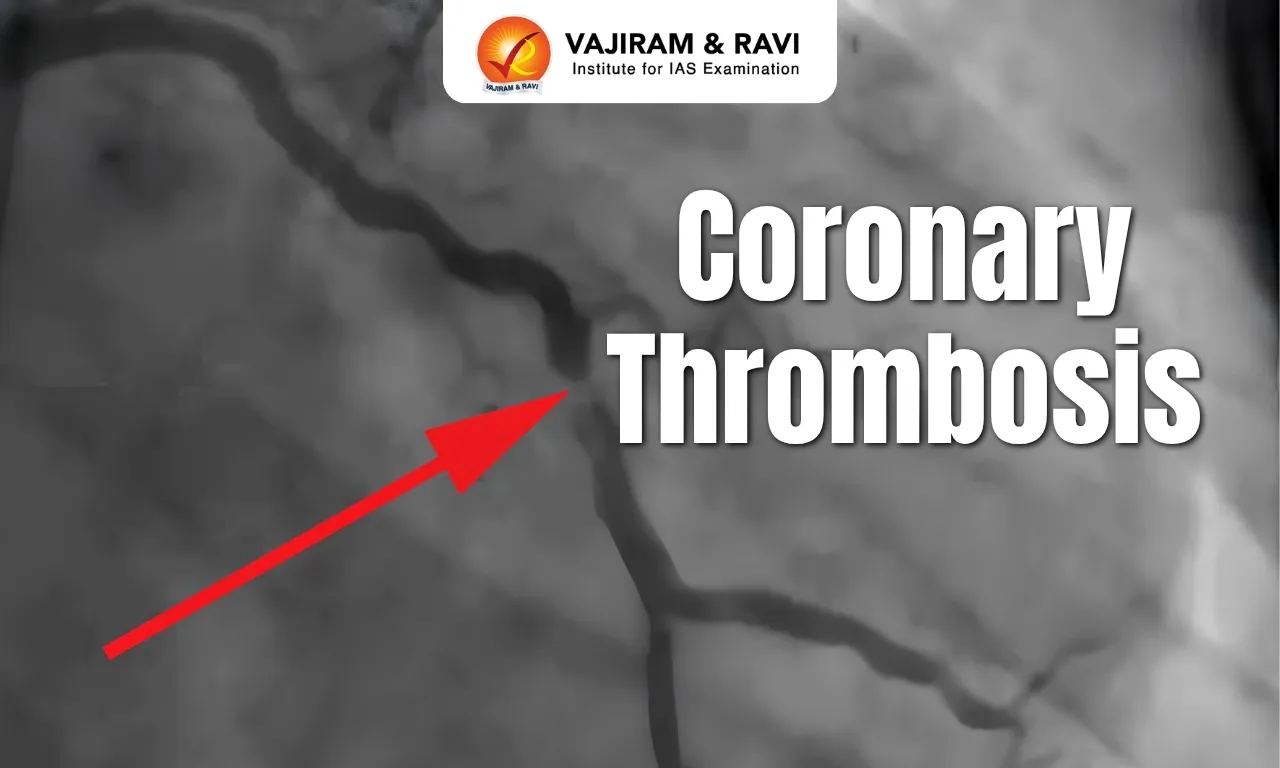
  • It occurs when a blood clot forms in one of the arteries that supply blood to the heart muscle.
    • These arteries carry oxygen and nutrients that the heart needs to function.
    • When a clot partly or completely blocks an artery, less blood reaches the heart muscle.
    • If the blood supply is cut off for too long, the heart muscle can become damaged, leading to a heart attack.
    • This form of thrombosis is often associated with atherosclerosis, in which fatty deposits, cholesterol and other substances build up in the artery walls.
  • Causes
    • Smoking is a major risk factor for coronary thrombosis as it can damage the blood vessels and promote the formation of blood clots.
    • High cholesterol levels can lead to the buildup of plaque in the arteries, increasing the risk of atherosclerosis and coronary thrombosis.
    • Hypertension can cause the arteries to become narrowed and damaged.
    • Obesity and a sedentary lifestyle are associated with an increased risk of coronary thrombosis.
  • Symptoms: Chest pain or discomfort, breathlessness, sweating, nausea, dizziness and unusual fatigue may also occur.
  • Treatment: It may include medications like blood thinners, clot-busting drugs, and antiplatelet agents. Procedures such as angioplasty with stent placement or coronary artery bypass surgery may be necessary to restore blood flow to the heart.

Source: TH

Coronary Thrombosis FAQs

Q1: What does Coronary Thrombosis occur?

Ans: It occurs when a blood clot forms in one of the arteries that supply blood to the heart muscle.

Q2: What are the treatments available for Coronary Thrombosis?

Ans: It may include medications like blood thinners, clot-busting drugs.

Mount Mukut

Mount Mukut

Mount Mukut Latest News

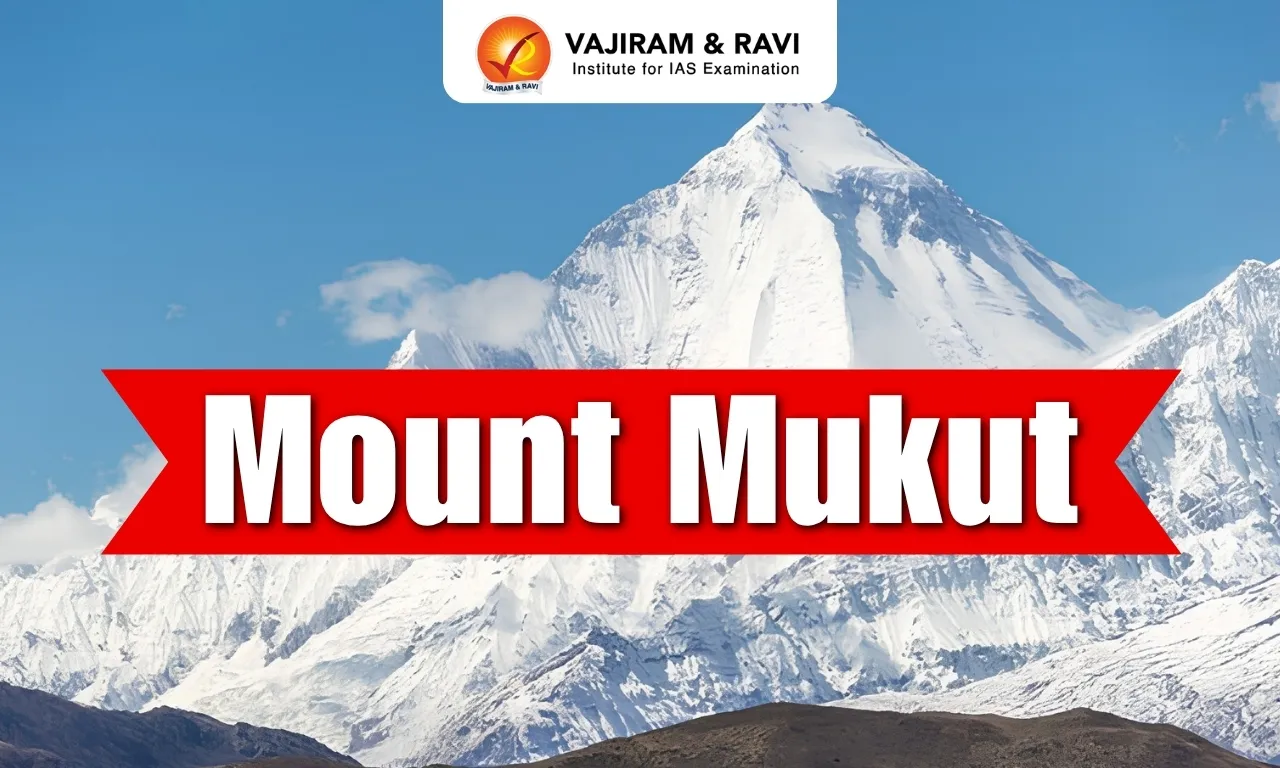
Recently, a 17-member Indian Coast Guard (ICG) mountaineering team has successfully scaled Mount Mukut (7,045-metre).

About Mount Mukut

  • Location: It is a high-altitude peak located in the Garhwal Himalaya of Uttarakhand, India, in the Zaskar Range near Mount Kamet.
  • It is part of the Gangotri Group of peaks and lies in the western Garhwal Himalayas, within the Nanda Devi Sanctuary. 
  • The peak is notable for its distinctive crown-like shape, which gives it the name “Mukut,” meaning crown in Hindi.
  • It occupies a transition zone between the greener, monsoon-influenced valleys of Garhwal and the dry, elevated landscape of the Tibetan Plateau.
  • The peak was first climbed in 1951 by a team from New Zealand which included Edmund Hillary and George Lowe. 
  • Topography: Its upper slopes consist almost entirely of exposed rock, permanent snow, glacier ice, and wind-scoured ridges.

Key Facts about Garhwal Himalaya

  • The Garhwal Himalaya forms the western part of the Central Himalayas and lies mainly in the Garhwal region of Uttarakhand.
  • It stretches from the Tons River in the west to the Kali River in the east.
  • The region shares its northern boundary with Tibet (China) and the southern boundary with the Shivalik Hills.
  • Rivers: It has numerous rivers including the Bhagirathi, Alaknanda, Mandakini, and Yamuna.
  • Flora: Dense forests of pine, oak, deodar, fir, and rhododendron.

Source: PIB

Mount Mukut FAQs

Q1: Where is Mount Mukut located?

Ans: Uttarakhand

Q2: Who climbed this Mount Mukut first?

Ans: The peak was first climbed in 1951 by a team from New Zealand which included Edmund Hillary and George Lowe. 

Research Development and Innovation Fund

Research Development and Innovation Fund

Research Development and Innovation Fund Latest News

Recently, the Research, Development and Innovation Fund (RDIF) has announced the first cohort of 19 Second Level Fund Managers (SLFMs). 

About Research Development and Innovation Fund

  • It is a flagship initiative of the Government of India.
  • It aims to provide long-term financing or refinancing with long tenors at low or nil interest rates to spur private sector investment in Research Development and Innovation.
  • Nodal Department: The Department of Science & Technology (DST).
  • Governance: The Governing Board of Anusandhan National Research Foundation (ANRF), chaired by the Prime Minister, will provide overarching strategic direction to the RDI Scheme. 

Key Objectives of the Research Development and Innovation Fund

  • Encourage the private sector to scale up research, development, and innovation (RDI) in sunrise domains and in other sectors relevant for economic security, strategic purpose, and self-reliance;
  • Finance transformative projects at higher levels of Technology Readiness Levels (TRL)
  • Support acquisition of technologies which are critical or of high strategic importance;
  • Facilitate setting up of a Deep-Tech Fund of Funds.

Funding Mechanism of Research Development and Innovation Fund

  • Total Budget: ₹1 Lakh crore
  • Implementation Structure
    • Special Purpose Fund (SPF): It will be established within the Anusandhan National Research Foundation (ANRF), which will serve as the custodian of the ₹1 lakh crore corpus. (Fund will not directly invest in industries and startups but will channel capital to Second-level fund managers)
    • Second-level fund managers: Who can be Alternative Investment Funds (AIF), Development Finance Institutions (DFI), Non-banking Finance Companies (NBFCs).
  • Modes of Financing
    • Long-term loan at low or nil interest rates.
    • Financing in the form of equity may also be done, especially in case of startups.

Source: PIB

Research Development and Innovation Fund FAQs

Q1: What is Research Development and Innovation Fund?

Ans: It is a flagship initiative of the Government of India.

Q2: What is the aim of Research Development and Innovation Fund?

Ans: It aims to provide long-term financing or refinancing with long tenors at low or nil interest rates to spur private sector investment in Research Development and Innovation.

Enquire Now