Agri Welfare Portal

Agri Welfare Portal

Agri Welfare Portal Latest News

Recently, the Union Agriculture and Farmers’ Welfare Minister launched the upgraded Agri Welfare Portal.

 About Agri Welfare Portal 

  • It aims to provide farmers across the country with direct, easy access to government schemes, financial assistance and reliable agricultural information on their mobile phones.

Key Features of Agri Welfare Portal

  • Scheme access: It brings information on initiatives including PM-KISAN, AgriStack and Pradhan Mantri Fasal Bima Yojana into a common interface, with online eligibility checks and application facilities.
  • Farm information: The portal is intended to provide updates on weather, farming practices, seeds, fertilisers and market prices.
  • Rural use: It is designed for basic smartphones and weak internet connections, with screen-reader support and simpler navigation for users with disabilities.
  • Assistance: A training campaign through Krishi Vigyan Kendras is planned to help farmers use the portal and other digital tools.
  • Wider network: Farmer Producer Organisations, Primary Agricultural Credit Societies, scientists, researchers and start-ups are also intended to be brought onto the platform.
  • Greater transparency and fewer intermediaries: It has features of Online eligibility checks, direct application facilities and the transfer of financial assistance through Direct Benefit Transfer (DBT).
  • Timely and reliable agricultural information: Farmers will be able to access authentic information on weather conditions, scientific farming practices, the availability of seeds and fertilisers, and prevailing market prices for agricultural produce.

Source: DD News

Agri Welfare Portal FAQs

Q1: Which ministry launched the Agri Welfare Portal?

Ans: Ministry of Agriculture and Farmers' Welfare

Q2: What is the aim of Agri Welfare Portal?

Ans: It aims to provide farmers across the country with direct, easy access to government schemes, financial assistance.

Swavlamban 2026

Swavlamban 2026

Swavlamban 2026 Latest News

The Indian Navy’s fifth Swavlamban seminar will build on a growing national effort to connect technological talent with the requirements of the maritime domain.

About Swavlamban 2026

  • It is the fifth edition of the Indian Navy’s flagship Naval Innovation and Indigenisation Seminar.
  • Venue: Manekshaw Centre in New Delhi 
  • The fifth edition will focus on converting indigenous technological innovations into operational capabilities for the Indian Navy. 
  • It aims to strengthen collaboration between the armed forces and India's domestic innovation ecosystem as the maritime security environment evolves. 
  • The two-day event will bring together innovators, industry partners, startups, micro, small, and medium enterprises (MSMEs), academic institutions, investors, and representatives of the Defence Forces. 
  • The exhibition will showcase indigenous technologies across several areas, including maritime surveillance, counter-unmanned aircraft systems (counter-UAS), artificial intelligence, quantum technologies, nuclear, biological, chemical, and damage control (NBCD), and systems designed to improve safety and operational efficiency. 
  • The programme will also include discussions on defence innovation, self-reliance, funding opportunities, and the commercialisation of technologies developed by Indian enterprises. 
  • The seminar has also been supported by the Government of India, the Ministry of Defence, the Society of Indian Defence Manufacturers, and the Defence Innovation Organisation.  
  • Participation has grown sharply since the first edition, reaching nearly 3,000 last year, with over 100 stalls expected this year.

News: RA

Swavlamban 2026 FAQs

Q1: What is Swavlamban 2026?

Ans: Swavlamban 2026 is the fifth edition of the Indian Navy’s flagship Naval Innovation and Indigenisation Seminar.

Q2: Where will Swavlamban 2026 be held?

Ans: At the Manekshaw Centre in New Delhi.

Q3: What is the primary focus of Swavlamban 2026?

Ans: Converting indigenous technological innovations into operational capabilities for the Indian Navy.

Homoporus Tridentata

Homoporus Tridentata

Homoporus Tridentata Latest News

Recently, entomologists have announced the discovery of a previously unknown parasitoid wasp species, Homoporus tridentate.

About Homoporus Tridentata

  • It is a new parasitoid wasp species.
  • Its name is directly derived from the Latin-based anatomical description of its distinctive three-toothed clypeal margin.
  • Features
    • The male species exhibits a brilliant metallic green head and thorax set against copper-brown eyes and ocelli.
    • Its most prominent feature is clypeus (a shield on the front of the face) carries three distinct teeth, with the middle tooth noticeably longer than the two stouter lateral teeth.
    • It possesses asymmetrical, or heterodont, mandibles, sporting four teeth on the right jaw and three on the left.
  • Ecological Significance: The wasps in the genus Homoporus are natural parasitoids that target the larvae and pupae of agricultural and forestry pests.

Source: RM

Homoporus Tridentata FAQs

Q1: What is Homoporus Tridentata?

Ans: It is a new parasitoid wasp species.

Q2: What is the significance of wasp species?

Ans: The wasps in the genus Homoporus are natural parasitoids that target the larvae and pupae of agricultural and forestry pests.

Bud Rot Disease

Bud Rot Disease

Bud Rot Disease Latest News

Coconut growers of Tiptur taluk, Tumakuru district, Karnataka, are worried as coconut trees are increasingly affected by Bud Rot Disease causing their crowns to break and fall off.

About Bud Rot Disease

  • It is a fatal disease of the coconut palm, characterized by the rotting of the terminal bud and the surrounding tissues. 
  • It affects the palms of all ages, but young palms are found to be most vulnerable. 
  • It is caused by the fungus Phytophthora palmivora, which attacks the growing point of the coconut palm.
    • Once the growing point is attacked, the palm is beyond recovery. 
  • The incidence is found to be severe during the monsoon when the relative humidity is high. 
  • With the onset of dry weather, the infection becomes less severe, and the fungus remains dormant in the leaf base. 
  • The disease is often seen in river banks subject to flooding. Normally, the disease is observed sporadically in widely scattered palms. 
  • Symptoms:
    • In seedlings, the earlier symptom is the yellowing of one or two younger leaves.
      • Basal tissues of the leaf rot quickly and can be easily pulled out from the crown.
      • In the later stages the spindle withers and drops down.
      • The tender leaf base and soft tissues of the crown rot into a slimy mass of decayed material emitting a foul smell.
      • Ultimately the entire crown falls down, and the palm dies.
    • In adult palms, the first visible symptom is the colour change of the spear, which becomes pale and breaks at the base and hangs down. 
      • The rotting slowly progresses downwards, finally affecting the meristem and killing the palms. 
      • This is accompanied by drooping of successive leaves. Even then, nuts that are retained on the palm may grow to maturity.
      • The disease proves fatal if not checked at the early stages, before damage of the bud.
  • Management: Because it can be fatal, management is about early detection and prompt action: cleaning out the rotted tissue, applying copper paste/fungicide (Bordeaux paste) to the wound and bud, and prophylactic crown sprays of neighbouring palms before and during the wet season.

News: DH

Bud Rot Disease FAQs

Q1: What is Bud Rot Disease?

Ans: Bud Rot Disease is a fatal disease of coconut palms characterised by the rotting of the terminal bud and surrounding tissues.

Q2: What causes Bud Rot Disease in coconut palms?

Ans: The fungus-like pathogen Phytophthora palmivora.

Q3: During which season is Bud Rot Disease generally more severe?

Ans: During the monsoon, when relative humidity is high.

Q4: What is the earliest symptom of Bud Rot Disease in coconut seedlings?

Ans: Yellowing of one or two younger leaves.

Q5: How is Bud Rot Disease managed in coconut palms?

Ans: By removing rotted tissue, applying a recommended copper-based treatment such as Bordeaux paste to the affected area, and spraying neighbouring palms preventively before and during the wet season.

Indian Cybercrime Coordination Centre

Indian Cybercrime Coordination Centre (I4C)

Indian Cybercrime Coordination Centre Latest News

The Indian Cyber Crime Coordination Centre (I4C) recently warned of a rise in financial fraud involving deceptive advertisements that use manipulated videos of the Prime Minister, the finance minister, and chief ministers to promote fake government welfare schemes.

About Indian Cybercrime Coordination Centre 

  • I4C has been established under the Ministry of Home Affairs (MHA) to act as a nodal point at the National level in the fight against cybercrime. 
  • The I4C was dedicated to the nation on 10th January 2020.
  • It is designed to provide a framework and ecosystem for law enforcement agencies (LEAs) to deal with cybercrime in a coordinated and comprehensive manner.
  • I4C brings together academia, industry, public, and government in the prevention, detection, investigation, and prosecution of cybercrimes.
  • Headquarters: New Delhi.

Indian Cybercrime Coordination Centre Objectives

  • To act as a nodal point to curb cybercrime in the country.
  • To strengthen the fight against cybercrime committed against women and children.
  • Facilitate easy filing of cybercrime-related complaints and identifying cybercrime trends and patterns.
  • To act as an early warning system for LEAs for proactive cybercrime prevention and detection.
  • Awareness creation among the public about preventing cybercrime.
  • Assist states/UTs in the capacity building of Police Officers, Public Prosecutors and Judicial Officers in the area of cyber forensics, investigation, cyber hygiene, cyber-criminology, etc.
  • Identify the research problems and needs of LEAs and take up R&D activities in developing new technologies and forensic tools in collaboration with academia/research institutes within India and abroad.
  • Suggest amendments, if required, in cyber laws to keep pace with fast-changing technologies and international cooperation.
  • To coordinate all activities related to the implementation of Mutual Legal Assistance Treaties (MLAT) with other countries related to cybercrimes in consultation with the concerned nodal authority in MHA.

Indian Cybercrime Coordination Centre Components

  • National Cybercrime Threat Analytics Unit (TAU)
  • National Cybercrime Reporting Portal (NCRP)
  • National Cybercrime Training Centre (NCTC)
  • National Cybercrime Research and Innovation Centre
  • Platform for Joint Cyber Crime Coordination Team
  • Cybercrime Ecosystem Management Unit
  • National Cybercrime Forensic Laboratory (Investigation) Ecosystem

Indian Cybercrime Coordination Centre Major Initiatives

  • Citizen Financial Cyber Fraud Reporting and Management System (CFCFRMS): For immediate reporting of financial cyber frauds and preventing the siphoning of funds by cyber criminals on a near-real-time basis.
  • National Toll-Free Helpline number ‘1930’ has been operationalized to provide citizen assistance in lodging online cyber complaints.
  • The social media handle “CyberDost”, which provides cyber safety tips at regular intervals.
  • I4C has envisaged the Cyber Crime Volunteers Program to bring together citizens with a passion to serve the nation on a single platform and contribute to the fight against cybercrime in the country.
  • Pratibimb geospatial crime mapping platform maps locations of criminals and crime infrastructure on a map to give visibility to jurisdictional officers.
  • Samanvaya Portal: 
    • It is a web-based Joint Cybercrime Investigation Facilitation System. 
    • The platform works as a centralized one-stop system for cybercrime data sharing, crime mapping, data analytics, and coordination among police and Law Enforcement Agencies (LEAs) across States and Union Territories.

How does the I4C differ from CERT-In (the Indian Computer Emergency Response Team)?

  • The I4C is a Ministry of Home Affairs body focused on cybercrime against citizens and the policing response, including the 1930 helpline and the cybercrime reporting portal. 
  • CERT-In, under the Ministry of Electronics and IT and anchored in Section 70B of the IT Act, 2000, handles cybersecurity incident response and network protection rather than crime against persons.

News: ET

Indian Cybercrime Coordination Centre FAQs

Q1: What is the Indian Cybercrime Coordination Centre (I4C)?

Ans: I4C is a national-level nodal centre established under the Ministry of Home Affairs to combat cybercrime in India.

Q2: What is the primary objective of Indian Cybercrime Coordination Centre (I4C)?

Ans: To provide a coordinated and comprehensive framework for law enforcement agencies to prevent, detect, investigate and prosecute cybercrimes.

Q3: When was Indian Cybercrime Coordination Centre (I4C) dedicated to the nation?

Ans: On 10 January 2020.

Q4: Where is the headquarters of Indian Cybercrime Coordination Centre (I4C) located?

Ans: New Delhi.

Pumped Storage Hydropower

Pumped Storage Hydropower

Pumped Storage Hydropower Latest News

According to recent updates India has 7.43 GW of operational Pumped Storage Hydropower (PSP) capacity across 10 projects as of August 2026.

About Pumped Storage Hydropower   

  • It is a type of hydroelectric energy storage.
  • PSH is a fundamentally simple system that consists of two water reservoirsat different elevations.
  • PSPs are classified according to how their reservoirs are connected to, or situated in relation to, natural watercourses.
  • Types: They are grouped into three types: on-stream, off-stream open-loop and off-stream closed-loop schemes.
  • On-stream Pumped Storage
    • Location: These have both reservoirs located on a river, stream or nallah.
    • To meet the electricity demands, water stored in the upper reservoir flows through turbines to generate electricity.
    • During periods of low electricity demand or surplus power, water is pumped back to the upper reservoir for reuse.
  • Off-stream Open-loop Pumped Storage
    • Location: These have one reservoir located on a river, stream or nallah. In contrast, the other reservoir is not located on a river, a perennial stream, or a perennial nallah.
    • When electricity is required, water flows from the upper reservoir through turbines to produce electricity.
    • Surplus electricity is subsequently used to pump the water back, restoring the system for another cycle.
  • Off-stream Closed-loop Pumped Storage
    • Location: Neither reservoir in an off-stream closed-loop pumped storage scheme is located on a river, perennial stream or perennial nallah.
    • Both reservoirs are situated away from perennial natural watercourses.
    • When electricity is required, water flows from the upper reservoir through turbines that generate power, and is then pumped back to the upper reservoir during periods of low electricity demand or surplus power.

Source: PIB

Pumped Storage Hydropower FAQs

Q1: What is Pumped Storage Hydropower?

Ans: It is a type of hydroelectric energy storage.

Q2: What are the types of Pumped Storage Hydropower?

Ans: They are grouped into three types: on-stream, off-stream open-loop and off-stream closed-loop schemes.

International Organisation of Legal Metrology

International Organisation of Legal Metrology

International Organization of Legal Metrology Latest News

India will host the 61st Meeting of the International Committee of Legal Metrology (CIML) which is being organised by the Department of Consumer Affairs in association with the International Organization of Legal Metrology (OIML). 

About International Organization of Legal Metrology

  • It is an intergovernmental organisation established in 1955 to promote the global harmonisation of legal metrology procedures.
  • It is an international standard-setting body.
  • Meeting: A meeting of the OIML Conference is held every four years to establish general policy, vote on the budget and confirm the decisions of the CIML.
  • Headquarter: Paris.
  • Functions
    • It develops international recommendations, standards and related documents for measuring instruments used in trade, industry, healthcare, safety and environmental protection.
    • It plays a crucial role in harmonising national laws and regulations on performance of measuring instruments like clinical thermometers, alcohol breath analysers, radar speed measuring instruments, ship tanks found at ports, and petrol dispensing units.
    • It develops model regulations, standards and related documents for use by legal metrology authorities and industry.
  • Members: There are 63 Member States (voting) and 66 Corresponding Members (nonvoting). 
    • India became a member of the OIML in 1956. In the same year, India signed the metric convention.
    • India can issue Internationally Accepted OIML (International Organization of Legal Metrology) Certificates for selling weights & measures anywhere in the world.  (There are 13 countries who can issues these certificates).
    • To sell a weight or measure in the International market an OIML Pattern Approval certificate is mandatory,
  • Administrative Structure: The International Committee of Legal Metrology (CIML) is the principal decision-making body responsible for guiding the technical and administrative activities of the OIML.

Source: PIB

International Organization of Legal Metrology FAQ's

Q1: What is International Organization of Legal Metrology?

Ans: It is an intergovernmental organisation established in 1955 to promote the global harmonisation of legal metrology procedures.

Q2: When did India become member of International Organization of Legal Metrology?

Ans: India became a member of the OIML in 1956

Rajmargyatra Application

Rajmargyatra Application

Rajmargyatra Application Latest News

The National Highways Authority of India (NHAI) recently introduced a ‘Toll Plaza Feedback’ feature on the Rajmargyatra mobile app, enabling National Highway users to rate their toll plaza experience, report concerns, and suggest improvements.

About Rajmargyatra Application

  • It is a citizen-centric unified mobile application developed by the National Highways Authority of India (NHAI). 
  • This user-friendly app empowers travelers with comprehensive information on Indian National Highways while also offering an efficient complaint redressal system. 
  • The app is currently available in  English, Hindi, and over 13 other regional languages.

Rajmargyatra Application Key Features

  • Comprehensive Highway Information: 
    • 'Rajmargyatra' serves as a one-stop repository of essential information for National Highway users. 
    • Get real-time weather conditions, timely broadcast notifications, and access to details about nearby toll plazas, petrol pumps, hospitals, hotels, and other essential services that ensure a seamless and safe journey on National Highways.
  • Revamped Route Planner (EnRoute): 
    • Plan your journey and see all tolls on your route—including National, State, and private plazas. 
    • Get precise cost estimates and instantly see how much you save with the Annual Pass.
  • Hassle-Free Complaint Redressal: 
    • The app comes equipped with an inbuilt complaint redressal and escalation mechanism. 
    • Users can easily report highway-related issues, attaching geo-tagged videos or photos for better clarity. 
    • The registered complaints will be handled in a time-bound manner, with system-generated escalations to higher authorities in case of any delays. 
    • Users can also track the status of their grievances for complete transparency.
  • Seamless FASTag Services: 'Rajmargyatra' integrates its services with various bank portals, making it convenient for users to recharge their FASTags, avail monthly passes, and access other FASTag-related banking services – all within a single platform.
  • Over-speeding notifications and voice assistance to encourage responsible and safe driving behavior.
  • Annual Pass Management: 
    • Your complete portal to buy, view, and renew the Annual Pass. 
    • Track your remaining toll trips and validity with a clean, simple dashboard. 
    • Find out all eligible toll plazas from NHAI’s official app.
  • Report & Track Issues: Lodge and track complaints about road conditions, toll operations, or facilities.
  • 24x7 Emergency Support: Get immediate assistance by calling the 1033 National Highway Helpline directly from the app.
  • Toll Plaza Feedback: Enables National Highway users to rate their toll plaza experience, report concerns and suggest improvements.

News: DDN

Rajmargyatra Application FAQs

Q1: What is the Rajmargyatra application?

Ans: Rajmargyatra is a citizen-centric unified mobile application that provides information and services for National Highway users in India.

Q2: What types of real-time information does the Rajmargyatra application provide?

Ans: Real-time weather conditions, notifications and information about nearby essential services.

Q3: What is the EnRoute feature of the Rajmargyatra application?

Ans: It is a revamped route planner that helps users plan journeys and view toll plazas along their routes.

Q4: In which languages is the Rajmargyatra application available?

Ans: English, Hindi and more than 13 other regional languages.

Exercise AUSTRAHIND

Exercise AUSTRAHIND

Exercise AUSTRAHIND 2026 Latest News

The 5th edition of the Exercise AUSTRAHIND 2026 commenced at the Foreign Training Node, Thiruvananthapuram, Kerala.

About Exercise AUSTRAHIND 2026

  • It is an annual joint military exercise conducted between India and Australia.
  • It is aimed at enhancing interoperability, jointmanship and operational coordination between the two armies while developing a common understanding of tactics, techniques and procedures for operations in island and coastal terrain.
  • Theme: “Joint Sub-Conventional Operations in Island and Coastal Environment under Chapter VII of the UN Mandate”.
  • Participation: The Indian Army contingent comprises troops from the Garhwal Rifles, along with personnel from other arms and services,
  • Focus: The training will focus on coordinated operations in coastal and island environments, surveillance and reconnaissance, protection of vital installations and response to Humanitarian Assistance and Disaster Relief contingencies.
    • As a first, an observer delegation from New Zealand will also be participating in the exercise.
  • Significance
    • It will further strengthen military-to-military cooperation, interoperability and mutual trust between India and Australia.
    • It will reinforce their shared commitment towards peace, stability and security in the Indo-Pacific region.

Source: PIB

Exercise AUSTRAHIND 2026 FAQs

Q1: Exercise AUSTRAHIND 2026 is conducted between which two countries?

Ans: India and Australia

Q2: Where is Exercise AUSTRAHIND 2026 is being conducted?

Ans: Thiruvananthapuram, Kerala.

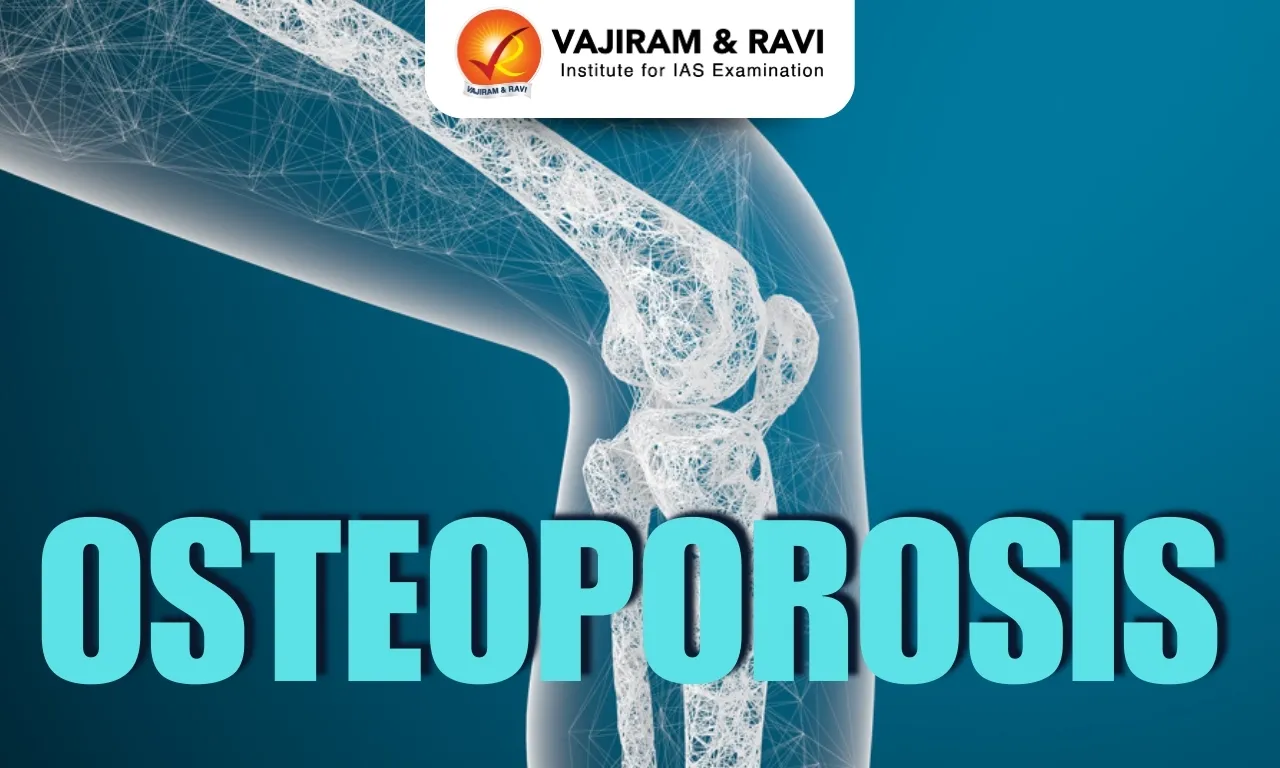
Osteoporosis

Osteoporosis

Osteoporosis Latest News

Osteoporosis is commonly associated with aging and postmenopausal women, but bone-health concerns are increasingly being noticed among younger adults in clinical practice.

About Osteoporosis

  • It is a disease in which your bones become weak and are likely to fracture (break). 
  • Osteoporosis means “porous bone.” Viewed under a microscope, a healthy bone looks like a honeycomb. When osteoporosis occurs, the holes and spaces in the honeycomb are much larger than in healthy bone. 
  • Osteoporotic bones have lost density or mass and contain abnormal tissue structure. As bones become less dense, they weaken and are more likely to break (bone fractures).  
  • Fractures can occur in any bone but happen most often in bones of the hip, vertebrae in the spine, and wrist. 

What Causes Osteoporosis?

  • Your bones are made of living tissue. To keep them strong, your body breaks down old bone and replaces it with new bone. 
  • Osteoporosis develops when more bone is broken down than replaced. 
  • You lose bone mass, and changes happen in the structure of your bone tissue. This can happen as you get older. 
  • Some of the common risk factors for developing osteoporosis include:
    • Are female
    • Over the age of 50
    • Are of white or Asian descent
    • Have a family history of osteoporosis, especially if your mother or father fractured a hip
    • Have low body weight
    • Have low levels of sex hormones (low estrogen in women, low testosterone in men)
    • Have too much thyroid hormone (hyperthyroidism)
    • Are chronically on certain medications such as steroids

Osteoporosis Symptoms

  • It is called a “silent” disease because it doesn’t usually cause symptoms. 
  • Although most people are not aware that they may have osteoporosis until they experience a fracture, there are some signs and symptoms that you may experience in later stages of the condition. They include:
    • Back pain (in the presence of vertebral compression fracture)
    • Loss of height over time (this will be gradual)
    • A stooped posture
    • Low-impact bone fracture

Osteoporosis Treatment

  • Treatment for osteoporosis may involve:
  • Making lifestyle changes, such as changing your diet and exercise routine
  • Taking calcium and vitamin D supplements
  • Using medicines to strengthen bones.

News: NDTV

Osteoporosis FAQs

Q1: What is osteoporosis?

Ans: Osteoporosis is a disease in which bones become weak, less dense and more likely to fracture.

Q2: Why are bones more likely to fracture in osteoporosis?

Ans: Because they lose bone mass and density, and their internal structure becomes weaker.

Q3: How does osteoporosis develop?

Ans: It develops when more bone is broken down than is replaced by new bone.

Q4: Why is osteoporosis called a “silent disease”?

Ans: Because it usually causes no noticeable symptoms until a fracture occurs.

Q5: What are the common symptoms of osteoporosis in its later stages?

Ans: Back pain, gradual loss of height, a stooped posture and fractures following minor impacts.

Enquire Now