Indian Pilot Smit Machchhar Receives UAE’s First Class Order of Zayed II for Saving 174 Passengers

First Class Order of Zayed II

First Class Order of Zayed II Latest News

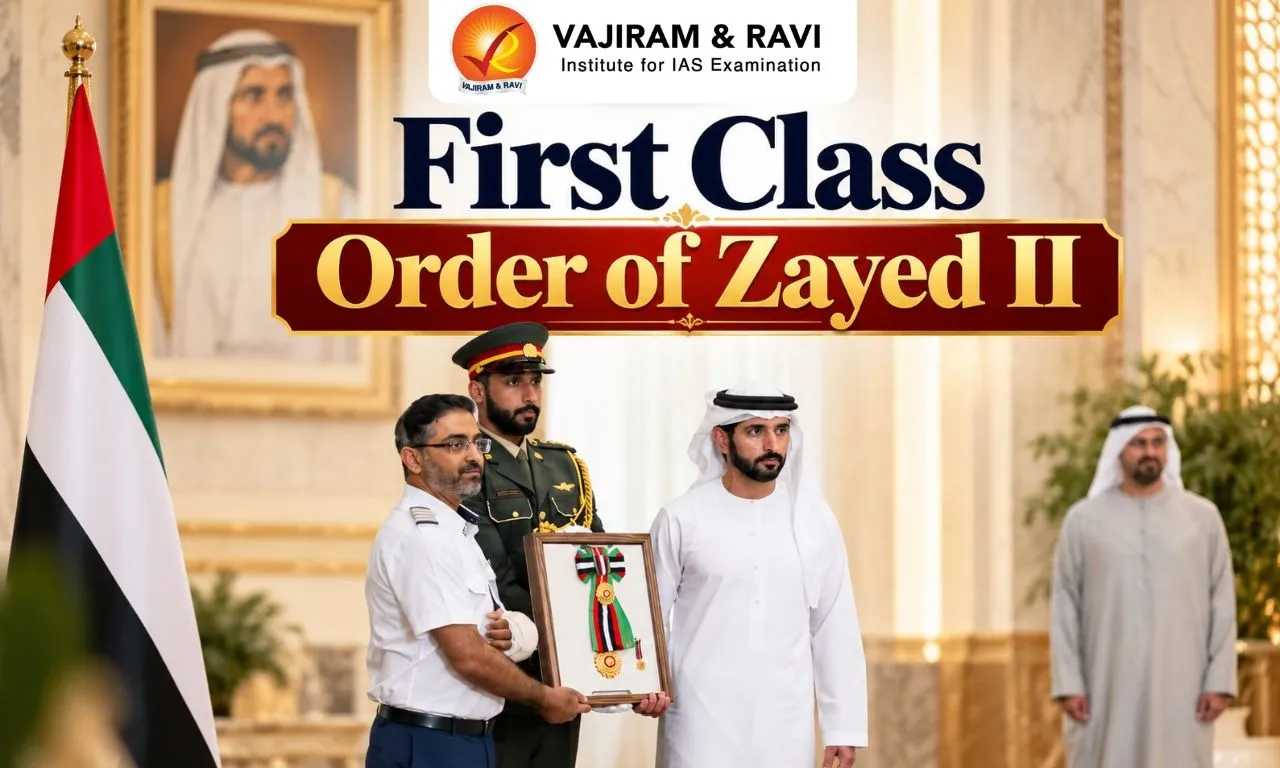
Indian Pilot Smit Machchhar recently received the UAE's First Class Order of Zayed II for his bravery in protecting 174 passengers aboard a Flydubai flight during an alleged attack by his Omani co-pilot. 

About First Class Order of Zayed II

  • It is one of the United Arab Emirates’ (UAE’s) prestigious civilian decorations.
  • It is named after Sheikh Zayed bin Sultan Al Nahyan, the country's founding president, who ruled from 1971 until his death in 2004. 
  • It is generally awarded to foreign diplomats, senior officials, and distinguished international figures whose work has made a significant contribution to the country or its international relations. 
  • Indian Recipients: 
    • Indian Pilot Smit Machchhar received the award in 2026 for his bravery in protecting 174 passengers aboard a Flydubai flight during an alleged attack by his Omani co-pilot.  
    • However, he is not the first Indian to receive the prestigious honour.
    • Two former Indian ambassadors to the UAE, Navdeep Singh Suri and Sunjay Sudhir, were previously awarded the same decoration for their contributions to strengthening bilateral relations. 
  • It is distinct from the Order of Zayed, the UAE's highest civilian honour, which has been presented to prominent world leaders, including Indian Prime Minister Narendra Modi in 2019.

News: NDTV

First Class Order of Zayed II FAQs

Q1: What is the First Class Order of Zayed II?

Ans: It is a prestigious civilian decoration awarded by the United Arab Emirates (UAE).

Q2: After whom is the First Class Order of Zayed II named?

Ans: Sheikh Zayed bin Sultan Al Nahyan, the founding president of the UAE.

Q3: Who are the usual recipients of the First Class Order of Zayed II?

Ans: Foreign diplomats, senior officials and distinguished international figures who have made significant contributions to the UAE or its international relations.

Q4: Which Indian pilot received the First Class Order of Zayed II in 2026?

Ans: Smit Machchhar.

Q5: Which two former Indian ambassadors to the UAE received the First Class Order of Zayed II?

Ans: Navdeep Singh Suri and Sunjay Sudhir.
Cyrtodactylus dimensis: Scientists Discover New Gecko Species in Assam’s Dima Hasao

Cyrtodactylus dimensis

Cyrtodactylus dimensis Latest News

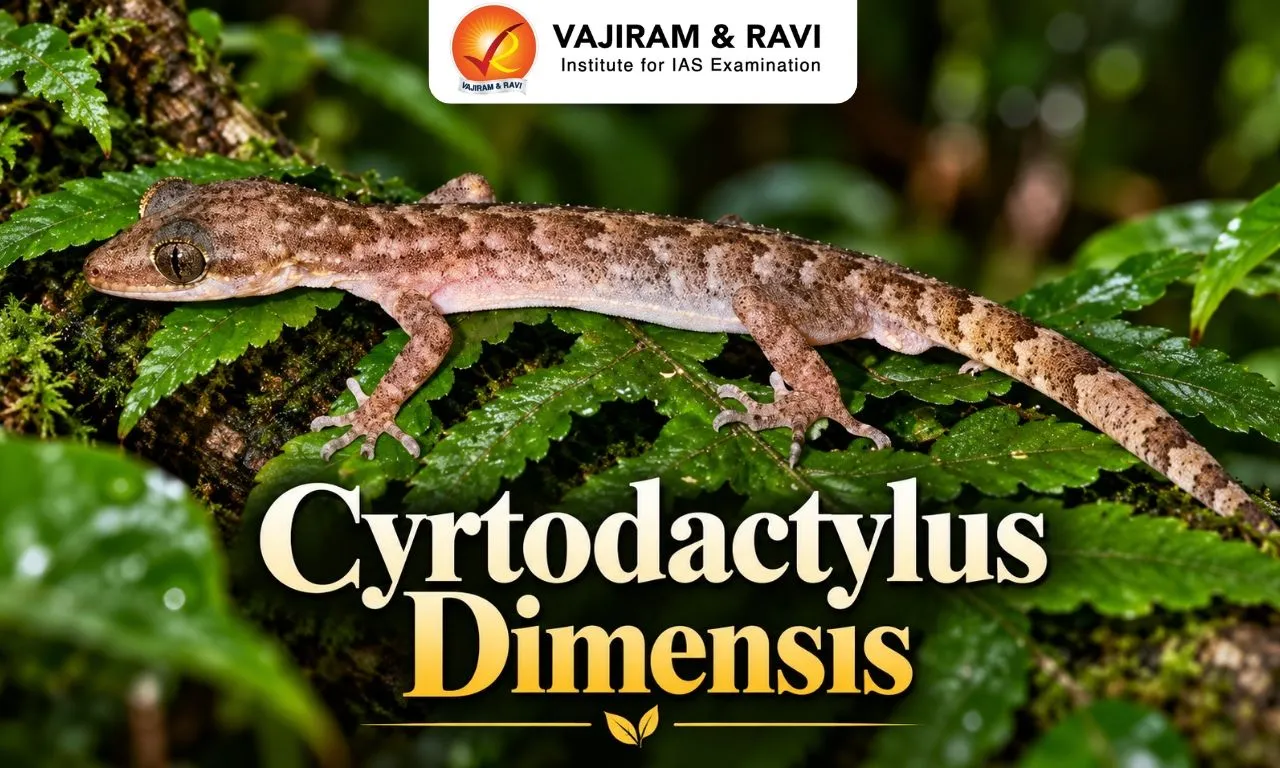
Researchers recently discovered a new species of gecko named Cyrtodactylus dimensis in the Umrangso area of Assam’s Dima Hasao district.

About Cyrtodactylus dimensis

  • It is a new species of gecko.
  • It was discovered in the Umrangso area of Assam’s Dima Hasao district. 
  • Dima Hasao forms part of the Indo-Burma biodiversity hotspot, a region known for its rich variety of plants and animals. 
  • Cyrtodactylus dimensis belongs to the bent-toed gecko group.   
  • The discovery brings the number of described Cyrtodactylus species recorded from Assam to eight. 
  • The species is closely related to Cyrtodactylus vanarakshaka, another gecko species described from Dima Hasao, but differs in its genetic and morphological characteristics. 
  • Cyrtodactylus dimensis was distinguished by a combination of characteristics, including the arrangement of scales and specialised structures on its body.

News: NEN

Cyrtodactylus dimensis FAQs

Q1: What is Cyrtodactylus dimensis?

Ans: It is a newly discovered species of gecko.

Q2: Where was Cyrtodactylus dimensis discovered?

Ans: In the Umrangso area of Dima Hasao district, Assam.

Q3: To which group of geckos does Cyrtodactylus dimensis belong?

Ans: The bent-toed gecko group.

Cabinet Approves ₹7,395 Crore Pradhan Mantri Viksit Gram Swaraj Yojana to Strengthen Panchayats

Pradhan Mantri Viksit Gram Swaraj Yojana

Pradhan Mantri Viksit Gram Swaraj Yojana Latest News

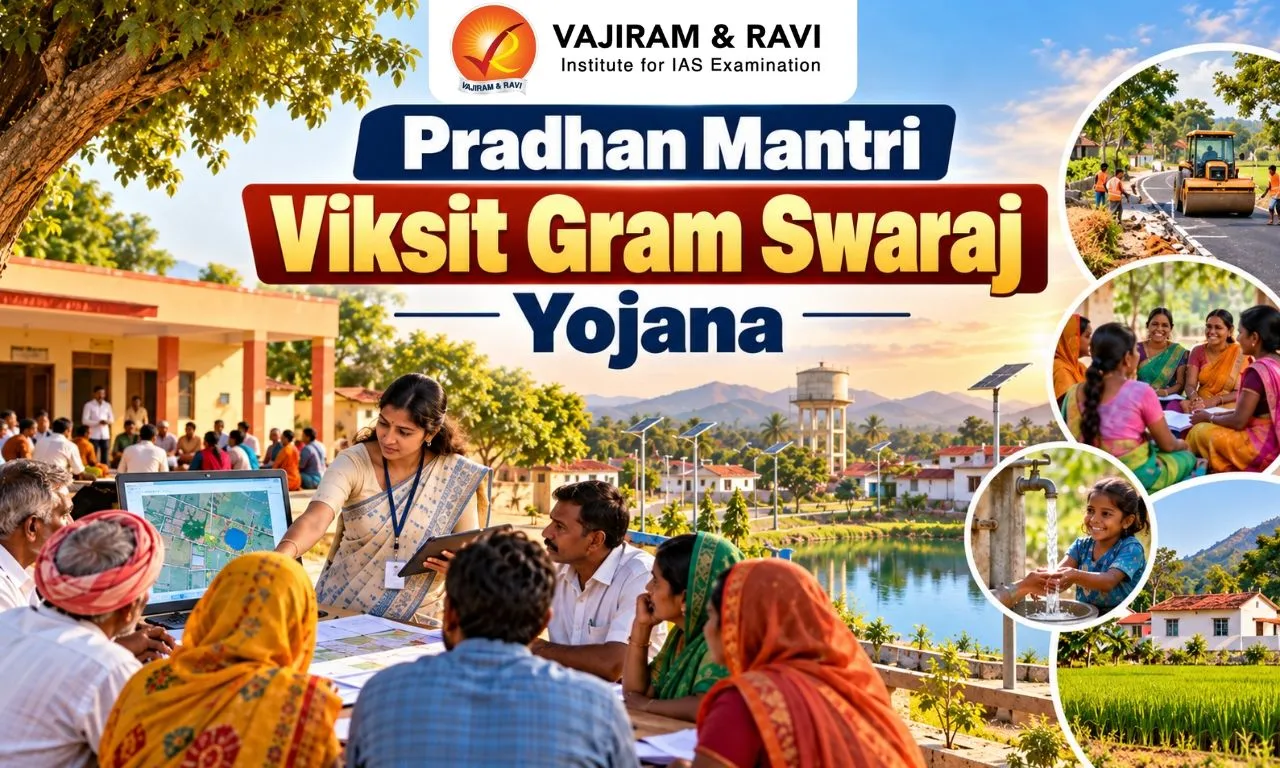
Recently, the Union Cabinet has approved the Pradhan Mantri Viksit Gram Swaraj Yojana (PM VGSY).

About Pradhan Mantri Viksit Gram Swaraj Yojana

  • It is a Centrally Sponsored Scheme (CSS) aimed at strengthening grassroots governance and rural development across the country.
  • Time Period: 2026-27 to 2030-31
  • Coverage: The scheme will extend to all States/UTs, including institutions of rural local government (traditional local bodies) in non-Part IX areas where Panchayats do not exist.

Key Features of Pradhan Mantri Viksit Gram Swaraj Yojana   

  • Annual planning target: Support preparation of 2.55 lakh Gram Panchayat Development Plans on the eGramSwaraj portal, bringing together village priorities, departmental interventions and available resources.
  • Capacity building: Train and provide digital support to around 32 lakh elected representatives, Panchayat functionaries and other stakeholders annually.
  • Financial accountability: Support at least 2.55 lakh online audit plans annually and timely completion of the corresponding audits through Audit Online, alongside better accounting, public disclosure and mobilisation of Panchayats’ own revenue.
  • Citizen engagement: Each coordinated awareness exercise is intended to reach at least one crore citizens.
  • The scheme will use Gram Sabhas and existing outreach tools, including PANCHAM, a two-way platform available in 17 Indian languages.
  • Implementation: States and Union Territories will submit annual action plans for appraisal by a Central Empowered Committee. No permanent posts will be created under the scheme, although need-based contractual staff may provide technical support.

Source: PIB

Pradhan Mantri Viksit Gram Swaraj Yojana FAQs

Q1: What is the coverage of Pradhan Mantri Viksit Gram Swaraj Yojana?

Ans: The scheme will extend to all States/UTs, including institutions of rural local government (traditional local bodies) in non-Part IX areas where Panchayats do not exist.

Q2: What is the time period of Pradhan Mantri Viksit Gram Swaraj Yojana?

Ans: 2026-27 to 2030-31

Dearness Allowance (DA): How Inflation Affects Government Employees’ Salaries

Dearness Allowance

Dearness Allowance Latest News

The Cabinet recently approved a 3% hike in dearness allowance and dearness relief, benefiting over 1.17 crore central government employees and pensioners.

About Dearness Allowance

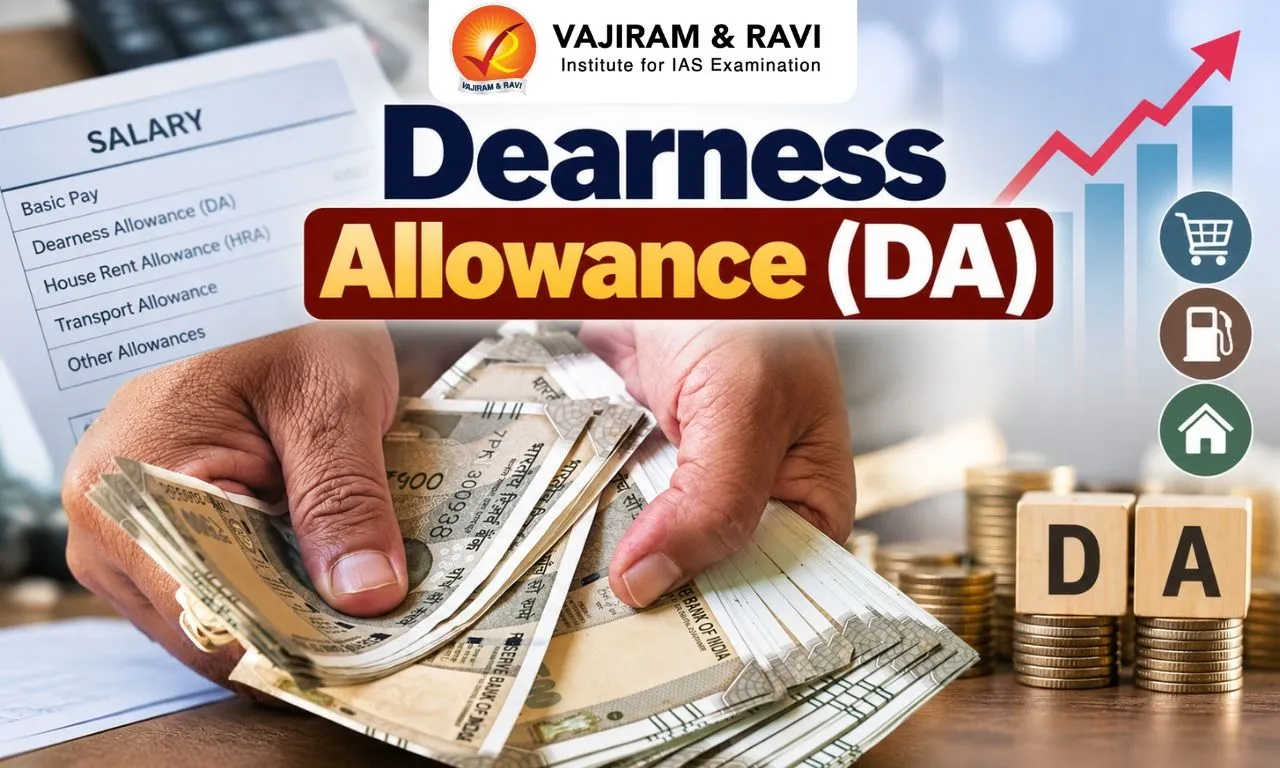
  • It is an allowance given to you if you are a government employee, public sector employee, and pensioner in India. 
  • It's a way to mitigate the impact of rising costs of living and inflation on people's earnings. 
  • It ensures that employees are protected against inflation, where the salary components help employees deal with the increasing prices of goods and essential items. 
  • It is calculated as a percentage of basic pay or basic pension.  
  • For example, if your basic pay is ₹40,000 and the applicable DA rate is 60%, your DA amount will be ₹24,000. 
  • This DA is added to your salary along with other components such as basic pay, HRA, special allowance, and other applicable benefits. 
  • Types of DA:
    • Industrial Dearness Allowance (IDA):
      • It is applicable to employees working in the public sector. 
      • The revision is done on a quarterly basis, depending on the Consumer Price Index (CPI), to successfully change the salaries according to the increasing rate. 
    • Variable Dearness Allowance (VDA):
      • It is mostly applicable to employees working in the central government sector. 
      • The revision is done twice a year i.e, in January and in July, based on the changes in the CPI.
      • VDA has three parts:
      • Fixed Variable DA: This part stays the same, unless the government changes the basic minimum wage.
      • Base Index: This is fixed for a set period and does not change during that time.
      • Consumer Price Index (CPI): The CPI is updated every month. It plays a big role in setting the VDA. Because the CPI moves, so does the VDA that employees receive.
  • Private-sector employees do not automatically receive DA. Many private companies use other salary components such as special allowance, flexible benefits, performance pay, or cost-to-company adjustments instead of a formal DA line item. 
  • Is DA Taxable?
    • It is fully taxable under the Income Tax Act, 1961. 
    • Employees are required to declare it separately when filing income tax returns.

News: TH

Dearness Allowance FAQs

Q1: What is Dearness Allowance (DA)?

Ans: Dearness Allowance is an allowance paid to eligible government employees, public sector employees and pensioners in India to help offset the impact of inflation.

Q2: What is the primary objective of Dearness Allowance (DA)?

Ans: To protect the purchasing power of employees and pensioners against rising prices and the cost of living.

Q3: How is Dearness Allowance (DA) calculated?

Ans: It is calculated as a percentage of basic pay or basic pension.

Q4: Do private-sector employees automatically receive Dearness Allowance (DA)?

Ans: No. Private-sector employees do not automatically receive DA; their compensation depends on their employer's salary structure.

Q5: Is Dearness Allowance (DA) taxable in India?

Ans: Yes, DA is generally fully taxable under the Income Tax Act, 1961.

Noyyal River Pollution: Tamil Nadu Farmers Demand Restoration of Cauvery Tributary

Noyyal River

Noyyal River Latest News

A recent comment by the Tamil Nadu Minister for Environment and Climate Change, that soap and shampoo used by the public can also cause excessive foaming in the Noyyal River, which flows through Tiruppur district, has sparked criticism.

About Noyyal River

  • It is an important tributary of the Cauvery River, flowing through Western Tamil Nadu. 
  • The "Noyyal" is a sacred river in Tamil history, and its original name was "Kanchi Nadi"; however, it was later changed to the name of the place where it drains into the Kaveri River in 1750 A.D. 
  • Course: 
    • It begins from numerous small streams in the Vellingiri Hills, which are part of the Nilgiri Biosphere Reserve in the Western Ghats.
    • It flows through the districts of Coimbatore, Tirupur, and Erode and meets the Cauvery River at the Noyyal village in Karur District.  
  • Total Length: 158 km
  • It is a seasonal river with rapid flows during the monsoon periods. 
  • The Noyyal watershed is connected with a series of 32 tanks, 14 major canals, 23 anicuts, and 55 check dams. 
  • Most of these check dams and anicuts were constructed by the Chola Kings, who ruled the region in the 9th to 12th centuries to augment irrigation and control floods downstream. 
  • The Noyyal River has two main tributaries: Cheyyar River (Chadiaar River) and Kanchimanadhi River.
  • It is also home to major dams like Aathupalayam Dam and Orathuppalayam Dam. 
  • Until the early 20th century, the Noyyal was the main drinking water source for the region.  
  • Today the Noyyal is one of the most polluted rivers in India.

News: TH

Noyyal River FAQs

Q1: Which river is the Noyyal River a tributary of?

Ans: The Cauvery River.

Q2: In which state does the Noyyal River flow?

Ans: Tamil Nadu.

Q3: Where does the Noyyal River originate?

Ans: From numerous small streams in the Vellingiri Hills of the Western Ghats.

Q4: Where does the Noyyal River meet the Cauvery River?

Ans: At Noyyal village in Karur district, Tamil Nadu.

Q5: What is the total length of the Noyyal River?

Ans: Approximately 158 km.

Cabinet Approves ₹1,856 Crore Khelo India Sports Goods Manufacturing Scheme

Khelo India Sports Goods Manufacturing Scheme

Khelo India Sports Goods Manufacturing Scheme  Latest News

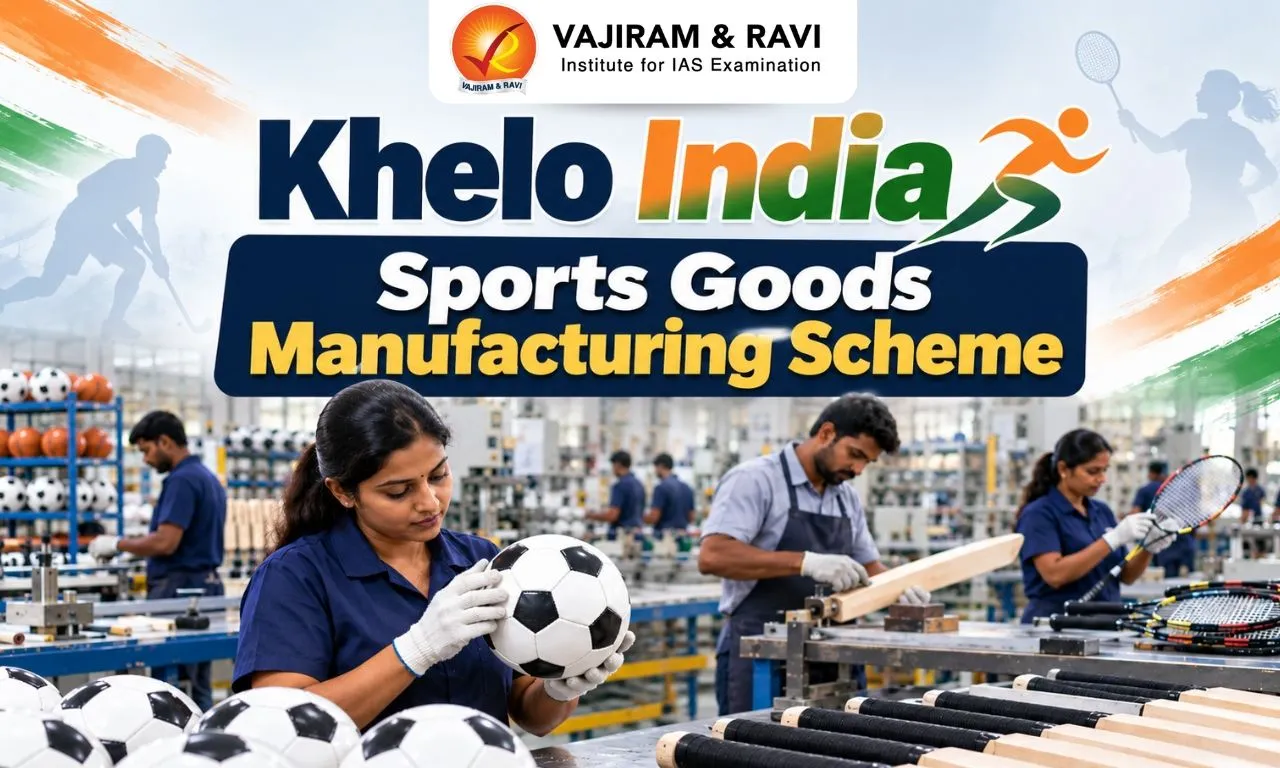
Recently, the Union Cabinet has approved the Khelo India Sports Goods Manufacturing Scheme.

About Khelo India Sports Goods Manufacturing Scheme

  • It aims to promote investment, manufacturing, innovation and exports, and strengthen India's position in the global sports goods sector.
  • It provides support across the sports goods manufacturing value chain, from infrastructure and investment to research, skills, certification and market development.
  • Time Period: 2026 to 2033-34.
  • It has two parts: incentives that support manufacturing and interventions that build the wider ecosystem.

Key Features of Khelo India Sports Goods Manufacturing Scheme

  • Developing Integrated Manufacturing Zones: These zones will bring together manufacturers, suppliers, testing facilities, design and prototyping centres, and ancillary enterprises.
    • These will be developed through convergence with the BHAVYA Scheme and NICDC Industrial Parks.
  • Attracting Investment and Expanding Production: The scheme earmarks a combined ₹1,130 crore for Anchor Investment Support and Turnover Linked Support.
    • Anchor Investment Support will encourage leading domestic and global manufacturers, brands and retail chains to establish facilities in the designated zones.
    • Turnover Linked Support will incentivize higher production, capacity expansion and sustained manufacturing growth.
  • Upgrading existing clusters and supporting MSMEs: Existing sports goods manufacturing clusters will receive support for upgrading common facilities and shared infrastructure through cost-sharing with States, helping smaller enterprises strengthen their manufacturing capabilities.
  • Supporting international certification: To improve access to international markets, ₹105 crore has been allocated to help manufacturers obtain and renew certifications from International Sports Federations. 
  • Advancing research and start-up innovation: Centres of Excellence in premier educational and research institutions will support research in sports equipment, material sciences, protective gear and advanced manufacturing technologies.
  • Research co-funding will be encouraged through convergence with the Anusandhan National Research Foundation. DPIIT-registered sports start-ups will be eligible for grants of up to ₹20 lakh.
  • Developing industry-aligned skills: Skill development initiatives will be implemented in collaboration with the Ministry of Skill Development and Entrepreneurship and relevant industry stakeholders to meet evolving workforce requirements.
  • Promoting Indian sports goods globally: Branding, outreach and market development initiatives will draw on the Export Promotion Mission to improve the visibility of Indian sports goods and expand their international reach.

Source:  PIB

Khelo India Sports Goods Manufacturing Scheme FAQ's

Q1: What is the aim of Khelo India Sports Goods Manufacturing Scheme?

Ans: It aims to promote investment, manufacturing, innovation and exports, and strengthen India's position in the global sports goods sector.

Q2: What are the two main parts of Khelo India Sports Goods Manufacturing Scheme?

Ans: It has two parts: incentives that support manufacturing and interventions that build the wider ecosystem.

India and Liechtenstein Reaffirm Ties: Know This Rare Doubly Landlocked Country

Liechtenstein

Liechtenstein Latest News

Recently, India and Liechtenstein reaffirmed commitment to strengthen multilateral institutions. 

About Liechtenstein

  • Location: It is a small, alpine and ‘doubly landlocked’ country.
  • Bordering Countries: It is bordered by Austria in the north and east; and by Switzerland in the south and west.  
  • It is situated on the banks of the Rhine River in Central Europe.
  • Capital City: Vaduz

Geographical Features of Liechtenstein

  • Topography: The Alpine mountains cover the eastern half of the country. The western part is dominated by the Rhine River valley. 
  • Highest Point: Liechtenstein's highest point is Vorder Grauspitz, which reaches 8,526 feet (2,599 m).
  • Lake: Liechtenstein has only one lake - Gampriner Seele.
  • Rivers: The Rhine and Samina are two major rivers flowing through the country.

Source: News On Air

Liechtenstein FAQs

Q1: Which are the bordering countries of Liechtenstein?

Ans: It is bordered with Austria in the north and east; and by Switzerland in the south and west.  

Q2: What is the capital city of Liechtenstein?

Ans: Vaduz

Union Cabinet Approves Container Manufacturing Promotion Scheme to Boost India’s Shipping Industry

Container Manufacturing Promotion Scheme

Container Manufacturing Promotion Scheme Latest News

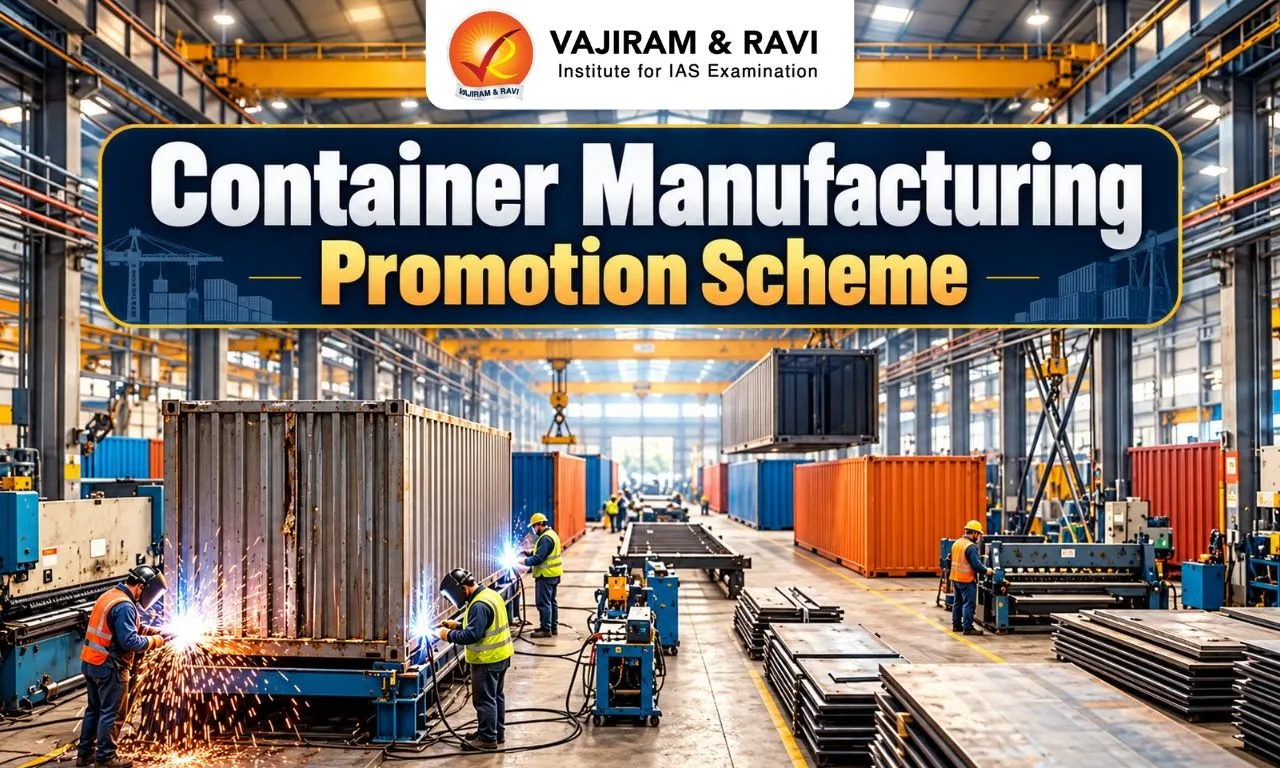
Recently, the Union Cabinet has approved the Container Manufacturing Promotion Scheme (CMPS). 

About Container Manufacturing Promotion Scheme

  • It aims to establish a globally competitive container manufacturing ecosystem by promoting domestic manufacturing and encouraging investment across the value chain.
  • The initiative seeks to reduce import dependence and strengthen supply-chain resilience.
  • It also supports new manufacturing facilities and expands existing container manufacturing units.
  • The scheme provides assistance through major components: investment support, operational expenditure, and testing and certification.

Components under Container Manufacturing Promotion Scheme

  • Interest Subvention Assistance (ISA)
    • ISA provides a 3% per annum interest subvention on eligible term loans (capital loans) availed by container manufacturers to set up greenfield facilities and brownfield expansion of existing manufacturing capacity.
    • To qualify for this support, projects must meet the following criteria
      • Greenfield facilities must have an annual capacity of at least 1,00,000 Twenty-foot Equivalent Units  (TEUs)
      • Brownfield expansions must add at least 25,000 TEUs of annual capacity to be commissioned within three years of in-principle approval, and comply with global container standards.
  • Operational Expenditure Assistance (OEA): The component provides a financial outlay of ₹8,891 crore to support containers manufactured as per global shipping standards and sold by eligible manufacturers.
    • Eligibility Criteria: To avail support, manufacturers must meet a minimum local-content requirement of 70% through FY 2031-32.
    • These criteria will further rise to 90% from FY 2032-33 to strengthen the domestic supply chain.
  • Testing and certification assistance: A financial outlay of ₹150 crore has been allocated to support the setting up of common facilities such as Dynamic longitudinal impact.

Source: PIB

Container Manufacturing Promotion Scheme FAQs

Q1: What is the aim of Container Manufacturing Promotion Scheme?

Ans: It aims to establish a globally competitive container manufacturing ecosystem by promoting domestic manufacturing and encouraging investment across the value chain.

Q2: What are the components of Container Manufacturing Promotion Scheme?

Ans: Major components: investment support, operational expenditure, and testing and certification.

Unified Logistics Interface Platform Launches Hackathon 2.0 to Transform India’s Supply Chains

Unified Logistics Interface Platform (ULIP)

Unified Logistics Interface Platform Latest News

After the Road Ministry recently sought an audit of users accessing the Centre’s logistics portal following complaints that multiple apps and websites were selling vehicle information, the Unified Logistics Interface Platform (ULIP) rejected the allegations of its misuse. 

About Unified Logistics Interface Platform

  • ULIP is a digital gateway that allows industry players to access logistics-related datasets from various Government systems through API-based integration.
  • It is conceptualized by the NITI Aayog and was developed under the PM Gati Shakti National Master Plan (PMGS-NMP). 
  • It was launched by the Prime Minister as part of the ‘National Logistics Policy (NLP)’ on September 17, 2022.
  • The platform is maintained and operated by NICDC Logistics Data Services (NLDS).
    • NICDC Logistics Data Services (NLDS) is a joint venture between the Government of India, represented by the National Industrial Corridor Development and Implementation Trust (NICDIT), and Japanese IT major NEC Corporation, with 50:50 equity participation.  
  • Currently, the platform integrates with 44 government systems from 11 ministries via 129 APIs, covering over 1800 data fields.
  • It covers major logistics databases, including VAHAN, SARATHI, FASTag, FOIS, ICEGATE, and Port Community Systems. 

Unified Logistics Interface Platform Objectives

  • To create a nationwide single window logistics platform for end-to-end visibility.
  • To develop a logistics gateway by integrating information available with various Govt. agencies across the value chain.
  • To provide visibility for optimal usage of various modes of transportation.
  • To provide data which can be utilized by the stakeholders for simplification of complicated processes like compliance, document filing, certifications, and approvals.
  • To offer a platform for data exchange among government and private entities who are directly or indirectly involved in the Indian Logistics ecosystem.

Unified Logistics Interface Platform Benefits

  • It will give direct and indirect benefits to all logistics stakeholders, like verification of drivers and vehicle details, tracking & tracing of consignment, Route Optimization Planning, and timely updates on the destination of the consignment, etc.
  • It will enable structured planning by helping in decision-making on optimum use of modes of logistics, thereby saving cost and time.

News: TH

Unified Logistics Interface Platform FAQs

Q1: What is the Unified Logistics Interface Platform (ULIP)?

Ans: ULIP is a digital gateway that enables industry stakeholders to access logistics-related datasets from various government systems through API-based integration.

Q2: Which organisation conceptualised the Unified Logistics Interface Platform (ULIP)?

Ans: NITI Aayog.

Q3: When was Unified Logistics Interface Platform (ULIP) launched?

Ans: September 17, 2022.

Q4: Which organisation maintains and operates Unified Logistics Interface Platform (ULIP)?

Ans: NICDC Logistics Data Services (NLDS).

Q5: How does Unified Logistics Interface Platform (ULIP) help improve logistics efficiency?

Ans: By integrating information from different government agencies and enabling better coordination across the logistics value chain.

IN-RoKN Exercise: India and South Korea Hold First Bilateral Naval Drill with INS Sahyadri

Exercise IN-RoKN

Exercise IN-RoKN Latest News

Indian Naval Ship Sahyadri is participating in the India-Republic of Korea Navy (IN-RoKN) Bilateral Exercise which is taking place at Busan Naval Harbour, Republic of Korea. 

About Exercise IN-RoKN

  • It is a bilateral naval exercise conducted between Indian Navy (IN) and South Korea Navy (RoKN).
  • Phases
    • Harbour phase: During this phase personnel of both navies will participate in professional interactions, cross-deck visits, cross-training activities and sporting events.
    • These activities will facilitate the exchange of operational experiences and Best Practices, while fostering mutual understanding and professional camaraderie.
    • Sea Phase: It involves INS Sahyadri and ROKS Munmu the Great, providing opportunities to strengthen operational coordination, enhance interoperability and consolidate professional ties between the two navies.
  • It underscores the shared commitment of India and the Republic of Korea to strengthening maritime cooperation and contributing to peace, stability and security in the Indo-Pacific.

Key Facts about INS Sahyadri

  • It is the third ship of the Shivalik Class Guided Missile Stealth Frigates which was built by Mazagon Dock Ltd in Mumbai.
  • It is indigenously designed, constructed and commissioned in 2012.
  • It is equipped with cutting-edge weapons and sensors, enabling her to identify and eliminate threats from the air, the surface, and the subsurface.
  • Capacity: It has a displacement capacity of 6,800 tons and has a massive surface speed of 32 knots.
  • Armaments: The ship is capable of carrying Barak-1 and Shtil-1 3S90M missiles, BrahMos anti-ship missiles, anti-submarine rocket launchers.
  • It is equipped with a versatile array of weapons and sensors, can carry multi-role helicopters and represent the ‘coming of age’ of India’s warship building capabilities.

Source: PIeB

Exercise IN-RoKN FAQs

Q1: Exercise IN-RoKN is conducted between which two countries?

Ans: India and South Korea

Q2: Which Indian Naval Ship is participating in Exercise IN-RoKN 2026?

Ans: INS Sahyadri

Enquire Now