CAPEX Support Scheme: Cabinet Approves ₹2,814 Crore for Lithium and Nickel Processing

CAPEX Support Scheme to Promote Critical Mineral Processing

CAPEX Support Scheme to Promote Critical Mineral Processing Latest News

Recently, the CAPEX Support Scheme to Promote Critical Mineral Processing has been approved by the Union Cabinet.  

About CAPEX Support Scheme to Promote Critical Mineral Processing

  • It provides targeted capital expenditure (CAPEX) support for establishing domestic critical mineral processing facilities.
  • Time Period: It will run for five years, from FY 2026-27 to FY 2030-31.
  • Nodal Ministry:Ministry of Mines, Government of India
  • Objectives
    • Promote domestic processing capacity: Help set up high-purity Lithium and Nickel processing plants.
      • Lithium plants will process ores and concentrates (excluding brines) into battery-grade products, while nickel plants will produce Class-1 nickel or battery-grade nickel sulphate, with cobalt recovery.
    • Build a resilient value chain: Strengthen the Lithium and Nickel value chain by filling the missing link in processing.
  • Financial Outlay and Support
    • Total outlay: ₹2,814 crore.
    • The scheme offers a capital subsidy of 30% of eligible investment for setting up four processing plants.
    • These include two Lithium plants of at least 30 kt capacity each and two Nickel plants of at least 50 kt capacity each.
    • Support is capped at ₹500 crore per Lithium beneficiary and ₹900 crore per Nickel beneficiary.
  • Selection and disbursement
    • Beneficiaries will be selected through a two-stage process: technical qualification followed by financial bidding.
    • Two beneficiaries will be selected for each mineral based on the least-cost criterion, prioritising bidders seeking the lowest government support.
    • Incentives will be disbursed in three tranches linked to the achievement of specified milestones.

Source: PIB

CAPEX Support Scheme to Promote Critical Mineral Processing FAQs

Q1: What is the aim of CAPEX Support Scheme to Promote Critical Mineral Processing ?

Ans: It provides targeted capital expenditure (CAPEX) support for establishing domestic critical mineral processing facilities.

Q2: What is the nodal ministry of CAPEX Support Scheme to Promote Critical Mineral Processing ?

Ans: Ministry of Mines, Government of India

Liocheles similipalensis

Liocheles similipalensis

Liocheles similipalensis Latest News

Researchers recently discovered a new scorpion species named Liocheles similipalensis  in Odisha. 

About Liocheles similipalensis

  • It is a new species of scorpion.
  • It was discovered in Odisha’s Similipal Tiger Reserve.
  • The species was recorded at an elevation of approximately 1,000 metres above sea level in a tropical moist deciduous forest within the reserve.  
  • The species is lithophilic, meaning it prefers rocky habitats. The specimens were predominantly found in rock crevices and taking shelter beneath rocks. 
  • At present, it is known only from its type locality in Similipal. 
  • The scorpions were classified under the genus Liocheles based on the presence of setae (small hair-like structures) beneath tarsomere II, a segment of their legs. 
  • It marks the first confirmed record of the genus Liocheles in Odisha.
  • Measuring between 44 and 53 mm in length, the scorpion has a predominantly dark black body with a glossy, iridescent bluish sheen. 
  • It also differs from the six previously known Liocheles species in several physical features. 
    • These include variations in the patterns of ridges and rough surfaces on different body parts, as well as the proportions of its median eyes.

News: MD

Liocheles similipalensis FAQs

Q1: What is Liocheles similipalensis?

Ans: It is a newly discovered species of scorpion.

Q2: Where was Liocheles similipalensis discovered?

Ans: It was discovered in the Similipal Tiger Reserve in Odisha.

Q3: What type of forest habitat does Liocheles similipalensis inhabit?

Ans: It inhabits tropical moist deciduous forests.

Q4: What is the characteristic body colour of Liocheles similipalensis?

Ans: It has a predominantly dark black body with a glossy, iridescent bluish sheen.

INS Amini: Indian Navy Receives Indigenous Anti-Submarine Warfare Ship

INS Amini

INS Amini Latest News

The Indian Navy recently formally inducted 'Amini', the fifth of eight Anti-Submarine Warfare Shallow Water Craft (ASW-SWC) being built to strengthen India's coastal defence and underwater surveillance capabilities.

About INS Amini

  • It is the fifth of eight Anti-Submarine Warfare Shallow Water Craft (ASW-SWC) being built by Kolkata-based Garden Reach Shipbuilders and Engineers (GRSE) for the Indian Navy.
  • The newly launched ASW ships belong to the Arnala class of vessels and replaced the Abhay class of anti-submarine warfare corvettes.  
  • Amini becomes the 119th warship designed and constructed by the defence public sector undertaking GRSE and the 81st delivered directly to the Indian Navy.
  • Designed for operations in coastal waters, ‘Amini’ is equipped to undertake comprehensive subsurface surveillance, search and attack missions, and coordinated anti-submarine warfare operations in conjunction with aircraft. 

INS Amini Features

  • The submarine hunter measures nearly 77.6 metres in length and a displacement of 900 tons.
  • It is powered by marine diesel engines coupled with waterjets, providing enhanced agility and manoeuvrability. 
  • It has a maximum speed of 25 knots (29 miles per hour) and an endurance of approximately 1,800 nautical miles (2,100 miles). 
  • With a draught requirement of approximately 2.7 metres, the warship is ideally suited for littoral operations.
  • Equipped with an advanced Combat Management System, lightweight torpedoes and anti-submarine warfare rockets, the warship is capable of detecting, tracking and engaging underwater threats.
  • It also carries an indigenously manufactured 30 mm naval surface gun developed by GRSE for protection against surface threats. 
  • Its integrated systems will allow it to coordinate with naval aircraft during anti-submarine missions.

News: IT

INS Amini FAQs

Q1: What is INS Amini?

Ans: It is the fifth of eight Anti-Submarine Warfare Shallow Water Craft (ASW-SWC) being built for the Indian Navy.

Q2: Which shipyard is constructing INS Amini?

Ans: Garden Reach Shipbuilders and Engineers (GRSE), Kolkata.

Q3: What is the primary operational role of INS Amini?

Ans: It is designed for anti-submarine warfare and subsurface surveillance in coastal waters.

Q4: Which major weapons and systems are equipped on INS Amini for anti-submarine warfare?

Ans: An advanced Combat Management System, lightweight torpedoes and anti-submarine warfare rockets.

Namika La Pass: 2 Army Personnel Killed in 600-Foot Gorge Accident in Ladakh

Namika La Pass

Namika La Pass Latest News

Two Army personnel were killed after their vehicle plunged into a 600-foot-deep gorge at Namika La Pass on the Kargil-Leh national highway recently.

About Namika La Pass

  • It is a high mountain pass located in the Union Territory of Ladakh. 
  • Also known as the ‘Pillar of the Sky Pass’, it lies in the Zanskar Range of the Himalayas.
  • It sits at a very high elevation, about 3,700 meters (or 12,139 feet) above sea level. 
  • Located on the Srinagar-Leh Highway (NH-1), the Namika La Pass is situated on the way to the Mulbek Valley.  
  • It is one of the 2 high passes that connect Kargil and Leh, the other being the higher Fotu La Pass.  
  • On the way to the Namika La Pass, there is the famous Chambal statue of Maitreya Buddha as well as a Gompa which attracts the tourists.

News: ET

Namika La Pass FAQs

Q1: Where is Namika La Pass located?

Ans: It is a high mountain pass located in the Union Territory of Ladakh.

Q2: In which mountain range is Namika La Pass located?

Ans: It is located in the Zanskar Range of the Himalayas.

Q3: What is the approximate elevation of Namika La Pass?

Ans: It is situated at an elevation of approximately 3,700 metres (12,139 feet) above sea level.

Q4: On which highway is Namika La Pass located?

Ans: It is located on the Srinagar–Leh Highway (NH-1).

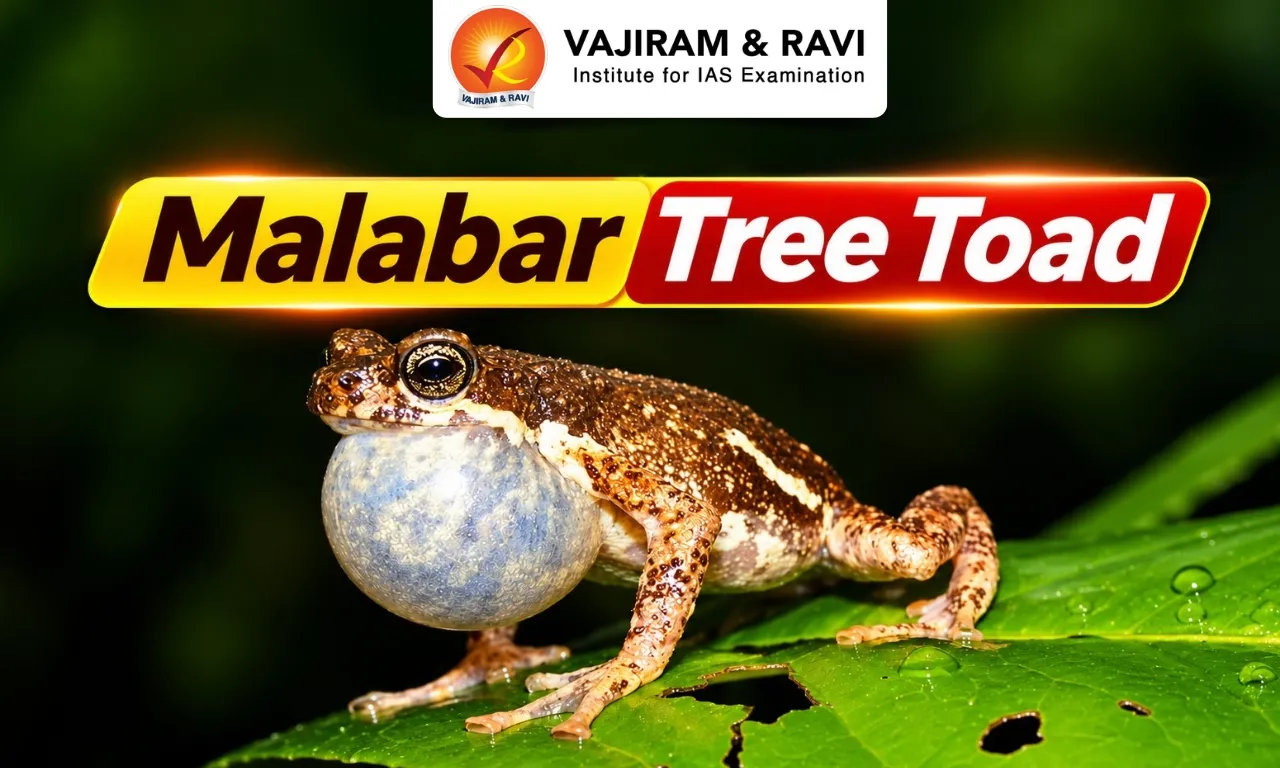
Malabar Tree Toad: Karnataka Becomes First Indian State to Declare State Amphibian

Malabar Tree Toad

Malabar Tree Toad Latest News

Recently, the Karnataka Forest, Ecology and Environment Department signed the orders and declared Malabar Tree Toad (Malenadina Mara Gantikappe) as the state amphibian.

About Malabar Tree Toad  

  • It is the only species in the monotypic genus Pedostibes.
  • It is locally known as Malenadina Mara Gantikappe or Petu.
  • It was first discovered in 1876 and the species was not sighted for more than 100 years. 
  • It was later rediscovered in 1980 at Silent Valley National Park in Kerala.
  • Habitat: It can be found along streams, on trees, and in tree cavities and in evergreen to moist deciduous forests at an altitude ranging from 50 m to over 1000 m above sea level.
  • Distribution: It is endemic to India’s Western Ghats.
  • Characteristics
    • It is the only arboreal species in India, having the unique capability to climb trees and dwell unlike the majority of the toads in the region that are ground-dwelling. 
    • Breeding: It comes to the ground to breed in water pools at the edges of the streams generated during the monsoon.
    • Its breeding cycle is from March to June, before the onset of monsoon. 
  • Conservation Status
    • IUCN Red List: Endangered
    • Wildlife (Protection) Act, 1972: Schedule II 

Source: NIE

Malabar Tree Toad FAQs

Q1: Where do we find Malabar Tree Toad ?

Ans: It is endemic to India’s Western Ghats.

Q2: What is the unique feature of Malabar Tree Toad ?

Ans: It is the only arboreal species in India, having the unique capability to climb trees and dwell unlike the majority of the toads in the region that are ground-dwelling. 

Self-Reliant India (SRI) Fund Supports 824 MSMEs, Boosts Women-Led Enterprises

Self Reliant India (SRI) Fund

Self-Reliant India Fund Latest News

The Ministry of Micro, Small and Medium Enterprises (MSME), Government of India, organised an “Awareness Workshop on the Self-Reliant India (SRI) Fund for Supporting Women-Led MSMEs”.

About Self-Reliant India Fund

  • It has been set up to infuse Rs. 50,000 crore as equity funding in those MSMEs which have the potential and viability to grow and become large units. 
    • Under this fund of Rs. 50,000 crore, there is a provision of Rs. 10,000 Crore from the Government of India and Rs. 40,000 Crore through Private Equity/Venture Capital funds.
  • It operates through a mother-fund and daughter-fund structure for equity or quasi-equity investments. 
  • It is being implemented by NSIC Venture Capital Fund Limited (NVCFL), which is an Alternative Investment Fund (AIF) of Category II registered with SEBI. 
  • The Government of India through the Ministry of Micro, Small and Medium Enterprises (MoMSME) is the anchor investor.
  • SRI fund is oriented to provide the funding support through NVCFL to the Daughter Funds for onward provision to MSMEs as growth capital, in the form of equity or quasi-equity, for the following:
    • Enhancing equity/equity-like financing to MSMEs and listing of MSMEs on stock exchanges.
    • Supporting faster growth of MSME businesses and thereby ignite the economy and create employment opportunities.
    • Supporting enterprises which have the potential to graduate beyond the MASME bracket and become National/International Champions.
    • Supporting MSSMEs, which help make India self-reliant by producing relevant technologies, goods, and services.
  • The Daughter Funds shall invest at least 5 times the amount of capital contribution received from SRI Fund (net of fees and expenses) in MSMEs, covered under the Micro, Small & Medium Enterprises Development Act, 2006.

Source: PIB

Self-Reliant India Fund FAQs

Q1: What is the financial outlay under Self-Reliant India Fund ?

Ans: It has been set up to infuse Rs. 50,000 crore as equity funding in those MSMEs which have the potential and viability to grow and become large units. 

Q2: How is Self-Reliant India Fund is being implemented?

Ans: It is being implemented by NSIC Venture Capital Fund Limited (NVCFL), which is an Alternative Investment Fund (AIF) of Category II registered with SEBI. 

Atomic Energy Regulatory Board Approves Major Equipment Installation at Kudankulam Units 5 and 6

Atomic Energy Regulatory Board

Atomic Energy Regulatory Board Latest News

Chairperson, Atomic Energy Regulatory Board (AERB) recently sought to allay concerns regarding the entry of private players into the country’s sensitive nuclear energy sector, asserting that there will be no compromise on safety aspects.

About Atomic Energy Regulatory Board 

  • It is India’s premier regulatory authority for nuclear and radiation safety.
  • Background: 
    • The AERB was constituted on November 15, 1983, by the President of India by exercising the powers conferred by the Atomic Energy Act, 1962.
    • The regulatory authority of AERB is derived from the rules and notifications promulgated under the Atomic Energy Act and the Environment (Protection) Act, 1986.
  • Objective: To ensure the use of ionizing radiation and nuclear energy in India does not cause undue risk to the health of people and the environment.
  • Headquarters: Mumbai.

Atomic Energy Regulatory Board Composition

  • It comprises six members, of which two are full-time members including the chairman. 
  • The other whole-time member is the executive director of the AERB Secretariat, who is an ex-officio member of the Board. 
  • The other four members are eminent experts from various disciplines relevant to the mandate of the board.
  • The Board reports to the Atomic Energy Commission (AEC), which in turn reports to the Prime Minister. 
  • Regional Regulatory Centres (RRCs) of AERB set up at Kolkata, Chennai, and New Delhi carry out regular surveillance of the radiation facilities in eastern, southern, and northern zones, respectively. 
  • AERB has a Safety Research Institute (SRI) located at Kalpakkam, Tamil Nadu, which carries out research in safety-related topics. 

Atomic Energy Regulatory Board Functions

  • Develop safety policies in nuclear, radiation, and industrial safety areas for facilities under its purview.
  • Develop Safety Codes, Guides, and Standards for siting, design, construction, commissioning, operation, and decommissioning of different types of nuclear and radiation facilities.
  • Grant consents for siting, construction, commissioning, operation, and decommissioning, after an appropriate safety review and assessment, for the establishment of nuclear and radiation facilities.
  • Ensure compliance with the regulatory requirements prescribed by AERB during all stages of consenting through a system of review and assessment, regulatory inspection, and enforcement.
  • Prescribe the acceptance limits of radiation exposure to occupational workers and members of the public and acceptable limits of environmental releases of radioactive substances.
  • Review the emergency preparedness plans for nuclear and radiation facilities and during transport of large radioactive sources, irradiated fuel, and fissile material.
  • Review the training program, qualifications, and licensing policies for personnel of nuclear and radiation facilities and prescribe the syllabi for training of personnel in safety aspects at all levels.
  • Take such steps as necessary to keep the public informed on major issues of radiological safety significance.
  • Maintain liaison with statutory bodies in the country as well as abroad regarding safety matters.
  • Promote research and development efforts in the areas of safety.
  • Review the nuclear and industrial safety aspects in nuclear facilities under its purview.
  • Notifying the public of the 'nuclear incident', occurring in the nuclear installations in India, as mandated by the Civil Liability for Nuclear Damage Act, 2010.

News: TH

Atomic Energy Regulatory Board FAQs

Q1: What is the Atomic Energy Regulatory Board (AERB)?

Ans: It is India's premier regulatory authority for nuclear and radiation safety.

Q2: Under which legislation was the AERB constituted?

Ans: The Atomic Energy Act, 1962.

Q3: What is the primary objective of the Atomic Energy Regulatory Board?

Ans: To ensure that the use of ionizing radiation and nuclear energy in India does not cause undue risk to human health and the environment.

Q4: Where is the headquarters of the Atomic Energy Regulatory Board located?

Ans: Mumbai, Maharashtra.

Q5: To which authority does the Atomic Energy Regulatory Board report?

Ans: The Board reports to the Atomic Energy Commission (AEC), which in turn reports to the Prime Minister.

Gaia Mission: ESA Retires Space Telescope After Mapping Nearly 2 Billion Stars

GAIA Mission

GAIA Mission Latest News

Recently, a team led by Indian astronomers redefined star cluster UBC 63 as a double cluster system spotted after close flyby using data from the European Space Agency's (ESA) Gaia mission.

About GAIA Mission

  • It was originally named Global Astrometric Interferometer for Astrophysics (GAIA), later simplified to Gaia.
  • It was launched in 2013 by the European Space Agency (ESA).
  • It aimed to create the most precise 3D map of the Milky Way through astrometry.
  • It is placed at Lagrange Point 2 (L2), 1.5 million km from Earth (behind Earth when viewed from the Sun).
  • Scientific Instruments
    • Twin Telescopes: Captured light from different directions.
    • Digital Camera: Nearly 1 billion pixels, the largest ever flown in space.
  • Three Key Instruments
    • Astrometer: Measures precise locations of celestial bodies.
    • Photometer: Determines brightness and temperature of stars.
    • Spectrometer: Identifies chemical composition and motion of objects.

What is UBC 63?

  • It is a poorly populated group of stars, bound loosely by gravity (Galactic open cluster) about 4892 light years away from the Earth.
  • It was previously identified as a single star cluster, and has now been found to be composed of two distinct star clusters.

Source: PIB

GAIA Mission FAQs

Q1: Which organisation launched the GAIA Mission?

Ans: It was launched in 2013 by the European Space Agency (ESA).

Q2: What was the aim of GAIA Mission?

Ans: It aimed to create the most precise 3D map of the Milky Way through astrometry.

Exercise Malabar 2026: India, US, Japan and Australia Begin Joint Naval Drills

Exercise Malabar

Exercise Malabar 2026 Latest News

Recently, INS Sahyadri reached Yokosuka Naval Base in Japan to participate in the multilateral naval exercise MALABAR 2026.

About Exercise Malabar 2026

  • It is a multilateral naval exercise.
  • Participating Countries:  India, Japan, the United States and Australia
  • Background
    • It was started in 1992 as a bilateral naval exercise between India and US navy.
    • The first Malabar Exercise in the Bay of Bengal took place in 2007.
    • It was expanded into a trilateral format with the inclusion of Japan in 2015.
    • In 2020, the Australian Navy joined the Malabar Exercise, making it a quadrilateral naval exercise.
    • It takes place annually in the Indian Ocean and Pacific Oceans alternatively.
  • MALABAR 2026 provides an opportunity for participating maritime forces to enhance operational coordination, strengthen interoperability and exchange professional expertise through a series of engagements in harbour and at sea.
  • Phases
  • Harbour Phase: It will include professional interactions and coordinated planning, followed by the sea phase involving INS Sahyadri and participating units of the United States, Australia and Japan.

Source: PIB

Exercise Malabar 2026 FAQs

Q1: Which countries participate in Exercise Malabar?

Ans: India, Japan, the United States and Australia

Q2: Where is Exercise Malabar 2026 is taking place?

Ans: Yokosuka Naval Base in Japan

Enquire Now