INS Betwa: Defence Ministry Signs ₹498 Crore Refit Deal with Cochin Shipyard

INS Betwa

INS Betwa Latest News

The Defence Ministry recently sealed a ₹498-crore contract with state-run Cochin Shipyard Ltd. for "refit and re-powering" of Indian Navy's guided-missile frigate INS Betwa.

About INS Betwa

  • INS Betwa (F39) is an indigenously built guided missile frigate of the Indian Navy.
  • It is the second vessel of the three-ship Brahmaputra class (Project 16A), the other two being INS Brahmaputra and INS Beas. 
  • It was built by the Garden Reach Shipbuilders and Engineers (GRSE), Kolkata.  
  • The ship is named for the Betwa River.  
  • It was commissioned into the Indian Navy on July 7, 2004. 
  • It is designed for multiple maritime operations, including anti-air, anti-surface, and anti-submarine warfare. 

INS Betwa Features

  • The 3,600-tonne warship measures 125 metres in length.
  • It currently has a steam-based propulsion system, which will be replaced by a diesel-engine-based system under the new contract signed with state-run Cochin Shipyard Ltd.
  • It is capable of speeds exceeding 30 knots. 
  • It is manned by 40 officers and 330 sailors. 
  • Range: 4500 miles at 12 knots 
  • It was the first Indian warship to have an indigenously designed and manufactured Combat Management System (EMCCA), which had been successfully integrated with a wide array of weapons and sensors. 
  • Their weapon and sensor systems include surface-to-surface missiles, air-defence systems, guns, torpedo launchers, and anti-submarine warfare equipment.  
  • The ships are also equipped to operate naval helicopters, extending their surveillance and operational reach.

News: TH

INS Betwa FAQs

Q1: What is INS Betwa?

Ans: INS Betwa (F39) is an indigenously built guided-missile frigate of the Indian Navy.

Q2: Which class of warships does INS Betwa belong to?

Ans: It belongs to the Brahmaputra class (Project 16A).

Q3: Which shipyard built INS Betwa?

Ans: Garden Reach Shipbuilders and Engineers (GRSE), Kolkata.

Q4: When was INS Betwa commissioned into the Indian Navy?

Ans: 7 July 2004.
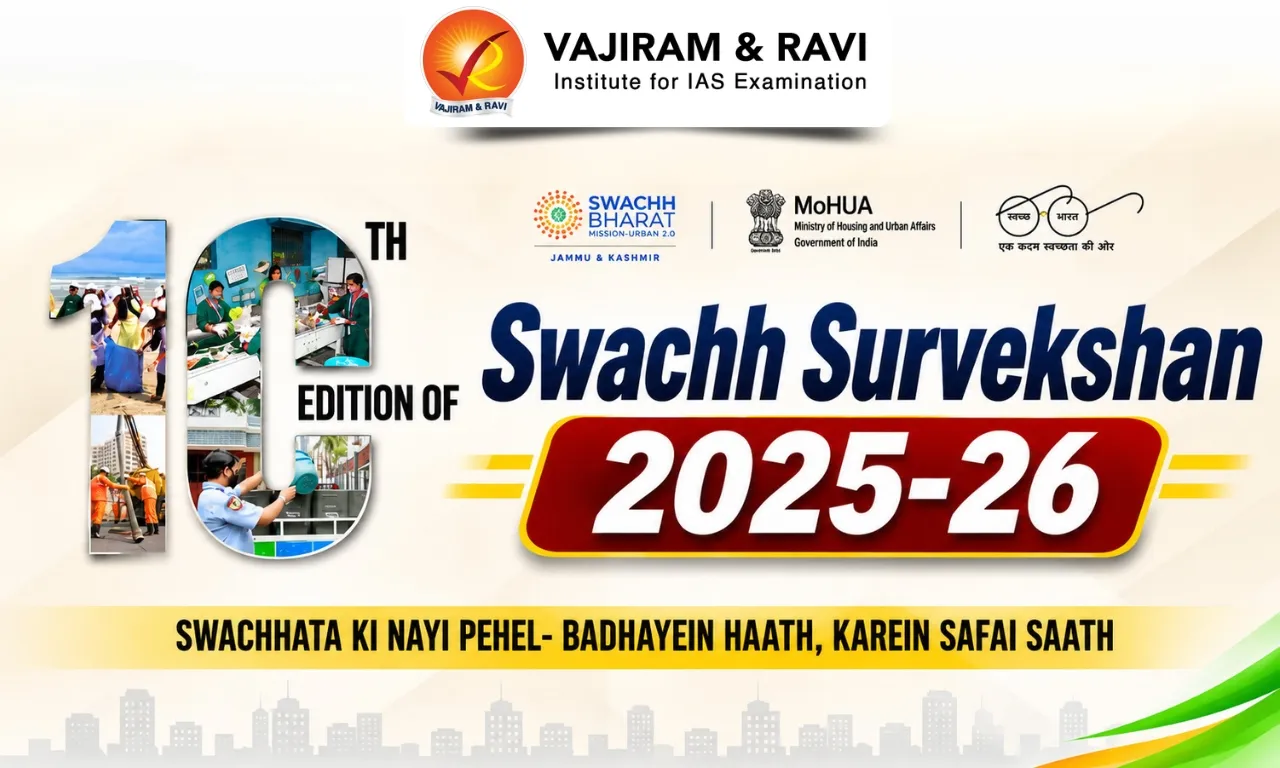
Swachh Survekshan 2025-26

Swachh Survekshan 2025-26

Swachh Survekshan 2025-26 Latest News

President Droupadi Murmu recently felicitated the winners of the Swachh Survekshan Awards 2025-26 at a ceremony held at Vigyan Bhawan in New Delhi.

About Swachh Survekshan 2025-26

  • The 10th edition of the annual Swachh Survekshan Awards, organized by the Ministry of Housing and Urban Affairs (MoHUA) under the Swachh Bharat Mission-Urban (SBM-U)
  • It is the world’s largest urban cleanliness survey and a key pillar of the SBM-U.
  • Launched in 2016, the survey assesses cleanliness and sanitation standards in urban areas across the country, encouraging competition among cities to improve waste management and sanitation. 
  • Over 4,751 cities participated in the latest edition. It expanded its coverage to include the Hills and Himalayan cities as well as River front and coastal towns.  
  • This year 60 national awards have been announced, under the following categories:
    • Clean Cities of Super Swachh League
    • Swachh Shehar in 5 population categories
    • Swachh River Front Town
    • Swachh Coastal Town
    • Clean Himalayan City
    • Swachh Shehar Jodi (SSJ)
    • State First Swachh City

Swachh Survekshan 2025-26 Rankings

  • Super Swachh League (Recognises sustained excellence in cleanliness): 
    1. Navi Mumbai
    2. Surat
    3. Vijayawad
  • Million Plus Population Category:
    1. Greater Visakhapatnam (Andhra Pradesh)
    2. Jabalpur (Madhya Pradesh) 
    3. Lucknow (Uttar Pradesh) 
  • Big Cities (Population 3–10 Lakh Category):
    1. Ujjain (Madhya Pradesh)
    2. Union Territory of Chandigarh
    3. Guntur (Andhra Pradesh)
  • Medium Cities (Population 50000–3 Lakh Category):
    1. Dewas  (Madhya Pradesh)
    2. New Delhi Municipal Council (NDMC)
    3. Sagar (Madhya Pradesh)
  • Small Cities (Population 20000–50000 Category): 
    1. Vita (Maharashtra)
    2. Aska (Odisha)
    3. Panaji (Goa)
  • Very Small Cities (Population < 20000 Category):
    1. Bilha (Chhattisgarh)
    2. Panchgani (Maharashtra)
    3. Budhni (Madhya Pradesh)
  • Indore, which had been ranked the cleanest city in the country for the past eight years, did not figure among the toppers this year. 
  • New Award Categories:
  • Swachh River Front Town: 
    1. Rewa (Madhya Pradesh)
    2. Bilaspur (Chhattisgarh) 
    3. Varanasi (Uttar Pradesh).
  • Swachh Coastal Town: 
    1. Puri (Odisha)
    2. Alappuzha (Keralam)
    3.  Ratnagiri (Maharashtra).
  • Clean Himalayan City: 
    1. Rudrapur (Uttarakhand)
    2. Jammu
    3. Shopian 
  • Swachh Shehar Jodi Initiative: 
    • It is a city-to-city mentorship and peer-learning programme launched under the SBM-U.
    • 70 mentor cities have been paired with 191 mentee cities to facilitate knowledge-sharing and improve sanitation outcomes. 
    • Ahmedabad and its partner town Sanand secured the top position in this category.
    • Indore, with its partner town, Depalpur, secured the second position, while Tirupati and its partner town, Kuppam, ranked third.

News: DDN

Swachh Survekshan 2025-26 FAQs

Q1: Which edition of the Swachh Survekshan Awards was conducted in 2025-26?

Ans: The 10th edition.

Q2: Which ministry organizes the Swachh Survekshan Awards?

Ans: The Ministry of Housing and Urban Affairs (MoHUA).

Q3: Which cities topped in the Super Swachh League of Swachh Survekshan 2025-26?

Ans: Navi Mumbai, Surat and Vijayawada.

Q4: Which city topped the Million Plus Population category in Swachh Survekshan 2025-26?

Ans: Greater Visakhapatnam, Andhra Pradesh.

Credit Guarantee Fund for Micro Units

Credit Guarantee Fund for Micro Units

Credit Guarantee Fund for Micro Units Latest News

The Union Cabinet, chaired has approved the continuation of Credit Guarantee Fund for Micro Units (CGFMU) for a period of five years upto 31.03.2031.

About Credit Guarantee Fund for Micro Units  

  • It was launched in 2016.
  • It has acted as a major catalyst in enabling the growth of Pradhan Mantri Mudra Yojana (PMMY) loans in the country.
  • The scheme provides credit guarantee coverage to the Lending Institutions through National Credit Guarantee Trustee Company Limited (NCGTC) against default risk.
  • Features
    • The fund will provide guarantee coverage for loans of up to ₹20 lakh extended to eligible micro enterprises under PMMY.
    • It will also cover overdrafts of up to ₹10,000 provided by banks through accounts under the Pradhan Mantri Jan Dhan Yojana (PMJDY).
    • Loans granted to self-help groups (SHGs) with a portfolio ranging from ₹10 lakh to ₹20 lakh will also be eligible for coverage.
    • The guarantee coverage will be linked to the actual credit exposure of lending institutions. For working capital facilities, it will be based on the amount disbursed, while for term loans, it will be linked to the outstanding loan amount.
    • Guarantee Fee: There will be reduction in the guarantee fee from 1 per cent per annum to 0.75 per cent per annum. The fee structure for SHG loans will remain unchanged, at 0.25 per cent for the first year and 0.50 per cent in subsequent years.
    • Duration of the Scheme: The Scheme would be applicable to all loans extended under PMMY.

Source: PIB

Credit Guarantee Fund for Micro Units FAQs

Q1: When was Credit Guarantee Fund for Micro Units launched?

Ans: It was launched in 2016.

Q2: What is the significance of Credit Guarantee Fund for Micro Units ?

Ans: The scheme provides credit guarantee coverage to the Lending Institutions through National Credit Guarantee Trustee Company Limited (NCGTC) against default risk.

Navegaon-Nagzira Tiger Reserve to Take Control of Buffer Zone from April 1

Navegaon-Nagzira Tiger Reserve

Nawegaon-Nagzira Tiger Reserve Latest News

A tiger has been recently found dead in Maharashtra’s Nawegaon-Nagzira Tiger Reserve (NNTR) in a suspected case of electrocution, prompting forest authorities to detain a farmer and seven other persons.

About Nawegaon-Nagzira Tiger Reserve

  • It is situated in the Gondia and Shandara districts of Maharashtra. 
  • It lies in the heart of the central Indian tiger landscape, which contributes almost 1/6 of the total tiger population of the country.
  • Officially notified as the 46th Tiger Reserve of India in 2013, it covers an area of approximately 1894.90 sq.km., out of which 656.36 sq.km. forms the core area.
  • It comprises the notified areas of Nawegaon National Park, Nawegaon Wildlife Sanctuary, Nagzira Wildlife Sanctuary, New Nagzira Wildlife Sanctuary, and Koka Wildlife Sanctuary.
  • It has linkages with Kanha, Pench, and Tadoba Tiger Reserves.
  • Topography: The topography is undulating, and the highest point, viz., ‘Zenda Pahad’, is around 702 m above Mean Sea Level.
  • It acts as a critical catchment area for the Vainganga, Chulbandh, and Gadvi rivers.  
  • Vegetation: Southern Tropical Dry Deciduous
  • Flora: The towering Teak (Tectona grandis) dominates the landscape, standing tall alongside Ain (Terminalia tomentosa), Haldu (Adina cordifolia), Dhaora (Anogeissus latifolia), and Bamboo (Dendrocalamus strictus). 
  • Fauna: 
    • Tiger and leopard are the main predators, with sloth bear, dhole (wild dog), jackal, and hyena also recorded. 
    • Herbivores include gaur, sambar, chital, nilgai, barking deer, and wild boar. 
    • It is a good birding destination, with notable ones like the Red-collared Dove, Spotted Dove, and Black-Winged Kite found in the reserve.

News: TP

Nawegaon-Nagzira Tiger Reserve FAQs

Q1: In which state is Nawegaon-Nagzira Tiger Reserve located?

Ans: Maharashtra.

Q2: Which five protected areas constitute Nawegaon-Nagzira Tiger Reserve?

Ans: It comprises the notified areas of Nawegaon National Park, Nawegaon Wildlife Sanctuary, Nagzira Wildlife Sanctuary, New Nagzira Wildlife Sanctuary, and Koka Wildlife Sanctuary.

Q3: Which rivers have their catchment areas in Nawegaon-Nagzira Tiger Reserve?

Ans: Wainganga, Chulbandh and Gadvi rivers.

Q4: What is the predominant vegetation type of Nawegaon-Nagzira Tiger Reserve?

Ans: Southern Tropical Dry Deciduous Forest.

Norway Imposes Near-Ban on Generative AI in Primary Schools

Norway

Norway Latest News

India and Norway are exploring joint research and technology solutions to convert industrial and construction waste into valuable resources for sustainable construction.

About Norway       

  • Location: It is located on the western half of the Scandinavian Peninsula. 
  • Bordering Countries: It shares land borders with Sweden, Finland and Russia in the east and an extensive coastline facing the North Atlantic Ocean on the west.
  • Maritime Border: It is bounded by the Barents Sea in the north, the Norwegian Sea and the North Sea in the west and the Skagerrak (Skager Strait) in the south.
  • Capital City: Oslo

Geographical Features of Norway

  • Topography: About two-thirds of Norway is mountainous, and off its much-indented coastline lie, carved by deep glacial fjords.
  • Highest Point:  The highest point in Norway is Galdhøpiggen, standing at 2,469 m
  • Rivers: Glama, the country’s longest, and the Dramselva, Lagen (two of them) and the Tana in the far north.
  • Lakes: Lake Mjosa is the largest Lake.
  • Natural Resources: It has deposits of iron ore, copper, titanium, coal, zinc, lead, nickel, and pyrite, and large offshore reserves of petroleum and natural gas.

Source: DD News

Norway FAQs

Q1: What is the capital city of Norway?

Ans: Oslo

Q2: Where is Norway located?

Ans: It is located on the western half of the Scandinavian Peninsula. 

Exercise IMNEX-26: India and Myanmar Begin 5th Naval Exercise in Visakhapatnam

Exercise Sea Vigil-26

Exercise Sea Vigil-26 Latest News

The Navy recently kicked off the fifth edition of 'Sea Vigil-26', the country’s largest coastal defence exercise.

About Exercise Sea Vigil-26

  • It is the fifth edition of the pan-India Coastal Defence Exercise.
  • The exercise is being coordinated by the Indian Navy as the lead agency. 
  • Objective: To assess and strengthen the country’s maritime security and coastal defence preparedness.  
  • Exercise Sea Vigil was conceptualised in 2018 to validate the measures instituted to strengthen maritime security in the aftermath of the 26/11 Mumbai terror attacks. 
  • The 2026 edition will cover the entire Indian coastline and Exclusive Economic Zone (EEZ), involving all coastal states and Union Territories, along with various maritime stakeholders, including fishing and coastal communities. 
  • It is the first since India's coastline was officially re-measured at 11,098.81 km, nearly 48 percent longer than the 7,516.6 km figure used for decades. 
  • The exercise is being conducted in two phases. The Coastal Defence and Security Readiness Evaluation (CDSRE) phase, followed by the Sea Phase on November 18 and 19. 
  • The exercise will bring together personnel and assets from the Indian Navy, the Indian Coast Guard, Coastal Security Police, Customs, and other maritime agencies.  
  • The exercise is being facilitated by the Ministries of Defence; Home Affairs; Ports, Shipping and Waterways; Petroleum and Natural Gas; and Fisheries, Animal Husbandry and Dairying, along with other central government agencies and coastal states and Union Territories. 
  • Sea Vigil also serves as a precursor to the Indian Navy’s biennial Theatre Level Readiness Operational Exercise (TROPEX). 
  • Together, Sea Vigil and TROPEX address the entire spectrum of maritime security challenges, from coastal defence to operations on the high seas.

News: TOI

Exercise Sea Vigil-26 FAQs

Q1: What is Exercise Sea Vigil?

Ans: It is a pan-India Coastal Defence Exercise conducted to assess and strengthen India's maritime security and coastal defence preparedness.

Q2: Which organisation is the lead agency coordinating Exercise Sea Vigil-26?

Ans: The Indian Navy.

Q3: Which major security organisations and agencies are participating in Exercise Sea Vigil-26?

Ans: Indian Navy, Indian Coast Guard, Coastal Security Police, Customs and other maritime agencies.

Q4: Which geographical areas will be covered by Exercise Sea Vigil-26?

Ans: The entire Indian coastline and Exclusive Economic Zone (EEZ).

Stand-Up India Scheme: ₹40,710 Crore Sanctioned to Over 1.8 Lakh Accounts

Stand-Up India Scheme

Stand-Up India Scheme Latest News

Recently, the union cabinet has approved the continuation of Stand-Up India Scheme for a period of 5 years upto 31.03.2031.  

About Stand-Up India Scheme     

  • It was launched on 5th April, 2016 to promote entrepreneurship among the Scheduled Castes/ Scheduled Tribes and Women.
  • Under the recent extension period it aims to provide financial assistance to additional 2.5 lakh entrepreneurs in a span of five years.
  • It operates under the Ministry of Finance.
  • Age Requirement: The applicant must be above 18 years of age.

Features of the Stand-Up India Scheme

  • Eligible borrowers: Women, SC and ST entrepreneurs for setting up new/green field enterprises
  • Financial Support: The loan can be in the form of either Composite (Working Capital and Term Loan) or Term loan for amounts above Rs.10.00 lakh and upto Rs.1.00 crore (upto 85% of the project cost).
  • Eligible Sectors: Manufacturing, Services, Trading and Agri allied activities.
  • Credit Guarantee coverage: 85% of the loan amount
  • Guarantee Fee: Standard guarantee fee of 0.50 %

Source: PIB

Stand-Up India Scheme FAQs

Q1: What is the objective of Stand-Up India Scheme?

Ans: It was launched on 5th April, 2016 to promote entrepreneurship among the Scheduled Castes/ Scheduled Tribes and Women.

Q2: What is the age requirement for Stand-Up India Scheme?

Ans: The applicant must be above 18 years of age.

Wangala Festival

Wangala Festival

Wangala Festival Latest News

Recently, Meghalaya’s 100 Drums Wangala Festival commenced in West Garo Hills with traditional music and cultural performances.

About Wangala Festival  

  • It is celebrated in the Garo Hills of Meghalaya, India.
  • It is also known as a 100 drums festival.
  • It is a harvest festival held in honour of Saljong, the Sun-god of fertility.
  • The celebration of the Wangala Festival marks the end of a period of toil, which brings good output from the fields. It also signifies the onset of winter.
  • It is the occasion when the tribals offer sacrifices to please their main deity Saljong - the Sun God.
  • It is generally celebrated for two days and sometimes continues for even a week.
  • The ceremony performed on the first day known as "Ragula" is performed inside the house of the chief.
  • On the second day is known as "Kakkat".
  • Basically, the Wangala Festival is a way to preserve and promote the cultural identity of Garos in Meghalaya.

Source: News On Air

Wangala Festival FAQs

Q1: What is Wangala Festival ?

Ans: It is celebrated in the Garo Hills of Meghalaya, India.

Q2: What is the other name of Wangala Festival ?

Ans: It is also known as a 100 drums festival.

Coal Gasification: Cabinet Approves ₹37,500 Crore Package to Boost Syngas Production

Coal Gasification

Coal Gasification Latest News

The government's ₹37,500-crore coal gasification scheme attracted only two applications in its second round, with experts citing financing constraints, uncertain demand and logistical costs.

About Coal Gasification

  • It is a thermo-chemical process that converts coal into syngas.
  • Contrary to what the name of the process suggests, coal gasification does not burn coal directly. 
  • It heats crushed coal with limited oxygen and steam at very high temperature (typically around 800–1,600°C) and pressure, producing syngas.
  • Syngas typically contains:
    • Carbon monoxide (CO)
    • Hydrogen (H₂)
    • Methane (CH₄)
    • Carbon dioxide (CO₂)
    • Water vapor (H₂O)
    • Trace gases (e.g., sulfur compounds)
  • Syngas can then be converted into:
    • Methanol
    • Ammonia
    • Urea
    • Synthetic Natural Gas (SNG)
    • Hydrogen
    • Liquid fuels and chemicals
  • Process of Coal Gasification:
    • Preparation: Coal is finely crushed to increase surface area.
    • Drying: Moisture is removed from the coal.
    • Pyrolysis: Coal is heated in the absence of oxygen to release volatile gases.
    • Oxidation: A controlled amount of oxygen or air is added to partially combust the coal, generating heat.
    • Reduction: Steam reacts with hot carbon to form syngas through water-gas reactions.
  • Advantages of Coal Gasification:
    • Fuel Flexibility: Can utilize low-grade coal and waste coal.
    • Cleaner Combustion: Lower SOx, NOx, and particulate emissions than direct coal combustion.
    • Feedstock for Chemicals: Syngas can be converted into ammonia, methanol, or synthetic fuels.
    • Power Generation: Integrated Gasification Combined Cycle (IGCC) plants convert syngas to electricity more cleanly.
    • Hydrogen Production: 
      • Provides a source of hydrogen for fuel cells and other industrial applications. 
      • With carbon capture and storage, coal-based hydrogen production can have substantially lower carbon emissions.

News: BS

Coal Gasification FAQs

Q1: What is coal gasification?

Ans: It is a thermo-chemical process that converts coal into synthesis gas (syngas).

Q2: What are the major constituents of syngas produced through coal gasification?

Ans: Carbon monoxide (CO) and hydrogen (H₂).

Q3: How does coal gasification promote fuel flexibility?

Ans: It enables the utilisation of low-grade coal and certain forms of waste coal.

Q4: How does coal gasification help reduce air pollution?

Ans: It allows sulphur compounds, particulates and other impurities to be removed from syngas before its use.

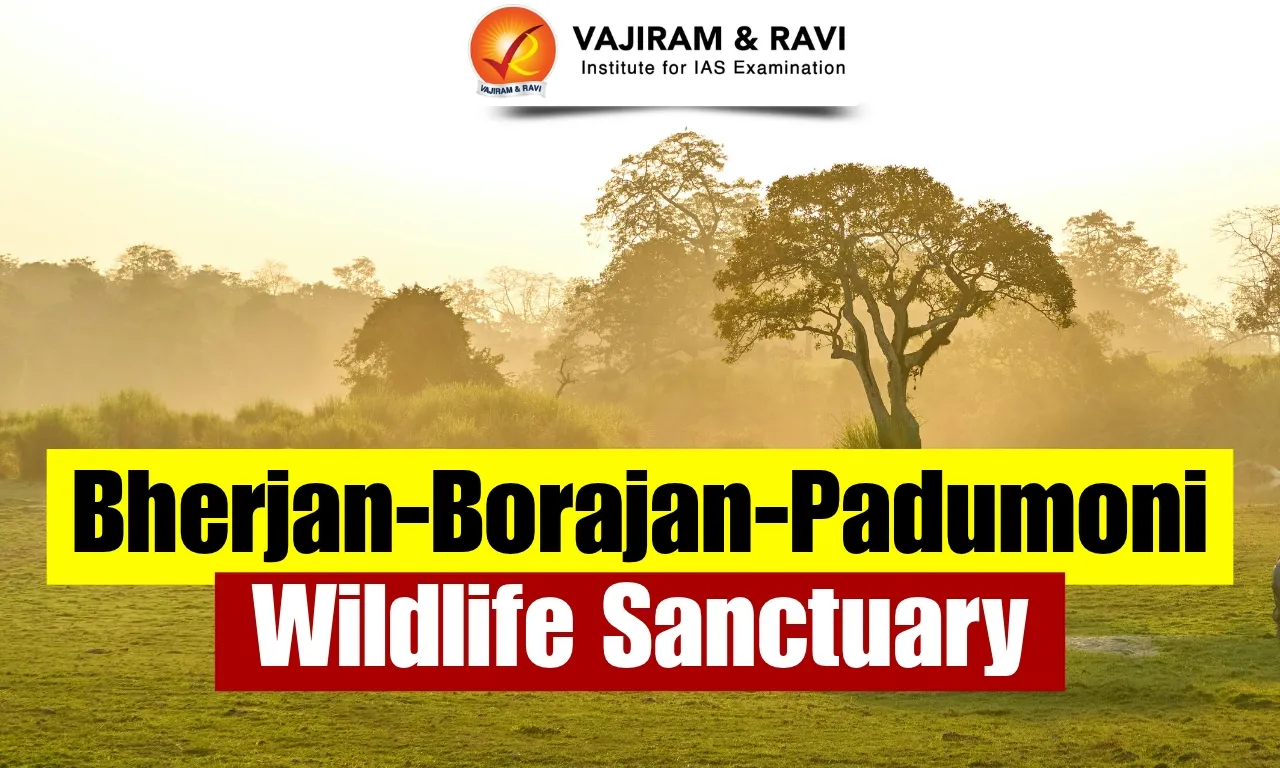
Bherjan-Borajan-Padumoni Wildlife Sanctuary

Bherjan-Borajan-Padumoni Wildlife Sanctuary

Bherjan-Borajan-Padumoni Wildlife Sanctuary Latest News

The Centre has proposed declaring a uniform one-kilometre area around the Bherjan-Borajan-Padumoni Wildlife Sanctuary in Assam's Tinsukia district as an Eco-Sensitive Zone (ESZ).

About Bherjan-Borajan-Padumoni Wildlife Sanctuary

  • It is a protected area situated in the Tinsukia district in the eastern part of Assam.
  • It is a small sanctuary covering an area of 7.22 sq.km.
  • Established in 1999, it is part of the Indo-Chinese tropical moist forest biome.
  • It comprises three separate forest blocks named Bherjan, Borajan, and Padumoni. 
    • The three areas are disjunct and separated by tea gardens and human habitations. 
    • These are entirely on the flat plains of the Brahmputra Valley.
  • The terrain is mostly flat with some scattered hillocks.
  • The sanctuary enjoys the typical humid subtropical climate of the Northeast Indian region, receiving heavy rainfall, which significantly influences its dense vegetation growth.
  • Flora: The vegetation of the sanctuary is almost tropical wet evergreen rainforest.
  • Fauna:
    • It holds the highest concentration of primates on the Indian subcontinent, including hoolock gibbons (only species of apes found in India), langurs, and macaques. 
    • The sanctuary also hosts mammals such as leopards, wild pigs, and giant flying squirrels. 
    • There are more than 84 species of birds, including Osprey, Indian Pied Hornbill, Kingfisher, Woodpecker, Lined Barbet, Common Myna, Drongo, Bulbul, Magpie Robin, Wagtail, and many more varieties of woodland birds.

News: AT

Bherjan-Borajan-Padumoni Wildlife Sanctuary FAQ's

Q1: Where is Bherjan-Borajan-Padumoni Wildlife Sanctuary located?

Ans: It is located in the Tinsukia district of Assam, in northeastern India.

Q2: What is the total area of Bherjan-Borajan-Padumoni Wildlife Sanctuary?

Ans: It is a small sanctuary covering an area of 7.22 sq.km.

Q3: Which forest biome is associated with Bherjan-Borajan-Padumoni Wildlife Sanctuary?

Ans: The Indo-Chinese tropical moist forest biome.

Q4: What type of vegetation is predominantly found in the Bherjan-Borajan-Padumoni Wildlife Sanctuary?

Ans: Tropical wet evergreen rainforest vegetation.

Enquire Now