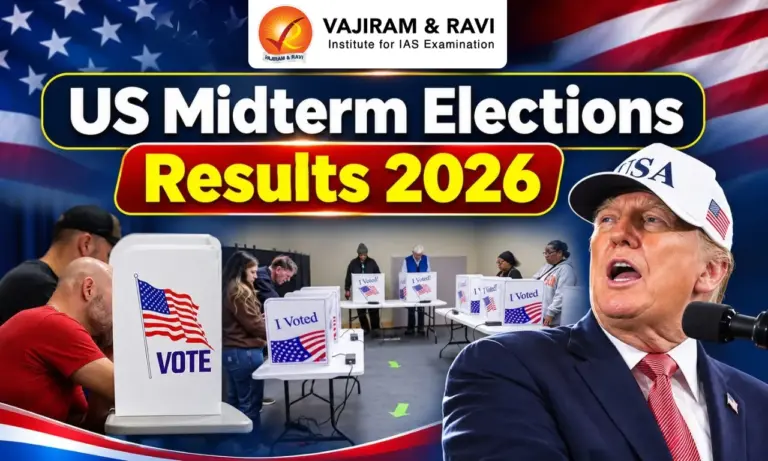
US Midterm Elections 2026, held on November 3, 2026, elected all 435 House members and 35 of the 100 Senate seats, midway through the presidential term. As of November 4, early projections indicated a change in control of the House, while the Senate outcome remained unconfirmed pending counting and certification. The results mark a major political shift and, if confirmed, would give Democrats greater influence over Congress and Trump’s legislative agenda for the remaining two years of his presidency. US Midterm Elections Results 2026 is discussed in detail in this article.
US Midterm Elections Results 2026 Latest Updates
The US Midterm Elections 2026, held on November 3, 2026, witnessed a major political shift as the Democratic Party secured projected control of both the Senate and the House of Representatives, defeating the Republican Party led by President Donald Trump. The results mark a significant setback for Republicans and will reshape American politics during the remaining two years of Trump’s presidency.
- Democrats Win Control of Congress: The Democratic Party secured projected majorities in both chambers of the US Congress, ending Republican control. This gives Democrats greater power to influence legislation, government spending and congressional investigations.
- Major Setback for Donald Trump: The election results represent a significant political defeat for President Donald Trump and the Republican Party. Democrats gained support across several traditionally Republican states and competitive congressional districts.
- Key Issues Behind Republican Defeat: Rising living costs, inflation, fuel prices, tariffs and the US-Iran conflict emerged as major election issues.
- Historic Democratic Victories: Democrats achieved major victories in traditionally Republican states, including Texas, Kansas, Iowa, Ohio and South Carolina. These results demonstrated a significant shift in voter support beyond traditional Democratic strongholds.
- Impact on Trump’s Remaining Presidency: Democratic control of Congress could make it harder for Trump to pass major legislation. Democrats will also gain greater influence over congressional committees, budget decisions and government oversight, although Trump will retain his presidential veto powers.
What Are US Midterm Elections?
The US Midterm Elections are held every two years, midway through the four-year term of the US President. They determine the composition of the US Congress, consisting of the House of Representatives and the Senate, and play an important role in shaping federal laws, government policies and the balance of political power.
- Election Cycle: Midterms take place halfway through a President’s term. The 2026 midterms were held on November 3, 2026, during President Donald Trump’s second term.
- House of Representatives Elections: All 435 voting members are elected every two years for two-year terms. A party generally needs 218 seats for a majority.
- Senate Elections: About one-third of the 100 Senate seats are contested every two years. Senators serve six-year terms, so the entire Senate is never replaced at once.
- State-Level Elections: Several states also elect governors, state legislatures and other public officials, making midterms important for both federal and state politics.
- Role of Congress: Congress makes federal laws, approves government spending and oversees the executive. The Senate also confirms key presidential appointments and approves treaties.
- Major Election Issues: The 2026 elections focused on inflation, fuel and food prices, housing costs, healthcare, immigration, trade tariffs and AI regulation. The US-Iran conflict and its economic impact were also key concerns.
- Balance of Political Power: Midterms decide whether the President’s party retains control of Congress or the opposition gains a majority, which can make it harder for the President to pass legislation.
- Public Opinion on the President: Midterms are often seen as an indicator of public satisfaction with the President’s performance, even though the President is not directly elected in these elections.
- Significance for the 2028 Presidential Election: The results may influence political strategies, party leadership and candidate selection ahead of 2028. Under the 22nd Amendment, Donald Trump cannot be elected President for a third term.
Also Read:- US Presidential Election 2024


US Midterm Elections 2026 House of Representatives Results
The Democratic Party was projected to regain control of the House, according to media projections. All 435 seats were contested, with 218 required for a majority. Democrats gained several seats previously held by Republicans.
- Projected Democratic Majority: According to NBC News estimates, Democrats were projected to win about 255 seats against 180 for Republicans, though individual races were still being counted.
- Republicans Lose Competitive Seats: Democrats made gains in Republican-held constituencies, including areas where Republicans performed strongly in the 2024 presidential election.
- Shift in Representation: The results indicated growing Democratic support across voter groups, reducing Republican representation in the House.
- Role of the House: The House makes federal laws, approves government spending and oversees the executive. Revenue bills must originate in the House, though they also require Senate approval.
- Importance of Democratic Control: A Democratic majority would allow the party to lead House committees, propose legislation and investigate government activities. Passing laws would still need the Senate and President’s agreement, unless Congress overrides a presidential veto.
Also Read:- India-US Relations
US Senate Election Results 2026 Democratic vs Republican Party Performance
The 100-member Senate was also up for election, with 35 seats contested. Before the elections, Republicans held a 53-47 majority, including two independents who caucused with Democrats. Democrats needed a net gain of four seats to take control. As of November 4, the final outcome was awaited and subject to counting and certification.
- Senate Control Unconfirmed: Reports indicated Democratic gains in some Republican-held seats, but control of the chamber had not yet been projected.
- Gains in Republican Strongholds: Democrats were reported to have made notable gains in traditionally Republican areas, though individual race results were still being updated.
- Retention of Existing Seats: Democrats were also reported to have defended several of their own seats, which is essential for securing control of the chamber.
- Republican Strongholds: Republicans continued to win elections in several traditional strongholds, maintaining representation in the upper chamber.
- Senate’s Constitutional Powers: The Senate passes federal legislation, approves treaties and confirms presidential appointments, including Cabinet officials, ambassadors and federal judges.
- Impact on Presidential Powers: If Democrats gain Senate control, it could make it more difficult for President Trump to secure approval for certain appointments and legislative proposals. However, the President retains important executive powers under the Constitution.
Also Read:- India-US Trade Dispute and Its Impact
US Democratic System and Structure of Government
The United States follows a federal presidential democratic system, based on separation of powers, checks and balances, federalism and constitutional supremacy. The US Constitution (adopted 1787, effective 1789) establishes three branches of government: Legislature, Executive and Judiciary.
- Federal System: The US is a federal republic of 50 states and Washington, D.C., with powers divided between the federal and state governments.
- Presidential Form: The President is both Head of State and Head of Government. Unlike India, the President is not responsible to the legislature and serves a fixed four-year term.
- Legislative Branch (Congress): Congress is bicameral. The House of Representatives has 435 voting members elected for two years, while the Senate has 100 members (two per state) serving six-year terms. Congress makes laws, approves federal spending and oversees the executive.
- Executive Branch: The President, Vice President and Cabinet implement federal laws, direct foreign policy, serve as Commander-in-Chief and appoint senior officials, subject to Senate confirmation.
- Judicial Branch: The Supreme Court (nine justices) and lower federal courts exercise judicial review, declaring laws or executive actions unconstitutional. Federal judges generally hold office during good behaviour.
- Separation of Powers: Authority is distributed among the three branches to prevent concentration of power. Unlike India, Cabinet members are not members of Congress.
- Checks and Balances: The President can veto legislation, Congress can override a veto with a two-thirds majority in both chambers, and courts can invalidate unconstitutional laws or executive actions.
- Electoral System: The President is elected indirectly through the Electoral College, while Congress is elected by popular vote. House members face elections every two years, and about one-third of senators every two years.
- Party System: The US has a two-party system dominated by the Democratic and Republican Parties, though other parties and independents can contest.
- Impeachment: The House impeaches federal officials, including the President, while the Senate conducts the trial. Removal requires a two-thirds majority of senators present.
- Constitutional Supremacy: The US Constitution is the supreme law, defining government powers, protecting fundamental rights and governing federal-state relations.

 Last updated on Nov, 2026
→ UPSC 2027 Notification will be released on 13 January 2027 at upsconline.nic.in.
→ Check Nobel Prize 2026 Winners List here.
→ Download PIB PRiSM Monthly Magazine 2026 here.
→ Check UPSC Monthly Current Affairs Magazine The Recitals here.
→ Check out the latest UPSC Syllabus here.
→ Download UPSC Model Answers for Mains 2026
→ UPSC Mains Question Paper 2026 is out now for Essay & GS Paper 1, 2, 3 & 4.
→ UPSC Calendar 2027 has been released.
→ Enroll in Vajiram & Ravi’s UPSC Mains Test Series 2027 for structured answer writing practice, expert evaluation, and exam-oriented feedback.
→ Join Vajiram & Ravi’s UPSC Mentorship Program 2027 for personalized guidance, strategy planning, and one-to-one support from experienced mentors.
→ Go through the UPSC Mains Previous Year Papers to enhance your preparation.
→ UPSC has released UPSC Toppers List 2025 with the Civil Services final result on its official website.
→ Also check Best UPSC Coaching in India
US Midterm Elections 2026 FAQs
Q1. Who won the US Midterm Elections 2026?+
Q2. When were the US Midterm Elections 2026 held?+
Q3. How many seats were contested in the US Midterm Elections 2026?+
Q4. How many seats are needed for a majority in the US Congress?+
Q5. How will the US Midterm Elections 2026 affect Donald Trump?+
Q6. Why are the US Midterm Elections 2026 important for India?+
Tags: us midterm elections us midterm elections results us midterm elections results 2026