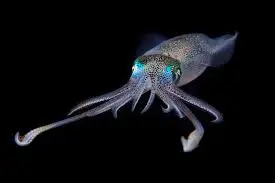
About Vampire Squid:
- It is a small (12-inch-long) cephalopod found in deep temperate and tropical seas.
- The vampire squid possesses characteristics of both squid and octopi, and occupies its own order in taxonomy (scientific classification).
- Habitat
- It lives in the tropical and subtropical oceans of the world at depths ranging from 300-3000m with a majority of squids living between the ranges of 1,500-2,500m.
- Vampire squids live in the oxygen minimum layer of the ocean where virtually no light penetrates
- Characteristics
- It has black chromatophores with reddish-brown ones interspersed.
- In contrast to other cephalopods, these chromatophores are non-functional because they have lost the muscles that enable rapid color change.
- It shares most other features with other octopods and decapods, but it has several adaptations that allow it to live in a deep-sea environment.
- The vampire squid also has photophores which are large circular organs which are located posterior to each adult fin and are also distributed over the surface of the mantle, funnel, head, and aboral surface.
- These photoreceptors produce luminescent clouds of glowing particles that allow the vampire squid to glow.
- Its most intriguing physical characteristic is that it has proportionally the largest eyes of any animal in the world.
- Food habit: They are deep-sea scavengers and are in fact usually gravitate toward feces and dead animals.
Q1: What are chromatophores?
These are organs that are present in the skin of many cephalopods, such as squids, cuttlefish, and octopuses, which contain pigment sacs that become more visible as small radial muscles pull the sac open making the pigment expand under the skin.
Source: Rare vampire squid’s appearance in South China Sea leaves biologists puzzled


 Last updated on Oct, 2026
→ UPSC 2027 Notification will be released on 13 January 2027 at upsconline.nic.in.
→ Asian Games 2026 are being held in Aichi-Nagoya, Japan, from 19 September to 4 October.
→ Check Nobel Prize 2026 Winners List here.
→ Download PIB PRiSM Monthly Magazine 2026 here.
→ Check UPSC Monthly Current Affairs Magazine The Recitals here.
→ Check out the latest UPSC Syllabus here.
→ Download UPSC Model Answers for Mains 2026
→ UPSC Mains Question Paper 2026 is out now for Essay & GS Paper 1, 2, 3 & 4.
→ UPSC Calendar 2027 has been released.
→ Enroll in Vajiram & Ravi’s UPSC Mains Test Series 2027 for structured answer writing practice, expert evaluation, and exam-oriented feedback.
→ Join Vajiram & Ravi’s UPSC Mentorship Program 2027 for personalized guidance, strategy planning, and one-to-one support from experienced mentors.
→ Go through the UPSC Mains Previous Year Papers to enhance your preparation.
→ UPSC has released UPSC Toppers List 2025 with the Civil Services final result on its official website.
→ Also check Best UPSC Coaching in India