What’s in today’s article?
- Why in News?
- What is Parliamentary oath?
- Who was Uda Devi?
- Who was Maharaja Bijli Pasi?
Why in News?
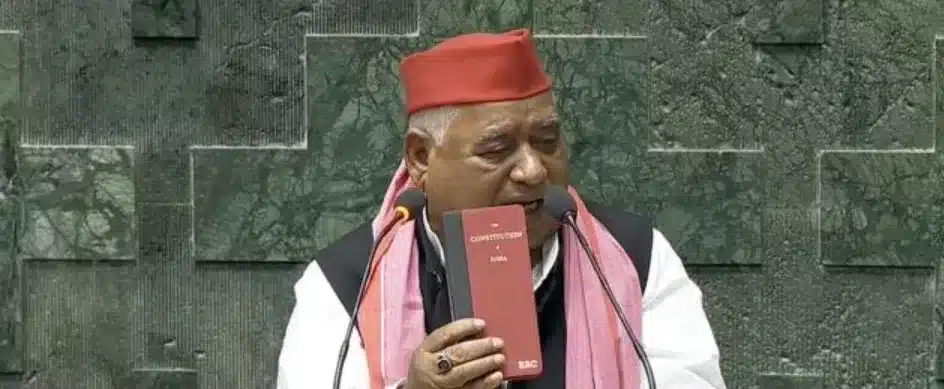
Earlier, a newly-elected MP from Faizabad, took his oath in the Lok Sabha. During the ceremony, he mentioned Veerangana Uda Devi and Maharaja Bijli Pasi, who are important figures in the Pasi (Dalit) community.


What is Parliamentary oath?
- About
- The third schedule of the Constitution contains the parliamentary oath.
- Through this, members swear or affirm to bear true faith and allegiance to the Constitution of India, uphold India’s sovereignty and integrity, and faithfully discharge their duties.
- Evolution of oath over the years
- The draft Constitution, prepared by the committee chaired by Dr. B.R. Ambedkar, initially did not invoke God in any oaths, emphasizing a solemn and sincere promise to uphold the Constitution.
- During the Constituent Assembly discussions, members like K.T. Shah and Mahavir Tyagi proposed amendments to include God in the President’s oath.
- They argued that it would provide a divine sanction for believers while allowing non-believers to affirm solemnly.
- Despite disagreements, Ambedkar accepted the amendments, recognizing the significance of invoking God for some individuals.
- The last modification to the oath came with the Constitution (Sixteenth Amendment) Act, 1963.
- This amendment added the commitment to uphold India’s sovereignty and integrity, following recommendations from the National Integration Council.
- Process
- Before taking the oath or affirmation, MPs must submit their election certificate to the Lok Sabha staff.
- This requirement was introduced after a 1957 incident where a mentally unsound individual posed as an MP and took the oath.
- MPs can then take their oath or affirmation in English or any of the 22 languages specified in the Constitution.
- MPs must use the name on their election certificate and adhere to the text of the oath.
- Deviations, such as adding suffixes or phrases, are not recorded, and MPs may be asked to retake the oath.
- While oaths and affirmations are a personal choice, 87% of MPs swore in the name of God in the last Lok Sabha, with the remaining 13% affirming allegiance to the Constitution.
- Some MPs alternate between swearing by God and affirming across different terms.
- Before taking the oath or affirmation, MPs must submit their election certificate to the Lok Sabha staff.
- Invoking different icons during oath taking ceremony in Parliament
- During the oath-taking ceremony in Parliament, elected members often invoke or mention various icons, historical figures, or personalities who hold significance to them personally or to their constituency or community.
- This can include mentioning leaders, historical figures, social reformers, or cultural icons who have made significant contributions to society or who represent important values and aspirations.
- These mentions can highlight the diversity and richness of India’s cultural and historical heritage, as well as the personal or political affiliations of the elected members.
Who was Uda Devi?
- Uda Devi, born in Ujirao, Lucknow, was part of the royal guard of Begum Hazrat Mahal of Awadh and took part in the 1857 Mutiny.
- She is known for mobilizing people to fight against the British.
- On November 16, 1857, she fought bravely near the Gomti River in Lucknow, reportedly killing at least three dozen British soldiers before being killed herself.
- Every year on November 16, events are held in central Uttar Pradesh to commemorate her martyrdom.
- Uda Devi remains an important icon, especially for the Dalit community.
Who was Maharaja Bijli Pasi?
- Bijli Pasi is a well-known figure among the Pasis of central Uttar Pradesh, including districts like Lucknow, Rae Bareli, Barabanki, Bahraich, Sultanpur, and Allahabad.
- He is one of the most prominent Pasi leaders, having ruled parts of UP during the medieval period.
- The ruins of his fort still stand in Lucknow, where a statue of him has also been erected.
- Other notable Pasi figures from this region include Daldev, Baldev, and Kakoran.
Q.1. Who was Begum Hazrat Mahal?
Begum Hazrat Mahal was a prominent figure during the Indian Rebellion of 1857. As the wife of Nawab Wajid Ali Shah of Awadh, she led the resistance against the British East India Company’s rule, becoming an icon of Indian independence struggle.
Q.2. What is eighth schedule of Indian Constitution?
The Eighth Schedule of the Indian Constitution lists the 22 languages recognized by the Republic of India. These languages are officially recognized for use in Parliament, state legislatures, and for official communication between the Union and state governments.
Source: Decode Politics: Who are the two Pasi icons invoked by new MP from Ayodhya in his oath | Business Standard

 Last updated on Oct, 2026
→ UPSC 2027 Notification will be released on 13 January 2027 at upsconline.nic.in.
→ Check Nobel Prize 2026 Winners List here.
→ Download PIB PRiSM Monthly Magazine 2026 here.
→ Check UPSC Monthly Current Affairs Magazine The Recitals here.
→ Check out the latest UPSC Syllabus here.
→ Download UPSC Model Answers for Mains 2026
→ UPSC Mains Question Paper 2026 is out now for Essay & GS Paper 1, 2, 3 & 4.
→ UPSC Calendar 2027 has been released.
→ Enroll in Vajiram & Ravi’s UPSC Mains Test Series 2027 for structured answer writing practice, expert evaluation, and exam-oriented feedback.
→ Join Vajiram & Ravi’s UPSC Mentorship Program 2027 for personalized guidance, strategy planning, and one-to-one support from experienced mentors.
→ Go through the UPSC Mains Previous Year Papers to enhance your preparation.
→ UPSC has released UPSC Toppers List 2025 with the Civil Services final result on its official website.
→ Also check Best UPSC Coaching in India