W Ursae Majoris Star Latest News
Astronomers from Aryabhatta Research Institute of Observational Sciences used data from Devasthal Fast Optical Telescope and NASA’s TESS space telescope to create detailed light curves of the W Ursae Majoris (W UMa) star.
About W Ursae Majoris Star
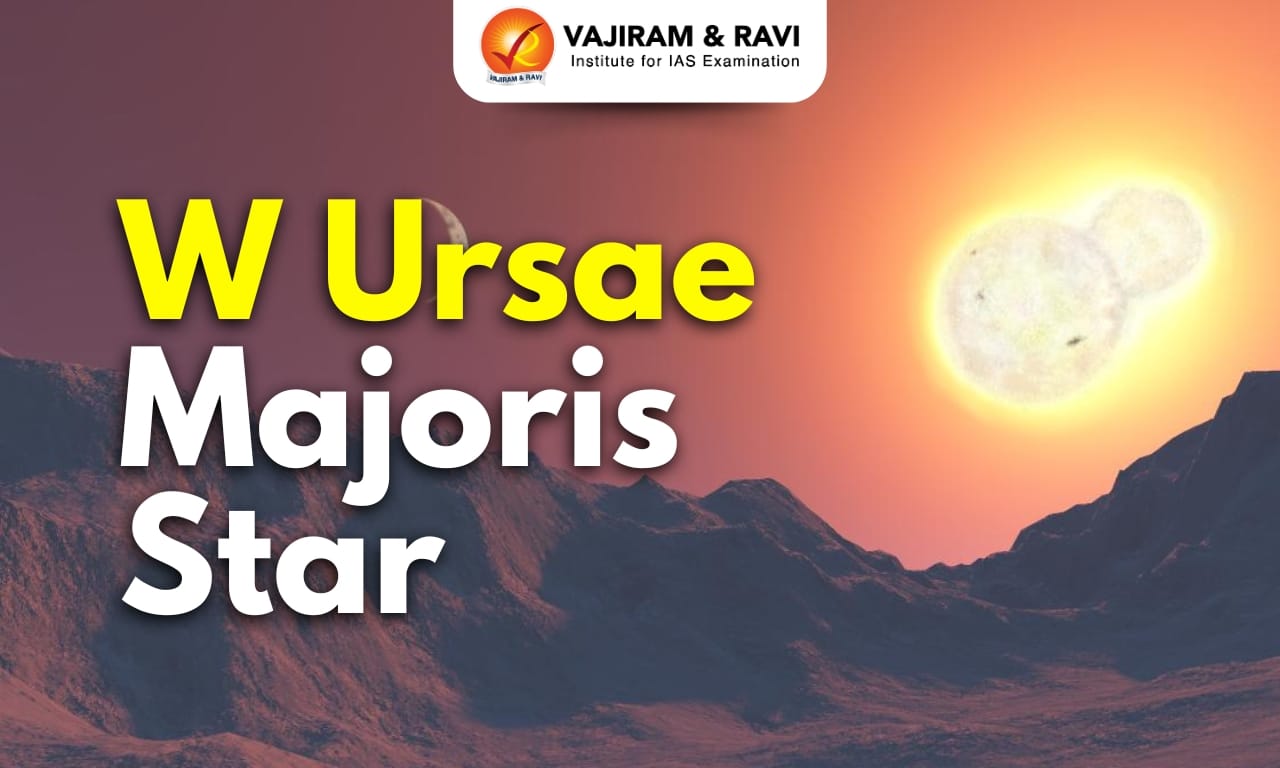
- It is also known as a low mass contact binary, is a type of eclipsing binary variable star.
- They share a single outer atmosphere and they orbit around each other.
- W UMa stars are easily recognized by their light curves with near equal minima and continuous light variation.
- Their variability ranges from a few tenths to slightly over a magnitude. The periods are typically short and range between 0.25 days to around 1.0 days.
- Origin: The traditional theory explaining the origin of contact binaries is that W UMa systems form from detached binaries of comparable periods through orbital decay by angular momentum loss.
- The idea of the contact binary seems to have been first introduced by Kuiper (1941).
- Significance W Ursae Majoris Star Study: They assist in precise determinations of fundamental stellar parameters such as masses, radii, and temperatures, crucial for testing theories about how stars evolve over time.


Key Findings about W Ursae Majoris Star
- It was found that stars share their outer layers, their orbits shift slightly over time, as if tugging and pulling on one another
- Some stars appear lopsided—brighter on one side than the other.
- It is found that there is an uneven brightness point at dark magnetic star spots similar to star spots.
- These spots rotate in and out of view, creating bumps in the light curves.
- This also suggests the stars have strong magnetic activity.
- Scientists also found specific light signals (called H-alpha and H-beta) that clearly show activity in the star’s outer layer, which is linked to magnetic events like star spots and stellar flares.
Source: PIB

 Last updated on Oct, 2026
→ UPSC 2027 Notification will be released on 13 January 2027 at upsconline.nic.in.
→ Asian Games 2026 are being held in Aichi-Nagoya, Japan, from 19 September to 4 October.
→ Check Nobel Prize 2026 Winners List here.
→ Download PIB PRiSM Monthly Magazine 2026 here.
→ Check UPSC Monthly Current Affairs Magazine The Recitals here.
→ Check out the latest UPSC Syllabus here.
→ Download UPSC Model Answers for Mains 2026
→ UPSC Mains Question Paper 2026 is out now for Essay & GS Paper 1, 2, 3 & 4.
→ UPSC Calendar 2027 has been released.
→ Enroll in Vajiram & Ravi’s UPSC Mains Test Series 2027 for structured answer writing practice, expert evaluation, and exam-oriented feedback.
→ Join Vajiram & Ravi’s UPSC Mentorship Program 2027 for personalized guidance, strategy planning, and one-to-one support from experienced mentors.
→ Go through the UPSC Mains Previous Year Papers to enhance your preparation.
→ UPSC has released UPSC Toppers List 2025 with the Civil Services final result on its official website.
→ Also check Best UPSC Coaching in India
W Ursae Majoris Star FAQs
Q1. What type of star system is W Ursae Majoris?+
Q2. In which constellation is W Ursae Majoris located?+
Tags: prelims pointers upsc current affairs upsc prelims current affairs w ursae majoris star