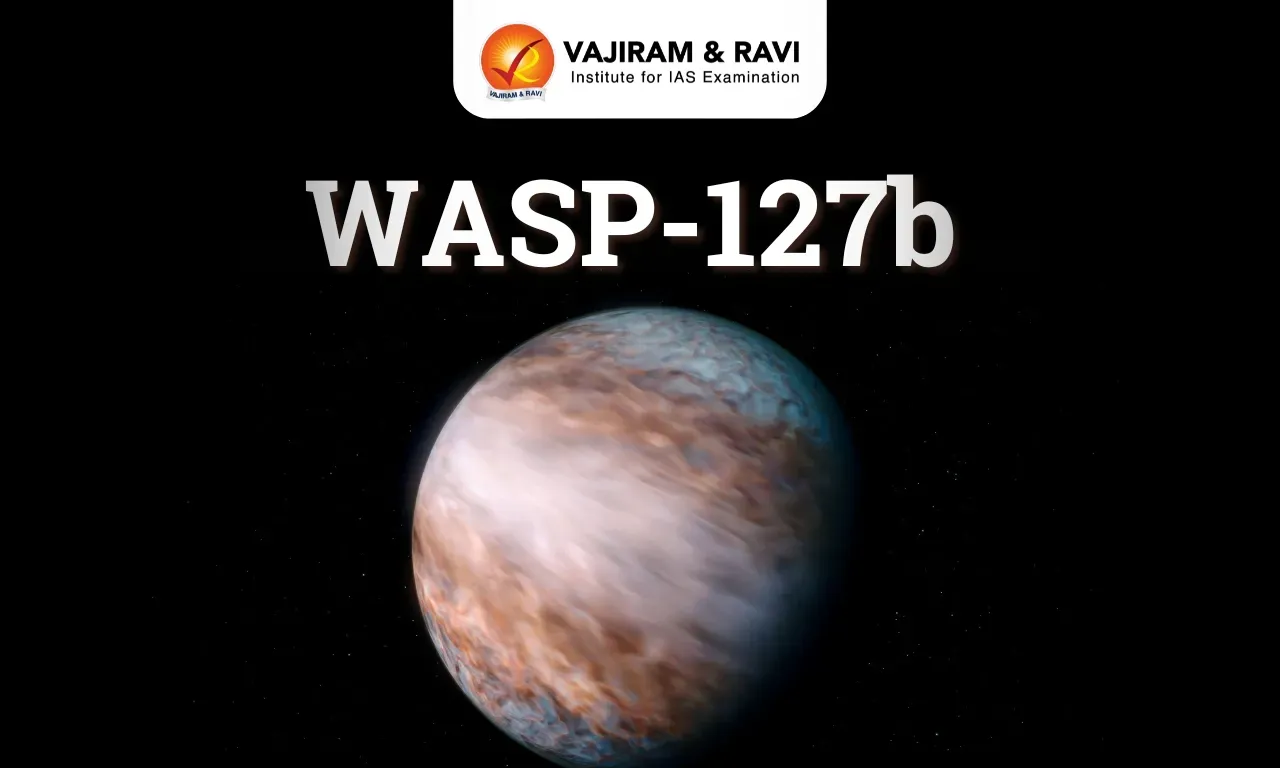
WASP-127b Latest News
Scientists recently detected ‘supersonic winds’ travelling at a speed of 33,000 km per hour on a giant gaseous planet named WASP-127b.
About WASP-127b
- It is a large gaseous exoplanet, located in our Milky Way galaxy.
- It is approximately 520 light-years from the earth in a tight orbit around a star similar to our sun.
- It is a type called a hot Jupiter, a gas giant that orbits very close to its host star.
- It orbits its star roughly every four days at just about 5% of the distance between the earth and the sun, leaving it scorched by stellar radiation.
- Like our moon is to the earth, one side of WASP-127b perpetually faces its star—the day side. The other side always faces away—the night side.
- Its atmosphere is about 2,060 degrees Fahrenheit (1,400 degrees Kelvin/1,127 degrees Celsius), with its polar regions less hot than the rest.
- WASP-127b’s diameter is about 30% larger than Jupiter’s, but its mass is only about 16% that of Jupiter’s, making it one of the puffiest planets ever observed.
- Like Jupiter, WASP-127b is composed mainly of hydrogen and helium, but its atmosphere also contains traces of more complex molecules such as carbon monoxide and water.
- WASP-127b is a gas giant planet, which means that it has no rocky or solid surface beneath its atmospheric layers.
- Instead, below the observed atmosphere lies gas that becomes denser and more pressurized the deeper one goes into the planet.
- The supersonic jet stream winds circling WASP-127b at its equator are the fastest of their kind on any known planet.


WASP-127b FAQs
Q1. When was WASP-127b discovered?
Ans. WASP-127b was discovered in 2016.
Q2. Why are planets named WASP?
Ans. Exoplanets named after astronomical or planet-searching projects include the HAT planets (after the Hungarian Automated Telescope Network (HATNet)), and the WASP planets (after the SuperWASP project), both of which are ground-based efforts.
Q3. How old is the Milky Way?
Ans. Our universe is about 13.8 billion years old, so most galaxies formed when the universe was quite young. Astronomers believe that our own Milky Way galaxy is approximately 13.6 billion years old.
Source: N18

 Last updated on Oct, 2026
→ UPSC 2027 Notification will be released on 13 January 2027 at upsconline.nic.in.
→ Check Nobel Prize 2026 Winners List here.
→ Download PIB PRiSM Monthly Magazine 2026 here.
→ Check UPSC Monthly Current Affairs Magazine The Recitals here.
→ Check out the latest UPSC Syllabus here.
→ Download UPSC Model Answers for Mains 2026
→ UPSC Mains Question Paper 2026 is out now for Essay & GS Paper 1, 2, 3 & 4.
→ UPSC Calendar 2027 has been released.
→ Enroll in Vajiram & Ravi’s UPSC Mains Test Series 2027 for structured answer writing practice, expert evaluation, and exam-oriented feedback.
→ Join Vajiram & Ravi’s UPSC Mentorship Program 2027 for personalized guidance, strategy planning, and one-to-one support from experienced mentors.
→ Go through the UPSC Mains Previous Year Papers to enhance your preparation.
→ UPSC has released UPSC Toppers List 2025 with the Civil Services final result on its official website.
→ Also check Best UPSC Coaching in India