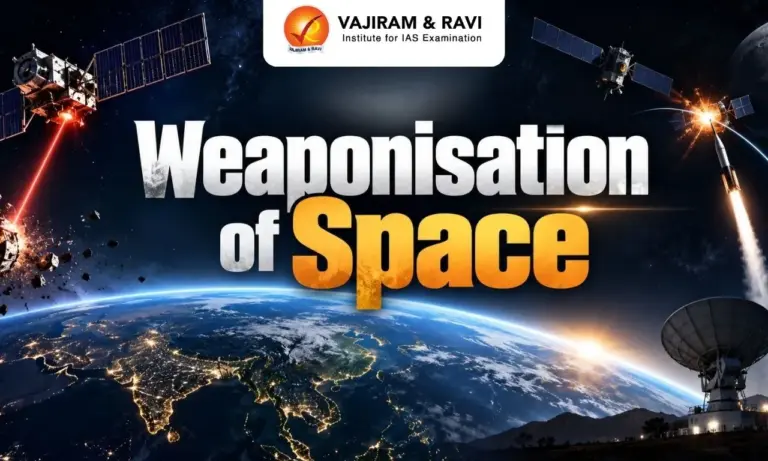
Weaponisation of Space refers to the development, deployment or use of technologies that can be used to attack, disrupt, damage or destroy satellites and other space-based systems. With countries increasingly depending on satellites for communication, navigation, weather forecasting, intelligence and military operations, space has become an important domain of strategic competition.
India has also strengthened its Space Situational Awareness (SSA) capabilities. ISRO’s latest Indian Space Situational Awareness Report for 2025 highlighted continued work under Project NETRA, including the development of tracking infrastructure and measures for sustainable use of outer space.
Why is Space Becoming a Security Domain?
The growing dependence on satellites for communication, navigation, surveillance, intelligence and military operations has made space an important domain of national security.
- Military dependence: Satellites support communication, navigation, intelligence, surveillance and reconnaissance.
- Critical infrastructure: Civilian services such as telecommunications, weather forecasting, banking and disaster management rely on space-based systems.
- Strategic competition: Major space powers are developing counter-space and anti-satellite capabilities.
- Dual-use technology: Many civilian satellites and technologies can also serve military purposes.
- Growing cyber threats: Satellites and ground stations can be targeted through cyberattacks, jamming and spoofing.
- Risk of conflict: An attack on a country’s space assets could disrupt both military operations and essential civilian services.
- Space debris: Destructive activities in orbit can create debris and increase the risk of collisions with other satellites.
Major Types of Space Weaponisation
Space weaponisation includes both physical and non-physical methods used to attack, disrupt or disable satellites and other space-based systems.
- Anti-Satellite (ASAT) Weapons: Designed to destroy or disable satellites through physical impact or other means.
- Direct-Ascent ASAT Weapons: Launched from the ground to directly intercept and destroy satellites in orbit, potentially creating large amounts of space debris.
- Co-orbital Weapons: Placed into orbit and capable of approaching another satellite to inspect, interfere with, disable or damage it.
- Electronic Warfare: Uses jamming and spoofing to disrupt satellite communication and navigation signals without physically destroying the satellite.
- Cyberattacks: Target satellites, ground stations and control networks to disrupt operations, manipulate data or interfere with communication.
- Directed-Energy Weapons: Technologies such as high-powered lasers can interfere with satellite sensors or potentially damage space-based systems.
- Satellite-Based Weapons: Systems deployed in space that could potentially be used to target other satellites or provide military capabilities directly from orbit.


Major Threats from Weaponisation of Space
The weaponisation of space can threaten satellites, critical services and national security while increasing the risk of space debris, conflict escalation and an arms race in outer space.
- Space Debris: Destruction of satellites can create large amounts of debris that may damage other spacecraft. For example, China’s 2007 ASAT test against the Fengyun-1C satellite generated thousands of debris fragments.
- Communication and Navigation Disruption: Jamming, spoofing or cyberattacks can interfere with satellite communication and navigation services, affecting military operations, aviation, shipping and civilian users.
- Threat to Military Operations: Modern militaries depend on satellites for surveillance, intelligence, communication and navigation. Disabling these systems can reduce a country’s ability to monitor and respond to security threats.
- Risk of Conflict Escalation: An attack on a satellite could be interpreted as a major act of aggression and may escalate a conflict on Earth. The dual-use nature of many satellites makes it difficult to separate civilian and military space infrastructure.
- Economic and Civilian Impact: Disruption of satellite services can affect telecommunications, banking, weather forecasting, disaster management and transport. A space conflict can therefore have consequences far beyond the military domain.
- Arms Race and Space Sustainability: Competition to develop ASAT weapons and other counter-space technologies can encourage an arms race. At the same time, repeated debris-producing activities can threaten the long-term sustainable use of Earth’s orbital environment.
International Legal Framework
The international legal framework governing outer space is mainly based on UN treaties, principles and resolutions aimed at ensuring the peaceful, safe and sustainable use of outer space.
- Outer Space Treaty, 1967: It is the basic legal framework for international space activities. It prohibits countries from placing nuclear weapons and other weapons of mass destruction in orbit around Earth. It also prohibits the establishment of military bases, installations and fortifications on the Moon and other celestial bodies.
- Peaceful Use of Outer Space: The treaty establishes that the Moon and other celestial bodies should be used exclusively for peaceful purposes. However, the treaty does not prohibit all military activities in outer space.
- No National Appropriation: States cannot claim sovereignty or ownership over outer space, the Moon or other celestial bodies. Space is considered the province of all humankind and should remain open for exploration and use by all states.
- State Responsibility: Countries are internationally responsible for their activities in outer space, including activities carried out by private companies and other non-governmental entities. States must authorise and continuously supervise such activities.
- Liability Convention, 1972: The Convention on International Liability for Damage Caused by Space Objects establishes rules for liability when a space object causes damage. The launching state can be held absolutely liable for damage caused on Earth or to aircraft in flight.
- Registration Convention, 1975: Countries are required to register space objects launched into orbit and provide relevant information to the UN Secretary-General. This improves transparency and helps identify responsibility for space objects.
- Rescue Agreement, 1968: It requires states to provide assistance to astronauts in distress and facilitate their safe return. It also provides for the return of space objects or their components found outside the territory of the launching state.
- Moon Agreement, 1979: It establishes additional principles for activities on the Moon and other celestial bodies. It states that the Moon and its natural resources are the common heritage of humankind and should not become the property of any state or private entity.
India’s Approach to Space Security
India’s approach to space security focuses on protecting critical space assets, improving Space Situational Awareness, developing indigenous capabilities and promoting the peaceful and sustainable use of outer space.
- Mission Shakti: In March 2019, India successfully conducted an Anti-Satellite (ASAT) test, demonstrating its capability to protect its space assets against potential threats.
- Space Situational Awareness: India is strengthening its ability to track satellites, space debris and other objects through Project NETRA and related observation and tracking systems.
- IS4OM: The ISRO System for Safe and Sustainable Space Operations Management monitors space objects, assesses collision risks and supports the safe operation of Indian satellites.
- Defence Space Agency: The Defence Space Agency (DSA) coordinates the country’s defence-related space activities and works towards enhancing capabilities in space-based communication, surveillance and reconnaissance.
- Space-based Surveillance: India is expanding the use of satellites for border surveillance, intelligence gathering, communication, navigation and disaster management.
- Satellite Protection: Greater focus is being placed on improving the resilience of satellites against jamming, cyberattacks, electronic interference and other counter-space threats.
- Indigenous Capabilities: India is developing domestic technologies in areas such as satellite communication, navigation, space-based surveillance, tracking and launch systems to reduce strategic dependence.
- Space Debris Management: India is working towards reducing the generation of debris and improving the safe and sustainable use of orbital space.

 Last updated on Oct, 2026
→ UPSC 2027 Notification will be released on 13 January 2027 at upsconline.nic.in.
→ Asian Games 2026 are being held in Aichi-Nagoya, Japan, from 19 September to 4 October.
→ Check Nobel Prize 2026 Winners List here.
→ Download PIB PRiSM Monthly Magazine 2026 here.
→ Check UPSC Monthly Current Affairs Magazine The Recitals here.
→ Check out the latest UPSC Syllabus here.
→ Download UPSC Model Answers for Mains 2026
→ UPSC Mains Question Paper 2026 is out now for Essay & GS Paper 1, 2, 3 & 4.
→ UPSC Calendar 2027 has been released.
→ Enroll in Vajiram & Ravi’s UPSC Mains Test Series 2027 for structured answer writing practice, expert evaluation, and exam-oriented feedback.
→ Join Vajiram & Ravi’s UPSC Mentorship Program 2027 for personalized guidance, strategy planning, and one-to-one support from experienced mentors.
→ Go through the UPSC Mains Previous Year Papers to enhance your preparation.
→ UPSC has released UPSC Toppers List 2025 with the Civil Services final result on its official website.
→ Also check Best UPSC Coaching in India
Weaponisation of Space FAQs
Q1. What is Weaponisation of Space?+
Q2. What are the major types of space weapons?+
Q3. What is an ASAT weapon?+
Q4. What is the difference between militarisation and weaponisation of space?+
Q5. Why is weaponisation of space a concern?+
Q6. What is Kessler Syndrome?+
Tags: weaponisation weaponisation of space