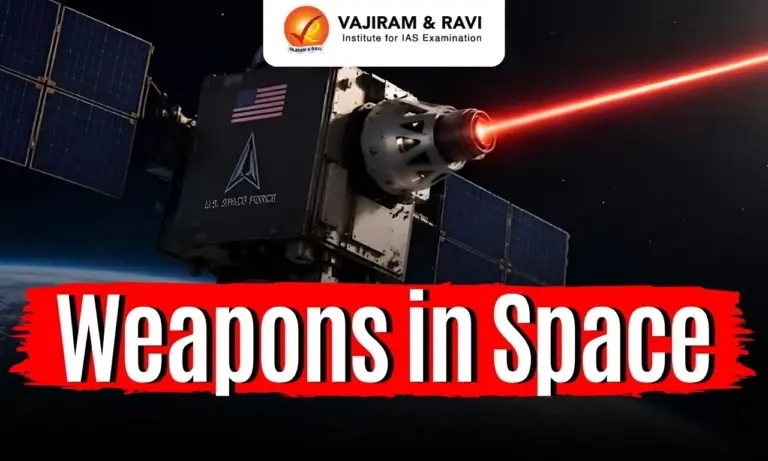
Weapons in Space Latest News
- The United States has publicly admitted that it has active weapons deployed in space. This is the first such admission by any country and has sparked a fresh global debate.
- US Air Force Secretary said at a conference in Maryland that the US now has “on-orbit space control weapons” capable of defending its joint forces against hostile adversary action. The US did not reveal the nature of the weapons or when they were deployed.
Reactions from China and Russia
- The two countries the US considers its space adversaries responded immediately:
- China urged the US to stop expanding its military capabilities and preparing for war in outer space.
- Russia called for keeping space free of weapons and expressed hope for broad international consolidation towards the complete demilitarisation of space.
- Ironically, the US itself accuses China and Russia of building counterspace capabilities to track and target US forces.
- It should be noted that the US Space Force was set up in 2019 during President Donald Trump’s first term.


What Weaponisation of Space Means
- Though this is the first public admission, the capabilities are neither new nor a revelation. Military use of outer space covers several categories:
- Earth-to-space: Launching a missile from Earth to destroy enemy satellites or other space assets
- Space-to-Earth: Sending weapons from space to destroy ground-based targets
- Space-to-space: Using space-based weapons to target other space-based assets
- It is unclear which category the newly acknowledged US weapons fall into.
Kinetic and Non-Kinetic Weapons
- Space weapons need not be “kinetic”, that is, capable of physical destruction. Non-kinetic methods can be equally effective in conflict:
- Disrupting or jamming communications between an enemy’s space and Earth-based systems.
- Attacking cyber-networks that control space assets.
- Several countries have developed some or all of these capabilities, though not all have been tested or demonstrated.
Demonstrated Capabilities So Far
- Anti-satellite (ASAT) tests are the most open demonstration of space weapons. Four countries have conducted them: the United States, Russia, China and India.
- Each targeted its own non-functional satellite, but the ability to completely destroy a space asset remains the most dramatic use of space weapons to date.
- Non-kinetic examples include:
- Just before Russia’s attack on Ukraine in February 2022, Russian hackers gained control of ground stations of the Viasat satellite, which provided internet services to Ukrainian subscribers, including military agencies.
- Russia has reportedly attempted to block GPS signals in Ukraine.
The Legal Ambiguity
- All countries emphasise peaceful use of space and urge each other not to militarise it.
- Yet no international law explicitly prohibits the deployment or use of conventional weapons or tactics in space.
- The Outer Space Treaty, 1967 remains the most relevant law on the subject. Its scope and gaps:
- It bars countries from carrying or placing nuclear weapons or other weapons of mass destruction in space.
- It is silent on conventional weapons and weapons targeting physical infrastructure in space.
- It says nothing about Earth-to-space weapons, which were still a distant prospect in the 1960s.
Failed Attempts at Regulation
- Efforts to create a binding framework have lacked support from major space powers:
- Around 2008, China and Russia jointly proposed a “Prevention of the Placement of Weapons in Outer Space” (PPWT) treaty to ban all weapons in space, not just WMDs.
- It excluded Earth-to-space weapons and never came to fruition.
- Discussions on “Prevention of an Arms Race in Outer Space” (PAROS) at the UN Conference on Disarmament have not produced any treaty.
The Artemis Accords
- The Artemis Accords, an initiative of NASA and the US State Department, are a voluntary code of conduct for space exploration with over 70 signatories, including India.
- All cooperative activities are meant to be for peaceful purposes. However, nothing in the Accords prevents signatories from deploying or using weapons in space.
Conclusion
- The US admission formalises what has long been an open secret: outer space is already militarised. The 1967 Outer Space Treaty bans only weapons of mass destruction, leaving conventional and non-kinetic weapons unregulated.
- With PPWT and PAROS stalled, the world lacks a binding framework to prevent a space arms race.
- For India, a demonstrated ASAT power and Artemis signatory, the challenge is to protect its growing space assets while pushing for credible international norms.

 Last updated on Oct, 2026
→ UPSC 2027 Notification will be released on 13 January 2027 at upsconline.nic.in.
→ Check Nobel Prize 2026 Winners List here.
→ Download PIB PRiSM Monthly Magazine 2026 here.
→ Check UPSC Monthly Current Affairs Magazine The Recitals here.
→ Check out the latest UPSC Syllabus here.
→ Download UPSC Model Answers for Mains 2026
→ UPSC Mains Question Paper 2026 is out now for Essay & GS Paper 1, 2, 3 & 4.
→ UPSC Calendar 2027 has been released.
→ Enroll in Vajiram & Ravi’s UPSC Mains Test Series 2027 for structured answer writing practice, expert evaluation, and exam-oriented feedback.
→ Join Vajiram & Ravi’s UPSC Mentorship Program 2027 for personalized guidance, strategy planning, and one-to-one support from experienced mentors.
→ Go through the UPSC Mains Previous Year Papers to enhance your preparation.
→ UPSC has released UPSC Toppers List 2025 with the Civil Services final result on its official website.
→ Also check Best UPSC Coaching in India
Weapons in Space FAQs
Q1. Why has the issue of weapons in space gained attention?+
Q2. What are the different categories of weapons in space?+
Q3. Are all weapons in space kinetic?+
Q4. Does international law prohibit weapons in space?+
Q5. What is the significance of the Artemis Accords for weapons in space?+
Tags: mains articles upsc current affairs upsc mains current affairs Weapons in Space