Western Ghats ESA Latest News
- The Western Ghats Ecologically Sensitive Area (ESA) notification, currently valid until the end of July 2026, is once again in focus.
- Six state governments continue to resist finalisation of ESA boundaries, even as a fresh expert committee works toward a resolution.
- The debate captures a fundamental tension in Indian environmental governance — conservation versus development.
What Are the Western Ghats and Why Do They Matter
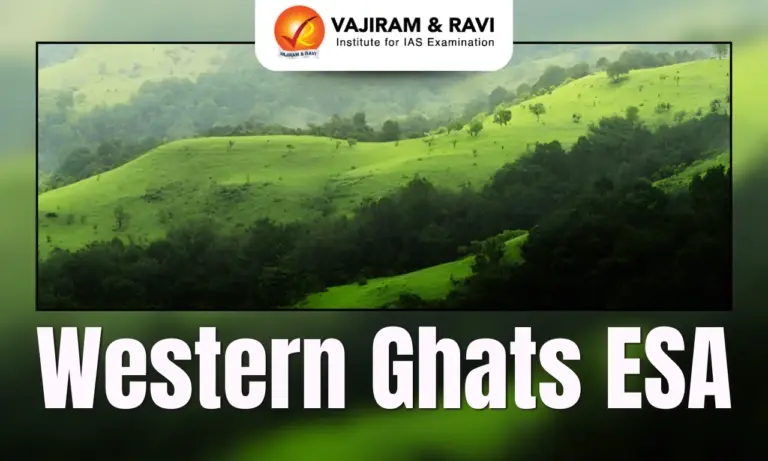
- The Western Ghats are a nearly unbroken mountain chain stretching 1,500 km along India’s western coast.
- Second only to the Himalayas in ecological importance, the Ghats are one of the eight “hottest hotspots” of biological diversity in the entire world. They harbour hundreds of plant and animal species found nowhere else on earth.
- The Ghats are not just ecologically rich — they are hydrologically critical. They act as a physical barrier against moisture-carrying monsoon winds, channelling heavy rainfall onto the coastal side.
- This rainfall feeds major rivers including the Godavari, Krishna, Cauvery, and Periyar — rivers that sustain the livelihoods of millions across peninsular India.
- Importantly, unlike most protected ecosystems, the Western Ghats are densely populated and economically active.
- The region is famous for cash crops — pepper, cardamom, cinnamon, coffee, mango, and jackfruit.
- It spans six states: Gujarat, Maharashtra, Goa, Karnataka, Kerala, and Tamil Nadu.
- This combination of ecological fragility and human habitation is at the heart of the ESA dispute.


What Is an Ecologically Sensitive Area (ESA)
- Under the Environment Protection Act, 1986, the Central Government can notify certain areas as Ecologically Sensitive Areas (ESAs) — also called Eco-Sensitive Zones (ESZs).
- The idea is to regulate or prohibit activities that could damage fragile ecosystems.
- In an ESA, activities like mining, quarrying, red-category polluting industries, thermal power plants, and large construction and townships are either banned or heavily regulated.
- ESAs have previously been notified around Dahanu (Maharashtra), Mahabaleshwar-Panchgani, and the Doon Valley.
The Two Panels: Gadgil vs. Kasturirangan
- The Gadgil Panel (2011)
- The Western Ghats Ecology Expert Panel, chaired by ecologist Madhav Gadgil, submitted its report in 2011.
- It took a strict position: the entire 1,29,037 sq km of the Ghats should be designated as ESA, with heavy cross-sectoral restrictions on development activities.
- States and local communities found this too restrictive and strongly opposed it.
- The Kasturirangan Panel (2013)
- Given the political resistance to the Gadgil report, the Centre set up a high-level working group under K. Kasturirangan, former chief of ISRO. His panel took a more calibrated approach.
- The panel identified 1,64,280 sq km as the Ghats’ total extent. Of this, it found that 60% was already “cultural landscape” — land under human use: settlements, plantations, and agriculture.
- The remaining 40% (approximately 60,000 sq km) was classified as “natural landscape” — high biological richness, low human density, and home to national parks, tiger reserves, and elephant habitats.
- The panel recommended that only this 60,000 sq km natural landscape be notified as ESA, along with a ban on the most damaging industrial activities.
- The then government accepted this in principle in December 2013.
A Decade of Draft Notifications and Deadlock
- The Centre issued its first draft ESA notification in March 2014, demarcating 56,825.7 sq km — already reduced from the 60,000 sq km recommended by Kasturirangan.
- Since 2014, the ESA draft notification has been issued and revised six times. The latest notification was issued on July 31, 2024, and is valid until the end of July 2026.
- Each time, the Environment Ministry has sought state approval on final ESA boundaries. Each time, states have returned with fresh demands or remained deadlocked.
- A notable change in the July 2024 notification: for the first time, it introduced a provision to finalise ESA in a phased, state-wise manner — rather than waiting for all six states to agree simultaneously.
- This allows the Centre to proceed with states where consensus is closer, without being held back by the more resistant ones.
Why Are States Opposing the ESA
- The core objection is economic. States fear that ESA notification will impose severe restrictions on industrial activity, mining, quarrying, and construction in their territories.
- Karnataka has been the most resistant. It has completely rejected the Kasturirangan panel recommendations and remains far from consensus.
- Kerala has sought to reduce its notified area from 9,993.7 sq km by another approximately 1,000 sq km. It wants villages in Idukki — particularly in the Cardamom Hills — excluded, citing active plantation and agricultural activity.
- Maharashtra has sought exclusion of 378 villages from the 2,133 listed in the draft, arguing these villages host industries, mining operations, or are geographically distant from core ESA zones.
- Goa, Gujarat, and Tamil Nadu have also raised objections, though the most acute tensions remain in Kerala and Karnataka.
The 2022 Expert Committee: A Fresh Attempt
- In 2022, the Centre constituted a new expert committee under Sanjay Kumar, former Director General of Forests, to re-examine state objections while keeping conservation needs in view.
- It has been working to resolve ground-level disputes — reconciling village-level data, revenue records, and satellite imagery.
- Notably, the committee is also considering financial incentives for states that protect the Ghats.
- The Kasturirangan panel had recommended that the six states negotiate for a grant-in-aid from the Centre as compensation for ecological protection.
- The concept of Payments for Ecosystem Services (PES) — where states receive financial compensation for the ecological services their forests provide (clean water, carbon sequestration, biodiversity) — is also on the table.
Conclusion
- The Western Ghats debate is not just about land demarcation. It is about how India balances ecological survival with economic development — a question central to India’s climate commitments, disaster preparedness, and long-term water security.
- The region has already seen the consequences of ecological degradation. Landslides and floods — including the devastating 2018 and 2019 Kerala floods — have been partly attributed to deforestation and unregulated construction in ecologically sensitive zones.
- Civil society groups in Kerala, Goa, Karnataka, and Maharashtra have simultaneously protested demanding both stronger protection and exclusion of their villages — reflecting the internal contradictions within states themselves.
Source: IE

 Last updated on Oct, 2026
→ UPSC 2027 Notification will be released on 13 January 2027 at upsconline.nic.in.
→ Asian Games 2026 are being held in Aichi-Nagoya, Japan, from 19 September to 4 October.
→ Check Nobel Prize 2026 Winners List here.
→ Download PIB PRiSM Monthly Magazine 2026 here.
→ Check UPSC Monthly Current Affairs Magazine The Recitals here.
→ Check out the latest UPSC Syllabus here.
→ Download UPSC Model Answers for Mains 2026
→ UPSC Mains Question Paper 2026 is out now for Essay & GS Paper 1, 2, 3 & 4.
→ UPSC Calendar 2027 has been released.
→ Enroll in Vajiram & Ravi’s UPSC Mains Test Series 2027 for structured answer writing practice, expert evaluation, and exam-oriented feedback.
→ Join Vajiram & Ravi’s UPSC Mentorship Program 2027 for personalized guidance, strategy planning, and one-to-one support from experienced mentors.
→ Go through the UPSC Mains Previous Year Papers to enhance your preparation.
→ UPSC has released UPSC Toppers List 2025 with the Civil Services final result on its official website.
→ Also check Best UPSC Coaching in India
Western Ghats ESA FAQs
Q1. Why is the Western Ghats ESA important for India?+
Q2. What is an Ecologically Sensitive Area under the Western Ghats ESA framework?+
Q3. How do the Gadgil and Kasturirangan reports differ on Western Ghats ESA?+
Q4. Why have states opposed the Western Ghats ESA notification?+
Q5. What solutions are being explored to resolve the Western Ghats ESA deadlock?+
Tags: mains articles upsc current affairs upsc mains current affairs Western Ghats ESA