Keir Starmer Resignation Latest News
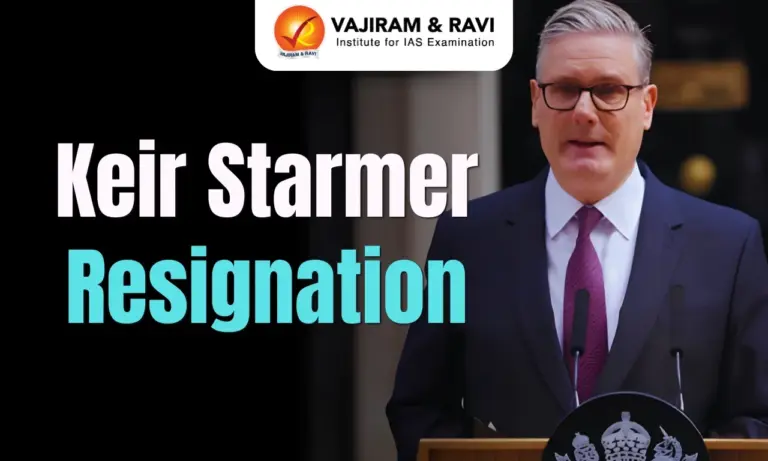
- Keir Starmer has formally resigned as the Prime Minister of the United Kingdom and as leader of the Labour Party.
- With this, the UK will have had seven Prime Ministers in a single decade — a remarkable sign of political instability in one of the world’s oldest parliamentary democracies.
- The 2024 general election was a landslide for Labour. The party won 412 seats, ending 14 years of Conservative rule. Two years later, he is gone.
Why Did Starmer Resign
- The ‘Freebies Gate’ Scandal – Starmer and his Cabinet Ministers were accused of accepting gifts worth thousands of pounds. Dubbed “Freebies Gate,” it caused a sharp drop in his approval ratings.
- Unpopular Policy Decisions – Several decisions deepened public resentment. He cut winter fuel subsidies for roughly 10 million pensioners to fund the National Health Service (NHS). He released 1,700 prisoners before their sentences were complete.
- The Brexit Shadow – Starmer’s resignation came a day before the tenth anniversary of Brexit — Britain’s 2016 decision to leave the European Union (EU). A decade on, the economic consequences are deeply felt.
- An estimated 2–8% contraction in GDP, high borrowing, tax hikes, rampant inflation, failed immigration control, and trade complications have made 57% of Britons believe Brexit was a mistake.
- The Final Blow: Local Elections and the Makerfield By-Election – In the May 2026 local elections, Labour lost 1,100 council seats and control of over 30 councils — a catastrophic performance.


How the UK Constitutional System Works: Understanding the Process
- This section is particularly important for UPSC, as it involves comparing parliamentary systems.
How the UK Chooses Its Prime Minister
- The UK Parliament has two Houses — the House of Lords and the House of Commons.
- The Commons has 650 seats. Citizens vote in general elections to elect their local Member of Parliament (MP).
- The leader of the party that secures a majority in the House of Commons is invited by the Monarch (currently King Charles III) to form the government.
- That leader becomes the Prime Minister.
- A critical point: the five-year term limit applies to Parliament, not to the individual PM.
- So even if the party retains its majority, the PM can be changed mid-term — without a fresh general election.
The PM as “First Among Equals” (Primus Inter Pares)
- The British system treats the PM not as a supreme executive, but as first among equals within the Cabinet and the parliamentary party.
- The PM’s authority rests entirely on the confidence of their own party’s MPs.
- Once that confidence erodes, the PM can be replaced — a much simpler and faster process than in presidential systems.
How a PM Is Replaced: Labour Party’s Internal Process
- Step 1 — Triggering a Vacancy: A leadership contest begins when the sitting leader resigns, or when 20% of Labour MPs (currently 81 members) formally back a challenger.
- Step 2 — NEC Convenes: The National Executive Committee (NEC) immediately meets to set the timetable — defining deadlines for nominations and the voting process.
- Step 3 — Candidate Nomination: Candidates must be sitting House of Commons MPs and must secure nominations from either 5% of Constituency Labour Parties (CLPs) or three affiliated organisations such as trade unions.
- Step 4 — Preferential Ballot: All party members and affiliates vote using a preferential ballot, ranking candidates in order of preference. The winner must cross 50% of votes. If no one achieves this in the first round, the least popular candidates are eliminated and their votes redistributed — until a winner emerges.
The Constitutional Handover
- The new Labour leader does not become PM automatically. The outgoing PM (Starmer) must travel to Buckingham Palace to formally tender resignation to King Charles III.
- The newly elected Labour leader is then summoned for an audience with the King, who invites them to form the government. Upon accepting, they officially become Prime Minister.
- Andy Burnham — the newly elected MP for Makerfield and former Mayor of Greater Manchester — is currently the frontrunner, with Streeting having withdrawn to back him.
Conclusion
- Since 2016, the UK has cycled through leaders with striking speed: David Cameron, Theresa May, Boris Johnson, Liz Truss (45 days — the shortest tenure in UK history), Rishi Sunak, and now Starmer. None has completed a full term.
- This pattern reflects a deeper structural crisis — the unresolved consequences of Brexit, economic stagnation, fractured party politics, and a rising far-right that is challenging the two-party order Britain has known for over a century.

 Last updated on Oct, 2026
→ UPSC 2027 Notification will be released on 13 January 2027 at upsconline.nic.in.
→ Asian Games 2026 are being held in Aichi-Nagoya, Japan, from 19 September to 4 October.
→ Check Nobel Prize 2026 Winners List here.
→ Download PIB PRiSM Monthly Magazine 2026 here.
→ Check UPSC Monthly Current Affairs Magazine The Recitals here.
→ Check out the latest UPSC Syllabus here.
→ Download UPSC Model Answers for Mains 2026
→ UPSC Mains Question Paper 2026 is out now for Essay & GS Paper 1, 2, 3 & 4.
→ UPSC Calendar 2027 has been released.
→ Enroll in Vajiram & Ravi’s UPSC Mains Test Series 2027 for structured answer writing practice, expert evaluation, and exam-oriented feedback.
→ Join Vajiram & Ravi’s UPSC Mentorship Program 2027 for personalized guidance, strategy planning, and one-to-one support from experienced mentors.
→ Go through the UPSC Mains Previous Year Papers to enhance your preparation.
→ UPSC has released UPSC Toppers List 2025 with the Civil Services final result on its official website.
→ Also check Best UPSC Coaching in India
Keir Starmer Resignation FAQs
Q1. What factors led to the Keir Starmer Resignation?+
Q2. How does the Keir Starmer Resignation reflect the UK parliamentary system?+
Q3. What constitutional process follows the Keir Starmer Resignation?+
Q4. Why is the Keir Starmer Resignation significant in British politics?+
Q5. How is Brexit connected to the Keir Starmer Resignation?+
Tags: Keir Starmer Resignation mains articles upsc current affairs upsc mains current affairs