What are Auroras?
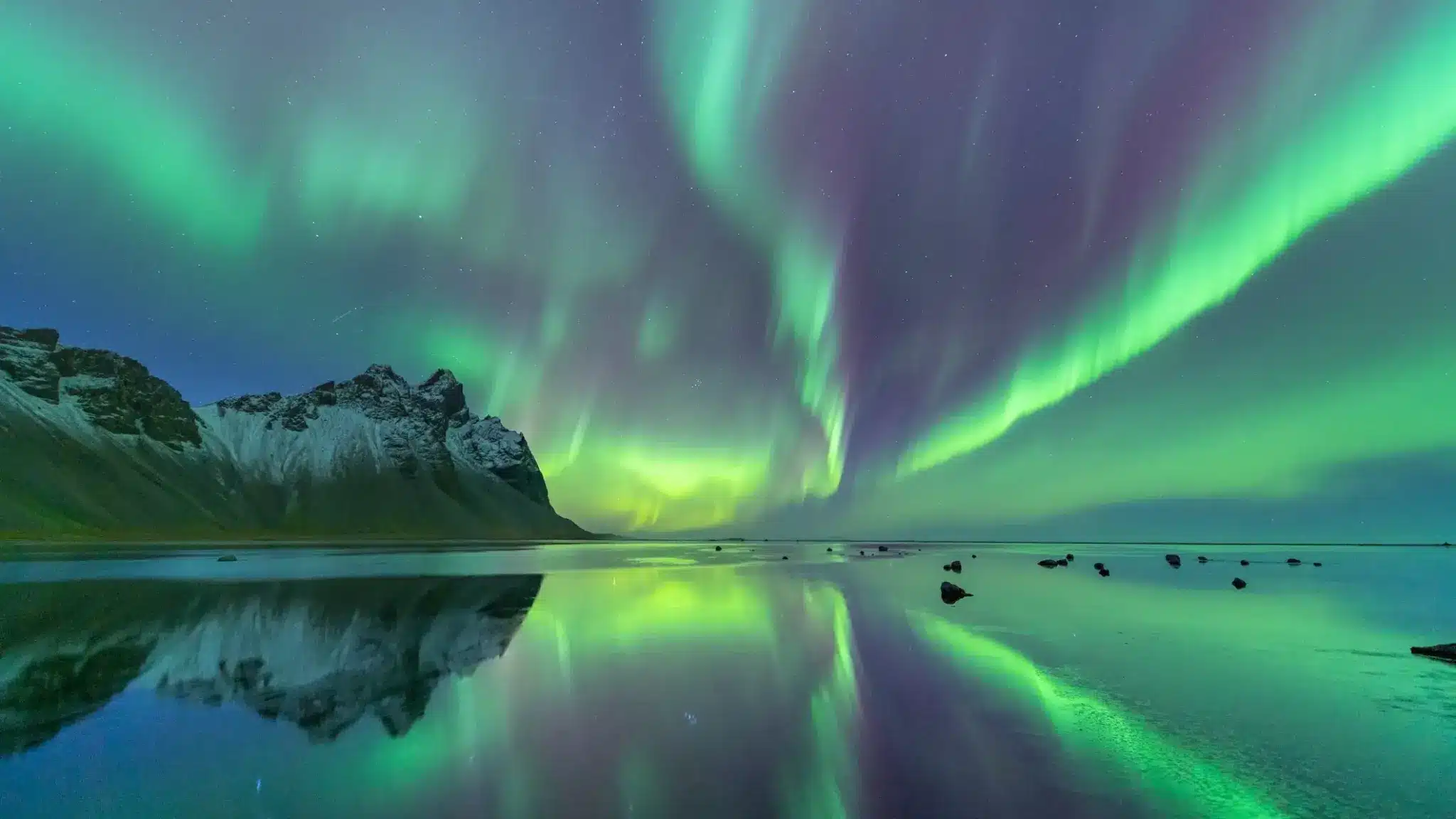
- An aurora is a natural light display in Earth’s sky, predominantly seen in high-latitude regions (around the Arctic and Antarctic).
- Auroras are caused by the interaction of energetic particles (electrons and protons) of the solar wind with atoms of the upper atmosphere.
- Auroras display dynamic patterns of brilliant lights that appear as curtains, rays, spirals, or dynamic flickers covering the entire sky.
- They are also commonly known as the northern lights (aurora borealis) or southern lights (aurora australis).
What is the Aurora Borealis?
- Often called the Northern Lights, it occurs in the northern hemisphere, predominantly in regions near the Arctic Circle.
- This includes countries like Norway, Sweden, Finland, Iceland, Canada, and Alaska.
- The northern lights result from charged particles from the sun, mainly electrons and protons, colliding with the Earth’s magnetosphere and interacting with gases in the Earth’s atmosphere.
- These collisions produce colourful displays of light, primarily in green, red and purple hues.
- The bright colors of the northern lights are dictated by the chemical composition of Earth’s atmosphere.
Q1: What is a Solar flare?
It is an intense burst of radiation coming from the release of magnetic energy associated with sunspots. Flares are our solar system’s largest explosive events.
Source: Knowledge Nugget of the day: Northern lights


 Last updated on Oct, 2026
→ UPSC 2027 Notification will be released on 13 January 2027 at upsconline.nic.in.
→ Check Nobel Prize 2026 Winners List here.
→ Download PIB PRiSM Monthly Magazine 2026 here.
→ Check UPSC Monthly Current Affairs Magazine The Recitals here.
→ Check out the latest UPSC Syllabus here.
→ Download UPSC Model Answers for Mains 2026
→ UPSC Mains Question Paper 2026 is out now for Essay & GS Paper 1, 2, 3 & 4.
→ UPSC Calendar 2027 has been released.
→ Enroll in Vajiram & Ravi’s UPSC Mains Test Series 2027 for structured answer writing practice, expert evaluation, and exam-oriented feedback.
→ Join Vajiram & Ravi’s UPSC Mentorship Program 2027 for personalized guidance, strategy planning, and one-to-one support from experienced mentors.
→ Go through the UPSC Mains Previous Year Papers to enhance your preparation.
→ UPSC has released UPSC Toppers List 2025 with the Civil Services final result on its official website.
→ Also check Best UPSC Coaching in India