


Coronal Mass Ejections Latest News
Astronomers have unveiled the intricate tale behind a series of powerful solar eruptions called Coronal Mass Ejections (CMEs), that resulted in rare northern lights dancing across Ladakh’s night skies in May 2024.
About Coronal Mass Ejections
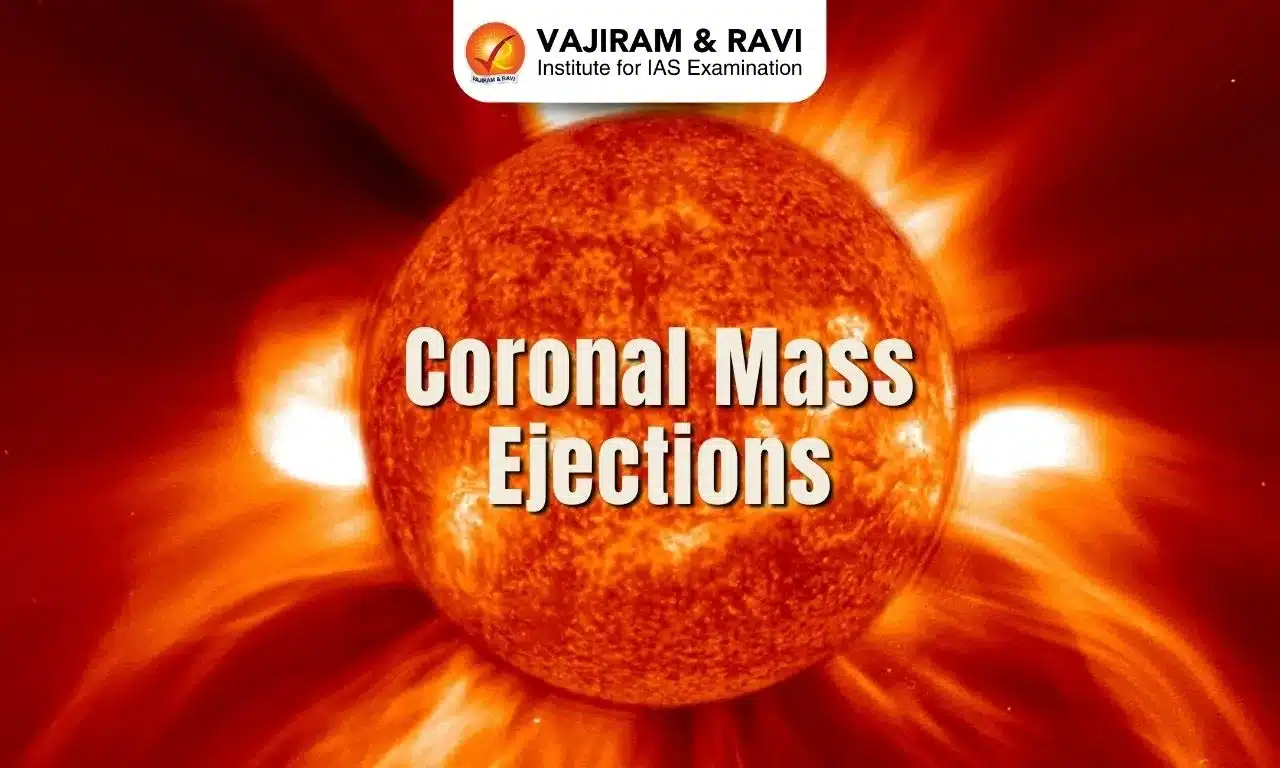
- These are massive ejections of magnetized plasma from the Sun’s corona.


How are Coronal Mass Ejections formed?
- They form similarly to solar flares—a result of the twisting and realignment of the sun’s magnetic field, known as magnetic reconnection.
- When magnetic field lines “tangle” they produce strong localized magnetic fields which can break through the surface of the sun at active regions, subsequently generating CMEs.
- CMEs usually take place around sunspot groups and are often accompanied by a solar flare, though the two don’t always occur in tandem.
- CMEs travel outward from the sun at speeds ranging from slower than 250 kilometers per second (km/s) to as fast as 3000 km/s.
- The fastest Earth-directed CMEs can reach our planet in as little as 15-18 hours.
- They expand in size as they propagate away from the Sun, and larger CMEs can reach a size comprising nearly a quarter of the space between Earth and the Sun by the time they reach our planet.
- CMEs, like solar flares, are most common during the solar maximum, a period in the sun’s 11-year cycle of activity when the star is at its most active.
- Impact on Earth: When such solar blasts are directed toward the Earth, they can cause geomagnetic storms capable of disrupting satellite operations, communication systems and power grids.
Source: PIB

 Last updated on Oct, 2026
→ UPSC 2027 Notification will be released on 13 January 2027 at upsconline.nic.in.
→ Check Nobel Prize 2026 Winners List here.
→ Download PIB PRiSM Monthly Magazine 2026 here.
→ Check UPSC Monthly Current Affairs Magazine The Recitals here.
→ Check out the latest UPSC Syllabus here.
→ Download UPSC Model Answers for Mains 2026
→ UPSC Mains Question Paper 2026 is out now for Essay & GS Paper 1, 2, 3 & 4.
→ UPSC Calendar 2027 has been released.
→ Enroll in Vajiram & Ravi’s UPSC Mains Test Series 2027 for structured answer writing practice, expert evaluation, and exam-oriented feedback.
→ Join Vajiram & Ravi’s UPSC Mentorship Program 2027 for personalized guidance, strategy planning, and one-to-one support from experienced mentors.
→ Go through the UPSC Mains Previous Year Papers to enhance your preparation.
→ UPSC has released UPSC Toppers List 2025 with the Civil Services final result on its official website.
→ Also check Best UPSC Coaching in India
Coronal Mass Ejections FAQs
Q1. What is the danger of a solar storm in space? +
Q2. Which ISRO mission aims to study solar flares, coronal mass ejections, and their effect on Earth's magnetic field?+
Tags: coronal mass ejections tadoba-andhari tiger reserve








