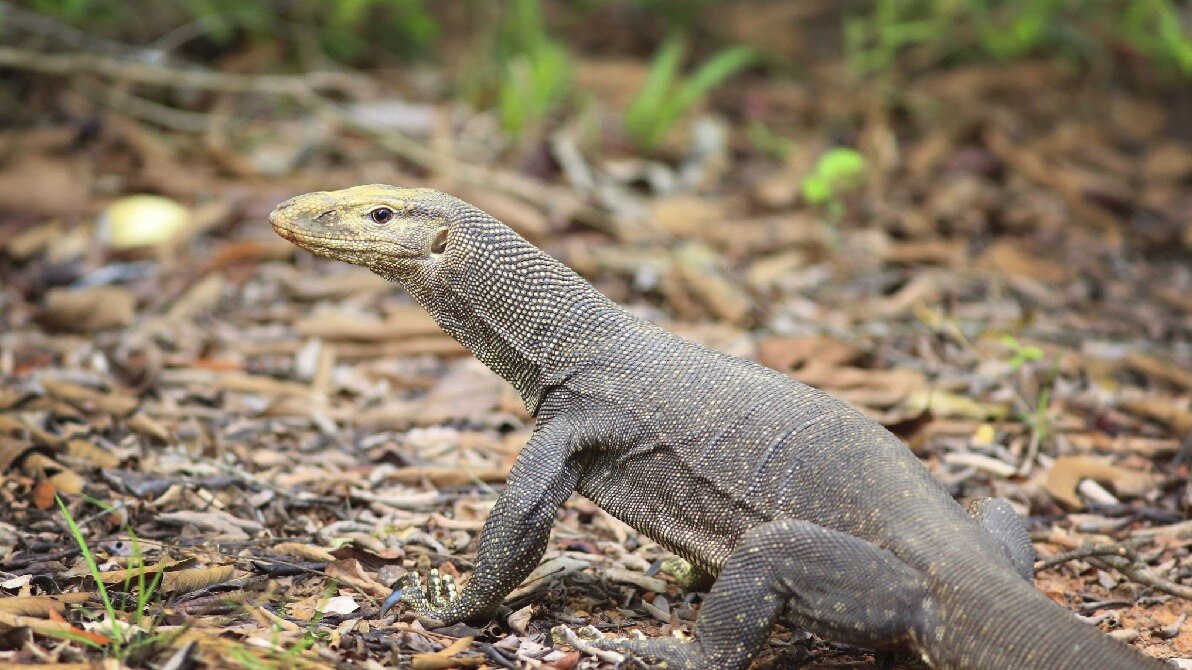
About Monitor Lizards
- They are a group of large reptiles belonging to the family Varanidae.
- They are known for their distinctive appearance, with long bodies, powerful limbs, and well-developed tails.
- They are considered to be the most intelligent of all lizards and some of the most intelligent reptiles in general.
- Distribution:
- They are mainly native to Asia, Africa, and Australia.
- India is home to four Monitor lizards – the Bengal Monitor (Varanus bengalensis), the Asian Water monitor (Varanus salvator), the Yellow monitor (Varanus flavescens) and the Desert monitor (Varanus griseus).
- Features:
- They have large claws, powerful tails, long necks, and well-developed legs.
- They can move quickly and powerfully in pursuit of prey.
- Most monitor lizards are terrestrial and largely carnivorous.
- They do not blink and they have very good vision.
- They have forked tongues which they use for smelling.
- Conservation Status:
- Wildlife Protection Act, 1972: Schedule 1
Key Facts about Komodo dragon:
- It is a type of monitor lizard.
- Scientific Name: Varanus komodoensis.
- It is the largest species of monitor lizard, and it can grow up to ten feet long and weigh 300 pounds.
- They are also generally known to be the most dangerous types of monitor lizards
- The skin of a Komodo dragon is also unusual compared to other monitors. It has tiny bones called osteoderms throughout its skin, which reinforces its toughness against predators.
Q1) What are Osteoderms?
Osteoderms are bony deposits embedded in the skin of certain animals, primarily reptiles. These structures provide protection and structural support to the body, often serving as armor against predators or environmental hazards. Osteoderms are typically found in the dermal layer of the skin and can vary in size, shape, and arrangement depending on the species.
Source: Monitor lizard rescued from residential areas in Thane, released in the wild


 Last updated on Oct, 2026
→ UPSC 2027 Notification will be released on 13 January 2027 at upsconline.nic.in.
→ Check Nobel Prize 2026 Winners List here.
→ Download PIB PRiSM Monthly Magazine 2026 here.
→ Check UPSC Monthly Current Affairs Magazine The Recitals here.
→ Check out the latest UPSC Syllabus here.
→ Download UPSC Model Answers for Mains 2026
→ UPSC Mains Question Paper 2026 is out now for Essay & GS Paper 1, 2, 3 & 4.
→ UPSC Calendar 2027 has been released.
→ Enroll in Vajiram & Ravi’s UPSC Mains Test Series 2027 for structured answer writing practice, expert evaluation, and exam-oriented feedback.
→ Join Vajiram & Ravi’s UPSC Mentorship Program 2027 for personalized guidance, strategy planning, and one-to-one support from experienced mentors.
→ Go through the UPSC Mains Previous Year Papers to enhance your preparation.
→ UPSC has released UPSC Toppers List 2025 with the Civil Services final result on its official website.
→ Also check Best UPSC Coaching in India