What is mRNA?
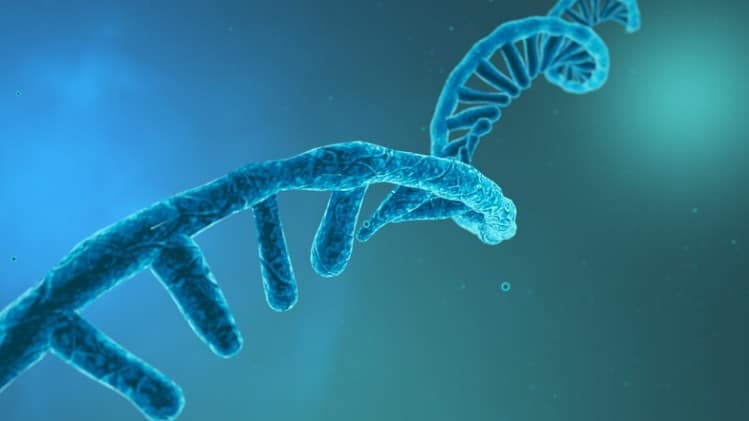
- Messenger RNA (a mRNA) is a type of single-stranded RNA involved in protein synthesis.
- mRNA is made from a DNA template during the process of transcription.
- The role of mRNA is to carry protein information from the DNA in a cell’s nucleus to the cell’s cytoplasm (watery interior), where the protein-making machinery reads the mRNA sequence and translates each three-base codon into its corresponding amino acid in a growing protein chain.
- So mRNA really is a form of nucleic acid which helps the human genome, which is coded in DNA, to be read by the cellular machinery.
About mRNA Vaccines:
- mRNA vaccines work by introducing a piece of mRNA that corresponds to a viral protein, usually a small piece of a protein found on the virus’s outer membrane.
- By using this mRNA, cells can produce the viral protein.
- As part of a normal immune response, the immune system recognizes that the protein is foreign and produces specialized proteins called antibodies.
- Once produced, antibodies remain in the body, even after the body has rid itself of the pathogen, so that the immune system can quickly respond if exposed again.
- Antibodies help protect the body against infection by recognizing individual viruses or other pathogens, attaching to them, and marking the pathogens for destruction.
- If a person is exposed to a virus after receiving mRNA vaccination for it, antibodies can quickly recognize it, attach to it, and mark it for destruction before it can cause serious illness.
- Individuals who get an mRNA vaccine are not exposed to the virus, nor can they become infected with the virus by the vaccine.
- How are mRNA vaccines made?
- To make an mRNA vaccine, scientists must first identify a protein on the outside of the virus that the body’s immune response will respond to (the “target” protein).
- The protein they choose must be sufficiently different from proteins on the outside of the body’s own cells, so the immune system only attacks the virus.
- They then identify the DNA that has the information for making the target protein.
- Scientists use the DNA to produce the mRNA for the target protein.
- Once enough mRNA has been made, the DNA is broken down to ensure that only the mRNA is packaged in the vaccine.
- The speed and efficiency of this process can make large amounts of mRNA in a short period of time.
Q1) What are Antibodies?
Antibodies are proteins that protect you when an unwanted substance enters your body. Produced by your immune system, antibodies bind to these unwanted substances in order to eliminate them from your system.
Source: Scientific breakthrough uses mRNA technology to create a highly effective malaria vaccine


 Last updated on Sep, 2026
→ UPSC 2027 Notification will be released on 13 January 2027 at upsconline.nic.in.
→ Asian Games 2026 are being held in Aichi-Nagoya, Japan, from 19 September to 4 October.
→ Check out the latest UPSC Syllabus here.
→ Download UPSC Model Answers for Mains 2026
→ UPSC Mains Question Paper 2026 is out now for Essay & GS Paper 1, 2, 3 & 4.
→ UPSC Calendar 2027 has been released.
→ Enroll in Vajiram & Ravi’s UPSC Mains Test Series 2027 for structured answer writing practice, expert evaluation, and exam-oriented feedback.
→ Join Vajiram & Ravi’s UPSC Mentorship Program 2027 for personalized guidance, strategy planning, and one-to-one support from experienced mentors.
→ Go through the UPSC Mains Previous Year Papers to enhance your preparation.
→ UPSC has released UPSC Toppers List 2025 with the Civil Services final result on its official website.
→ Also check Best UPSC Coaching in India