What’s in today’s article?
- Why in News?
- What are the Rules on Expunging from the Record?
- What is considered as “unparliamentary” expression?
- How is the decision to expunge a word (or portion of a speech) taken?
- What happens after a word has been expunged?
Why in News?
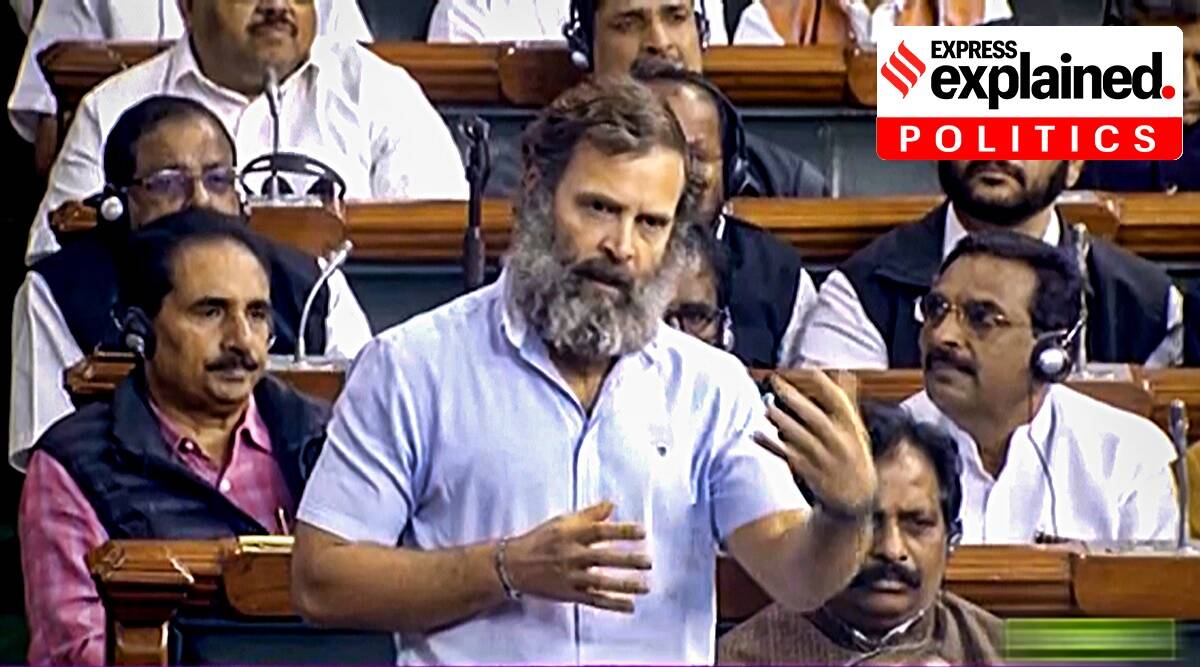
- Portions of Congress leader Rahul Gandhi’s speech delivered in Lok Sabha on February 7 have been expunged — or removed — from the records of Parliament by the orders of the Speaker.
- The expunging of certain words, sentences, or portions of a speech from the records is fairly routine procedure, and is carried out in accordance with laid down rules.
What are the Rules on Expunging from the Record?
- Under Article 105(2) of the Constitution, “no Member of Parliament shall be liable to any proceedings in any court in respect of anything said…in Parliament or any committee thereof”.
- However, MPs don’t enjoy the freedom to say whatever they want inside the House.
- The speech of MPs is subject to the discipline of the Rules of Parliament, “good sense” of its Members, and the control of proceedings by the Speaker.
- These checks ensure that MPs cannot use “defamatory or indecent or undignified or unparliamentary words” inside the House.
- Rule 380 (“Expunction”) of the Rules of Procedure and Conduct of Business in Lok Sabha says –
- “If the Speaker is of opinion that words have been used in debate which are defamatory or indecent or unparliamentary or undignified, the Speaker may, while exercising discretion order that such words be expunged from the proceedings of the House.”
- Rule 381 says –
- “The portion of the proceedings of the House so expunged shall be marked by asterisks and an explanatory footnote shall be inserted in the proceedings as follows: ‘Expunged as ordered by the Chair’.”


What are considered as “unparliamentary” expressions?
- Over the years, a huge number of words, both in English and other Indian languages, have been found to be “unparliamentary” by the Presiding Officers.
- These unparliamentary expressions are kept out of Parliament’s records.
- The Lok Sabha Secretariat has brought out a bulky volume of ‘Unparliamentary Expressions’.
- This book contains words or expressions that would likely be considered rude or offensive in most cultures. But it also contains content that would appear to be fairly harmless and innocuous.
- State legislatures too are guided mainly by the same book of unparliamentary expressions.
How is the decision to expunge a word (or portion of a speech) taken?
- When a member uses a word that could be unparliamentary, the head of the reporting section sends it to the Presiding Officer citing relevant rules and precedence with a recommendation to expunge them.
- The Presiding Officer has the discretion under Rule 380 to expunge the word or usage.
- Once the Presiding Officer expunges the word or usage, it comes back to the reporting section which removes the word from the records and mentions in the proceedings as “expunged as ordered by the chair”.
What happens after a word has been expunged?
- Expunged portions of the proceedings cease to exist in the records of Parliament, and they can no longer be reported by media houses.
Q1) What is a Parliamentary Privilege?
Parliamentary privilege is a legal immunity enjoyed by members of certain legislatures, in which legislators are granted protection against civil or criminal liability for actions done or statements made in the course of their legislative duties.
Q2) Who decides which words are unparliamentary or not in the Lok Sabha?
Under Rule 380 of the Rules of Procedure and Conduct of Business in the Lok Sabha, the Speaker is given the authority to order the expunction of words or phrases that, in his or her judgement, are “defamatory or indecent or unparliamentary or undignified”.
Source: Parts of Rahul Gandhi’s parliamentary speech expunged: What does this mean and when does this happen? | Indian Express

 Last updated on Oct, 2026
→ UPSC 2027 Notification will be released on 13 January 2027 at upsconline.nic.in.
→ Check Nobel Prize 2026 Winners List here.
→ Download PIB PRiSM Monthly Magazine 2026 here.
→ Check UPSC Monthly Current Affairs Magazine The Recitals here.
→ Check out the latest UPSC Syllabus here.
→ Download UPSC Model Answers for Mains 2026
→ UPSC Mains Question Paper 2026 is out now for Essay & GS Paper 1, 2, 3 & 4.
→ UPSC Calendar 2027 has been released.
→ Enroll in Vajiram & Ravi’s UPSC Mains Test Series 2027 for structured answer writing practice, expert evaluation, and exam-oriented feedback.
→ Join Vajiram & Ravi’s UPSC Mentorship Program 2027 for personalized guidance, strategy planning, and one-to-one support from experienced mentors.
→ Go through the UPSC Mains Previous Year Papers to enhance your preparation.
→ UPSC has released UPSC Toppers List 2025 with the Civil Services final result on its official website.
→ Also check Best UPSC Coaching in India