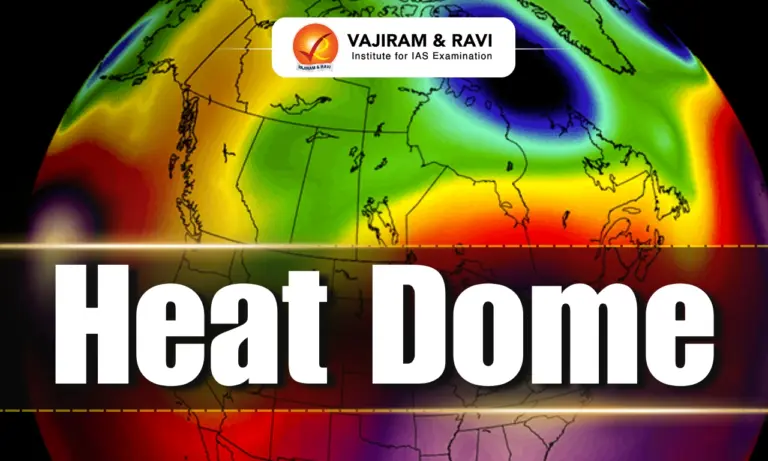
A Heat Dome is a major weather event that causes unusually high temperatures over a large area for several days or even weeks. It develops when atmospheric conditions prevent heat from escaping, leading to continuous warming. Heat Domes can trigger severe heat waves, droughts, wildfires and serious health risks. Understanding how they form, the role of the jet stream and their impacts is important because such extreme heat events are becoming more frequent and intense in many parts of the world.
Why Heat Dome in News 2026?
Heat Dome is in the news after an intense high pressure system expanded across the central United States in 2026, bringing temperatures above 100°F from Dallas to North Dakota. Around 70 million people came under heat advisories, while many regions recorded temperatures 10°F to 15°F above normal. Forecasters warned that high humidity, warm nights and the stationary weather pattern would significantly increase heat stress and health risks.
What is a Heat Dome?
A Heat Dome is an atmospheric condition where a persistent high pressure system traps warm air close to the Earth’s surface for an extended period. Since the hot air cannot rise, cloud formation becomes limited and rainfall decreases. Continuous sunshine further heats the land, dries the soil and reduces evaporation. As the trapped air becomes compressed near the ground, temperatures rise day after day. Heat Domes often trigger severe heat waves, although heat waves can also occur without a Heat Dome.


What Causes Heat Dome Formation?
Heat Dome formation depends on atmospheric circulation, pressure systems, ocean temperatures and changing climate conditions that allow hot air to remain trapped over a region.
- Persistent High Pressure: A strong high pressure system pushes air downward. As the sinking air becomes compressed, it warms further and creates a dome of hot, dry air that remains over the same area for several days or weeks.
- Clear Sky and Continuous Heating: High pressure prevents clouds from developing because warm air cannot rise and cool. More sunlight reaches the surface, increasing land temperatures, drying soils and reducing evaporation that could otherwise provide cooling.
- Ocean Temperature Gradient: Differences between warmer and cooler ocean waters increase convection over warm oceans. Rising warm air is transported by prevailing winds, later becoming trapped over land under high pressure conditions, strengthening extreme heat.
- Reduced Rainfall and Soil Moisture: Dry soils release less moisture through evaporation, leaving more solar energy available for heating the ground. This feedback continuously raises daytime temperatures and prolongs extremely hot conditions.
- Influence of Climate Change: Researchers suggest rising global temperatures may increase the intensity and duration of Heat Domes by making atmospheric circulation and jet stream patterns more irregular, leading to more frequent extreme heat events.
- La Niña Connection: Heat Domes are considered more likely during La Niña years because cooler eastern Pacific waters and warmer western Pacific waters strengthen temperature contrasts that support the atmospheric conditions needed for their development.
Role of Jet Stream in Heat Dome
The Jet Stream plays a central role by controlling the movement of weather systems and determining whether a high pressure system remains stationary.
- The Jet Stream is a narrow band of powerful winds located about 5 to 9 miles above Earth’s surface in the mid to upper troposphere, generally flowing from west to east.
- Under normal conditions, the jet stream follows a north-south wave pattern that continuously shifts weather systems, preventing prolonged heating over any one region.
- When jet stream waves become larger, elongated and slow moving, they may become nearly stationary. This allows a high pressure system to remain fixed, creating a long lasting Heat Dome.
- Warm air trapped beneath the stationary high pressure system cannot escape upward. Continuous compression and uninterrupted sunshine steadily increase temperatures and maintain dangerous heat conditions.
- Scientists suggest that rising global temperatures may make the jet stream more wavy with larger deviations, increasing the likelihood of persistent Heat Domes and prolonged extreme heat episodes.
Heat Dome Effects and Impacts
Heat Domes produce prolonged extreme heat that affects human health, agriculture, ecosystems, infrastructure and energy demand over large geographical regions.
- Extreme Heat and Heat Waves: Heat Domes create long lasting heat waves with temperatures rising well above seasonal averages. During the 2026 United States event, temperatures exceeded 100°F, with many places recording 10°F to 15°F above normal.
- Greater Health Risks: Weak winds, high humidity and warmer nights reduce the body’s ability to cool through sweating. This increases the risk of heat exhaustion, heat stroke, dehydration and heat related deaths, especially among children, older adults and people with medical conditions.
- Reduced Night Time Recovery: High humidity prevents sufficient cooling after sunset, allowing heat stress to accumulate over consecutive days and increasing pressure on the heart, lungs and respiratory system.
- Agriculture and Drought: Continuous sunshine and reduced rainfall dry soils and vegetation, damaging crops, lowering agricultural productivity and increasing drought conditions across affected regions.
- Wildfire and Infrastructure Damage: Hot, dry weather makes forests and grasslands more vulnerable to wildfires. Extreme heat can also damage roads, buildings and other infrastructure not designed for prolonged high temperatures.
- Higher Energy Demand: Increased dependence on air conditioning during Heat Domes sharply raises electricity demand, placing additional pressure on power systems and increasing energy consumption.
- Historical Impact: One of the deadliest examples occurred during the 1995 Chicago heat wave, when an estimated 739 people died within five days, highlighting the severe consequences of prolonged extreme heat.
Heat Dome vs Heat Wave
Heat Dome and Heat Wave are closely related but represent different atmospheric concepts.
- Basic Difference: A Heat Dome is a high pressure weather system that traps hot air over a region, whereas a Heat Wave is a prolonged period of unusually hot weather lasting more than two days.
- Cause and Result: A Heat Dome is one atmospheric mechanism that can produce a heat wave, but heat waves may also develop without a Heat Dome when warm, humid tropical air remains over an area.
- Atmospheric Conditions: Heat Domes are associated with persistent high pressure, sinking air, clear skies and reduced cloud formation. Heat waves mainly describe the period of excessive heat regardless of the exact weather system causing it.
- Duration: Heat Domes can remain stationary for several days or even weeks, continuously intensifying temperatures. Heat waves continue as long as unusually hot conditions persist, whether caused by a Heat Dome or other atmospheric patterns.
- Humidity and Human Impact: Both events can become more dangerous when humidity is high because the heat index rises and the body cools less effectively through sweating. Extremely high wet bulb temperatures can make prolonged outdoor exposure life threatening.

 Last updated on Oct, 2026
→ UPSC 2027 Notification will be released on 13 January 2027 at upsconline.nic.in.
→ Asian Games 2026 are being held in Aichi-Nagoya, Japan, from 19 September to 4 October.
→ Check Nobel Prize 2026 Winners List here.
→ Download PIB PRiSM Monthly Magazine 2026 here.
→ Check UPSC Monthly Current Affairs Magazine The Recitals here.
→ Check out the latest UPSC Syllabus here.
→ Download UPSC Model Answers for Mains 2026
→ UPSC Mains Question Paper 2026 is out now for Essay & GS Paper 1, 2, 3 & 4.
→ UPSC Calendar 2027 has been released.
→ Enroll in Vajiram & Ravi’s UPSC Mains Test Series 2027 for structured answer writing practice, expert evaluation, and exam-oriented feedback.
→ Join Vajiram & Ravi’s UPSC Mentorship Program 2027 for personalized guidance, strategy planning, and one-to-one support from experienced mentors.
→ Go through the UPSC Mains Previous Year Papers to enhance your preparation.
→ UPSC has released UPSC Toppers List 2025 with the Civil Services final result on its official website.
→ Also check Best UPSC Coaching in India
Heat Dome FAQs
Q1. What is a Heat Dome?+
Q2. Why does a Heat Dome cause extreme heat?+
Q3. What is the role of the jet stream in Heat Dome formation?+
Q4. What are the major Effects and Impacts of a Heat Dome?+
Q5. What is the difference between a Heat Dome and a Heat Wave?+
Tags: geography heat dome world geography