About Spider Star System:
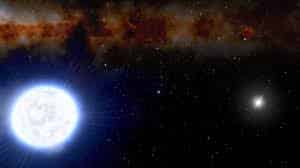
- It is a binary star system in which a superdense star (pulsar) spins quickly, eats another star.
- The super-dense object that begins to pull a matter from the companion resembles the habits of spiders of the genus Latrodectus, in which the female eats the male after mating, hence the name came.
- Initially, the dense pulsar strips material from the outer atmosphere of its companion, periodically shedding the gathered material in violent explosions.
- In the later stage of their lifetimes, the energetic particles streaming out of the pulsar can strip the atmosphere of its companion.
- In either case, the pulsar slowly erodes its companion over time.
- Two Types:
- Black widows: Binary pulsar systems, in which the mass of a companion star is less than 5 percent of the pulsar.
- Redback: Binary pulsar systems in which mass of the companion star is from 10 to 50 percent of the pulsar.
What is a Binary Star System?
- A binary system is one in which two stars orbit around a common centre of mass, that is they are gravitationally bound to each other.
What are Pulsars?
- Pulsars are rapidly spinning neutron stars, extremely dense stars composed almost entirely of neutrons and having a diameter of only 20 km (12 miles) or less.
- They emit concentrated streams of radiation far across the cosmos.
What are Neutron Stars?
- They are the remnants of giant stars that died in a fiery explosion known as a supernova.
- After such an outburst, the cores of these former stars compact into an ultradense object with the mass of the sun packed into a ball the size of a city.
Q1) What is a supernova?
A supernova is what happens when a star has reached the end of its life and explodes in a brilliant burst of light. Supernovae can briefly outshine entire galaxies(opens in new tab) and radiate more energy than our sun(opens in new tab) will in its entire lifetime. They’re also the primary source of heavy elements in the universe.
Source: Scientists spot 1st gamma-ray eclipses from strange ‘spider’ star systems


 Last updated on Oct, 2026
→ UPSC 2027 Notification will be released on 13 January 2027 at upsconline.nic.in.
→ Check Nobel Prize 2026 Winners List here.
→ Download PIB PRiSM Monthly Magazine 2026 here.
→ Check UPSC Monthly Current Affairs Magazine The Recitals here.
→ Check out the latest UPSC Syllabus here.
→ Download UPSC Model Answers for Mains 2026
→ UPSC Mains Question Paper 2026 is out now for Essay & GS Paper 1, 2, 3 & 4.
→ UPSC Calendar 2027 has been released.
→ Enroll in Vajiram & Ravi’s UPSC Mains Test Series 2027 for structured answer writing practice, expert evaluation, and exam-oriented feedback.
→ Join Vajiram & Ravi’s UPSC Mentorship Program 2027 for personalized guidance, strategy planning, and one-to-one support from experienced mentors.
→ Go through the UPSC Mains Previous Year Papers to enhance your preparation.
→ UPSC has released UPSC Toppers List 2025 with the Civil Services final result on its official website.
→ Also check Best UPSC Coaching in India