About Tidal Disruption Event (TDE)
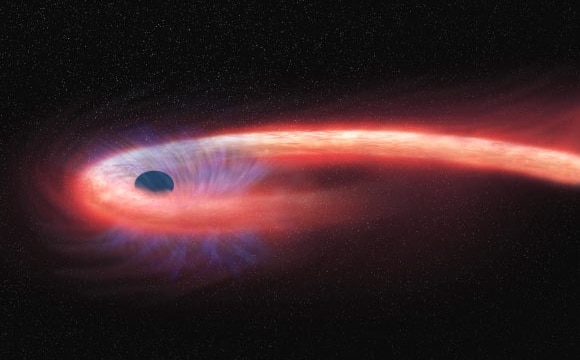
- TDE is a phenomenon in astronomy that occurs when a star passes too close to a supermassive black hole or a massive stellar-mass black hole.
- The intense gravitational forces from the black hole cause tidal forces that can tear the star apart. This process is also known as “tidal disruption.”
- How does a TDE typically unfold?
- Close Approach: A star in a galaxy approaches a black hole on a very close trajectory due to gravitational interactions within the galaxy.
- Tidal Forces: As the star gets closer to the black hole, the gravitational forces acting on it become increasingly uneven due to the difference in gravitational pull on the near side and far side of the star. These tidal forces can be strong enough to disrupt the star.
- Stellar Disruption: When the tidal forces exceed the self-gravitational forces holding the star together, it undergoes a process called “tidal disruption.” The star is stretched and eventually torn apart into a stream of gas and debris.
- Accretion Disk Formation: The debris from the disrupted star forms an accretion disk around the black hole. This disk is composed of hot gas and dust, and it spirals inwards towards the black hole.
- Energy Release: As the material in the accretion disk spirals inwards, it releases a tremendous amount of energy in the form of X-rays and ultraviolet radiation.
- Flares and Observations: TDEs are often observed as bright flares of radiation from the center of a galaxy. These flares can last for several months to years, gradually fading as the disrupted star’s material is consumed by the black hole.
What is a Blackhole?
- A black hole is a place in space where gravity pulls so much that even light cannot get out. The gravity is so strong because matter has been squeezed into a tiny space.
- This can happen when a star is dying.
- Because no light can get out, people can’t see black holes. They are invisible. Space telescopes with special tools can help find black holes.
- Event Horizon: The event horizon is the boundary around a black hole beyond which nothing can escape, not even light. It marks the point of no return. Anything that crosses this boundary is inevitably drawn into the black hole.
- Supermassive Black Holes: These are found at the centers of most galaxies and have masses ranging from millions to billions of times that of our Sun.
Q1) What is ultraviolet radiation (UV)?
Ultraviolet (UV) radiation is a type of electromagnetic radiation with wavelengths shorter than those of visible light but longer than X-rays. It falls within the electromagnetic spectrum between X-rays and visible light. UV radiation is produced by the sun, as well as by certain artificial sources such as UV lamps and lasers.
Source: Supermassive black hole gives astronomers a glimpse of star’s innards after a messy feast


 Last updated on Oct, 2026
→ UPSC 2027 Notification will be released on 13 January 2027 at upsconline.nic.in.
→ Asian Games 2026 are being held in Aichi-Nagoya, Japan, from 19 September to 4 October.
→ Check Nobel Prize 2026 Winners List here.
→ Download PIB PRiSM Monthly Magazine 2026 here.
→ Check UPSC Monthly Current Affairs Magazine The Recitals here.
→ Check out the latest UPSC Syllabus here.
→ Download UPSC Model Answers for Mains 2026
→ UPSC Mains Question Paper 2026 is out now for Essay & GS Paper 1, 2, 3 & 4.
→ UPSC Calendar 2027 has been released.
→ Enroll in Vajiram & Ravi’s UPSC Mains Test Series 2027 for structured answer writing practice, expert evaluation, and exam-oriented feedback.
→ Join Vajiram & Ravi’s UPSC Mentorship Program 2027 for personalized guidance, strategy planning, and one-to-one support from experienced mentors.
→ Go through the UPSC Mains Previous Year Papers to enhance your preparation.
→ UPSC has released UPSC Toppers List 2025 with the Civil Services final result on its official website.
→ Also check Best UPSC Coaching in India