Gum Arabic Latest News
Gum Arabic, essential in products like Coca-Cola and M&M’s, is being increasingly trafficked from rebel-held Sudanese regions, complicating supply chains for Western companies.
About Gum Arabic
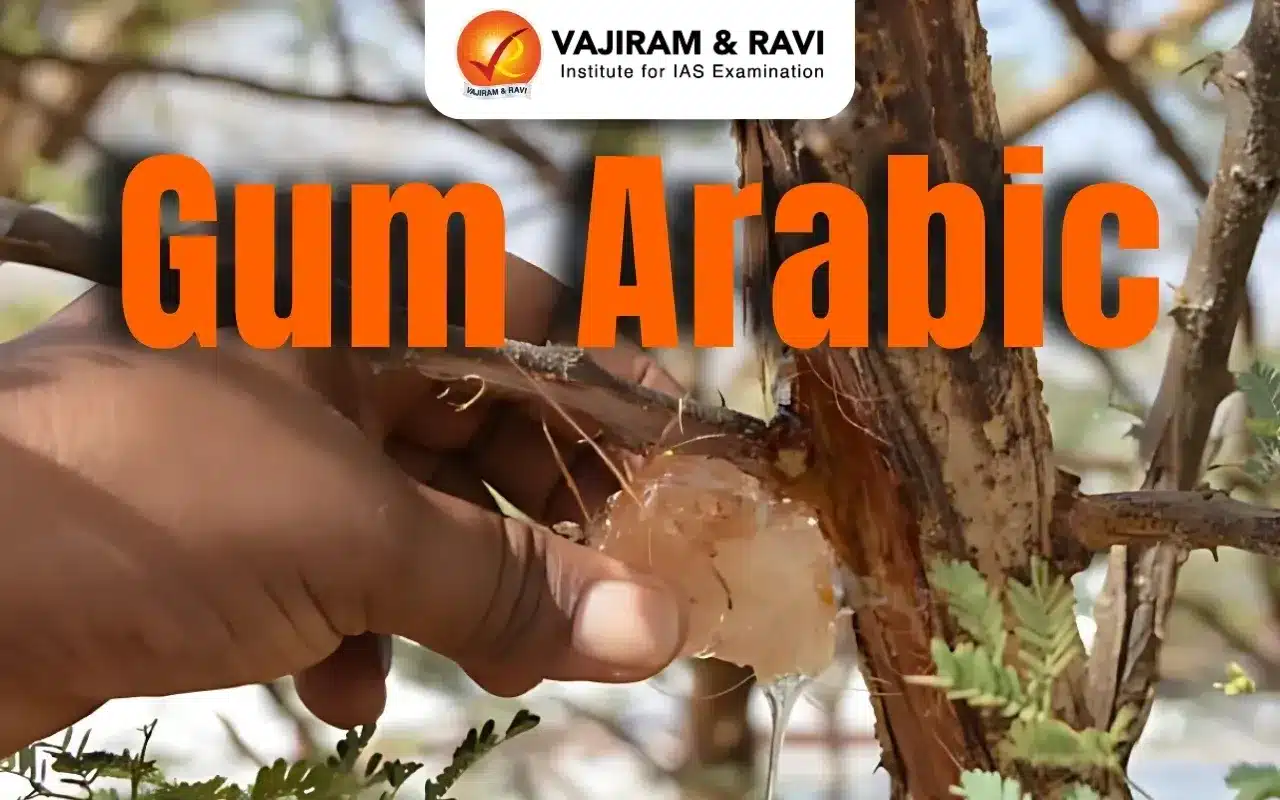
- It is a dried, water-soluble exudate that comes primarily from two species of acacia, Acacia senegal and A. seyal.
- Distribution:
- The trees are native to North Africa and grow mainly in the sub-Saharan or Sahel zone of Africa and also in Australia, India, and South America.
- A. senegal is found in some parts of India, mainly in the dry rocky hills of south east Punjab, in the northern Aravalli hills, and in other drier parts of Rajasthan and Gujarat.
- Major producing countries: Cameroon, Chad, Mali, Nigeria, and Sudan (market share of about 70%).
- Humans have in fact used gum arabic for thousands of years; one of its earliest known uses was as an embalming agent in ancient Egypt.
- Gum Arabic has numerous applications, particularly in the food industry and in areas such as ceramics, painting, photography, and printmaking.


Gum Arabic Properties
- It is a neutral or slightly acidic salt of a complex polysaccharide containing calcium, magnesium, and potassium cations.
- It is non-toxic, odourless, and has a bland taste, and it does not affect the odour, colour or taste of the system in which it is used.
- It is somewhat yellowish in colour.
- It is insoluble in oils and in most organic solvents, but usually dissolves completely in hot or cold water, forming a clear, mucilaginous solution.
- It yields L-arabinose, L-rhamnose, D-galactose, and D-glucuronic acid after hydrolysis.
Gum Arabic FAQs
Q1. Is gum arabic ok to eat?
Ans. Yes, gum arabic is safe to eat and is widely used in the food and beverage industry as a natural additive.
Q2. Is gum arabic water-soluble?
Ans. It dissolves completely in hot or cold water, forming a clear, mucilaginous solution.
Q3. Is gum arabic soluble in oils?
Ans. It is insoluble in oils and in most organic solvents.
Source: ET

 Last updated on Oct, 2026
→ UPSC 2027 Notification will be released on 13 January 2027 at upsconline.nic.in.
→ Check Nobel Prize 2026 Winners List here.
→ Download PIB PRiSM Monthly Magazine 2026 here.
→ Check UPSC Monthly Current Affairs Magazine The Recitals here.
→ Check out the latest UPSC Syllabus here.
→ Download UPSC Model Answers for Mains 2026
→ UPSC Mains Question Paper 2026 is out now for Essay & GS Paper 1, 2, 3 & 4.
→ UPSC Calendar 2027 has been released.
→ Enroll in Vajiram & Ravi’s UPSC Mains Test Series 2027 for structured answer writing practice, expert evaluation, and exam-oriented feedback.
→ Join Vajiram & Ravi’s UPSC Mentorship Program 2027 for personalized guidance, strategy planning, and one-to-one support from experienced mentors.
→ Go through the UPSC Mains Previous Year Papers to enhance your preparation.
→ UPSC has released UPSC Toppers List 2025 with the Civil Services final result on its official website.
→ Also check Best UPSC Coaching in India