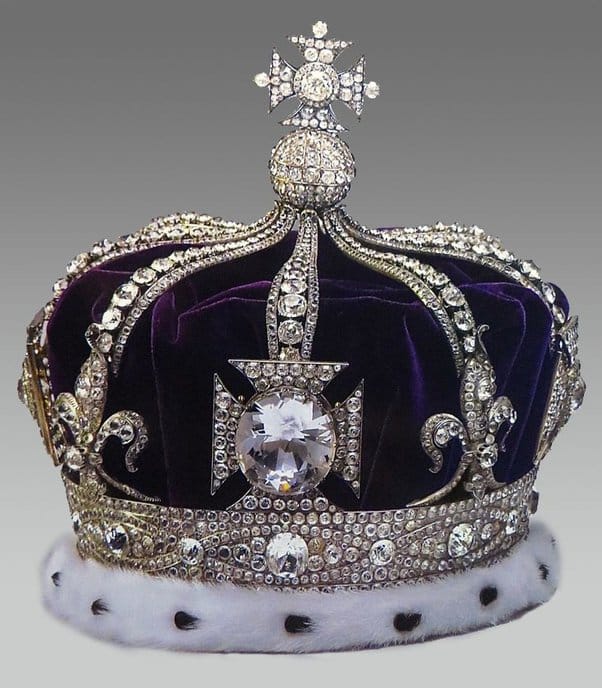
About Kohinoor Diamond:
- The Kohinoor/Koh-i-Noor diamond (also Koh-i-Nur or Kūh-e Nūr) is one of the largest and most famous cut diamonds in the world.
- The name of the stone is Persian, meaning ‘Mountain of Light’ and refers to its astounding size.
- The diamond originally weighed 191 carats, but it was recut to 105.6 carats to enhance its fire and brilliance in 1852 by Garrard of London, the royal jeweller.
- History:
- It is believed that the diamond was first mentioned more than 5000 years ago in a Sanskrit script, where it was called the Syamantaka.
- After this first written mention, for over 4,000 years, the diamond is not mentioned.
- Up until 1304, the diamond was in the possession of the Rajas of Malwa.
- In 1304, it belonged to the Emperor of Delhi, Allaudin Khilji.
- In 1339, the diamond was taken back to the city of Samarkand, where it stayed for almost 300 years.
- In 1526 the Mogul ruler Babur mentioned the diamond in his writings, Baburmama. The diamond was gifted to him by Sultan Ibrahim Lodi.
- From Babur, the diamond passed to Shah Jahan and Aurangzeb before coming into the possession of his grandson, Sultan Mahamad.
- In 1739, the Persian general Nadir Shah defeated Sultan Mahamad to conquer Delhi – and the diamond. It was Nadir Shah that gave the diamond its current name.
- In 1747, Nadir Shah was assassinated, and the diamond got to one of his generals, Ahmad Shah Durrani.
- A descendant of Ahmad Shah, Shah Shuja Durrani brought the Koh-i-noor back to India in 1813 and gave it to Ranjit Singh (the founder of the Sikh Empire). In exchange, Ranjit Singh helped Shah Shuja get back the throne of Afghanistan.
- In 1849, after the conquest of the Punjab by the British forces, the properties of the Sikh Empire were confiscated.
- The Koh-i-Noor was transferred to the treasury of the British East India Company in Lahore.
- Since 1849, the Koh-i-Noor has been part of the British crown jewels.
Q1) What is a Diamond Cut?
Cut refers not to a diamond’s shape (e.g. round, oval, pear, etc.) but to a diamond’s proportions, symmetry and polish. The beauty of a diamond depends more on cut than any other factor.
Source: India’s PM Modi eyes return of Kohinoor, thousands of other treasures from Britain


 Last updated on Oct, 2026
→ UPSC 2027 Notification will be released on 13 January 2027 at upsconline.nic.in.
→ Asian Games 2026 are being held in Aichi-Nagoya, Japan, from 19 September to 4 October.
→ Check Nobel Prize 2026 Winners List here.
→ Download PIB PRiSM Monthly Magazine 2026 here.
→ Check UPSC Monthly Current Affairs Magazine The Recitals here.
→ Check out the latest UPSC Syllabus here.
→ Download UPSC Model Answers for Mains 2026
→ UPSC Mains Question Paper 2026 is out now for Essay & GS Paper 1, 2, 3 & 4.
→ UPSC Calendar 2027 has been released.
→ Enroll in Vajiram & Ravi’s UPSC Mains Test Series 2027 for structured answer writing practice, expert evaluation, and exam-oriented feedback.
→ Join Vajiram & Ravi’s UPSC Mentorship Program 2027 for personalized guidance, strategy planning, and one-to-one support from experienced mentors.
→ Go through the UPSC Mains Previous Year Papers to enhance your preparation.
→ UPSC has released UPSC Toppers List 2025 with the Civil Services final result on its official website.
→ Also check Best UPSC Coaching in India