Meningitis Latest News
Health officials in England are scrambling to stop a new meningitis outbreak after a student died and two more fell seriously ill in areas around Reading and Oxfordshire recently.
About Meningitis
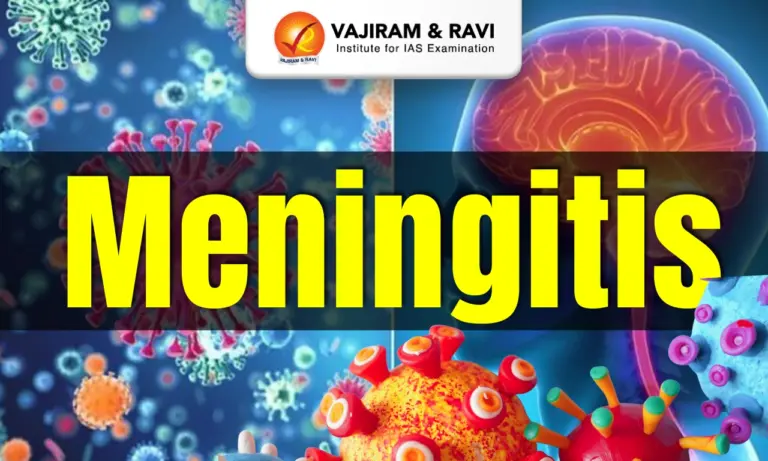
- Meningitis is an inflammation (swelling) of the protective membranes covering the brain and spinal cord. These membranes are called meninges.
- It can be deadly and often results in serious long-term health issues.
- Causes:
- It can be caused by several species of bacteria, viruses, fungi, and parasites.
- Injuries, cancers, and drugs cause a small number of cases.
- Bacterial meningitis is the most serious type of meningitis. It is a severe, life-threatening condition that can often lead to long-term adverse health consequences.
- Transmission: Infections that cause meningitis can be spread through sneezing and coughing.
- Symptoms:
- Common symptoms of meningitis are neck stiffness, fever, confusion or altered mental status, headaches, nausea, and vomiting.
- Less frequent symptoms are seizures, coma, and neurological deficits (for example hearing or vision loss, cognitive impairment, or weakness of the limbs).
- Types of meningitis caused by viruses or bacteria can have similar symptoms. Symptoms may be stronger in some types of meningitis than in others and require different treatment.
- Treatment and Prevention:
- Meningitis is a medical emergency. It is potentially fatal within 24 hours and requires urgent medical attention.
- Meningitis can vary in severity, appropriate treatment and care depending on the cause.
- Meningitis caused by bacteria requires immediate antibiotic treatment.
- Vaccines offer the best protection against common types of bacterial meningitis.
- Antibiotics for close contacts of those with meningococcal disease, when given promptly, decreases the risk of transmission.
- Viral meningitis usually goes away on its own without treatment.
Source: TOI


 Last updated on Oct, 2026
→ UPSC 2027 Notification will be released on 13 January 2027 at upsconline.nic.in.
→ Check Nobel Prize 2026 Winners List here.
→ Download PIB PRiSM Monthly Magazine 2026 here.
→ Check UPSC Monthly Current Affairs Magazine The Recitals here.
→ Check out the latest UPSC Syllabus here.
→ Download UPSC Model Answers for Mains 2026
→ UPSC Mains Question Paper 2026 is out now for Essay & GS Paper 1, 2, 3 & 4.
→ UPSC Calendar 2027 has been released.
→ Enroll in Vajiram & Ravi’s UPSC Mains Test Series 2027 for structured answer writing practice, expert evaluation, and exam-oriented feedback.
→ Join Vajiram & Ravi’s UPSC Mentorship Program 2027 for personalized guidance, strategy planning, and one-to-one support from experienced mentors.
→ Go through the UPSC Mains Previous Year Papers to enhance your preparation.
→ UPSC has released UPSC Toppers List 2025 with the Civil Services final result on its official website.
→ Also check Best UPSC Coaching in India
Meningitis FAQs
Q1. What is Meningitis?+
Q2. What are the protective membranes covering the brain and spinal cord called?+
Q3. What are the major causes of meningitis?+
Q4. Which is the most serious type of meningitis?+
Q5. Why is meningitis considered a medical emergency?+
Tags: meningitis