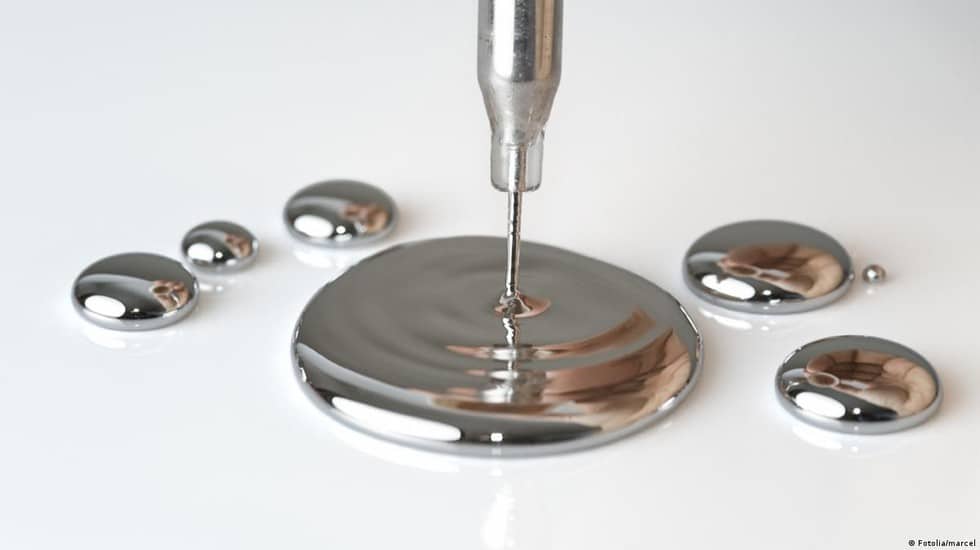
About Mercury’s superconductivity
- In 1911, Dutch physicist Heike Kamerlingh Onnes discovered superconductivity in mercury.
- He found that at a very low temperature, called the threshold temperature, solid mercury offers no resistance to the flow of electric current.
- Scientists later classified mercury as a conventional superconductor because its superconductivity could be explained by the concepts of the Bardeen-Cooper-Schrieffer (BCS) theory.
- In BCS superconductors, vibrational energy released by the grid of atoms encourages electrons to pair up, forming so-called Cooper pairs.
- These Copper pairs can move like water in a stream, facing no resistance to their flow, below a threshold temperature.
What is Superconductivity?
- A material can conduct electricity without any resistance. It is observed in many materials when they are cooled below a critical temperature.
What is Mercury?
- It is a naturally occurring element that is found in air, water and soil.
- It is released into the atmosphere through natural processes such as weathering of rocks, volcanic eruptions, geothermal activities, forest fires, etc.
Q1) What are superconductors?
A superconductor is a material that achieves superconductivity, which is a state of matter that has no electrical resistance and does not allow magnetic fields to penetrate. An electric current in a superconductor can persist indefinitely.
Source: A clear picture of how mercury becomes a superconductor.


 Last updated on Oct, 2026
→ UPSC 2027 Notification will be released on 13 January 2027 at upsconline.nic.in.
→ Check Nobel Prize 2026 Winners List here.
→ Download PIB PRiSM Monthly Magazine 2026 here.
→ Check UPSC Monthly Current Affairs Magazine The Recitals here.
→ Check out the latest UPSC Syllabus here.
→ Download UPSC Model Answers for Mains 2026
→ UPSC Mains Question Paper 2026 is out now for Essay & GS Paper 1, 2, 3 & 4.
→ UPSC Calendar 2027 has been released.
→ Enroll in Vajiram & Ravi’s UPSC Mains Test Series 2027 for structured answer writing practice, expert evaluation, and exam-oriented feedback.
→ Join Vajiram & Ravi’s UPSC Mentorship Program 2027 for personalized guidance, strategy planning, and one-to-one support from experienced mentors.
→ Go through the UPSC Mains Previous Year Papers to enhance your preparation.
→ UPSC has released UPSC Toppers List 2025 with the Civil Services final result on its official website.
→ Also check Best UPSC Coaching in India