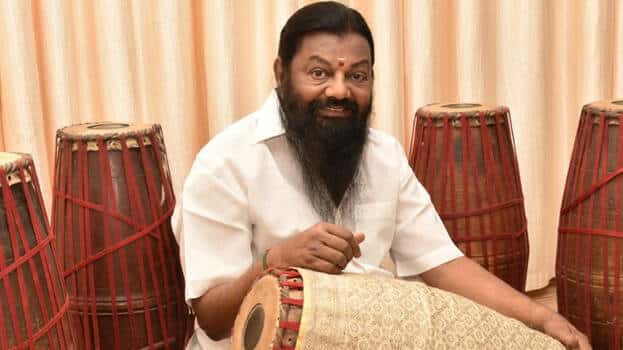
About Mridangam:
- It is one of the oldest Indian percussion instruments, originating 2,000 years ago.
- This traditional instrument is found in various parts of South India.
- It is a popular bifacial drum of Carnatic music and is used as an accompaniment in South Indian Classical music.
- It is also known by the name of maddal or maddalam.
- It is held across the lap and played on both ends with the hands and fingers.
- A similar instrument, the pakhavaj, is played in the Hindustani tradition of northern India, as well as in Pakistan and Bangladesh.
- Making process:
- The body of the mridangam is scooped out of a single block of wood.
- Jack wood or redwood is the ideal choice of mridangam makers, but the wood of the morgosa tree or the core of the coconut tree and the palm tree is also used for this purpose.
- Shape: It is shaped like a barrel whose right head is a little smaller than the left.
- Layered parchments, fastened to leather hoops and kept intact and tight by leather braces, control the skin tension.
- At times, small pieces of wood are also put in between these braces to facilitate the tuning.
- A removable patch of tuning paste is affixed to each end, giving the drum a definite pitch.
Q1) What is pakhavaj?
Pakhawaj is a percussion instrument made of wood, parchment, leather, and black paste. This traditional instrument is found in various parts of North India. Majorly used in North Indian classical concerts particularly with ‘Dhrupad’ and ‘Dhamar’ style of music and with the instruments played in Dhrupad style such as Been, Rabab, Surbahar, etc. Also a solo instrument.
Source: Legendary mridangam maestro Karaikudi Mani dies


 Last updated on Oct, 2026
→ UPSC 2027 Notification will be released on 13 January 2027 at upsconline.nic.in.
→ Check Nobel Prize 2026 Winners List here.
→ Download PIB PRiSM Monthly Magazine 2026 here.
→ Check UPSC Monthly Current Affairs Magazine The Recitals here.
→ Check out the latest UPSC Syllabus here.
→ Download UPSC Model Answers for Mains 2026
→ UPSC Mains Question Paper 2026 is out now for Essay & GS Paper 1, 2, 3 & 4.
→ UPSC Calendar 2027 has been released.
→ Enroll in Vajiram & Ravi’s UPSC Mains Test Series 2027 for structured answer writing practice, expert evaluation, and exam-oriented feedback.
→ Join Vajiram & Ravi’s UPSC Mentorship Program 2027 for personalized guidance, strategy planning, and one-to-one support from experienced mentors.
→ Go through the UPSC Mains Previous Year Papers to enhance your preparation.
→ UPSC has released UPSC Toppers List 2025 with the Civil Services final result on its official website.
→ Also check Best UPSC Coaching in India