About Quantum Navigation:
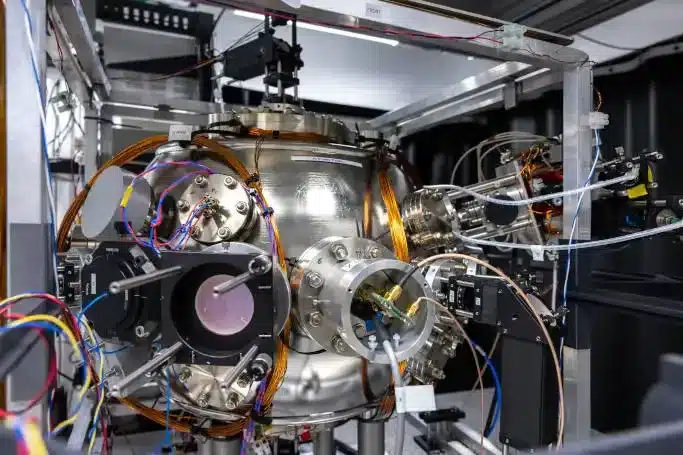
- Where satellite navigation relies on the signal bouncing back from space, quantum navigation focuses on the movement of a single atom tracked under cryogenic conditions.
- Instead of a satellite floating in space, a quantum navigation system is within each individual vehicle, with measurements being made “at point of use”.
- This means the signal “doesn’t drift”, making interception much harder to achieve.
- Global navigation satellite systems (GNSS) like GPS are susceptible to accidental and deliberate outages, whereas quantum navigation is ‘unjammable’.
- But quantum navigation systems are unlikely to replace GNSSs any time soon.
- This is because, ultra-cold atoms are needed to achieve quantum navigation, and the equipment is currently sizable.
What is GPS?
- The Global Positioning System (GPS) is a space-based radio-navigation system consisting of a constellation of satellites broadcasting navigation signals and a network of ground stations and satellite control stations used for monitoring and control.
- Currently, 31 GPS satellites orbit the Earth at an altitude of approximately 11,000 miles, providing users with accurate information on position, velocity, and time anywhere in the world and in all weather conditions.
- It is operated and maintained by the U.S. Department of Defense (USDOD).
- The USDOD originally put the satellites into orbit for military use, but they were made available for civilian use in the 1980s.
- GPS works in any weather conditions, anywhere in the world, 24 hours a day, with no subscription fees or setup charges.
- How GPS Works?
- GPS satellites circle the Earth twice a day in a precise orbit.
- Each satellite transmits a unique signal and orbital parameters that allow GPS devices to decode and compute the precise location of the satellite.
- GPS receivers use this information and trilateration to calculate a user’s exact location.
- Essentially, the GPS receiver measures the distance to each satellite by the amount of time it takes to receive a transmitted signal.
- With distance measurements from a few more satellites, the receiver can determine a user’s position and display it electronically.
Q1: What is Navigation with Indian Constellation (NaVIC)?
NaVIC or the Indian Regional Navigation Satellite System (IRNSS) uses seven satellites to provide real-time positioning and timing services in India and an area extending up to 1,500 km from the country’s borders. Of the seven satellites used by NaVIC at present, three are in the geostationary orbit and four in the geosynchronous orbit.
Source: What’s quantum navigation? It could even replace GPS


 Last updated on Oct, 2026
→ UPSC 2027 Notification will be released on 13 January 2027 at upsconline.nic.in.
→ Asian Games 2026 are being held in Aichi-Nagoya, Japan, from 19 September to 4 October.
→ Check Nobel Prize 2026 Winners List here.
→ Download PIB PRiSM Monthly Magazine 2026 here.
→ Check UPSC Monthly Current Affairs Magazine The Recitals here.
→ Check out the latest UPSC Syllabus here.
→ Download UPSC Model Answers for Mains 2026
→ UPSC Mains Question Paper 2026 is out now for Essay & GS Paper 1, 2, 3 & 4.
→ UPSC Calendar 2027 has been released.
→ Enroll in Vajiram & Ravi’s UPSC Mains Test Series 2027 for structured answer writing practice, expert evaluation, and exam-oriented feedback.
→ Join Vajiram & Ravi’s UPSC Mentorship Program 2027 for personalized guidance, strategy planning, and one-to-one support from experienced mentors.
→ Go through the UPSC Mains Previous Year Papers to enhance your preparation.
→ UPSC has released UPSC Toppers List 2025 with the Civil Services final result on its official website.
→ Also check Best UPSC Coaching in India