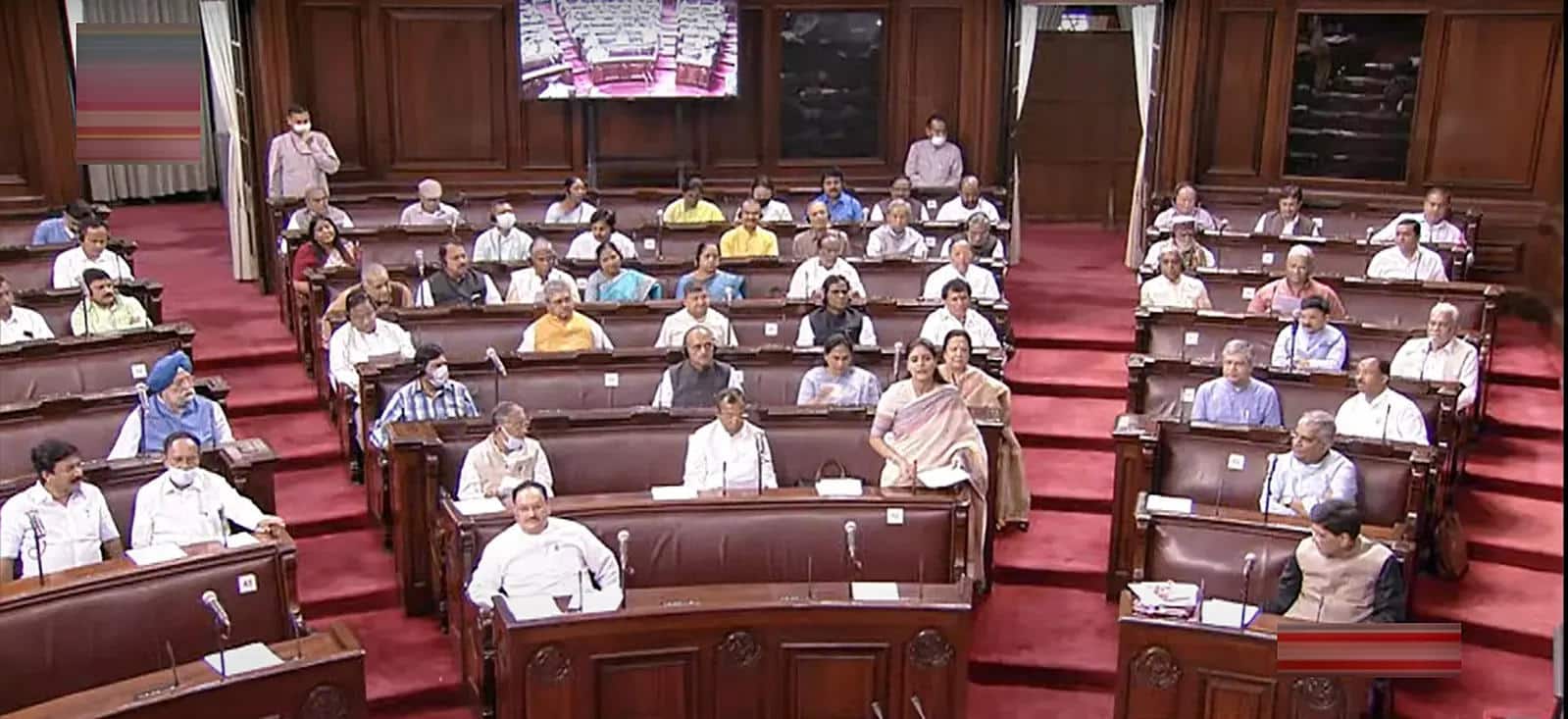
About Rule 267:
- According to the Rules of Procedure and Conduct of Business in the Council of States (Rajya Sabha), Rule 267 relates to the suspension of rules.
- It says, “Any member may, with the consent of the Chairman, move that any rule may be suspended in its application to a motion related to the business listed before the Council of that day, and if the motion is carried, the rule in question shall be suspended for the time being; provided further that this rule shall not apply where specific provision already exists for suspension of a rule under a particular chapter of the Rules.”
- Simply put, under Rule 267, Rajya Sabha MPs can submit a written notice to suspend all listed business in the House and discuss an issue of importance that the country is facing.
- A motion under Rule 267 indicates that a matter was serious enough for the House to suspend its normal business to take it up.
- The rule further says, “The Chairman alone has the power to give consent for moving of a motion for suspension of a rule, and it is for the House to decide whether a particular rule should be suspended or not.”
- Thus, it is the discretion of the Chairman to decide whether to allow a motion under Rule 267, as it states that “the consent of the Chairman” is required for a member to bring such a motion.
- However, this rule does not apply where specific provisions already exist for the suspension of a rule under a particular chapter of the rules.
- Who can issue Rule 267?
- Any member of the Rajya Sabha can issue a notice to the Chairperson for a discussion on any subject under Rule 267.
- When was Rule 267 last invoked?
- The last time it was used was in November 2016, when the Upper House invoked Rule 267 to discuss demonetisation.
Q1) What is Rule 176 in Rajya Sabha?
Rule 176 allows for a short-duration discussion, not exceeding two-and-a-half hours, on a particular issue. It states that “any member desirous of raising discussion on a matter of urgent public importance may give notice in writing to the Secretary-General specifying clearly and precisely the matter to be raised: Provided that the notice shall be accompanied by an explanatory note stating reasons for raising discussion on the matter in question: Provided further that the notice shall be supported by the signatures of at least two other members.”
Source: Monsoon session LIVE updates: Opposition gives notices in both Houses over Manipur issue


 Last updated on Sep, 2026
→ UPSC 2027 Notification will be released on 13 January 2027 at upsconline.nic.in.
→ Asian Games 2026 are being held in Aichi-Nagoya, Japan, from 19 September to 4 October.
→ Check out the latest UPSC Syllabus here.
→ Download UPSC Model Answers for Mains 2026
→ UPSC Mains Question Paper 2026 is out now for Essay & GS Paper 1, 2, 3 & 4.
→ UPSC Calendar 2027 has been released.
→ Enroll in Vajiram & Ravi’s UPSC Mains Test Series 2027 for structured answer writing practice, expert evaluation, and exam-oriented feedback.
→ Join Vajiram & Ravi’s UPSC Mentorship Program 2027 for personalized guidance, strategy planning, and one-to-one support from experienced mentors.
→ Go through the UPSC Mains Previous Year Papers to enhance your preparation.
→ UPSC has released UPSC Toppers List 2025 with the Civil Services final result on its official website.
→ Also check Best UPSC Coaching in India