About Space Variable Objects Monitor (SVOM):
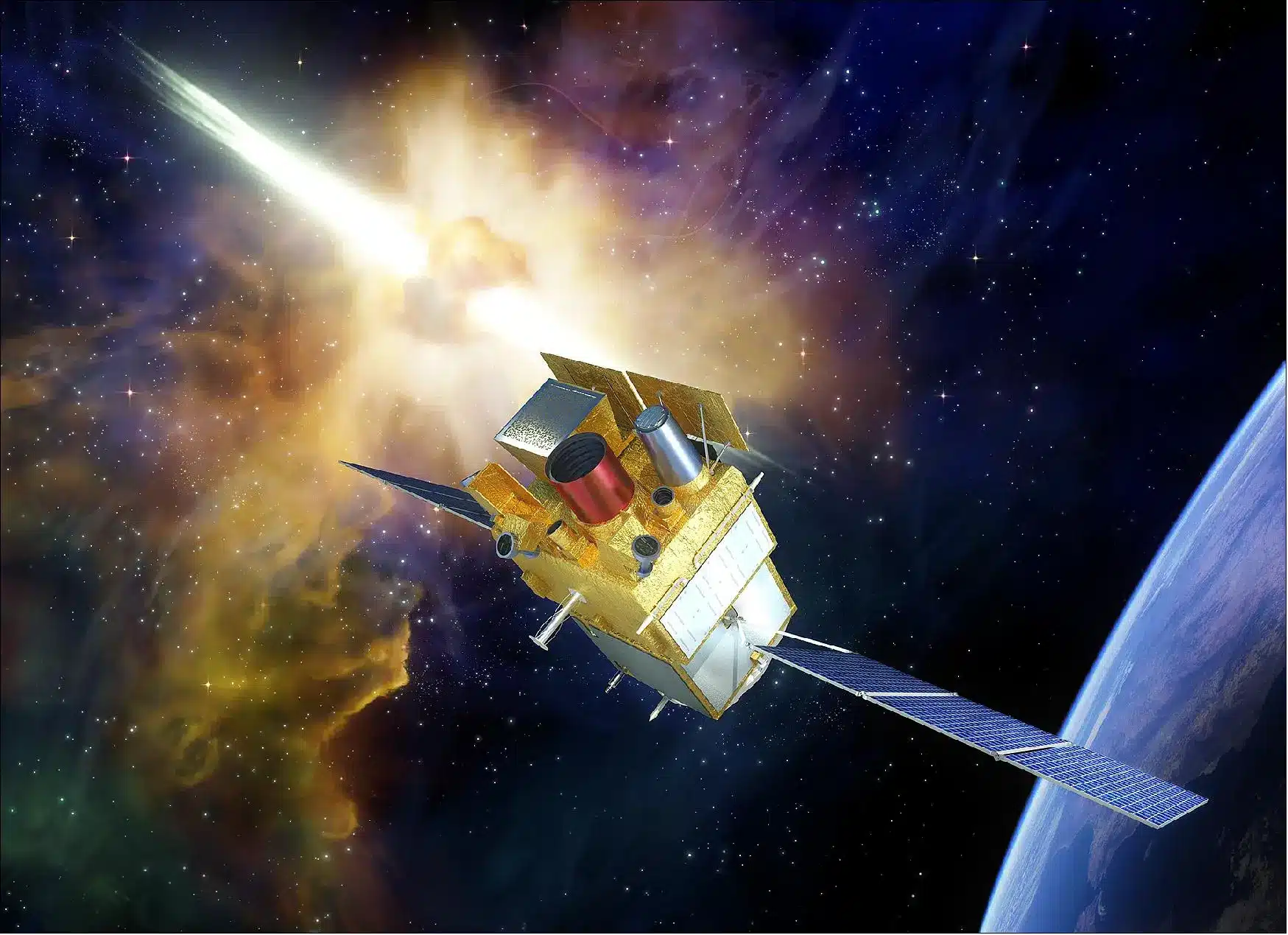
- It is a French-Chinese satellite which aims to detect and study gamma-ray bursts.
- It was launched by a Long March-2C rocket from the Xichang Satellite Launch Center in southwest China’s Sichuan Province.
- It is a 930-kilogram satellite carrying four instruments – two French and two Chinese.
- The satellite has been sent into an orbit over 600 kilometers above Earth and has a designed life of five years, though scientists expect it could be operational for as long as 20 years.
- Gamma-ray bursts (GRBs):
- GRBs generally occur after the explosion of huge stars – those more than 20 times as big as the sun – or the fusion of compact stars.
- The extremely bright cosmic beams can give off a blast of energy equivalent to over a billion billion suns.
- Observing them is like “looking back in time, as the light from these objects takes a long time to reach earth.
- The rays carry traces of the gas clouds and galaxies they pass through on their journey through space – valuable data for better understanding the history and evolution of the universe.
- GRBs are notoriously hard to catch as they can appear anywhere in the sky and last for just a few seconds. They are readily absorbed by the Earth’s atmosphere, so the only way to record them is to place probes in space.
- SVOM has the potential to unravel several mysteries in the field of GRBs, including detecting the most distant GRBs in the universe, which correspond to the earliest GRBs.
- The data gathered will help test the laws of physics under conditions that cannot be replicated on Earth and provide insights into the dynamics of the universe.
Q1: What are Gamma Rays?
Gamma rays have the smallest wavelengths and the most energy of any wave in the electromagnetic spectrum. They are produced by the hottest and most energetic objects in the universe, such as neutron stars and pulsars, supernova explosions, and regions around black holes. On Earth, gamma waves are generated by nuclear explosions, lightning, and the less dramatic activity of radioactive decay.
Source: Rocket carrying French-Chinese satellite launches from southwestern China to study gamma-ray bursts


 Last updated on Oct, 2026
→ UPSC 2027 Notification will be released on 13 January 2027 at upsconline.nic.in.
→ Check Nobel Prize 2026 Winners List here.
→ Download PIB PRiSM Monthly Magazine 2026 here.
→ Check UPSC Monthly Current Affairs Magazine The Recitals here.
→ Check out the latest UPSC Syllabus here.
→ Download UPSC Model Answers for Mains 2026
→ UPSC Mains Question Paper 2026 is out now for Essay & GS Paper 1, 2, 3 & 4.
→ UPSC Calendar 2027 has been released.
→ Enroll in Vajiram & Ravi’s UPSC Mains Test Series 2027 for structured answer writing practice, expert evaluation, and exam-oriented feedback.
→ Join Vajiram & Ravi’s UPSC Mentorship Program 2027 for personalized guidance, strategy planning, and one-to-one support from experienced mentors.
→ Go through the UPSC Mains Previous Year Papers to enhance your preparation.
→ UPSC has released UPSC Toppers List 2025 with the Civil Services final result on its official website.
→ Also check Best UPSC Coaching in India