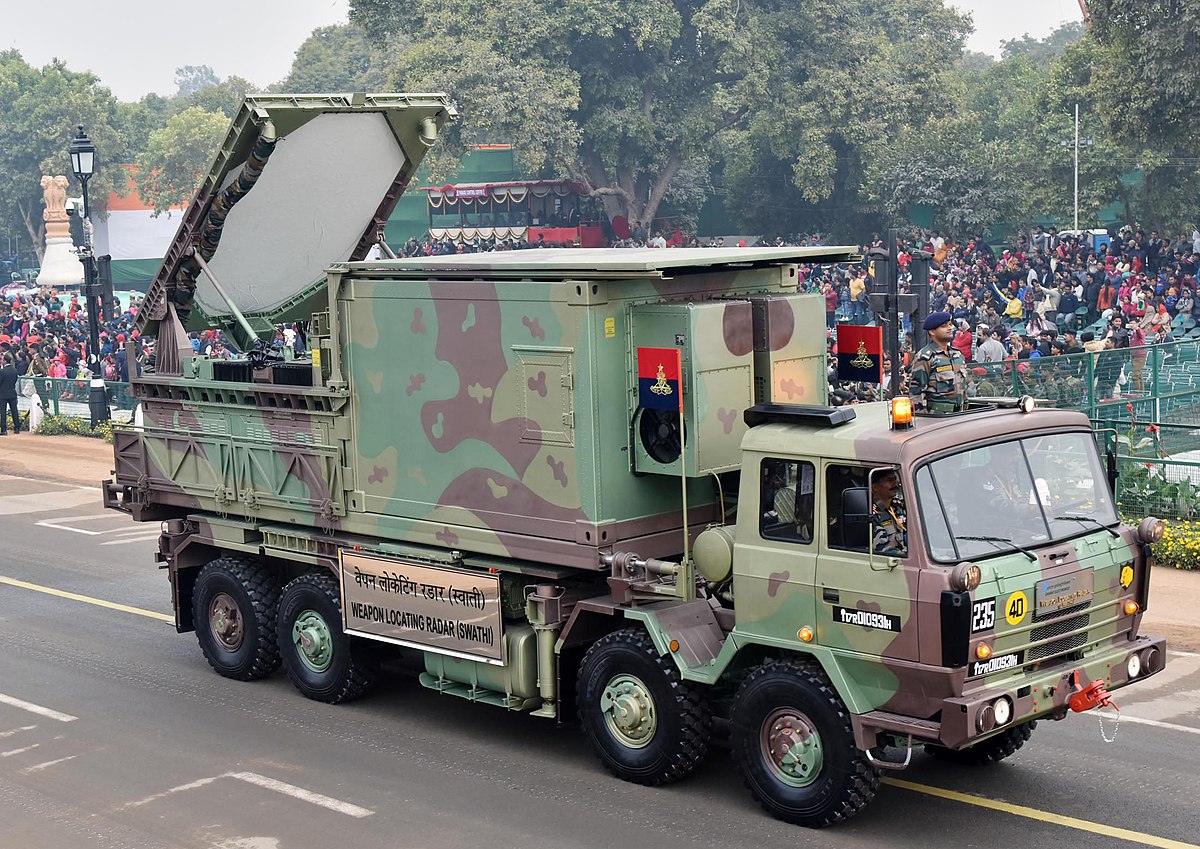
About Swathi Mountains
- The Swathi Mountains WLR is an advanced electronically scanned phased array radar.
- It is specifically designed for operations in mountainous and high-altitude areas.
- It was developed by Bharat Electronics Limited (BEL) in Bengaluru.
What is a Weapon Locating Radar?
- The WLR stands as a critical asset for modern militaries, employing advanced signal processing techniques to autonomously detect and track hostile artillery, mortars, and rocket launchers.
- It even tracks friendly fire trajectories, enabling precise calculations for more accurate artillery strikes.
- The radar’s sophistication lies in its ability to detect and track small projectiles across the battlefield while factoring in environmental conditions for precise launch and impact point estimations.
- A hallmark of the WLR is its high mobility and swift deployment capabilities, allowing it to adapt to changing operational requirements efficiently.
- Its slewable platform further enhances its agility, enabling the scanning of different areas without the need for physical repositioning.
- The WLR also acts as a potent friendly force multiplier by providing critical information on enemy weapon systems.


Swathi Plains vs Swathi Mountains
- The Swathi radar comes in two versions: the Swathi Plains (WLR) and the Swathi Mountains (WLR-M).
- The Swathi Plains version is primarily designed to locate hostile guns, mortars, and rockets, and it can also track the fall of shot from friendly weapons for corrective measures on flat terrains like Plains, as the name of the version suggests.
- Swathi Mountains version:
- It is a more compact and mobile version specifically designed for operations in mountainous and high-altitude terrains.
- It is capable of detecting mortar shells and rockets and tracking projectiles.
- It classifies projectile and non-projectile targets, rejecting unwanted signals like birds, clutter, and aircraft.
- It offers trajectory estimation and launch/impact point extrapolation, automatically correcting for height to enhance accuracy.
- The radar system is equipped to store and display trajectory data and maintain communication with higher echelons for better coordination.
Q1) What is a Radar?
Radar stands for “Radio Detection and Ranging.” It is a technology used to detect and track objects, such as aircraft, ships, weather formations, and other physical phenomena. Radar works by emitting electromagnetic waves (radio waves) and then analyzing the reflections or echoes of those waves when they bounce back after hitting an object.
Source: Big Push To Defence: Indian Army Inducts Swathi Mk2 Radar For Mountain Surveillance

 Last updated on Sep, 2026
→ UPSC 2027 Notification will be released on 13 January 2027 at upsconline.nic.in.
→ Asian Games 2026 are being held in Aichi-Nagoya, Japan, from 19 September to 4 October.
→ Check out the latest UPSC Syllabus here.
→ Download UPSC Model Answers for Mains 2026
→ UPSC Mains Question Paper 2026 is out now for Essay & GS Paper 1, 2, 3 & 4.
→ UPSC Calendar 2027 has been released.
→ Enroll in Vajiram & Ravi’s UPSC Mains Test Series 2027 for structured answer writing practice, expert evaluation, and exam-oriented feedback.
→ Join Vajiram & Ravi’s UPSC Mentorship Program 2027 for personalized guidance, strategy planning, and one-to-one support from experienced mentors.
→ Go through the UPSC Mains Previous Year Papers to enhance your preparation.
→ UPSC has released UPSC Toppers List 2025 with the Civil Services final result on its official website.
→ Also check Best UPSC Coaching in India