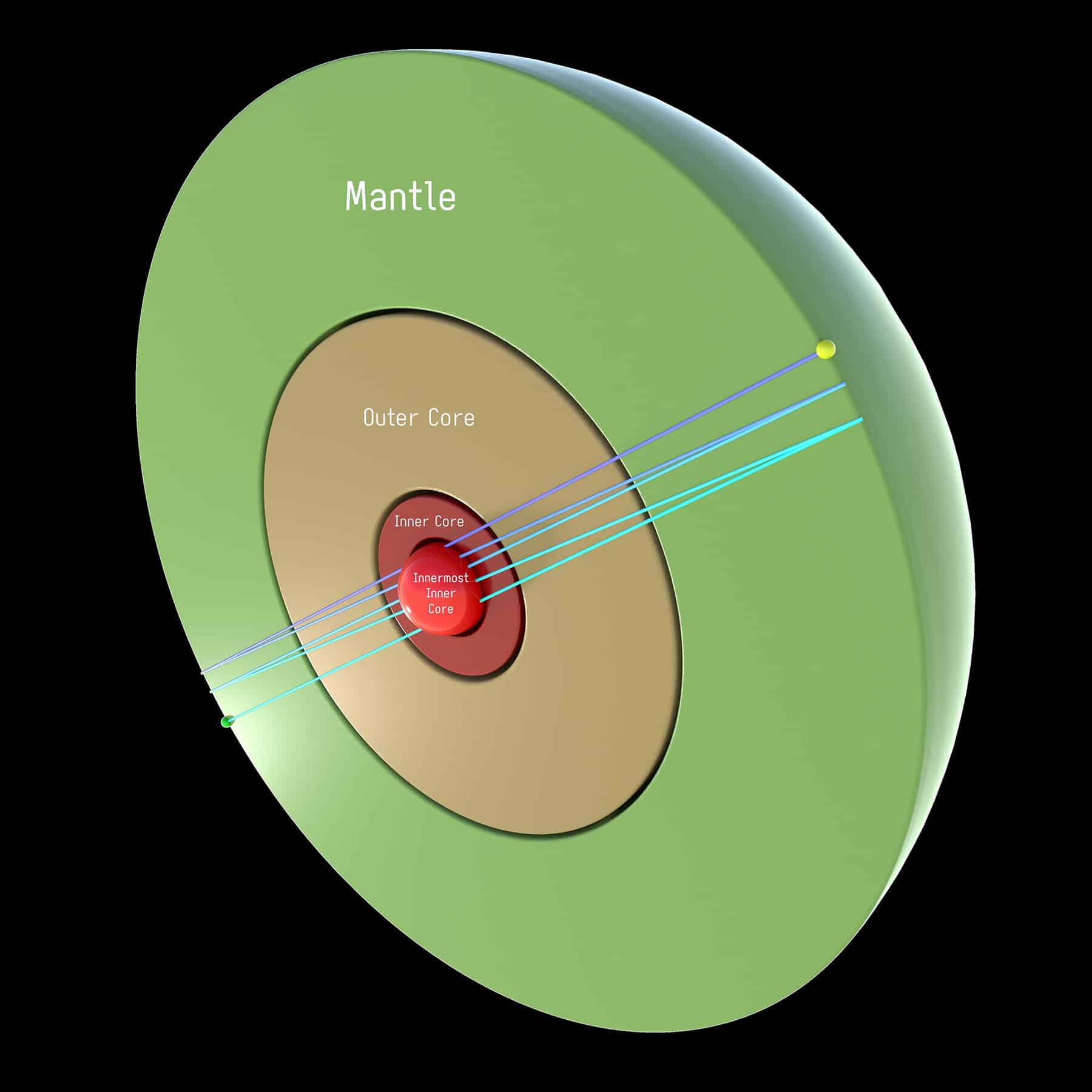
About Earth’s innermost inner core (IMIC):
- It is a 400-mile-wide (644-kilometer-wide) ball of metal.
- IMIC exists in a solid state as an alloy of iron and nickel because of the extreme pressure at the center of the Earth.
- Its temperature is estimated to be about 5,500-6,000 degrees (Celsius/9,930-10,830 Fahrenheit), similar to the sun’s surface temperature.
- It has a distinct anisotropy, which is a property of a substance that allows it to take on different characteristics depending on the angle from which it’s approached.
- The concept of the innermost part of the inner core was first proposed in 2002 by seismologists from Harvard University— Miaki Ishii and Adam Dziewonski.
About the Inner core of the Earth:
- It is a solid metallic ball made mainly of iron.
- The inner core is solid due to the pressure caused by the weight put on it by the Earth’s other top layers.
- It is distinct from the outer core, which is a liquid.
- Radius:
- The inner core has an average radius of 1220 km.
- The boundary between the inner and outer core is located at approximately 5150 km below the surface of the Earth.
- This boundary is called the Lehman Seismic Discontinuity.
Temperature: Inner core temperatures reach extraordinary levels, estimated to be between 7,200–8,500ºF (4,000–4,700ºC).
Properties:
- It is predicted to have very high thermal and electrical conductivity.
- The inner core generates its own magnetic field and spins a bit faster than the rest of the planet.
Q1) What are the different layers of earth?
The structure of the earth is divided into four major components: the crust, the mantle, the outer core, and the inner core. Each layer has a unique chemical composition, physical state, and can impact life on Earth’s surface


 Last updated on Oct, 2026
→ UPSC 2027 Notification will be released on 13 January 2027 at upsconline.nic.in.
→ Asian Games 2026 are being held in Aichi-Nagoya, Japan, from 19 September to 4 October.
→ Check Nobel Prize 2026 Winners List here.
→ Download PIB PRiSM Monthly Magazine 2026 here.
→ Check UPSC Monthly Current Affairs Magazine The Recitals here.
→ Check out the latest UPSC Syllabus here.
→ Download UPSC Model Answers for Mains 2026
→ UPSC Mains Question Paper 2026 is out now for Essay & GS Paper 1, 2, 3 & 4.
→ UPSC Calendar 2027 has been released.
→ Enroll in Vajiram & Ravi’s UPSC Mains Test Series 2027 for structured answer writing practice, expert evaluation, and exam-oriented feedback.
→ Join Vajiram & Ravi’s UPSC Mentorship Program 2027 for personalized guidance, strategy planning, and one-to-one support from experienced mentors.
→ Go through the UPSC Mains Previous Year Papers to enhance your preparation.
→ UPSC has released UPSC Toppers List 2025 with the Civil Services final result on its official website.
→ Also check Best UPSC Coaching in India