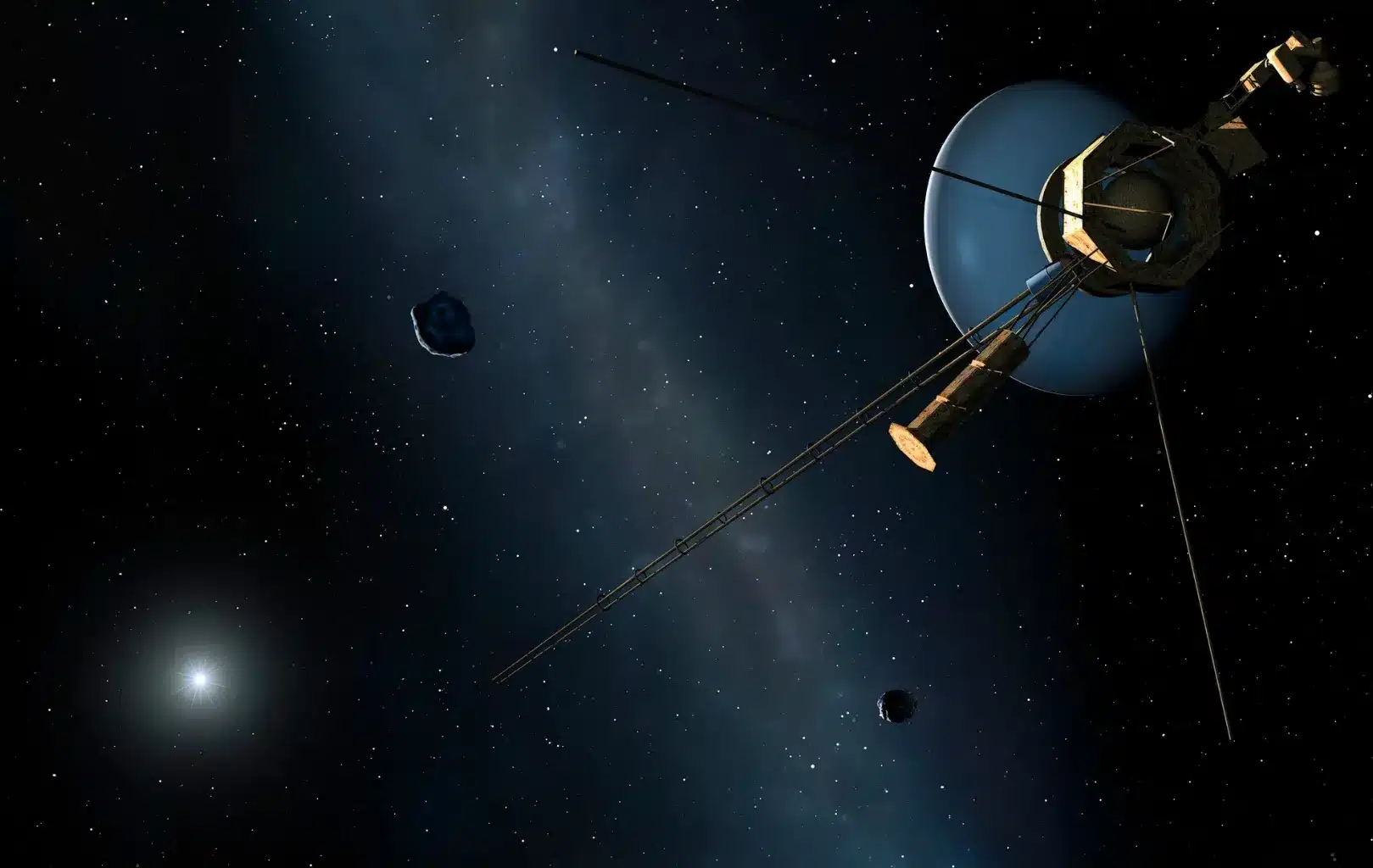
About Voyager 2 Spacecraft:
- It is an unmanned space probe launched by NASA on August 20, 1977, just a few weeks before its sister craft, Voyager 1.
- Primary mission: Its mission was to study the outer planets of our solar system, including Jupiter, Saturn, Uranus, and Neptune and their moons, and then continue on an interstellar mission.
- It is the only spacecraft to have ever visited Uranus and Neptune.
- It carries a Golden Record, a phonograph record containing sounds and images from Earth, intended to be a message to any potential extraterrestrial civilizations it might encounter in the future.
- Firsts:
- It is the only spacecraft to study all four of the solar system’s giant planets at close range.
- It discovered a 14th moon of Jupiter.
- It was the first human-made object to fly past Uranus.
- At Uranus, Voyager 2 discovered 10 new moons and two new rings.
- It was the first human-made object to fly by Neptune.
- At Neptune, Voyager 2 discovered five moons, four rings, and a “Great Dark Spot.”
- After completing its primary mission, Voyager 2 continued on its journey into interstellar space, where it is still sending back data on the interstellar medium and the heliosphere.
- It is the second spacecraft to enter interstellar space. On Dec. 10, 2018, the spacecraft joined its twin—Voyager 1—as the only human-made objects to enter the space between the stars.
- It is currently the second most distant human-made object from Earth, after Voyager 1.
Q1: What is the heliosphere?
The Sun sends out a constant flow of charged particles called the solar wind, which ultimately travels past all the planets to some three times the distance to Pluto before being impeded by the interstellar medium. This forms a giant bubble around the Sun and its planets, known as the heliosphere.
News: Voyager-2 visited Uranus in 1986. Something more happened when it arrived


 Last updated on Oct, 2026
→ UPSC 2027 Notification will be released on 13 January 2027 at upsconline.nic.in.
→ Check Nobel Prize 2026 Winners List here.
→ Download PIB PRiSM Monthly Magazine 2026 here.
→ Check UPSC Monthly Current Affairs Magazine The Recitals here.
→ Check out the latest UPSC Syllabus here.
→ Download UPSC Model Answers for Mains 2026
→ UPSC Mains Question Paper 2026 is out now for Essay & GS Paper 1, 2, 3 & 4.
→ UPSC Calendar 2027 has been released.
→ Enroll in Vajiram & Ravi’s UPSC Mains Test Series 2027 for structured answer writing practice, expert evaluation, and exam-oriented feedback.
→ Join Vajiram & Ravi’s UPSC Mentorship Program 2027 for personalized guidance, strategy planning, and one-to-one support from experienced mentors.
→ Go through the UPSC Mains Previous Year Papers to enhance your preparation.
→ UPSC has released UPSC Toppers List 2025 with the Civil Services final result on its official website.
→ Also check Best UPSC Coaching in India