What’s in Today’s Article?
- Global Pandemic Treaty Latest News
- Need For a Global Pandemic Treaty
- Key Provisions of the Pandemic Treaty
- Criticism of the Global Pandemic Treaty
- Global Pandemic Treaty FAQs
Global Pandemic Treaty Latest News
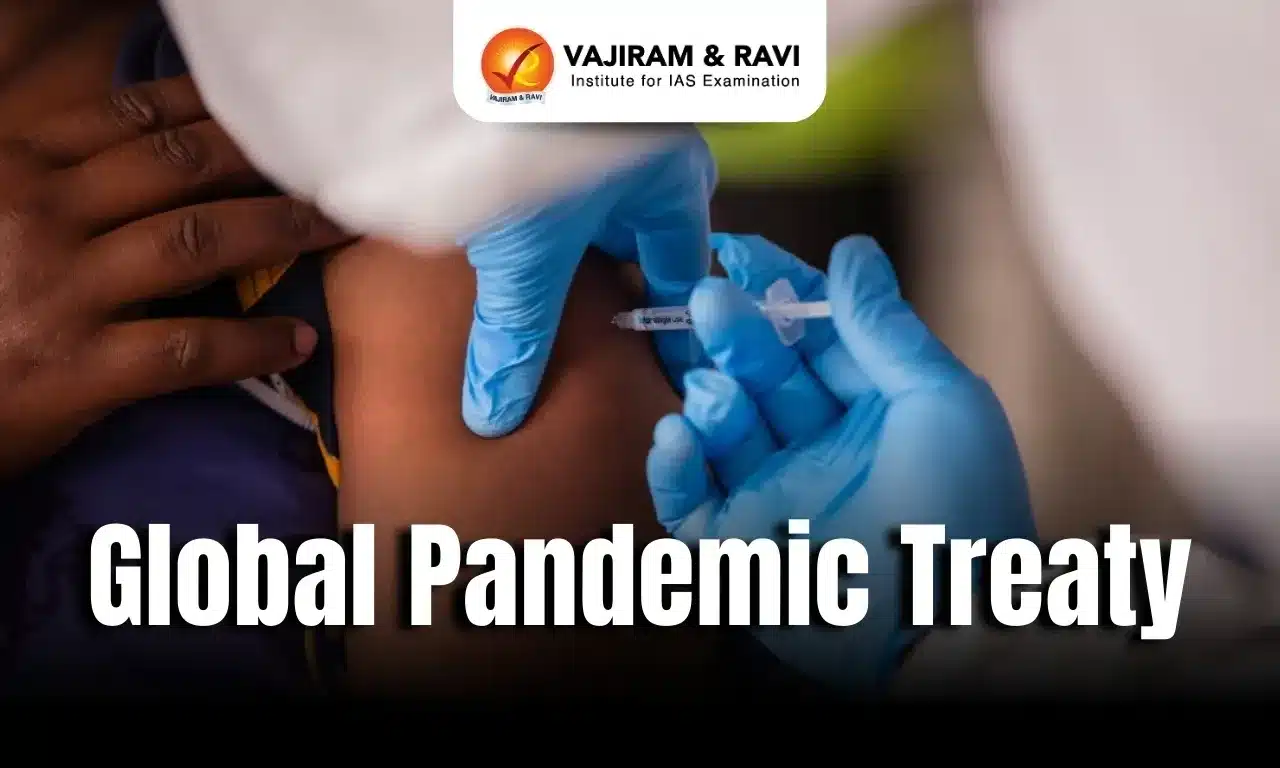
- After over three years of negotiations, WHO member states (excluding the United States) have agreed on a draft of a legally binding treaty aimed at improving global preparedness and response to future pandemics.
- This treaty, set to be ratified at the World Health Assembly in May, marks only the second legally binding accord in WHO’s history—the first being the 2003 tobacco control treaty.


Need For a Global Pandemic Treaty
- Unequal Vaccine Distribution During COVID-19
- When the Omicron variant surged in late 2021, vaccine-producing countries hoarded doses, leaving low-income nations with limited or no access.
- This highlighted deep global inequities in pandemic response.
- Preventable Loss of Lives
- A 2022 study in Nature estimated that over one million lives could have been saved with fairer vaccine distribution.
- By that time, COVID-19 had already taken more than seven million lives globally.
- Systemic Failures in Global Response
- A 2021 report by the Independent Panel for Pandemic Preparedness and Response blamed poor strategic choices, inequality, and lack of coordination for turning the pandemic into a major humanitarian disaster.
- A Call for Coordinated Global Action
- In response to these failures, WHO member states began negotiating a pandemic treaty in December 2021.
- After 13 rounds of talks over nearly three-and-a-half years, a draft agreement was reached to ensure better preparedness, equity, and coordination in future pandemics.
Key Provisions of the Pandemic Treaty
- Pathogen Access and Benefit Sharing
- The treaty introduces a system where pharmaceutical companies gain access to scientific data—like pathogen samples and genomic sequences—in exchange for a commitment to equitably share the resulting vaccines, drugs, and diagnostics during a pandemic.
- Production Allocation to WHO
- Manufacturers participating in the agreement must allocate:
- 10% of their pandemic-related products (vaccines, therapeutics, diagnostics) to WHO free of charge, and
- An additional 10% at affordable prices.
- Manufacturers participating in the agreement must allocate:
- Technology and Knowledge Sharing
- Member states are expected to encourage or incentivize the transfer of technology and know-how, enabling developing countries to manufacture their own medical tools during pandemics.
- Conditions on Publicly Funded Research
- Countries must create policies that require any publicly funded research—whether at universities or private companies—to ensure equitable and timely access to resulting treatments or diagnostics during health emergencies.
- Government Intervention for Public Benefit
- The treaty empowers governments to intervene when life-saving medicines, developed using public funds, are unaffordable or inaccessible, ensuring availability for citizens and vulnerable populations worldwide.
Criticism of the Global Pandemic Treaty
- Limited Authority of the WHO
- While the treaty is considered a major step forward, it does not grant the WHO any legal power over individual countries.
- Clause 24 explicitly states that the WHO cannot direct or change any national laws or policies.
- It also cannot enforce travel bans, lockdowns, vaccine mandates, or any public health measures.
- No Enforcement Mechanism
- The WHO has no power to ensure compliance. In a future crisis, countries could again prioritize national interests—such as hoarding vaccines—without facing consequences.
- This weakens the treaty’s enforceability.
- Concerns from the Pharmaceutical Industry
- Pharma leaders argue that unclear rules around intellectual property and benefit-sharing may discourage investment in high-risk pandemic research.
- They emphasized the need for legal certainty to maintain innovation and public-private partnerships in future health emergencies.
- Lack of Clarity in Key Provisions
- The “pathogen access and benefit sharing” system—central to the treaty—lacks detailed implementation guidelines, raising concerns about its practicality and effectiveness.
- Absence of the United States
- The U.S., a major player in vaccine and drug production, withdrew from negotiations after Donald Trump’s return to power.
- Its absence significantly weakens the treaty’s impact.
- Experts described the lack of U.S. participation as a “gaping hole” in global pandemic preparedness efforts.
Global Pandemic Treaty FAQs
Q1. What is the global pandemic treaty?
Ans. A legally binding WHO accord to improve pandemic preparedness and equitable access.
Q2. Why was the treaty needed?
Ans. To address COVID-19-era vaccine hoarding and global health inequality.
Q3. What are key treaty provisions?
Ans. Fair vaccine sharing, tech transfer, and publicly funded research access.
Q4. Does WHO have enforcement power?
Ans. No, the treaty gives no legal authority over national governments.
Q5. Why is US absence significant?
Ans. The US dominates vaccine production; its absence weakens treaty impact.

 Last updated on Oct, 2026
→ UPSC 2027 Notification will be released on 13 January 2027 at upsconline.nic.in.
→ Asian Games 2026 are being held in Aichi-Nagoya, Japan, from 19 September to 4 October.
→ Check Nobel Prize 2026 Winners List here.
→ Download PIB PRiSM Monthly Magazine 2026 here.
→ Check UPSC Monthly Current Affairs Magazine The Recitals here.
→ Check out the latest UPSC Syllabus here.
→ Download UPSC Model Answers for Mains 2026
→ UPSC Mains Question Paper 2026 is out now for Essay & GS Paper 1, 2, 3 & 4.
→ UPSC Calendar 2027 has been released.
→ Enroll in Vajiram & Ravi’s UPSC Mains Test Series 2027 for structured answer writing practice, expert evaluation, and exam-oriented feedback.
→ Join Vajiram & Ravi’s UPSC Mentorship Program 2027 for personalized guidance, strategy planning, and one-to-one support from experienced mentors.
→ Go through the UPSC Mains Previous Year Papers to enhance your preparation.
→ UPSC has released UPSC Toppers List 2025 with the Civil Services final result on its official website.
→ Also check Best UPSC Coaching in India