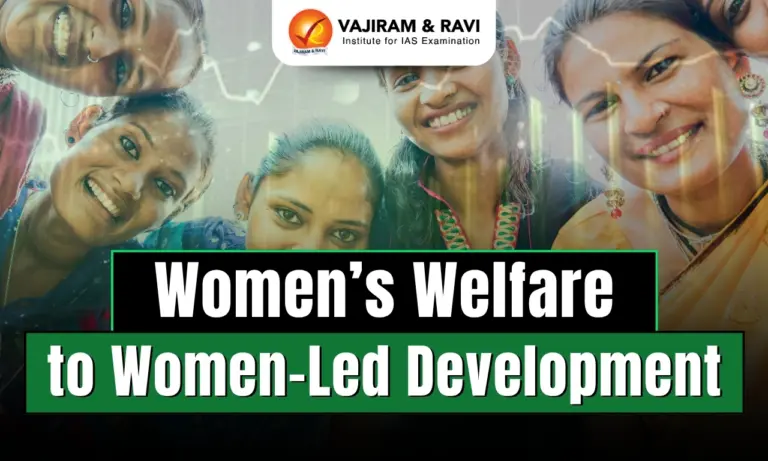
Women’s empowerment has emerged as a central pillar of India’s development strategy. Over the last decade, India has moved beyond the traditional approach of “women’s welfare”, which focused primarily on protection and assistance, towards “women-led development”, where women are recognised as active agents of economic growth, governance, innovation, and nation-building.
This transition reflects a lifecycle-based approach covering education, health, nutrition, livelihoods, financial inclusion, entrepreneurship, leadership, and political participation.
What is Women-Led Development?
Women-led development refers to a development paradigm where women are not merely beneficiaries of welfare programmes but are equal participants, decision-makers, entrepreneurs, and leaders driving socio-economic transformation.
| Women’s Welfare Approach | Women-Led Development Approach |
|
Women viewed as beneficiaries |
Women viewed as change-makers |
|
Focus on protection and assistance |
Focus on participation and leadership |
|
Addressing vulnerabilities |
Creating opportunities |
|
State-driven support |
Women-driven growth |
|
Social justice orientation |
Economic and developmental orientation |
|
Limited role in decision-making |
Central role in governance and development |
Lifecycle Approach to Women Empowerment
India’s transition from “Women’s Welfare” to “Women-Led Development” has been guided by a lifecycle approach that supports women at every stage of life, from birth and childhood to education, employment, entrepreneurship, and leadership. This approach recognises that women’s empowerment requires sustained interventions across health, nutrition, education, livelihoods, financial inclusion, safety, and political participation.
Birth and Survival: Protecting the Girl Child
- The Beti Bachao Beti Padhao (BBBP) programme was launched in 2015 to address the declining Child Sex Ratio, prevent gender-biased sex selection, and promote the survival, protection, and education of girls.
- The scheme combines strict implementation of the PCPNDT Act with large-scale awareness campaigns aimed at challenging discriminatory social norms.
- As a result of sustained interventions, the sex ratio in India improved from 943 females per 1,000 males in Census 2011 to 1,020 females per 1,000 males in NFHS-5, reflecting greater acceptance of the girl child.
Maternal Care: Ensuring Safe Pregnancy and Childbirth
- The Pradhan Mantri Matru Vandana Yojana (PMMVY) provides maternity benefits to pregnant and lactating mothers, enabling them to access better nutrition, healthcare, and institutional services during pregnancy.
- Since its inception, more than 4.92 crore women have been enrolled, and over ₹20,150 crore has been transferred directly to beneficiaries.
- The Pradhan Mantri Surakshit Matritva Abhiyan (PMSMA) provides free antenatal check-ups every month and has benefited over 7.4 crore pregnant women, while identifying more than 1.03 crore high-risk pregnancies for specialised care.
- Schemes such as Janani Suraksha Yojana (JSY) and Janani Shishu Suraksha Karyakram (JSSK) have expanded access to institutional deliveries and free maternal healthcare services.
These efforts have contributed to a significant increase in institutional deliveries from 79% in 2015-16 to 90.6% in 2023-24, while the Maternal Mortality Ratio declined from 130 to 88 per lakh live births.
School Education: Ensuring Access and Continuity
- The Samagra Shiksha programme has strengthened school infrastructure and improved educational access for girls across the country.
- Nearly 99.3% of schools now have drinking water facilities, while 97.3% have separate toilets for girls, creating a more supportive learning environment.
- Female enrolment has increased substantially, reaching 11.93 crore students, which accounts for nearly 48% of total school enrolment.
- The Kasturba Gandhi Balika Vidyalayas (KGBVs) have expanded educational opportunities for girls from disadvantaged communities through residential schooling.
- The number of KGBVs increased to 5,316 schools, while enrolment rose to 7.58 lakh girls by 2026.
Higher Education and STEM Participation
- The National Education Policy (NEP) 2020 has integrated gender inclusion into the education system through flexible learning pathways and targeted support mechanisms.
- Scholarship schemes such as the AICTE Pragati Scholarship, Central Sector Scholarships, and Postgraduate Scholarships have reduced financial barriers to higher education.
- The Vigyan Jyoti Scheme has encouraged girls to pursue careers in Science, Technology, Engineering and Mathematics (STEM) by providing mentoring, laboratory exposure, and career guidance.
- The scheme has benefited more than 1.12 lakh girls across 300 districts.
- Women’s participation in IITs and NITs has increased from less than 10% to more than 20%, while women account for over 53% of UGC-NET JRF scholars in STEM disciplines.


Skill Development and Digital Empowerment
- The Pradhan Mantri Kaushal Vikas Yojana (PMKVY) has enabled women to acquire market-relevant skills and improve employability.
- Nearly 45% of all PMKVY beneficiaries are women, reflecting their growing participation in skill development programmes.
- The latest phase of PMKVY focuses on emerging sectors such as Artificial Intelligence, drone technology, electronics, and green energy.
- The NAVYA initiative, launched in 2025, equips adolescent girls with skills in cybersecurity, digital marketing, AI-enabled services, financial literacy, and future-oriented occupations.
Health, Nutrition and Well-being
- The Saksham Anganwadi and Poshan 2.0 programme has strengthened nutrition support and early childhood care through upgraded infrastructure and improved service delivery.
- More than 1.03 lakh Anganwadi Centres have been upgraded, while 10.58 lakh Anganwadi workers have been trained in nutrition and early childhood care.
- The programme focuses on maternal nutrition, infant feeding practices, and addressing severe and moderate malnutrition.
- Through Mission Indradhanush, more than 11.87 crore children and 3.96 crore pregnant women have been registered for immunisation services.
- Under Ayushman Bharat, nearly 21 crore women have received Ayushman Cards, while around 4.97 crore women have benefited from hospital admissions under PM-JAY.
- More than 1.84 lakh Ayushman Arogya Mandirs are providing comprehensive primary healthcare services closer to communities.
Financial Inclusion and Economic Independence
- The Pradhan Mantri Jan Dhan Yojana (PMJDY) has enabled millions of women to enter the formal banking system and access savings, insurance, pensions, and direct benefit transfers.
- The Sukanya Samriddhi Yojana has encouraged families to invest in the future of girl children through structured savings and financial planning.
These initiatives have strengthened women’s financial autonomy and increased their participation in formal economic activities.
Livelihood Promotion and Entrepreneurship
- The Deendayal Antyodaya Yojana–National Rural Livelihood Mission (DAY-NRLM) has transformed Self-Help Groups into a powerful platform for women’s collective economic empowerment.
- Today, 93.85 lakh Self-Help Groups comprising more than 10.07 crore women members operate across the country.
- These groups have accessed over ₹12.18 lakh crore in bank credit, enabling women to engage in income-generating activities and enterprise development.
- The Lakhpati Didi Initiative seeks to create 6 crore women entrepreneurs earning more than ₹1 lakh annually, thereby promoting sustainable livelihoods.
- The Pradhan Mantri Mudra Yojana has significantly expanded access to collateral-free credit, with total sanctioned loans exceeding ₹40 lakh crore by 2026.
- Through Stand-Up India, more than 2.05 lakh women entrepreneurs have received institutional credit for establishing enterprises.
- The PM SVANidhi Scheme has supported women street vendors with working capital loans and digital financial services, while women account for 46% of beneficiaries.
- The Namo Drone Didi Scheme is enabling women to become drone operators and agri-service providers, marking their entry into advanced agricultural technologies.
- Through the Womaniya initiative on GeM, over 2.1 lakh women-led enterprises have secured government procurement opportunities worth more than ₹28,000 crore.
Dignity, Living Standards and Reduction of Drudgery
- The Swachh Bharat Mission has improved sanitation, dignity, and safety for women through the construction of more than 12 crore household toilets.
- The Pradhan Mantri Ujjwala Yojana has provided 10.55 crore LPG connections, reducing dependence on traditional fuels and lowering indoor air pollution.
- The Jal Jeevan Mission has connected 15.84 crore rural households with tap water, significantly reducing the time women spend collecting water.
- The Pradhan Mantri Awas Yojana has promoted women’s asset ownership, with 96% of houses under PMAY-Urban 2.0 allotted to women.
Safety, Protection and Access to Justice
- The Mission Shakti framework integrates safety and empowerment initiatives to create a secure environment for women.
- More than 973 One Stop Centres have assisted over 14.49 lakh women facing violence and distress.
- The Women Helpline (181) has provided support to more than 3 crore women through round-the-clock assistance.
- Over 15,000 Women Help Desks have been established in police stations to improve access to justice and law enforcement services.
- Digital platforms such as SHe-Box and community institutions such as Nari Adalats have further strengthened grievance redressal mechanisms.
Leadership and Decision-Making
- Women’s participation in democratic processes has increased significantly, with women constituting 48.62% of India’s electorate.
- More than 14.5 lakh women serve as elected representatives in Panchayati Raj Institutions, accounting for nearly 46% of total representatives.
- The Nari Shakti Vandan Adhiniyam, 2023 has provided a constitutional framework for 33% reservation in the Lok Sabha and State Legislative Assemblies.
- Women are also entering traditionally male-dominated institutions, as reflected in the graduation of the first batch of women cadets from the National Defence Academy in 2025.
By supporting women at every stage of life, India has moved beyond welfare-based interventions towards creating women as active agents of economic growth, social transformation, and democratic governance. This transformation forms the foundation of the vision of Women-Led Development and Viksit Bharat 2047.
Significance of Women-Led Development
The significance of women-led development lies in its ability to create a more prosperous, inclusive, and resilient nation.
- Demographic Dividend Multiplier: Greater participation of women in education, skills, and employment expands India’s productive workforce and strengthens the demographic dividend.
- Inclusive Economic Growth: Women’s increased participation in entrepreneurship, SHGs, agriculture, and MSMEs broadens the base of economic growth and promotes inclusive development.
- Human Capital Enhancer: Educated and empowered women invest more in children’s health, nutrition, and education, creating intergenerational human capital gains.
- Poverty Reduction Accelerator: Access to credit, livelihoods, and entrepreneurship opportunities enables women to break cycles of poverty and economic dependency.
- Social Transformation Engine: Women-led development challenges patriarchal norms and promotes gender-equitable social relations within families and communities.
- Nutrition and Health Multiplier: Empowered women make informed decisions regarding healthcare, sanitation, immunisation, and nutrition, improving overall development outcomes.
- Grassroots Governance Strengthener: Greater participation of women in Panchayati Raj Institutions improves focus on local issues such as drinking water, sanitation, education, healthcare, and nutrition.
- Democratic Deepening Mechanism: Increased representation of women in political institutions makes governance more participatory, representative, and responsive.
- Rural Transformation Catalyst: Women-led SHGs, Lakhpati Didis, Bank Sakhis, and Drone Didis are emerging as key drivers of rural economic transformation.
- Agricultural Productivity Booster: Women’s access to technology, credit, extension services, and agri-entrepreneurship enhances farm productivity and rural incomes.
- Innovation and Entrepreneurship Promoter: Greater participation of women in startups, STEM fields, and digital enterprises expands the country’s innovation ecosystem.
- Sustainable Development Enabler: Greater involvement of women in environmental management, water conservation, clean energy adoption, and community institutions strengthens sustainable development.
- Viksit Bharat Foundation: Achieving the vision of Viksit Bharat 2047 requires unlocking the full potential of nearly half of India’s population through leadership, participation, and empowerment.

 Last updated on Oct, 2026
→ UPSC 2027 Notification will be released on 13 January 2027 at upsconline.nic.in.
→ Asian Games 2026 are being held in Aichi-Nagoya, Japan, from 19 September to 4 October.
→ Check Nobel Prize 2026 Winners List here.
→ Download PIB PRiSM Monthly Magazine 2026 here.
→ Check UPSC Monthly Current Affairs Magazine The Recitals here.
→ Check out the latest UPSC Syllabus here.
→ Download UPSC Model Answers for Mains 2026
→ UPSC Mains Question Paper 2026 is out now for Essay & GS Paper 1, 2, 3 & 4.
→ UPSC Calendar 2027 has been released.
→ Enroll in Vajiram & Ravi’s UPSC Mains Test Series 2027 for structured answer writing practice, expert evaluation, and exam-oriented feedback.
→ Join Vajiram & Ravi’s UPSC Mentorship Program 2027 for personalized guidance, strategy planning, and one-to-one support from experienced mentors.
→ Go through the UPSC Mains Previous Year Papers to enhance your preparation.
→ UPSC has released UPSC Toppers List 2025 with the Civil Services final result on its official website.
→ Also check Best UPSC Coaching in India
Women’s Welfare to Women-Led Development FAQs
Q1. What is meant by Women-Led Development?+
Q2. How has India adopted a lifecycle approach to women’s empowerment?+
Q3. How have Self-Help Groups (SHGs) contributed to women’s economic empowerment?+
Q4. What role does women-led development play in achieving Viksit Bharat 2047?+
Q5. What are the major achievements of India’s transition from women’s welfare to women-led development?+
Tags: women’s welfare to women-led development