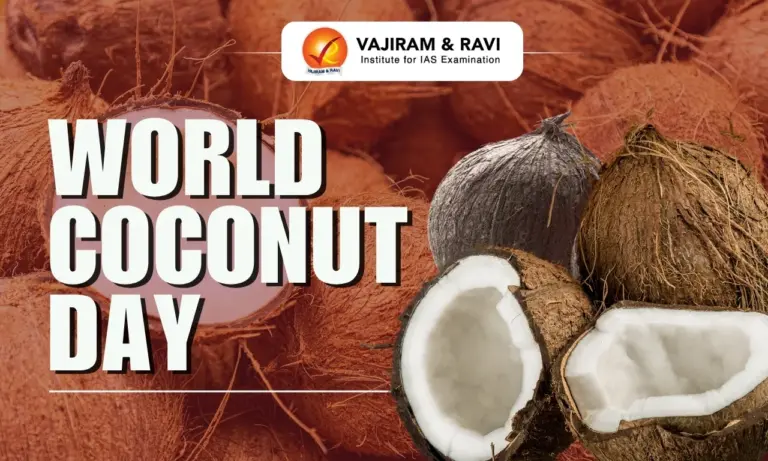
World Coconut Day is observed every year on 2 September to highlight the importance of coconut in agriculture, nutrition, livelihoods and the economy. The day raises awareness about the wide range of uses of coconut and encourages the sustainable cultivation and development of the coconut sector. It also recognises the contribution of coconut farmers and promotes the potential of coconut as an important agricultural resource.
World Coconut Day History
- World Coconut Day is observed every year on September 2 in several countries of the Asia-Pacific region, including India. The day highlights the importance of coconut and its wide range of uses.
- The first World Coconut Day was celebrated on September 2, 2009. The date is observed to mark the foundation day of the Asian and Pacific Coconut Community (APCC).
- The APCC is an intergovernmental organisation established in 1969 to support the sustainable development of the coconut sector in the Asia-Pacific region. Its headquarters is in Jakarta, Indonesia.
- The main purpose of World Coconut Day is to create awareness about the economic, nutritional and industrial importance of coconut and encourage investment in the coconut sector.
- Coconut cultivation provides livelihood opportunities to millions of farmers and workers. The industry also supports activities related to food processing, oil production, coir products and other value-added products.
- Coconut is scientifically known as Cocos nucifera and is often called the “Tree of Life” because almost every part of the plant can be used in different ways.
World Coconut Day Theme and Importance
- The theme of World Coconut Day 2026 is “Coconuts in Times of Uncertainty: Securing Food, Energy, and Livelihoods.”
- The theme highlights the importance of coconut in ensuring food security, energy resources and sustainable livelihoods.
- World Coconut Day aims to highlight the multiple benefits and uses of coconut in everyday life, agriculture, food, industry and rural livelihoods.
- Coconut is a nutritious food containing minerals, fibre, protein and certain B vitamins. Coconut water, milk and oil are widely used in food and beverages.
- Different parts of the coconut plant have many practical uses. Coir from the husk is used to make ropes, mats and other products, while coconut shells can be used for charcoal and other purposes.
- The coconut tree is particularly important in tropical regions because it provides both food and income while supporting various small-scale industries.
- For healthy coconut growth, a warm and humid tropical climate is preferred. An annual rainfall of around 1,300-2,300 mm and an average temperature of about 27°C are considered suitable conditions.


Coconut Sector in India
The Coconut Sector in India is important for farmers, rural livelihoods, agriculture and exports. The following sections cover its production, economic importance and government support.
Livelihood and Cultural Importance
- The coconut sector plays an important role in India’s rural economy, agriculture and cultural traditions.
- Around 30 million people, including nearly 10 million farmers, depend on coconut cultivation and related activities for their livelihood.
- Coconut is traditionally known as “Kalpavriksha”, or the tree of life, because almost every part of the tree can be used. It provides food, drinking water, oil, fibre, timber, fuel and other raw materials.
- Coconut cultivation in India has a history of nearly three thousand years and continues to support rural employment and income.
- Most coconut growers are small and marginal farmers, making the sector important for inclusive rural development.
- Coconut is also finding new areas of cultivation. For example, farmers in Chhattisgarh have started adopting coconut cultivation as an alternative livelihood opportunity.
- India has an important position in the global coconut economy. It ranks first in coconut production and third in cultivation area, accounting for about 31.24% of global production and 17.90% of the global area.
- According to DA&FW data, India produced around 20,301.22 million coconuts in 2024-25 from nearly 2.19 million hectares, with an average productivity of 9,249 nuts per hectare.
- Kerala has the largest area under coconut cultivation, covering around 7.54 lakh hectares and producing about 5,149.87 million nuts. Tamil Nadu leads in production, while Andhra Pradesh has the highest productivity, followed by West Bengal and Tamil Nadu.
Coconut Production, Exports and Value-Added Products
- The coconut sector has become an important part of India’s agricultural export economy. Coconut products are now exported not only as traditional commodities but also as a wide range of value-added products.
- India’s coconut product exports reached around ₹7,038.35 crore (USD 794.70 million) in 2025-26, registering a 62% increase from the previous year.
- The growth is significant compared with 2001-02, when coconut product exports were only around ₹25.3 crore and were mainly limited to products such as coconut oil, coconut, desiccated coconut and coconut shell charcoal.
- Over the years, India’s export basket has become more diverse. Major products now include virgin coconut oil, coconut milk, coconut water, activated carbon, copra, fresh or frozen coconut and desiccated coconut.
- Activated carbon has remained one of the major products in India’s coconut export basket. Indian coconut products are now reaching markets across the Middle East, Europe, the Americas and Australia.
- During the last five years, important trading partners have included the USA, UAE, Sri Lanka, Germany, Russia, Turkey, Belgium, the UK and the Netherlands.
- The Government aims to strengthen India’s export capacity, with targets of USD 2 trillion in exports by 2030 and USD 21 trillion by 2047. The expanding coconut export sector can contribute to these broader goals.
- The Government follows a multi-pronged approach to support the coconut sector. This includes Minimum Support Price (MSP) for copra, development schemes, skill-building programmes, enterprise promotion and support across the coconut value chain.
Government Schemes for Coconut Cultivation and Farmer Support
- Copra, which is the dried kernel of coconut, is one of the 22 mandated agricultural crops covered under the MSP system. India mainly produces two types – milling copra and ball copra.
- Milling copra is mainly used for oil extraction, while ball copra is used as an edible dry fruit and also for religious purposes.
- NAFED and NCCF act as the Central Nodal Agencies for copra procurement, while suitable state-level agencies also support procurement.
- The Coconut Development Board (CDB) implements several schemes to improve coconut cultivation, increase productivity, provide quality planting material, encourage technology adoption and strengthen markets.
- Under the Demonstration Cum Seed Production Farm (DSPF) programme, new farms demonstrate scientific cultivation practices and produce quality coconut seedlings. During 2025-26, around 2.41 lakh quality seedlings were produced through 11 DSPFs.
- The Nucleus Coconut Seed Garden scheme supports the production of improved and quality planting material. During 2025-26, ₹24 lakh was allocated, of which ₹20.29 lakh was utilised.
- Under the Small Coconut Nursery scheme, assistance was given to establish 12 new nurseries with a combined annual capacity of around 1.06 lakh seedlings. Support was also provided for maintaining 6 existing nurseries.
- The Accreditation and Rating of Coconut Nurseries initiative helps ensure that farmers receive genuine and quality planting material.
- During 2025-26, ₹239.35 lakh was provided to eligible public-sector nurseries, including State Departments, State Agricultural Universities, PSUs, KVKs and CDB seed production farms. This supported the production of around 11.97 lakh quality planting materials, enough for new plantations over an estimated 6,850-7,500 hectares.
- To expand coconut cultivation, the Government provides financial assistance and technical support for planting coconut in suitable new areas. The programme also aims to improve the productivity of existing coconut-growing regions.
- Under the area expansion programme, financial assistance of ₹56,000 per hectare is provided for planting coconut seedlings in new areas. The amount is released in two equal annual installments.
- The subsidy is available for a maximum of 2 hectares and a minimum of 0.08 hectares (20 cents) per beneficiary.
- During 2025-26, around 2,175 hectares were brought under new coconut cultivation, while about 1,672 hectares were covered under rejuvenation.
- The Coconut Promotion Scheme introduced in the Union Budget 2026-27 further aims to strengthen the sustainability of the sector, promote exports and improve farmers’ incomes.
- Together, these measures are helping India’s coconut sector move beyond traditional cultivation towards higher productivity, value addition, stronger exports and better livelihood opportunities.
Also Read : Coir Board

 Last updated on Oct, 2026
→ UPSC 2027 Notification will be released on 13 January 2027 at upsconline.nic.in.
→ Check Nobel Prize 2026 Winners List here.
→ Download PIB PRiSM Monthly Magazine 2026 here.
→ Check UPSC Monthly Current Affairs Magazine The Recitals here.
→ Check out the latest UPSC Syllabus here.
→ Download UPSC Model Answers for Mains 2026
→ UPSC Mains Question Paper 2026 is out now for Essay & GS Paper 1, 2, 3 & 4.
→ UPSC Calendar 2027 has been released.
→ Enroll in Vajiram & Ravi’s UPSC Mains Test Series 2027 for structured answer writing practice, expert evaluation, and exam-oriented feedback.
→ Join Vajiram & Ravi’s UPSC Mentorship Program 2027 for personalized guidance, strategy planning, and one-to-one support from experienced mentors.
→ Go through the UPSC Mains Previous Year Papers to enhance your preparation.
→ UPSC has released UPSC Toppers List 2025 with the Civil Services final result on its official website.
→ Also check Best UPSC Coaching in India
World Coconut Day FAQs
Q1. When is World Coconut Day celebrated?+
Q2. What is the theme of World Coconut Day 2026?+
Q3. When was the first World Coconut Day celebrated?+
Q4. Why is World Coconut Day celebrated?+
Q5. Why is coconut called the Tree of Life?+
Q6. What is the scientific name of coconut?+
Q7. What is the importance of the coconut sector in India?+
Q8. Which country is the largest producer of coconut?+
Q9. Which states are major coconut producers in India?+
Q10. What are the major government initiatives for the coconut sector?+
Tags: important day 2026 important day sept world coconut day